Legal framework for drone defense in Germany and the EU
Explore the legal framework for drone defense in Germany and the EU. Learn how the 2026 EU Action Plan and new German laws impact C-UAS deployment.
The legal landscape for drone defense in Europe is evolving from fragmented national policies to a unified EU framework. Propelled by the 2026 EU Counter-UAS Action Plan and Germany's active interception laws, organizations must navigate new rules for C-UAS deployment.
Key Takeaways
- 1EU operational authorisations for higher-risk drone flights have grown steadily as commercial use expanded.
- 2The 2026 EU Action Plan proposes lowering the drone registration threshold to 100g.
- 3The EU aims to introduce voluntary C-UAS performance standards by the end of 2026.
- 4A 2025 German legislative amendment empowers federal police to actively shoot down drones.
The Escalating Need for C-UAS Frameworks in Europe
Critical infrastructure across Europe faces an expanding array of unauthorized unmanned aerial system (UAS) overflights and security vulnerabilities. In early October 2025, confirmed drone sightings near Munich Airport disrupted flight operations on two consecutive evenings. The first closure alone prompted the cancellation of more than 30 flights and disrupted travel for nearly 3,000 passengers. This incident exposed significant gaps in civilian detection capabilities and highlighted the operational friction between safety mandates and security enforcement across European airspaces.
For robotics research faculties and aviation security teams, these disruptions illustrate that non-cooperative drones represent both a physical hazard and an informational threat. As autonomous flight control algorithms advance, identifying, tracking, and neutralizing uncooperative platforms requires robust legal authority alongside technical capabilities like automated drone verification systems.
- Disruption of civilian transport hubs and international airports
- Inadvertent or hostile intelligence gathering over sensitive academic and industrial facilities
- Asymmetry between low-cost commercial hardware and expensive traditional defense measures
- Lack of unified cross-border notification mechanisms among European air traffic managers
Consequently, policymakers across the European Union have prioritized establishing structured legal frameworks for counter-drone operations (C-UAS), shifting the paradigm from ad-hoc reactive measures toward continuous, policy-backed airspace security.
The EU Aviation Safety Baseline: Regulations 2019/945 and 2019/947
European civilian drone regulation is grounded in Commission Implementing Regulation (EU) 2019/947 and Commission Delegated Regulation (EU) 2019/945. Applicable across EU member states since December 2020, these regulations established a risk-based operational topology comprising three distinct categories: Open, Specific, and Certified.
While operational authorisations under the Specific category have grown steadily across Europe as commercial applications expanded, these baseline regulations were designed primarily for air safety and collision avoidance rather than counter-terrorism or security enforcement. For instance, obtaining operational approvals for complex flights often relies on standard risk assessments such as BVLOS approval pathways.
| Category | Risk Profile | Regulatory Focus | C-UAS Applicability |
|---|---|---|---|
| Open | Low risk | Visual line of sight, weight caps (<25 kg) | Passive identification (Remote ID) |
| Specific | Medium risk | Operational authorisation via SORA framework | Cooperative geo-fencing and tracking |
| Certified | High risk | Licensed operators, certified hardware standards | Full integration into air traffic management |
Because 2019/947 focuses on cooperative operators who voluntarily broadcast identification and conform to geo-fencing rules, it leaves significant legal ambiguity regarding non-cooperative or malicious actors. Consequently, active counter-drone measures remained outside EASA civilian safety mandates and were left to individual member state security laws.
The 2026 EU Action Plan on Counter-Drone Security
To bridge the gap between aviation safety and internal security, the European Commission released the comprehensive Action Plan on Drone and Counter Drone Security in February 2026. This initiative establishes a unified European framework to harmonize detection capabilities, streamline incident reporting, and strengthen civilian-military synergies across all 27 member states.
A pivotal legal reform proposed within the Action Plan is the reduction of the mandatory registration threshold for unmanned aircraft from 250 grams down to 100 grams. By capturing micro-drones under mandatory operator registration and Direct Remote ID requirements, European regulators aim to drastically reduce unidentifiable airborne platforms in urban and sensitive airspace.
- Registration expansion: Lowering mandatory registration and identification rules down to 100g platforms
- Security standards: Introducing an EU Trusted Drone label to certify supply chain integrity and secure electronics by end of 2026
- Detection integration: Deploying 5G network infrastructure as distributed radar nodes for real-time tracking
- Operational coordination: Establishing an EU Counter-Drone Centre of Excellence to standardize testing protocols
Technical university faculties designing autonomous platforms must align their hardware specifications with these evolving requirements, as uncertified or unidentifiable hardware will face severe operational restrictions in European airspaces.
Standardizing C-UAS Performance and Certification
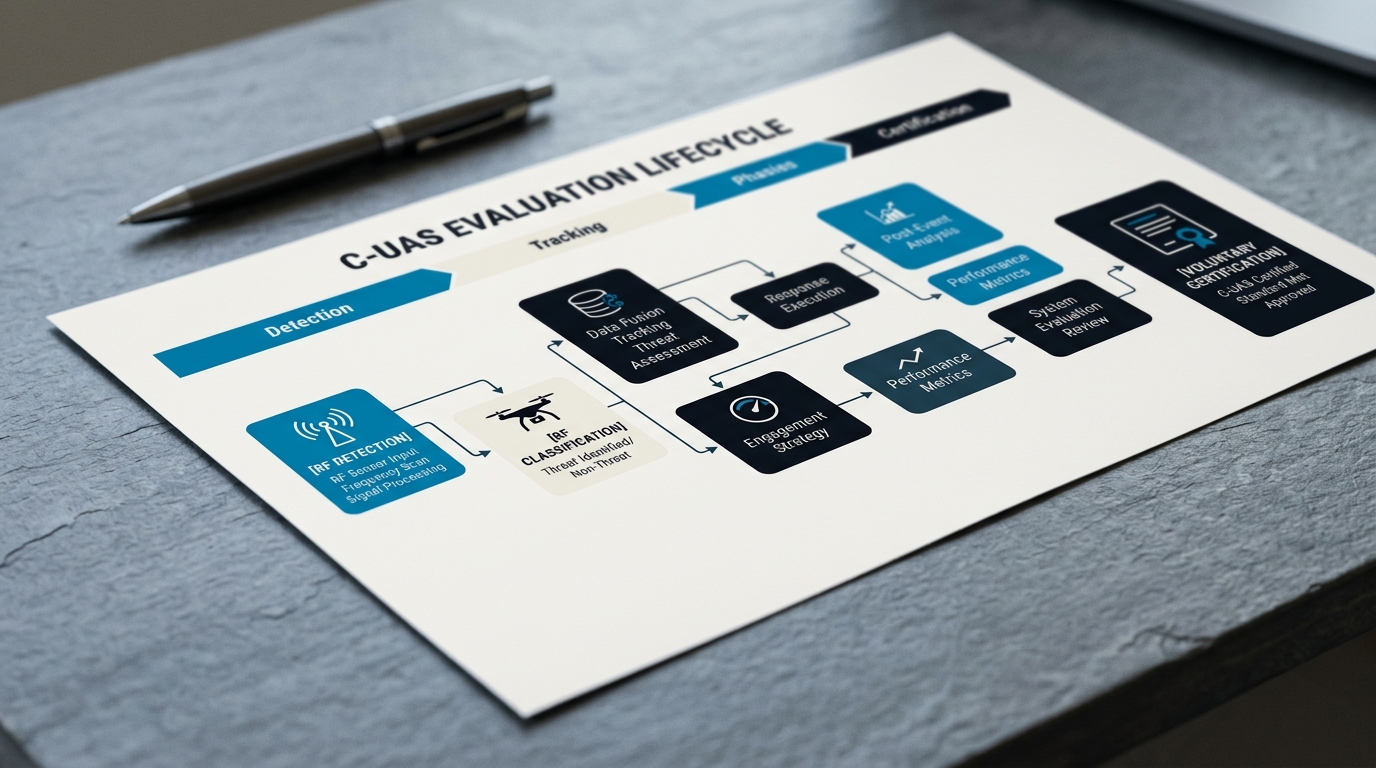
A major obstacle in deploying counter-drone systems across Europe has been the absence of standardized testing benchmarks and performance certifications. Under the 2026 EU Action Plan, the European Commission committed to recommending voluntary performance standards for C-UAS detection and mitigation hardware by the end of 2026.
Developing reliable C-UAS hardware requires dual-use technology compliance that bridges civilian research and defense requirements. Standardized testing frameworks will evaluate detection ranges, false-positive ratios, signal classification accuracy, and collateral impact risks for both radio frequency (RF) jammers and kinetic interceptors.
Standardized technical benchmarks enable academic institutions and industry developers to evaluate C-UAS algorithms against official test profiles. This structured certification path reduces legal uncertainty when deploying counter-measures near critical civilian infrastructure or aerial inspection zones.
Germany's Legislative Push for Active Drone Interception
While European directives set broad standards, individual member states retain authority over internal security and law enforcement. On 8 October 2025, the German Federal Cabinet adopted a draft law restructuring the Federal Police Act (Bundespolizeigesetz - BPolG) to modernize police powers against contemporary airborne threats.
The draft authorises the Federal Police to down drones that pose an immediate threat, and it was accompanied by the creation of a dedicated counter-drone unit within the force. The new powers also cover the use of police drones as sensor carriers and for the detection and defence of threatening drones, alongside preventive telecommunications surveillance and background checks for new recruits. In practice, the unit inaugurated in December 2025 works with signal jamming, detection technology, physical means and interceptor drones. This statutory change marks a shift from passive monitoring to active defense around federal transportation hubs, borders, and government facilities.
- Statutory authority for active electronic and kinetic interception of non-cooperative drones by law enforcement
- Enhanced deployment of sensor-equipped police drones for defensive airspace surveillance
- Pre-emptive telecommunications surveillance powers to trace remote pilot command signals
- Mandatory background security checks for personnel operating specialized defense systems
This legislative expansion provides a clear statutory framework for German authorities, balancing active interception powers against public safety considerations in populated environments.
The Drone Wall Concept and Cross-Border Airspace Security
Escalating hybrid security challenges along Europe's eastern borders have accelerated plans for a multi-layered European Drone Wall, now taken forward as the European Drone Defence Initiative alongside the Eastern Flank Watch, two of the four flagship projects named in the Commission's Readiness Roadmap 2030. Conceived as an integrated network of acoustic sensors, radar arrays, optical trackers, and automated interceptors, this initiative spans multiple eastern EU member states to secure sovereign airspace.
Operating a cross-border C-UAS defense shield presents significant legal and technical challenges regarding data sovereignty, radio spectrum allocation, and rules of engagement. Interoperable communication protocols are vital to ensure seamless handoffs between national air traffic control centers and defense nodes.
| Domain | Operational Requirement | Harmonization Standard |
|---|---|---|
| Spectrum Management | De-conflicted jamming frequencies | EU Radio Equipment Directive (RED) compliance |
| Data Exchange | Real-time trajectory sharing | U-space tactical data linkage |
| Liability & Rules of Engagement | Cross-border kinetic authority | Bilateral defense agreements and EU civil protection mandates |
Harmonizing sensor data and operational protocols across national boundaries remains essential for creating an effective, continuous protective shield across European airspace.
Ensuring Compliance in C-UAS Deployment and Operations
For technical university robotics faculties, research organizations, and facility operators, integrating counter-drone technology requires navigating a complex matrix of European civil aviation rules, national security statutes, and telecommunications law. Operating detection or mitigation equipment without explicit legal clearance can violate radio spectrum regulations or aviation safety codes.
Ensuring compliance involves verifying hardware certifications, conducting rigorous risk assessments under EASA guidelines, and establishing clear operational boundaries between public security agencies and private facility managers. Engaging an experienced systems integrator helps research institutions align complex experimental configurations with national and European regulatory frameworks.
- Regulatory mapping: Audit proposed sensor and effector frequencies against local telecommunications laws
- Operational authorization: Conduct SORA risk assessments for test flights and defensive trials
- Hardware specification: Utilize engines like Spec Engine to verify system parameters against EASA standards
- Multi-tier monitoring: Implement tools like Cockpit to maintain audit logs and real-time operational status
As European drone defense regulations mature through the 2026 EU Action Plan and national statutory updates, structured planning and verification platforms provided by partners like werob allow academic and enterprise teams to deploy compliant autonomous systems efficiently.
FAQ
- What is the EU Action Plan on Counter-Drone Security?
- Published in February 2026, the European Commission's Action Plan aims to harmonize fragmented counter-UAS regulations. It proposes stricter rules, such as lowering the drone registration threshold to 100g, and plans to introduce voluntary performance standards for C-UAS systems by the end of 2026.
- Can police in Germany shoot down drones?
- Yes, under an October 2025 policing legislation amendment, German federal police are empowered to actively shoot down or intercept malicious drones to protect critical infrastructure and airspace, moving beyond passive surveillance.
- What are the foundational EU drone regulations?
- The baseline rules are EU Regulations 2019/945 and 2019/947, which established operational categories and safety standards for civilian drones. Under these rules, operational authorisations in the Specific category have increased steadily as commercial drone use expanded.
- What is the proposed European drone wall?
- The 'drone wall' is a strategic concept proposed to defend European airspace. It involves a coordinated network of sensors and interceptors deployed across member states to detect, track, and neutralize hostile drone threats.
- Why is C-UAS compliance complex in Europe?
- Compliance is complex because organizations must navigate overarching EU safety directives alongside specific national laws. Deploying active drone defense systems requires verifying regulatory readiness and ensuring interoperability across borders.
Related reading
Drone Reconnaissance: Legal Rules for First Responders
Learn the legal rules for BOS drone aerial reconnaissance, including sovereign operation exemptions, geozone flights, SORA 2.5, and strict GDPR requirements.
17 August 2026drone defense and c uas what it isDrone defense and C-UAS: What it is and how it works
Learn how Counter-Unmanned Aircraft Systems (C-UAS) work. Discover the detection, tracking, and mitigation technologies powering modern drone defense.
6 August 2026drone as first responder how security teams verifyDrone as First Responder: how security teams verify alarms in minutes
See how Drone as First Responder systems verify alarms in under 5 minutes using automated landing pads, compliant BVLOS flight, and unified mission dashboards.
3 July 2026bvlos approval germany medical droneBVLOS approval for medical drones in Germany: SORA, LUC and the path to routine operation
What it actually takes to get a clinic drone route approved in Germany: the specific category under Regulation (EU) 2019/947, the binding SORA 2.5 methodology, SAIL levels, the LUC pathway and the two bottlenecks operators underestimate.
23 July 2026police control center drone networkPolice drone networks: A live picture within minutes
Drone networks for police control centers provide immediate aerial situational pictures. Learn about BOS rights, SORA exemptions, and system integration.
17 August 2026