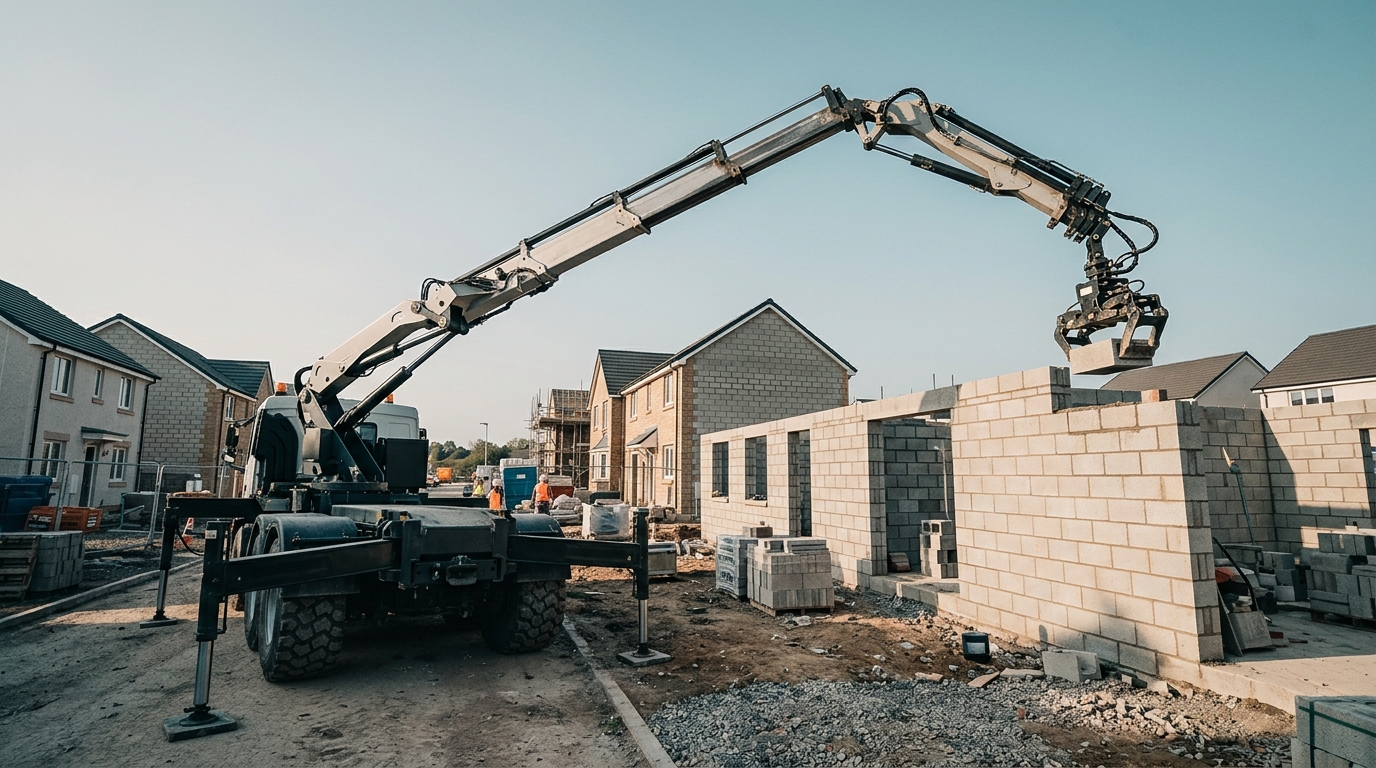
Bricklaying Robots 2026: Fastbrick Systems on Site
Evaluate masonry robotics for construction in 2026. Discover what truck-mounted systems like Fastbrick's Hadrian X actually deliver on real job sites.
Fastbrick-class robotic arms are bringing automated block-laying to real construction sites, using truck-mounted telescopic booms to place large-format blocks straight from a digital wall design. For contractors evaluating masonry automation, understanding what these systems actually deliver on straight-run walls -- and where human trades still take over -- is the key to sourcing the right system for the job.
Key Takeaways
- 1Truck-mounted robotic arms lay up to 360 large-format blocks per hour from digital CAD designs.
- 2Modern systems use fast-drying industrial adhesives instead of traditional mortar for tight bonding.
- 3Robots operate faster on straight-run walls but require human finishing trades for complex corners.
- 4Integrators use a service model instead of a 7.8 million AUD capital purchase for contractors.
What Fastbrick-Class Systems Actually Are
The public perception of construction automation is frequently clouded by humanoid concepts and laboratory prototypes that promise to replace tradespeople on equal terms. In practical job site environments, automated masonry has taken a completely different engineering route. Fastbrick-class systems do not attempt to mimic human posture, gait, or manual trowel handling. Instead, they are heavy industrial machines, typically mounted directly onto commercial truck chassis or heavy gantry bases, engineered specifically to extrude structural wall envelopes from digital design files with continuous kinematic precision.
The benchmark for this equipment class is the Hadrian X, developed by Australian OEM Fastbrick Robotics (FBR). Rather than placing standard clay bricks one by one with wet cementitious mortar, the system operates as a mobile automated factory on wheels. Mounted to a cab-over-engine truck, the machine deploys a 32-metre telescopic boom arm and is rated for lay speeds of up to 360 blocks per hour at peak performance. FBR's Dynamic Stabilisation Technology measures and counteracts movement and vibration in real time, allowing the robotic end-effector to place units accurately outdoors.
The Shift from Traditional Bricks to Large-Format Structural Blocks
A foundational engineering shift in this automation category is the departure from standard residential brick dimensions. Conventional masonry relies on units weighing roughly two to three kilograms that fit comfortably in a human mason's hand. In contrast, truck-mounted robotic arms are optimized for high structural throughput using large-format masonry blocks: FBR rates Hadrian for blocks up to a maximum size of 600 x 400 x 300 mm and a payload of up to 45 kg per block.
By handling units that would require two-person mechanical lifts under traditional manual labor standards, the robotic arm dramatically increases the square metres of wall constructed per robotic cycle. Palletized blocks are fed into the rear of the vehicle, cut to size on demand, coated with a proprietary construction adhesive that cures in roughly 45 minutes, and shuttled through the boom's block delivery system directly to the placement head[1].
| Specification Dimension | Manual Masonry Benchmark | Fastbrick-Class Robotic System |
|---|---|---|
| Unit Placement Medium | Handheld brick or CMU | Automated boom-fed shuttle mechanism |
| Maximum Unit Weight | Approx. 15-20 kg (two-person CMU) | Up to 45 kg per block |
| Maximum Unit Dimensions | Standard masonry sizes | Up to 600 x 400 x 300 mm |
| Peak Placement Throughput | 30-60 standard bricks per hour | Up to 360 large-format blocks per hour |
| Boom Reach / Operating Envelope | Limited to scaffolding height | 32 m telescopic reach (up to 3 storeys) |
Where Masonry Robots Excel on Site Today
On active construction projects, automated block-laying delivers its highest return on long, uninterrupted wall runs. Multi-unit residential developments, commercial perimeter walls, acoustic highway barriers, and large warehouse envelopes represent the ideal operational profile for boom-mounted manipulators. In these applications, the machine executes repetitive linear paths without requiring scaffolding erection, constant manual realignment, or mid-wall crew rotations.
A primary catalyst for this speed is the replacement of wet mortar beds with fast-curing polyurethane-based industrial adhesives. Traditional cement mortar requires mixing stations, continuous water supplies, strict slump management, and multi-hour curing intervals before bearing the weight of subsequent courses. By applying measured adhesive beads automatically during the internal block shuttle pass, the system creates bonds that achieve structural integrity rapidly, allowing continuous vertical progress on structural walls in a single working shift.
Relieving Severe Trade Labor Shortages
The economic justification for automated masonry is rooted directly in workforce availability. Masonry remains one of the most physically punishing disciplines in the building sector, resulting in high attrition rates and an aging trade demographic. According to industry surveys from the National Association of Home Builders, 67% of builders report severe shortages of bricklayer and masonry subcontractors[2]. Deploying construction robots for repetitive structural envelopes allows general contractors to maintain project schedules that would otherwise stall due to missing crews.
- Continuous high-throughput laying on multi-unit exterior perimeters and commercial warehouse shells
- Scaffolding elimination for walls up to three storeys high due to long-reach telescopic booms
- Minimal on-site physical fatigue for the operating crew, shifting labor from heavy lifting to machine supervision
- Significant reduction in material waste through automated precision cutting modules integrated into the base unit
The Real Limits of Robotic Block-Laying
While marketing demonstrations often portray autonomous machines operating without friction, deploying heavy robotics on real construction sites reveals hard physical and architectural constraints. Construction sites are dynamic, exposed environments where weather conditions, ground topography, and geometric complexity frequently challenge robotic operating parameters.
Environmental thresholds impose strict operational limits. Because boom arms extend over 30 metres, wind turbulence exerts substantial mechanical leverage on the mast and end-effector. While active stabilization systems counteract normal site breezes, Hadrian is specified for winds up to 60 km per hour (37.3 mph) and light rain only, with heavy rain halting operations. When gusts exceed operating thresholds, the system must stow its boom, creating site downtime that project managers must account for in project schedules.
Architectural Geometry and the Necessity of Human Trades
Robotic block-layers excel at orthogonal geometry, straight linear coursing, and pre-calculated window or door cutouts. However, they struggle with non-standard masonry bonds, irregular radial curves, tight courtyard configurations, and complex structural penetrations where mechanical clearance is restricted. Furthermore, an automated arm places structural blocks but does not install lintels, embed mechanical ties, insert cavity insulation, or perform facade finishing.
- Wind limits: Operation halted when sustained gusts exceed roughly 60 km/h to prevent placement inaccuracies
- Rain thresholds: Heavy precipitation compromises block surface dry conditions and adhesive curing performance
- Geometric restrictions: Limited efficiency on intricate custom bonding patterns, short segmented walls, and tight internal angles
- Continuing trade requirement: Skilled human masons and carpenters remain essential for lintels, damp-proof courses, ties, and aesthetic face brickwork
Site Prerequisites and Wall-Design Translation
Deploying a heavy robotic bricklaying machine requires rigorous preparation long before the truck enters the access gates. The vehicle chassis and outrigger setup demand a level, compacted staging pad capable of supporting multi-ton axle loads without subsidence. Overhead clearances must be surveyed to ensure total isolation from live electrical utility lines, tower crane operating envelopes, and adjacent scaffold structures.
Beyond physical readiness, the digital translation pipeline is the critical bottleneck in automated masonry. Architectural BIM models and standard CAD drawings cannot be fed directly into robotic motion controllers without intermediate translation. General contractors must provide clean, clash-checked structural drawings that define block dimensions, opening coordinates, and cut lists.
Translating CAD into ROS-Compatible Action Graphs
To bridge the gap between architectural intent and machine execution, integrators utilize specialized software tools such as Spec Engine. This setup layer processes architectural plans and general contractor requirements into formally verified, ROS-compatible action graphs within 48 hours. By compiling wall geometry into deterministic coordinate paths, the translation layer verifies that every cut block, bond overlap, and adhesive dispensing path is collision-free before hardware arrives on site.
- Geotechnical and pad verification: Confirm compacted ground stability for truck outriggers and telehandler material staging
- Utility clearance audit: Map 3D airspace to enforce minimum exclusion zones from overhead power cables and crane swings
- CAD and BIM ingest: Extract exact wall boundaries, rough openings, and structural tie positions from engineering drawings
- ROS spec generation: Compile digital wall files into machine-executable block paths using Spec Engine
- Material sequencing check: Confirm block pallet counts, adhesive batches, and cut tolerances prior to machine mobilization
Scoping Hardware and the Service Model
Evaluating automated masonry equipment requires general contractors and developers to look past equipment novelty and analyze total lifecycle economics. Sourcing robotic capacity is not simply a matter of buying a machine; it involves assessing regional support ecosystems, maintenance availability, operator training, and supply chain compatibility for specialized blocks and bonding agents.
A primary financial hurdle is capital expenditure. A new Fastbrick-class system represents a significant capital commitment: FBR lists a base price for Hadrian of 7,800,000 AUD, subject to final specifications, optional extras and tariffs. For the vast majority of regional general contractors and residential developers, purchasing such equipment directly onto their balance sheet introduces severe financial risk and asset under-utilization.
Supplier Evaluation and Wall as a Service
Instead of capital purchase, independent integrators guide contractors toward service-oriented procurement models, commonly structured as Wall as a Service (WaaS). Through algorithmic sourcing tools like Supplier Match, integrators evaluate OEM options across regional service footprints, regulatory readiness, and price bands. This approach prevents costly OEM robot hardware lock-in, enabling contractors to pay per square meter of erected wall rather than absorbing machine depreciation and maintenance overhead.
| Model Parameter | Direct CAPEX Purchase | Wall as a Service (WaaS) / Subcontracted Model |
|---|---|---|
| Upfront Capital | 7,800,000 AUD listed base price | Zero machine capital expenditure |
| Maintenance & Overhaul | GC assumes full maintenance and spare parts risk | OEM or specialized fleet operator manages all maintenance |
| Crew Certification | GC must recruit and train dedicated certified operators | Trained 2-person crew, one robot operator plus one telehandler operator |
| Utilization Risk | Idle time directly increases cost per square meter | GC pays strictly for completed wall volume on schedule |
| Software & Spec Updates | GC manages machine software and controller revisions | Continuous software updates provided via integrator pipeline |
GC Sequencing and Contractor Integration
Integrating an autonomous bricklaying system into an active commercial or residential job site requires strict chronological sequencing. FBR states that Hadrian can build the structural, load-bearing walls of a brick or block house in as little as a day, and that output rate will quickly create workflow bottlenecks if preceding and succeeding trades are not synchronized with it.
Before the automated boom begins placement, foundation slabs must achieve full design strength, survey pins must be verified, and sub-slab plumbing and electrical rough-ins must be stubbed to exact tolerances. If a conduit penetrates a slab 50 mm off-axis, an automated arm following a pre-programmed coordinate path will collide with the pipe or place a block over it, forcing immediate manual stoppage. Precision site preparation is therefore non-negotiable.
API Middleware and ERP Scheduling
To keep trade schedules aligned, system integrators implement pre-built middleware such as Connectors. These integration layers link real-time machine telemetry and progress logs directly with the general contractor's project management software and enterprise systems like SAP. When the robotic arm completes an elevation, milestone completion signals are instantly transmitted to follow-on subcontractors, triggering immediate dispatch for floor joist installation, lintel placement, and MEP rough-in.
Working alongside an experienced robotics systems integrator ensures that interfaces between the automated machinery, material suppliers, and trade contractors remain seamless throughout the building cycle.
- Phase 1 - Substructure completion: Pour foundations, cure slab to engineering spec, and verify precision survey datums
- Phase 2 - Material staging: Stage certified large-format blocks and adhesive supplies within telehandler loading radius
- Phase 3 - Automated structural build: Mobilize robotic arm to execute wall perimeter per ROS spec files
- Phase 4 - Milestone handoff via Connectors: Automated telemetry triggers GC scheduling software to notify follow-on trades
- Phase 5 - Follow-on trade integration: Install lintels, mechanical ties, floor framing, and window packages
Fleet Monitoring and Project Escalation
Once a robotic block-laying system is active on site, operational oversight transitions to real-time monitoring and proactive risk mitigation. Operating heavy machinery in proximity to dynamic job site variables requires continuous visibility across mechanical health, environmental conditions, and digital plan adherence.
Live oversight is managed through Cockpit, a centralized monitoring dashboard that provides use-case-level traffic lights across four core operational dimensions: hardware health, physical infrastructure, regulatory compliance, and specification fidelity. Hadrian's published weather envelope is peak gusts up to 60 km per hour and light rain only, so when on-site anemometers trend toward that ceiling, or when adhesive behaviour drifts with ambient conditions, the dashboard flags an early warning before physical defects or emergency stops occur.
This comprehensive operational governance is orchestrated through the robotics fleet planning architecture of the werob Platform. By unifying CAD specification translation, OEM sourcing, ERP data connectivity, and live telemetry tracking into a single lifecycle framework, the werob Platform enables general contractors and homebuilders to deploy Fastbrick-class masonry robotics with predictable cost, verified safety, and guaranteed structural performance.
- Hardware dimension: Live telemetry on boom hydraulic pressures, saw module blade wear, and sensor calibration
- Infrastructure dimension: Outrigger pad stability, telehandler supply flow, and power generator voltage consistency
- Regulatory dimension: Exclusion zone barrier verification, operator certification logging, and local noise ordinance compliance
- Spec fidelity dimension: As-built block placement coordinates compared in real time against original CAD models
FAQ
- What are Fastbrick-class masonry robots?
- They are truck or gantry-mounted robotic arms, like Fastbrick Robotics' Hadrian X, designed to autonomously place large building blocks using digital wall designs rather than functioning as humanoid bricklayers.
- How fast can a robotic bricklayer work?
- FBR rates Hadrian at a maximum lay speed of up to 360 blocks per hour on straight-run walls, well beyond manual laying rates, though real output falls back on complex wall geometry.
- Do masonry robots use traditional mortar?
- No, most modern automated block-laying systems use specialized industrial adhesives that bond quickly and hold tightly, allowing continuous building without waiting for standard mortar to cure.
- Can bricklaying robots build an entire house autonomously?
- No. While they can erect the primary structural load-bearing walls rapidly, human finishing trades are still required for complex bonds, detailed corners, and final aesthetic brickwork.
- How do general contractors source these robots?
- Rather than buying a machine at FBR's listed base price of 7,800,000 AUD, most contractors use a service model sourced through a systems integrator, paying for the completed wall structure without the capital risk.
Related reading
Construction Robots Against the Skilled-Labour Shortage: Which Tasks Pay Off in 2026
Discover which construction robots pay off in 2026 as general contractors in the DACH region deploy automated layout, rebar, and drilling systems.
17 July 2026construction robots crane time site logisticsCrane Time Is the Scarcest Resource: Which Construction Robots Need No Pick
The crane sets the tempo of the site, and it is not going autonomous in this planning cycle. So the useful question is not which robot lifts, but which one works without booking crane time — and which one competes for the hook or the airspace anyway.
2 September 2026robotics systems integratorThe Role of a Robotics Systems Integrator in Modern Operations
A robotics systems integrator bridges the gap between raw hardware and operational ROI by managing the entire deployment lifecycle. This guide explores how werob uses a four-layer platform to deliver live robots in eight weeks.
7 July 2026robotics fleet planningRobotics Fleet Planning: Strategies for Scalable Automation
Professional robotics fleet planning transfers isolated pilot projects into profitable operational processes. As a systems integrator, werob delivers the manufacturer-independent platform for the specification, selection, and live management of your robot fleet.
6 June 2026layout robot construction siteLayout robots on site: printing BIM onto the slab to the millimetre
Discover how layout robots print BIM models directly onto concrete slabs with millimetre precision to eliminate manual errors and coordinate all trades.
17 July 2026