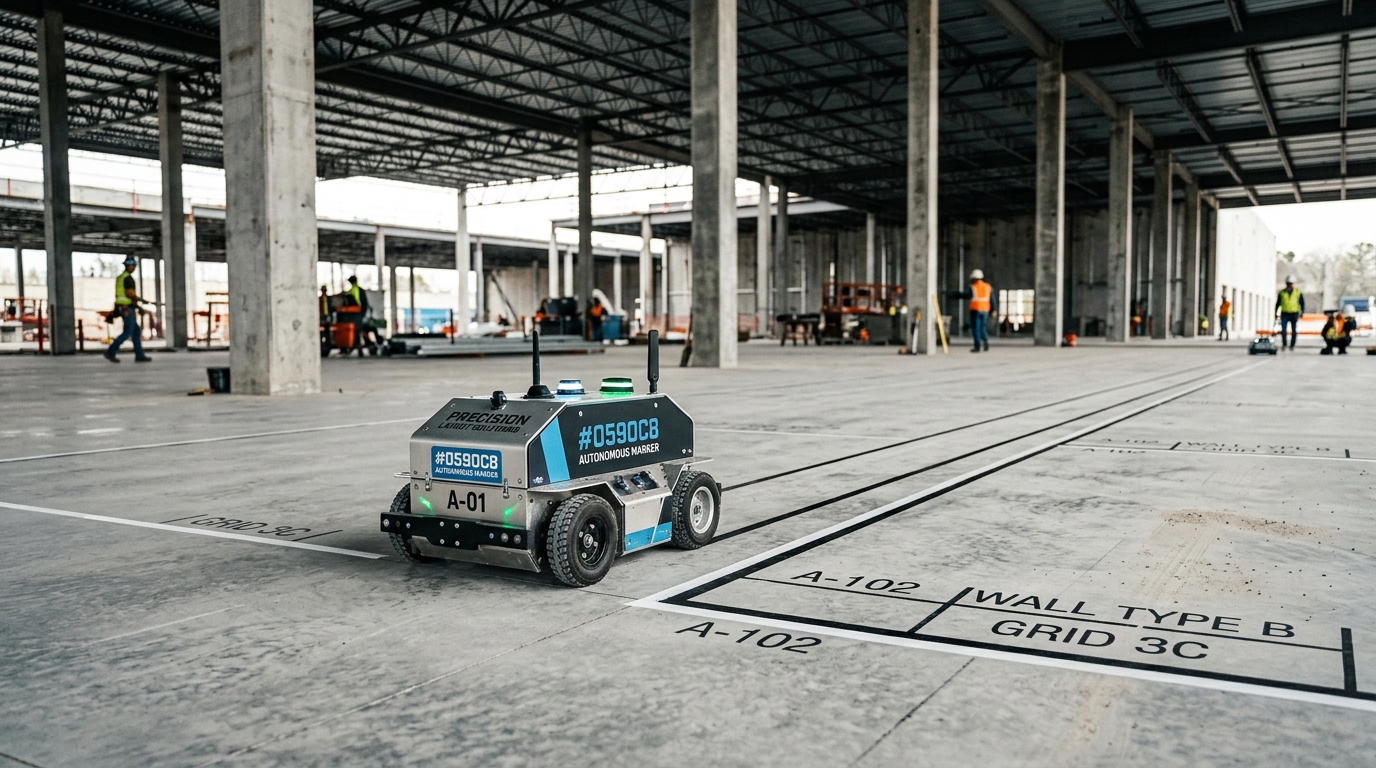
Layout robots on site: printing BIM onto the slab to the millimetre
Discover how layout robots print BIM models directly onto concrete slabs with millimetre precision to eliminate manual errors and coordinate all trades.
Layout robots automate site marking by printing BIM designs directly onto concrete slabs with millimetre precision. This manufacturer-independent approach ensures every trade builds from a single physical source of truth, eliminating the need for slow, manual chalk lines.
Key Takeaways
- 1Layout robots print BIM designs directly onto concrete floor slabs with millimetre precision, eliminating manual layout errors.
- 2By establishing a single physical source of truth, trades such as MEP and framing coordinate seamlessly, minimizing subsequent rework.
- 3Solutions like HP SitePrint achieve layout speeds significantly faster than manual crews.
- 4Using a manufacturer-independent integrator like werob allows companies to deploy these tools without vendor lock-in or integration gaps.
The Bottleneck of Manual Site Layout in Construction
Traditional manual site layouts rely heavily on physical tape measures, string lines, and manual chalk lines to transfer blueprints onto concrete slabs. This manual approach is slow and introduces cumulative errors on large construction sites, which leads to expensive, time-consuming rework for subsequent trades. In Germany, there are currently 81,890 active construction companies facing intense pressure to deliver projects on schedule. Minimizing physical layout errors on site has become a critical operational necessity, especially as the industry confronts a forecast skilled-worker shortage of over 100,000 workers by 2030.
To address these mounting efficiency challenges, forward-thinking supervisors are turning to mobile layout robots. Autonomous systems, such as the Dusty FieldPrinter and HP SitePrint, print digital BIM models directly onto the concrete slab with millimetre precision. Instead of individual crews interpreting paper drawings and snapping chalk lines independently, every subcontractor builds from a single, physical source of truth printed on the floor. Deploying these marking robots through automation against skilled labor shortages allows existing teams to complete floor layout tasks up to ten times faster while completely eliminating human measuring errors.
- Traditional Layout: Relies on manual measurements and chalk lines, risking cumulative errors and trade-by-trade disputes.
- Robotic Layout: Prints digital BIM data directly onto concrete slabs with millimetre-level precision, establishing a single source of truth.
- Resource Efficiency: Frees up skilled supervisors for high-value oversight, mitigating the impact of severe workforce shortages.
Implementing these robotics systems requires technical alignment rather than simply purchasing hardware. As a manufacturer-independent robot integrator, werob helps construction companies select and deploy the optimal layout hardware for their specific workflows. Through the werob Platform, operators can easily match their layout requirements with appropriate hardware, ensure seamless CAD or BIM software integrations, and monitor fleet performance on active jobsites without being locked into a single robot manufacturer's ecosystem.
Enter the Layout Robot: Translating BIM onto Concrete
Traditional manual site layout is a notorious bottleneck for craftsmen and construction supervisors. Dragging heavy tape measures and snapping manual chalk lines often leads to cumulative layout errors that propagate through every subsequent trade. Enter layout robots, which automate the transfer of digital Building Information Modeling (BIM) data directly onto concrete floor slabs with millimetre precision. For large-scale projects, such as upgrading the numerous bridges on federal trunk roads in Germany (monitored by the Federal Highway Research Institute, BASt, Bundesanstalt für Straßenwesen), this rapid marking is crucial to keeping schedules on track. By acting as a manufacturer-independent integrator, werob helps construction companies select and implement the ideal robotic system for their specific on-site workflows.
Layout robots such as the Dusty FieldPrinter or HP SitePrint execute this task by printing detailed markings directly onto the concrete slab. Key capabilities of this automated process include:
- Millimetre accuracy as robots navigate using total stations to print lines, walls, and penetrations exactly as designed in the BIM model.
- Multi-trade coordination by printing 1:1 scale lines, dimensions, and text annotations to ensure every contractor builds from a single, unified physical source of truth.
- A frictionless workflow that eliminates manual drafting errors and reduces the reliance on traditional hand-marking techniques.
This shift to automated layout is becoming essential as the industry faces severe human resource challenges. The Main Association of the German Construction Industry (HDB) has forecast that Germany will experience a severe skilled-worker shortage in the coming years. To combat this, deploying mobile robots is a key part of modern automation strategies. By partnering with an independent systems integrator like werob, companies can evaluate leading layout systems without manufacturer lock-in, ensuring that advanced hardware seamlessly integrates into existing site operations.
Hardware in the Field: Dusty FieldPrinter and HP SitePrint
Manual layouts on concrete slabs are traditionally slow, exhausting, and prone to human error. For the many construction companies operating today, finding qualified layout surveyors is increasingly difficult. This challenge is compounded by a forecast of a severe skilled-worker shortage in the coming years. To mitigate this shortage of skilled workers, werob helps sites replace traditional chalk lines with automated printing. As a manufacturer-independent robot integrator rather than a hardware producer, werob evaluates and deploys the best field hardware, such as the Dusty Robotics FieldPrinter and HP SitePrint, to print digital BIM plans directly onto concrete slabs.
Each layout robot brings distinct physical capabilities to the field. HP SitePrint is designed for rapid traversal, navigating between print elements at high speeds. In contrast, the Dusty Robotics FieldPrinter focuses on maximum precision, marking points with millimetre-level accuracy and operating at speeds significantly faster than manual layout processes. Because these systems print exact lines, text, and QR codes directly onto the slab, subsequent trades have complete clarity on where to install drywall, pipes, or conduits.
- HP SitePrint: Optimised for speed, providing fast travel and printing with high tolerance.
- Dusty FieldPrinter: Built for high precision, delivering millimetre-level accuracy to completely eliminate manual chalk line drift.
- Unified BIM Source: Both machines translate digital models into clean, multi-colored lines directly on-site, providing a single physical reference point for all trades.
Selecting the right layout robot depends on your specific floor conditions, required accuracy, and software environment. Rather than committing to a single manufacturer, using werob as a partner ensures a hardware-agnostic setup. Through a collaborative robotics integrator partner utilizing the werob Platform, construction supervisors receive complete systems integration, including training, site readiness checks, and unified monitoring to ensure successful BIM-to-slab execution.
The Physics of Precision: How Robotic Total Stations Guide the Robot
Traditional manual site layouts rely on slow, physical tape measures and chalk lines that are highly vulnerable to human error. For, achieving millimetre-level accuracy on a busy concrete slab requires a more scientific approach. Autonomous layout robots achieve this precision by pairing with a Robotic Total Station (RTS) positioned on a known site control point. The RTS uses a high-frequency tracking laser to follow a 360-degree active prism mounted directly on top of the robot. By continuously measuring distance and angles, the RTS reports exact coordinates to the layout robot's drive system, allowing it to correct its path in real time as it moves across the slab.
This optical tracking system relies on a continuous closed feedback loop:
- Establishment of Control: The RTS is set up over an established control point on the construction floor plan, orienting itself to the local coordinate system.
- Continuous Laser Lock: The RTS locks its tracking beam onto the robot's active 360-degree prism, ensuring the laser connection is not lost during movement.
- Real-Time Telemetry: Positional coordinates are transmitted at high frequencies via radio link from the RTS directly to the robot's onboard controller.
- Path Correction: The machine compares its physical coordinate location to the digital BIM model and adjusts its steering to stay within millimetre-level tolerances.
Integrating these advanced hardware systems requires deep technical expertise, as layout robots must seamlessly interface with different total station brands. Leading solutions like the Dusty FieldPrinter and HP SitePrint rely on these robust optical links to execute layouts without manual error. As a manufacturer-independent robotics integrator, werob ensures that these hardware components are properly configured. Utilizing the werob Platform, we turn a standalone layout robot into a unified extension of your digital BIM model.
One Source of Truth: Multi-Trade Collaboration on Site
On traditional construction sites, coordination errors between separate trades are a frequent source of costly rework. When mechanical, electrical, plumbing (MEP), drywall, and structural teams pull measurements from different reference points, conflicting chalk lines are almost inevitable. Operating from a unified digital foundation changes this dynamic completely. By printing BIM data directly onto the concrete slab with millimetre accuracy, layout robots establish a single physical source of truth that all trades follow without deviation.
This multi-trade collaboration is particularly beneficial for complex infrastructure projects where precision directly impacts grid-level safety and construction timing. These automated layouts support critical utility and industrial projects, such as:
- Marking accurate coordinates for control systems along Germany's extra-high-voltage grid, where physical discrepancies can delay major grid connections.
- Drafting precise foundation points and cable routing paths for wind turbines across extensive onshore and offshore developments.
- Routing dense electrical conduits and mechanical piping in commercial developments, ensuring no utility runs conflict during the rough-in phase.
Implementing this digital-to-slab workflow requires reliable robotic hardware. Leading options such as the Dusty FieldPrinter and HP SitePrint offer robust layout capabilities, yet every construction site presents unique technical demands. Because werob is a manufacturer-independent systems integrator and not a robot manufacturer, we help operators evaluate and implement the exact hardware setup required for their specific workflows. Through custom middleware and comprehensive technical onboarding, we ensure layout automation delivers seamless, error-free results across every trade.
Sourcing and Deploying Layout Automation: The Integrator's Role
For the many construction companies operating today, adopting layout automation represents a massive leap in efficiency. Advanced mobile printers like the Dusty FieldPrinter or HP SitePrint project digital Building Information Modeling (BIM) data directly onto concrete slabs. This delivers millimetre-level precision, ensuring that all subsequent trades build from a single physical source of truth. However, selecting the right hardware and verifying regional service coverage can be highly complex for craftsmen and construction supervisors, who must avoid vendor lock-in to keep operations flexible.
As a manufacturer-independent automation partner, werob resolves these deployment hurdles by managing the entire lifecycle. Rather than forcing clients into a single hardware ecosystem, the werob Platform uses Supplier Match to evaluate over 44 robot OEMs based on regulatory readiness, regional footprint, and operational cost. Once the hardware is chosen, werob leverages its Spec Engine to translate site-specific layout requirements into formally verified, ROS-compatible action plans within 48 hours. This ensures that the robot arrives on site ready to print without requiring internal programming expertise.
- Hardware Evaluation: Evaluating over 44 robot OEMs through Supplier Match to identify the ideal printer based on slab conditions and site scale.
- Workflow Specification: Utilizing Spec Engine to generate verified, ROS-compatible action graphs from digital designs in under 48 hours.
- Operational Integration: Deploying pre-built software Connectors to link the onsite layout robot with existing digital tools and project management systems.
- Continuous Oversight: Monitoring hardware health and dispatching escalations in real time through the unified Cockpit dashboard.
By letting an independent integrator manage the procurement, software mapping, and on-site setup, construction teams bypass the traditional risks of early technology adoption. This approach ensures that crews can focus entirely on high-quality execution, relying on a unified slab printout rather than manual chalk lines.
Real-Time Fleet Monitoring and Site Operations
Traditional manual layouts are slow and error-prone, but manufacturer-independent layout robots print digital BIM data directly onto concrete slabs with millimetre precision, enabling all construction trades to build from a single source of truth. However, a successful robotic layout relies on preparing the floor slab and continuously monitoring operations. This level of supervision is vital for craftsmen and construction supervisors. Implementing these systems helps companies deal with severe personnel gaps, as the industry faces a forecast of a severe shortage of skilled workers in the near future. Adapting to this reality requires robust automation strategies to keep complex building projects on schedule.
To achieve this, the werob Platform integrates hardware fleet telemetry into Cockpit, a unified monitoring dashboard. This integration allows managers to track layout progress and fleet health in real-time. For instance, cloud tools provided by manufacturers like HP SitePrint let operators prepare print jobs and track usage dynamically. By merging these direct robot streams with the werob dashboard, site managers get live visibility without needing to inspect the floor physically.
- Hardware status: Tracking battery levels, layout accuracy, and connection status to robotic total stations.
- Regulatory compliance: Monitoring obstacle alerts and safety parameters to protect site staff.
- Printing progress: Comparing physical printing completed on the slab against digital BIM blueprints.
In addition to real-time telemetry, pre-built Connectors link layout operations directly with existing operator databases and planning software. By syncing on-site printing progress with the back office, every trade stays aligned on a unified, verified dataset. This manufacturer-independent approach ensures that craftsmen and construction supervisors can deploy modern layout fleets reliably, safely, and with millimetre precision.
FAQ
- What is a layout robot in construction?
- A layout robot is an autonomous mobile printer that transfers digital Building Information Modeling (BIM) data directly onto a concrete slab at a 1:1 scale. By printing highly accurate lines, layout dimensions, and clear text annotations, the robot guides field crews and subcontractors during installation. This automated process replaces the slow and error-prone traditional method of manual marking using tape measures and chalk lines, ensuring that every trade works from the exact same coordinate points.
- How accurate are construction layout robots?
- Modern layout robots achieve extreme precision, often superior to manual chalk lines. For example, the Dusty Robotics FieldPrinter and HP SitePrint robots provide millimetre-level precision. This high accuracy prevents cumulative spacing errors and tolerance stack-up, protecting the structural integrity of multi-trade installations.
- How do layout robots navigate on a concrete slab?
- Layout robots navigate using a combination of onboard drive sensors and a Robotic Total Station (RTS) set up at a known control point. The RTS tracks a 360-degree active prism mounted on top of the robot, using a continuous laser beam to calculate its coordinates in real time. This positional data is wirelessly transmitted back to the robot, which compares it against the digital BIM model and dynamically corrects its steering to print each element in its exact physical position.
- Can layout robots work on rough or wet concrete floors?
- Layout robots require a relatively flat, swept, and dry surface to operate effectively. Rough debris or standing water can disrupt the traction of the robot and interfere with ink adhesion. Manufacturers offer different specialized ink types to accommodate varying surface conditions, but basic floor preparation is essential. Dust, mud, and major floor level deviations should be cleared beforehand to ensure the total station maintains a continuous line of sight to the robot's tracking prism.
- How fast do layout robots print compared to manual crews?
- Layout robots print significantly faster than traditional manual crews. Case studies show that solutions like the Dusty FieldPrinter can complete complex multi-trade plans in a fraction of the usual time. Additionally, HP SitePrint offers rapid traversal speeds. This speed prevents delays, keeps subsequent trades on schedule, and helps address the industry's severe labour shortages.
Related reading
Crane Time Is the Scarcest Resource: Which Construction Robots Need No Pick
The crane sets the tempo of the site, and it is not going autonomous in this planning cycle. So the useful question is not which robot lifts, but which one works without booking crane time — and which one competes for the hook or the airspace anyway.
2 September 2026robot commissioning on siteHow a robot learns your building: off-site vs on-site
Understand how robots learn to navigate your building, what vendors can train off-site, and why on-site integration dictates the commissioning schedule.
27 August 2026construction site theft surveillance robot drone night2,156 thefts, one in ten solved: what a construction site can establish at night, and what is not its job
The Baden-Württemberg state criminal police office counted a good two thousand thefts from construction sites and building shells in 2023, with almost ten million euros of damage, and about one case in ten was solved. The nationwide figures circulating beside that differ by a factor of six. From the numbers that hold up follows a task for the technology, and it is not to recognise the thief: it is to establish that something is happening on the ground, and to send someone.
16 September 2026autonomous construction site surveyAutonomous Ground Survey with Legged Robots: As-Built and Progress as a Time Series
Discover how autonomous legged robots and high-precision laser scanners turn isolated site surveys into repeatable weekly progress time series.
17 July 2026robot fiducial marker site configurationThe 146 millimetre square your inspection round depends on
Boston Dynamics specifies the printed marker Spot localises against down to the millimetre, and documents what happens when one moves. It is building infrastructure with a tolerance, and it is on nobody's maintenance schedule.
9 September 2026