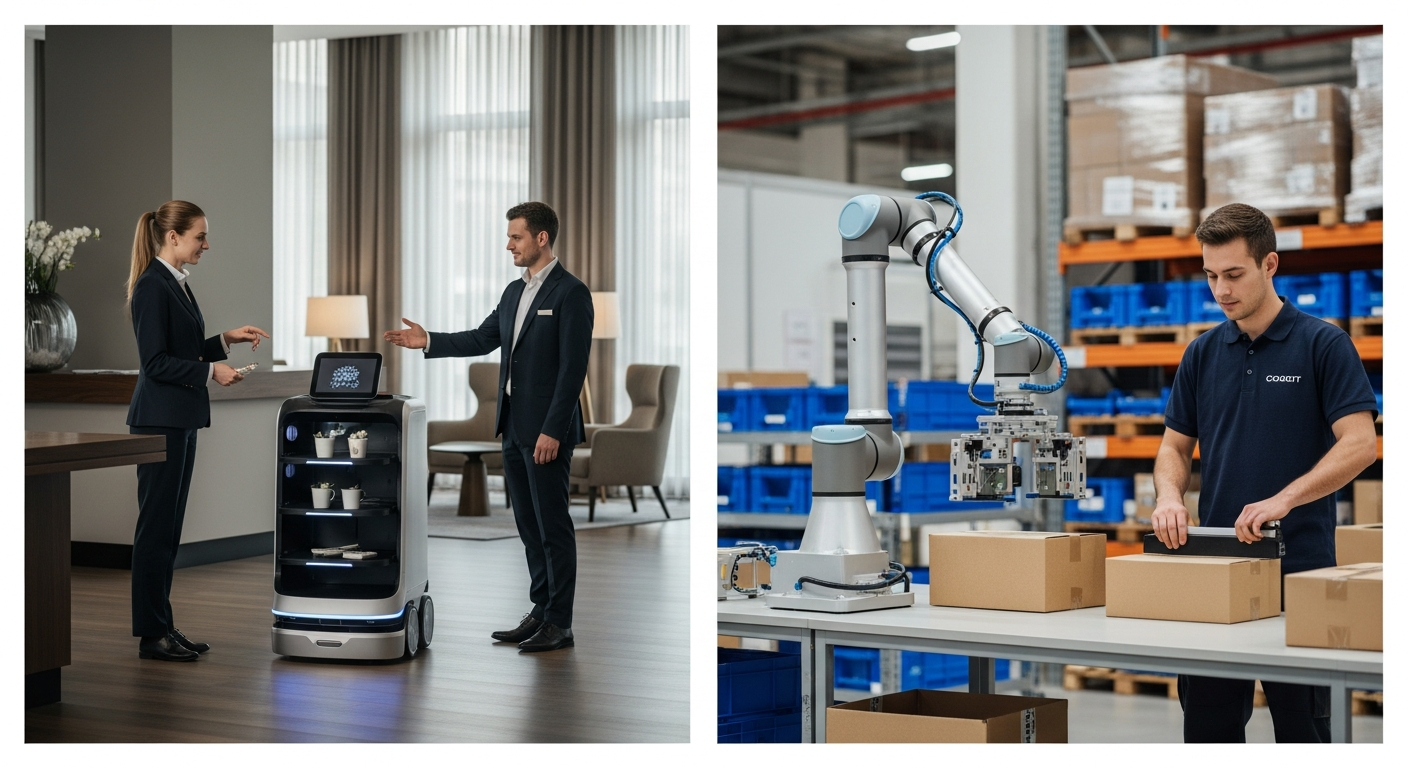
Hardware markup OEM robots: system integration instead of vendor lock-in
The choice of robot hardware is secondary to process integration. werob explains how hardware markup for OEM robots paves the way from requirement to productive fleet in eight weeks.
Logistics center. 3:15 a.m. The night shift is in full swing. An autonomous robot precisely navigates aisles to stage pallets for early shipping. At this moment, the operator does not know which OEM supplied the hardware and it does not play any role in operational success. What counts is the integration into SAP EWM and strict compliance with the EU Machinery Regulation. While traditional consulting firms are still creating discovery decks, this robot is already in week twelve of live operations. werob translated the site's workflow into a specification in 48 hours, ranked the appropriate OEM from a catalog of 44 partners and brought the hardware to the site within eight weeks.
Key Takeaways
- 1Hardware agnostics prevents vendor lock-in with access to 44+ OEM partners and 280 robot models.
- 2The Spec Engine translates operational workflows into precise technical markups in 48 hours.
- 3Ready-made connectors enable integration into systems such as SAP EWM, Opera PMS and PointClickCare.
Moving away from the hardware focus: Why the OEM is secondary
In the current robotics landscape, many companies make the mistake of putting hardware at the center of their strategy. They buy a robot from a specific manufacturer and then try to design their processes around that device. werob turns this model around. As a system integrator we view the hardware as just one component in a larger operational stack. A hardware markup does not start with an OEM's brochure, but with the workflow on the floor.
werob is not a robot manufacturer or a single OEM reseller. The strength lies in hardware agnosticism. With over 44 OEM partners in the catalog and 280 maneuverable robots, werob offers access to a variety that a single manufacturer can never match. Whether Boston Dynamics, Keenon, Pudu or Apptronik, the selection is purely data-based using the Supplier Match System. The goal is to avoid the vendor lock-in that occurs when you commit to a proprietary hardware platform early on.
Effective hardware markup ensures that the chosen hardware meets exactly the requirements specified by the workflow. This includes load capacity, battery life, ability to navigate in tight environments and, most importantly, connectivity. When a hotel uses room service robots, the brand of the robot is less important than whether it can communicate natively with the Opera PMS or Mews. werob delivers these integrations as ready-made connectors, so that the hardware is productive immediately after delivery.
The Spec Engine: From Words to Specification in 48 Hours
The bottleneck when introducing robotics is often the planning phase. Traditional projects spend three to six months in the discovery phase. werob shortens this period to 48 hours using the Spec Engine. Trained on over 35,000 projects, this system translates the human description of a shift schedule or task directly into a ready-to-use robot action graph.
The process is standardized and highly efficient. The operator describes the shift, the form of the task and the on-site infrastructure. The Spec Engine analyzes this data and creates a technical markup that contains all the necessary parameters. This includes not only the physical requirements for the hardware, but also regulatory aspects and necessary software interfaces. In nursing, for example, this means that the Spec Engine immediately recognizes whether integration into PointClickCare or MatrixCare is required to document medication rounds.
This speed means we achieve an implementation time that is unique in the market. A concrete offer will be made within five days of initial contact. The robot is in use after eight weeks. werob reduces the complexity of hardware selection through automated markup. The operator does not have to be a robotics expert to make the right decision. The Spec Engine takes care of the technical validation and ensures that the hardware exactly matches the application.
Supplier Match: Ranking of 44+ OEMs against reality
As soon as the specification is determined, the Supplier Match System comes into action. werob compares the requirements with the performance data of over 280 different robot models. This ranking is objective and manufacturer-independent. While an OEM seller will always present their own product as the best solution, whoever filters out the hardware that delivers the best result for the specific location.
The ranking takes into account factors such as reliability, maintenance intervals, spare parts availability in Europe and compliance with local regulations. Such markup is particularly essential for humanoids such as the models from Apptronik, Figure AI or Unitree, as the technology is developing rapidly. werob ensures that operators do not invest in outdated hardware, but always receive the technology that is best suited to their purpose. This offers an advantage for companies pursuing a long-term automation strategy.
A real-world example shows the relevance of this approach. Automating a medication round in a leading operator's care facility is not just about driving from A to B. The hardware must meet hygienic standards, navigate safely through occupied hallways and provide secure storage for medication. The Supplier Match System identifies exactly the hardware from the global catalog that meets these criteria and at the same time realizes significant cost reductions per location and year.
EU Machinery Regulation 2023/1230: The compliance path
A critical aspect of hardware markup is regulatory compliance. From January 20, 2027, the new EU Machinery Regulation 2023/1230 will be binding. This presents many operators with enormous challenges, as hardware from Asian OEMs in particular often does not have sufficient conformity assessments for the European market. werob acts as the necessary compliance path here.
Every robot that is purchased via the werob platform goes through a check for compliance with the relevant standards such as ISO 13482 for service robots in the personal area. werob takes responsibility for regulatory security and ensures that the fleet can continue to operate legally after 2027. This also includes compliance with the GDPR when processing sensor data and cybersecurity in accordance with IEC 62443. Without an integrator who masters this regulatory markup, companies risk high fines and shutdowns of their fleets.
In industries such as security or logistics where BewachVO or specific occupational safety guidelines apply, this point is non-negotiable. An autonomous patrol robot in a retail environment must not only function technically, but also act in a legally compliant manner. werob integrates these requirements directly into the Spec Engine, so compliance is not an afterthought but a built-in feature of the solution. This gives those responsible the security they need for large-scale rollouts.
Connectors: The bridge into the operator stack
Hardware without software integration is worthless in a modern B2B environment. A robot that does not exchange data with the leading system only creates new manual work steps. werob solves this problem with prefabricated connectors. These interfaces connect the robot hardware directly to the systems the operator already uses. Whether SAP EWM in logistics, Opera PMS or Mews in the hotel industry or Toast and Lightspeed in the catering industry. The integration is part of the standard package.
The hardware markup therefore always includes software mapping. If a robot takes on room service tasks in a hotel, it needs to know which order is available in which room. Through the werob connector to Mews, the robot receives this information in real time. After the delivery is completed, the status is automatically updated in the PMS. This eliminates human errors and ensures complete documentation of the services provided. In the hotel industry, this leads to a verified significant annual cost reduction for room service.
Connectors also play a central role in the area of facility management and security. Integration into platforms such as Genetec makes it possible to integrate robots as mobile sensors into the existing security concept. An alarm in the control center can automatically trigger a patrol by the robot. This level of automation is only possible because we separate the hardware level from the logic level and make it centrally controllable via the cockpit. The operator does not manage individual robots, but rather an integrated service.
Economic efficiency and outcome-only model
A key differentiator of werob is its commercial model. werob works according to the outcome-only principle. This means that the operator only pays when the robot is in productive use. There are no hidden consulting costs or upfront investments in hardware that ultimately do not bring the desired result. This model shifts the risk from the operator to the integrator and underlines werob's trust in its own technology and spec matching.
The economic advantages are proven by concrete figures. In nursing, an automated medication round relieves the budget by significant amounts per location and year. Transporting laundry or waste saves further costs. In the catering industry, a tray bot in the dishwashing chamber also significantly reduces costs. These savings are not theoretical projections, but are based on the live operation of over 200 robots in eleven European countries.
The hardware markup ensures that only hardware that guarantees a positive ROI is used. If the Supplier Match System shows that there is no economically viable hardware for a specific application, this will be communicated openly. werob is focused on building long-term partnerships based on measurable results. The goal for 2028 is to operate 2,000 robots, which can only be achieved through a consistent focus on profitability and operational excellence.
The werob Cockpit: Live fleet management on four levels
After successful integration, the werob cockpit takes over the monitoring and control of the fleet. It is a four-dimensional traffic light system that displays the status of hardware, infrastructure, regulations and specifications in real time. An operator can see at a glance whether all robots are ready for use or whether action is required at a location. This is particularly important for companies with multiple locations.
The cockpit makes it possible to continuously optimize the performance of the fleet. As on-site workflows change, the specification can be adjusted via the Spec Engine and transferred to the robots. This flexibility is a core advantage of the werob platform. The hardware remains the same, but its behavior is adapted to the new requirements. This extends the life cycle of the investment and ensures that the automation grows with the company.
In addition, the cockpit offers detailed reports on the savings achieved and operational availability. This data is the basis for strategic decisions about the further expansion of the robotics fleet. In a northern German care facility, for example, the first humanoid pilot project is currently being monitored via the cockpit in week twelve of operation. The insights gained flow directly into the markup for future rollouts, which constantly increases the efficiency of the entire system.
Success in eight weeks: The implementation path
The path to a productive robotics fleet with werob is clearly structured and designed for speed. It all starts with the eight-step onboarding intake. Here the operator provides information about his company, the shifts, the task and the existing infrastructure. On this basis, the Spec Engine creates the technical markup within 48 hours. This is followed by the Supplier Match Ranking, which identifies the optimal hardware.
After selecting the hardware and confirming the offer within five days, the integration phase begins. The necessary connectors are configured to integrate the robot into the existing software stack. At the same time, regulatory compliance is ensured so that operations can start in a legally secure manner. After eight weeks, the robot is on site and starts working. The operator only pays for the service provided from this moment onwards.
This process is designed to minimize complexity for the customer. werob takes on the role of general contractor for robotics. From the initial idea to daily operation in the cockpit, werob offers an end-to-end solution that is hardware-agnostic, scalable and economically attractive. Companies that want to invest in robotics today will find in werob the partner who speaks their language and puts operational results above technical gadgets.
Hardware markup as key to scaling
The hardware markup for OEM robots is much more than a technical specification. It is the foundation for a successful automation strategy in Europe. By separating hardware procurement and system integration, werob enables companies to react flexibly to technological developments without being tied to individual manufacturers. The combination of Spec Engine, Supplier Match, connectors and cockpit creates a platform that combines speed and security.
In view of the shortage of skilled workers and increasing cost pressure in industries such as care, hotels and logistics, automation is no longer an optional project, but a necessity. With verified significant cost reductions per year and a clear path to compliance with the EU Machinery Regulation 2023/1230, werob offers the safest and most efficient solution on the market. The focus on the outcome ensures that investments are directly translated into operational excellence.
Those who take the first step today will benefit from an implementation time of just eight weeks. In a world where speed determines competitive advantage, werob is the partner who brings robotics from theory into practice. Launch your Spec in 48 hours and see how hardware-agnostic integration transforms your operations.
FAQ
- What differentiates werob from a traditional robot trader?
- werob is a system integrator, not a dealer. We don't sell off-the-shelf hardware, but rather match the best hardware from over 44 OEMs against your specific operational requirements and integrate them into your software stack.
- How does werob ensure compliance with the EU Machinery Regulation 2023/1230?
- werob acts as a compliance path and carries out the necessary conformity assessments for all robots used. This is particularly important for Asian OEMs in order to ensure that their operations in Europe are legally secure from January 2027.
- Which software systems can be connected to the robots?
- We offer ready-made connectors for PointClickCare, MatrixCare, Opera PMS, Mews, Toast, Lightspeed, GolfNow, Genetec and SAP EWM. Further integrations are possible via our platform level.
- What does the outcome-only commercial model mean specifically?
- You only pay when the robot is running productively in your company. There are no upfront costs for planning or hardware purchases without a functioning workflow. The risk is ours.
- How long does it take from the first request to the robot running?
- We deliver the specification in 48 hours, a quote in five days and the robot ready for use in eight weeks.
- Can we also integrate humanoid robots?
- Yes, we have humanoid robots from partners such as Apptronik, Boston Dynamics and Unitree in our catalog and already have the first pilot projects in live operation, for example in care.
Related reading
Robotics platform for operations: integration instead of hardware
A modern robotics platform is much more than a control unit for individual machines. It acts as an operational layer that combines hardware agnostics, regulatory compliance and deep software integration in one system to realize measurable cost reductions.
5 July 2026robotics integratorRobotics Integrator: Scaling without hardware risk
A robotics integrator closes the gap between hardware manufacturers and operational reality. werob translates your processes into a specification in 48 hours and brings robots into live operation in eight weeks.
4 July 2026autonomous trucks mining investment$310M Bet: Autonomous Trucks Make Stranded Mines Viable
Mariana Minerals raised $310 million to advance autonomous trucks in copper mining. Discover how autonomous haulage makes stranded mines economically viable.
18 August 2026retrofit autonomy kits investment trendRetrofit Autonomy: Why Capital Backs Kits Over New Machines
Discover why capital is flowing to retrofit autonomy kits over new machines, with a deep dive into the recent Gravis Robotics and Mariana Minerals deals.
18 August 2026construction excavator retrofit autonomyRetrofit vs Replace: SoftBank's Signal for Excavators
SoftBank's $200 million investment in Gravis Robotics signals a shift toward retrofitting existing heavy excavators with autonomous AI kits.
18 August 2026