Crane Time Is the Scarcest Resource: Which Construction Robots Need No Pick
The crane sets the tempo of the site, and it is not going autonomous in this planning cycle. So the useful question is not which robot lifts, but which one works without booking crane time — and which one competes for the hook or the airspace anyway.
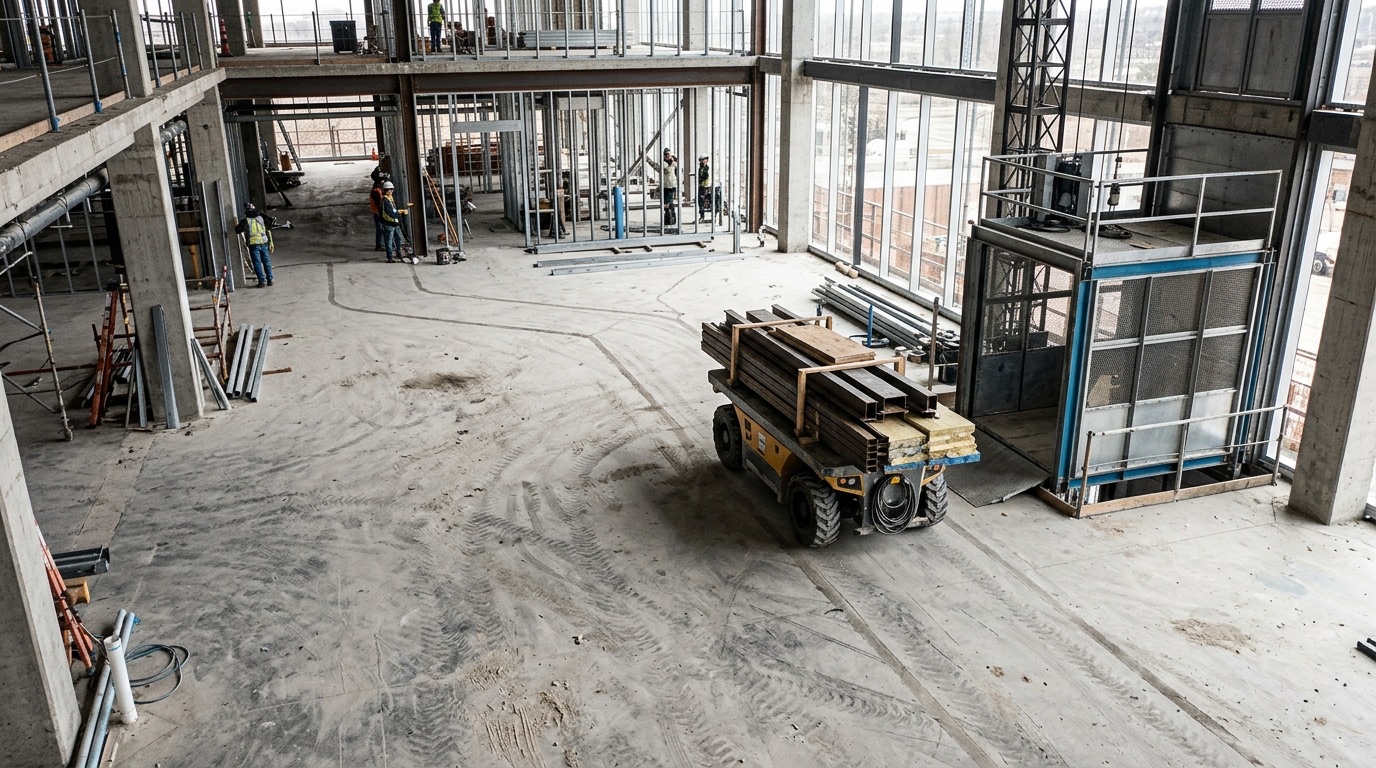
On a building site there is exactly one resource every trade queues for at the same time: the hook. The crane decides when material is up, and in deciding that it decides the tempo of the whole build. Anyone bringing robotics onto that site therefore usually asks the wrong question. It is not which robot lifts heavy loads. It is which robot works without booking crane time.
Key Takeaways
- 1The crane is not going autonomous in this planning cycle. DGUV Vorschrift 52 § 29 binds the independent operation of a crane to a named person: at least 18 years old, physically and mentally suitable, instructed and having demonstrated capability, and appointed by the employer — in writing for mobile power-driven cranes.
- 2The useful metric is not “does it need a crane, yes or no” but picks per shift: a single mobilisation pick spread over thousands of work cycles is a different thing entirely from a machine that wants the hook every cycle.
- 3Layout, rebar tying and survey run with no crane time at all in operation. That is precisely why they can be scheduled into the windows the crane does not want — the real lever, and it costs nothing.
- 4The Hadrian X does not compete for the hook but for the airspace: FBR states a 32-metre telescopic boom for the machine. That boom works in exactly the volume a tower crane slews through.
- 5Vertical transport stays human-directed. The one exception that can be named on the evidence today is the Kewazo LIFTBOT — and Kewazo describes it on its own product page as “battery-powered and remote controlled”, that is, a remote-controlled hoist and not an autonomous crane.
The hook is the only genuinely shared resource
Every trade on a site brings its own tools. The concrete crew has its formwork, the ironworkers their tying tools, the MEP trades their drills. Nobody queues for any of that. There is exactly one resource everybody shares and nobody can multiply: the hook.
A second tower crane is not a procurement decision. It is a decision about site setup, foundations, slew envelopes and often about the permit. Within a running project crane time is therefore fixed. The only thing that moves is the order — and in practice the day's pick list is the real programme, whatever the bar chart says.
That has a consequence for anyone introducing robotics here. The binding constraint is not what the robot can do. It is whether deploying it lengthens or shortens the pick list. A machine that performs a task superbly and needs the hook three times a day is competing with the structural works for the scarcest resource on the site — and it loses that competition reliably, because the structural works set the tempo.
Why the crane is not going autonomous in this planning cycle
There are two reasons, and only one of them is technical. The more important one sits in the German rulebook.
DGUV Vorschrift 52 “Krane”, § 29 governs whom an employer may put in independent charge of a crane at all: only insured persons “who have completed their 18th year of life”, “who are physically and mentally suitable”, “who are instructed in operating or maintaining the crane and have demonstrated their capability to him”, and “of whom it can be expected that they will reliably fulfil the tasks assigned to them”. It continues: “The employer must appoint crane operators and maintenance personnel to their tasks. For mobile power-driven cranes the employer must appoint the crane operator in writing.” Paragraph 2 exempts hand-operated cranes alone.
This is not a prohibition on automation. The rule does not say a crane may not move automatically; it says who may operate it. But it is written throughout around a named natural person — with an age, a suitability finding, a demonstration of capability and a signature. A machine cannot be appointed, and no parallel provision transfers that role to a system. Anyone planning an autonomous crane would first have to answer who exactly is being appointed in writing.
The second reason is the conformity route. The EU Machinery Regulation 2023/1230 applies from 20 January 2027 and already sits in the standards set on the werob construction page. It governs how machinery — lifting equipment included — is placed on the market. It does not create a route that makes the crane operator dispensable.
Taken together this is an organisational and legal statement about this planning cycle, not a technical forecast. It reads simply: whoever plans a site for 2027 plans with a crane operator.
The right metric is not “needs a crane” but picks per shift
Once the crane is accepted as a fixed quantity, the selection question gets precise. It is no longer “which robot needs no crane” — a yes/no question that throws away the interesting cases. It is: how many picks does this machine consume, and across how much output are they spread?
That sorts candidates into three classes, and the middle one matters most:
- No picks at all. The machine drives or walks itself to where it works and away again. It never appears on the pick list.
- One pick to mobilise, none in operation. The machine has to be lifted onto the deck once and then works a whole pour without seeing the hook again. One pick spread across thousands of work cycles is arithmetically close to zero.
- Competes continuously. The machine wants the hook every cycle, or it occupies the airspace the crane slews through.
The third class is not a disqualification. It only means the machine does not belong in the robot schedule but in the crane schedule, weighed there against the structural works like any other major-plant question. Skip that distinction and you have planned two long booms into the same air, and you find out on the day.
What runs without crane time: layout, rebar, drilling, survey
Layout. Dusty Robotics describes the FieldPrinter as a system that autonomously prints the layout from the BIM model onto the surface — concrete, subfloor, formwork, asphalt — at a stated accuracy of one sixteenth of an inch. HP correspondingly calls SitePrint an autonomous robot that prints site layouts directly onto the floor; the constraint there, on HP's own description, is an unobstructed line of sight to the total station. Both drive themselves. That is a sightline condition, not a crane question. What it means for trade coordination is set out in the piece on layout robots on site.
Rebar. The TyBot from Advanced Construction Robotics is the most instructive case, because it falls honestly into the middle class. ACR states that the robot works on a gantry adjustable from nine to 117 feet in span, running on the deck's existing screed rails or on rails ACR supplies, and that it identifies intersections by itself and ties at over 1,100 ties per hour. That gantry has to get onto the deck — and that is a pick. Exactly one. After it, the whole pour runs without another. Why the work itself then stops competing for crane picks and hoist access is set out in the piece on rebar-tying robots and is not repeated here.
Overhead drilling. Hilti markets the Jaibot under its own product name, “Semi-Autonomous Drilling Robot”. The worker positions the machine by remote control, and the holes within reach are then drilled automatically from the BIM data, referenced by the Hilti PLT 300 total station. So the Jaibot needs a person. It does not need a crane. Those are two different scarcities, and only one of them is contended.
Survey. Leica Geosystems describes the BLK ARC as an autonomous laser-scanning module for robotic carriers with which scan missions can be repeated autonomously; the first carrier is the Boston Dynamics Spot. The robot walks onto the deck and off it again. The time-series logic behind that is in the piece on autonomous ground survey with legged robots.
The value of these four cases is not primarily in hours saved. It is that they can be scheduled into the windows the crane does not want: nights, weekends, the hours around a pour. Anything that needs nothing from the hook is decoupled from the tempo of the structural works — and that is a programme advantage first and a labour advantage second.
What does compete: the Hadrian X needs the airspace cleared
Not every construction machine with a robotic element fits in this obligingly. FBR's Hadrian X is the counter-example, and for a reason that is easy to miss: it does not compete for the hook. It brings its own boom.
FBR states a 32-metre telescopic boom for the machine, with which walls up to three storeys high can be built from the roadside, along with a stabilisation technology that measures movement from wind, vibration and inertia and counteracts it in real time. A boom of that length works in exactly the volume a tower crane claims when it slews. So the conflict is not a timing conflict at the hook but a spatial conflict in the air — and that is the harder one, because it is exclusive for the entire duration of the deployment rather than for the duration of a pick.
The site preparation that follows from this is already described in the piece on bricklaying robots, down to mapping the exclusion zones against overhead lines, tower crane operating envelopes and adjacent scaffolds. The point here is a different and purely planning one: a machine with a 32-metre boom is a major-plant item in the programme, even if the brochure calls it a robot. It gets planned against the crane, not parked alongside the other robots.
Vertical transport stays human-directed
Which brings us to the uncomfortable part. For the way up — material from the ground to the level where it gets installed — there is nothing autonomous you can procure today. Everything regularly named in this space is either an assist device a human guides, or a demonstration. Demonstrations do not go into a programme.
One exception can be named on the evidence, and it is exactly as narrow as it sounds. The LIFTBOT from Kewazo GmbH of Garching near Munich is a lifting device for material on scaffolding. Kewazo describes it on its own product page as “battery-powered and remote controlled”, and names deployments there at BASF in Ludwigshafen, at the Nobian site in the Netherlands, and a 72-metre scaffold together with Marr Scaffolding. The machine is real, it is deployed — and on the manufacturer's own description it is remote-controlled, not autonomous.
That is exactly how it should be named, and named that way it is useful: it takes material up a scaffold without a crane pick and without a human carrying chain. That makes it a hoist, not an autonomous crane. The distinction is already established across the werob desk — demolition robots have always been described there as remote-controlled rather than autonomous, and the LIFTBOT is held to the same standard.
For an operator this means the automation on a building site happens on the ground. What runs there is collected on the construction solution page — layout, rebar, drilling, survey, material routes on the level. Vertical transport is deliberately not in it, and that is not a gap in the offer but a statement about the market.
What the operator settles
The decision actually being made here is a scheduling decision, not a technology decision. It has four parts.
First: the pick list before the robot list. Anyone who does not know how many picks a typical shift on this site consumes, and on what, is specifying robotics blind. That list already exists on every site, usually in the site manager's head.
Second: three numbers per machine. Picks to mobilise, picks in running operation, airspace required yes or no. The first selection round needs nothing more, and those three numbers sort candidates more reliably than any performance comparison.
Third: use the windows. Whatever runs without crane time belongs in the hours the crane does not want. That is the largest lever in the whole calculation, and it costs no additional hardware — only the willingness to stop aligning the robot schedule with the daily rhythm of the structural works.
Fourth: no autonomous crane in this plan. Plan one in and you are planning against § 29, and you will discover it in the appointment and approval process rather than on the site.
werob is manufacturer-independent and picks the platform from the task, not the other way round. Describe the site, the task and the crane loading in plain language: first spec in 48 hours, first robot on site in eight weeks.
FAQ
- Will the tower crane become autonomous any time soon?
- Not in this planning cycle, and the reason is legal and organisational before it is technical. DGUV Vorschrift 52 § 29 permits independent operation of a crane only by persons aged 18 or over who are physically and mentally suitable, instructed, who have demonstrated their capability, and who have been appointed by the employer — in writing for mobile power-driven cranes. The rule is built around a named person, and a machine cannot be appointed in writing. That is not a prohibition on automation, but it does mean: whoever plans for 2027 plans with a crane operator.
- Which construction robots need no crane time in operation?
- Layout, rebar tying, overhead drilling and survey. The Dusty FieldPrinter and HP SitePrint drive themselves and print the layout onto the surface; the Hilti Jaibot is, on the manufacturer's description, positioned by the worker via remote control and drills the holes within reach automatically from the BIM data; the Boston Dynamics Spot carrying the Leica BLK ARC walks its survey route itself. None of these machines appears on the pick list during running operation.
- Doesn't the rebar robot need a crane pick after all?
- Yes, exactly one. The gantry the ACR TyBot works on has to be lifted onto the deck; ACR states that it is adjustable from nine to 117 feet in span and runs on the existing screed rails. After that the machine works the whole pour without occupying the hook again. That is why the sensible metric is not “needs a crane, yes or no” but picks per shift relative to the output delivered.
- Why does the Hadrian X compete if it brings its own boom?
- Because it does not compete for the hook but for the airspace. FBR states a 32-metre telescopic boom for the Hadrian X, with which walls up to three storeys are built from the roadside. That boom works in the same volume the tower crane slews through, and it occupies it for the entire deployment rather than for the duration of a pick. In the programme the machine is therefore a major-plant item and is planned against the crane.
- Is there autonomous material transport upwards?
- No, nothing autonomous you can procure. The only machine that can be named on the evidence here is the LIFTBOT from Kewazo GmbH of Garching: a lifting device for material on scaffolding, which Kewazo describes on its own product page as “battery-powered and remote controlled” and for which it names deployments at BASF Ludwigshafen, at the Nobian site in the Netherlands and on a 72-metre scaffold. It is remote-controlled, not autonomous — and it should be named precisely as a hoist. Everything else in this space is assistance or demonstration.
Related reading
Autonomous Ground Survey with Legged Robots: As-Built and Progress as a Time Series
Discover how autonomous legged robots and high-precision laser scanners turn isolated site surveys into repeatable weekly progress time series.
17 July 2026layout robot construction siteLayout robots on site: printing BIM onto the slab to the millimetre
Discover how layout robots print BIM models directly onto concrete slabs with millimetre precision to eliminate manual errors and coordinate all trades.
17 July 2026bricklaying robot masonry constructionBricklaying Robots 2026: Fastbrick Systems on Site
Evaluate masonry robotics for construction in 2026. Discover what truck-mounted systems like Fastbrick's Hadrian X actually deliver on real job sites.
21 August 2026rebar tying robot construction sitesRebar-Tying Robots: What Construction Sites Automate First
Discover why rebar-tying robots are the first automation target for construction sites, offering proven ROI, safety, and up to 1,200 ties per hour.
21 August 2026qsr kitchen robotics worth itQSR kitchen robotics: which tasks pay off and which do not
A sober framework for QSR and mid-market operators: which kitchen tasks are worth automating, which are not, and why a narrow robot loses its case the moment the task stops being narrow.
25 July 2026