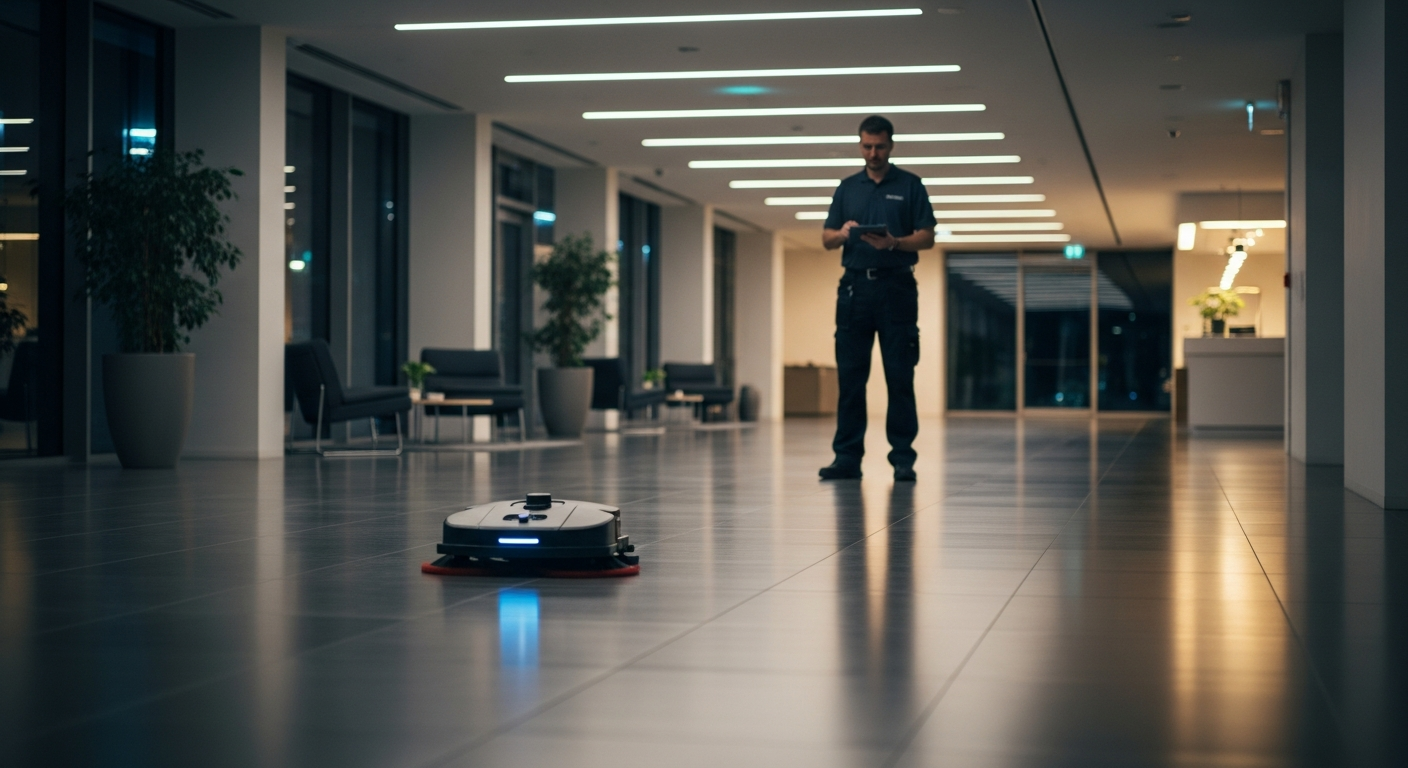
Autonomous Floor Cleaning for Large Areas: Efficiency for FM Operators
Automating floor cleaning on large areas reduces operating costs and sustainably solves staff shortages. This is how werob, as a systems integrator, realizes the process from specification to live operation in eight weeks.
Monday, 4:30 a.m. A logistics center in Hamburg. While the early shift arrives, the cleaning robot has already prepared 8,000 square meters of hall floor dust-free. Minimal personnel effort for routine tasks, no delay. In the facility management (FM) sector, autonomous floor cleaning is no longer a pilot project but an economic necessity. With 140,000 FM sites in Europe, the pressure to secure efficiency through technology is rising. The system translates these operational requirements into a deployable specification in 48 hours and brings the right hardware onto the floor within eight weeks. In doing so, werob acts not as a manufacturer but as the decisive operational layer between the operator stack and the robotics hardware.
Key Takeaways
- 1werob delivers a deployable robotics specification within 48 hours instead of months.
- 2Hardware agnosticism prevents vendor lock-in through access to more than 44 OEM partners.
- 3The EU Machinery Regulation 2023/1230 is covered in a legally compliant manner by werob as a compliance path.
The Economic Reality in Facility Management
The facility management market faces massive challenges. Rising labor costs and a chronic shortage of cleaning staff threaten margins on large projects. Autonomous floor cleaning for large areas offers measurable relief here. While conventional cleaning methods cause high personnel costs, automated systems pay for themselves through continuous readiness for use. In the F&B area, automating kitchen floor cleaning, for example, leads to significant cost relief per site. These figures are not theoretical estimates but are based on real deployment data from the werob network.
For FM service providers who look after hundreds of sites, scalability is the decisive factor. The manual cleaning of logistics halls or retail areas is error-prone and difficult to control. Autonomous systems, on the other hand, deliver consistent results and a digital documentation of the performance delivered. werob supports operators in using these advantages without having to tie themselves to a single hardware manufacturer. Through the hardware-agnostic approach, exactly the robots that match the customer's specific ground conditions and environmental conditions are selected from more than 44 OEM partners.
Spec Engine: From Requirement to Solution in 48 Hours
Traditional consulting projects in robotics often take three to six months before the first hardware touches the floor. werob breaks up this slow process. With the Spec Engine, an operator's workflow is translated into a deployable robot specification within 48 hours. This engine was trained on more than 35,000 projects and immediately recognizes which technical requirements are critical for large-area cleaning. Whether it is about overcoming thresholds, navigating in dynamic environments, or integrating into elevator controls, the Spec Engine delivers a precise requirements profile.
This accelerated workflow is essential for FM companies to be able to react quickly to tenders. Instead of lengthy discovery phases, customers receive a valid technical concept that can go directly into implementation. The specification takes into account not only the cleaning performance per hour but also infrastructural prerequisites such as charging stations and water connections. Through this data-supported approach, werob minimizes the risk of wrong purchases and ensures that the chosen solution is precisely tailored to the operational reality on site.
Hardware Agnosticism and Supplier Match
A common mistake in automation is so-called vendor lock-in. Operators tie themselves to a manufacturer and are dependent on its innovation cycle and pricing. werob pursues a different approach. As a systems integrator, werob ranks more than 280 different robot models from more than 44 OEM partners against the customer's individual specification. In the area of floor cleaning, this includes leading systems such as the Pudu CC1 or solutions from Ecovacs and Avidbots. The goal is not the sale of a particular device but the finding of the optimal hardware for the respective use case.
The Supplier Match process evaluates the robots according to performance, reliability, and integration capability. For a large area in a hospital, different requirements apply than for an industrial hall. While in healthcare disinfection and ISO 13482 compliance are in the foreground, in logistics it is above all the robustness and the ability to deal with obstacles such as forklifts that count. werob takes over the pre-selection and the ranking, so that the operator receives a well-founded basis for decision-making. This process ensures that the fleet remains flexible even with future expansions and that new technologies can be seamlessly integrated.
Direct Integration into the Operator Stack
A cleaning robot that acts as an isolated island solution creates additional administrative effort. The true value of automation arises through integration into existing IT systems. werob offers pre-built connectors into the operator stack, including interfaces to SAP EWM for logistics or specialized PMS systems for hospitality. These connectors make it possible to automatically trigger cleaning cycles when certain areas of a hall are cleared or when a room in the hotel is marked as 'checkout'.
The integration also ensures complete data transmission. Cleaning reports are fed directly into the customer's management systems, which considerably simplifies the obligation to provide proof to clients. In facility management, this digital audit trail is a competitive advantage. It demonstrates compliance with hygiene standards and cleaning intervals without manual documentation effort. werob acts here as a technical translator that translates the proprietary protocols of the robot manufacturers into the language of corporate IT.
Live Fleet Management via the werob Cockpit
As soon as the robots are deployed, the werob Cockpit takes over central monitoring. For FM service providers operating fleets at different sites or in different countries, this central view is indispensable. The Cockpit uses a four-dimensional traffic-light system that displays the status of the hardware, the infrastructure, the regulatory compliance, and the original specification in real time. This way, management immediately recognizes when a robot is not ready for use due to a blocked charging station or when maintenance intervals are due.
The Cockpit serves not only for troubleshooting but also for improvement. By analyzing the performance data, cleaning routes can be refined and deployment times adjusted. werob operates this live Cockpit for all 200 robots that are currently in active operation. This relieves the local staff on site, as technical problems can often be identified and solved remotely before they disrupt operations. The transparency that the Cockpit offers is the basis for werob's outcome-only model: the customer pays for the result, not for ownership of the hardware.
Regulation: The EU Machinery Regulation 2023/1230
A critical aspect that many operators underestimate is legal compliance. From 20 January 2027, the new EU Machinery Regulation 2023/1230 becomes binding. This regulation imposes considerably higher requirements on the safety and conformity assessment of autonomous systems, especially when these are deployed in areas with human public traffic. Many Asian OEMs currently do not have the necessary certifications for the European market. werob acts here as a compliance path.
As a systems integrator, werob ensures that all deployed systems comply with applicable European standards. This includes not only the Machinery Regulation but also the GDPR when processing sensor data as well as industry-specific standards such as ISO 13482 for personal care robots or ISO 27001 as well as SOC 2 Type II for information security. For an FM operator, working with werob means legal safeguarding. werob takes responsibility for the regulatory conformity of the overall solution, which considerably minimizes the liability risk for the operator. At a time when regulatory requirements are becoming ever more complex, this built-in compliance path is a decisive factor for long-term investment security.
Cost-Benefit Analysis and Outcome-only Model
Investment in robotics is often inhibited by high acquisition costs and unclear ROI calculations. werob clears these hurdles out of the way with an outcome-only commercial model. This means: you only pay once the robot is running and delivering the agreed performance. There are no hidden list prices or high upfront investments for hardware that ultimately does not meet expectations. This model perfectly aligns the interests of werob and the operator, as werob is only successful when the robots are permanently productive.
The economic advantages are significant. In addition to the already mentioned significant relief in F&B kitchen cleaning, data from other areas show similar potential. In hospitality, automating bar and breakfast preparation can save considerable costs per year. These funds can be reinvested in the quality of service or in retaining specialist staff. werob delivers a binding quote within five days that transparently presents these cost advantages. Through the fast implementation within eight weeks, operators reach a break-even point very quickly.
Implementation in Eight Weeks: The Path to Success
The path to autonomous floor cleaning on large areas follows a structured eight-stage process at werob. It all begins with capturing the current state: Who are you, what does the shift look like, and which tasks should be automated? After the 48-hour specification phase and the Supplier Match, technical integration follows. werob ensures that the robots are not only physically present but can also communicate digitally with the environment. This includes mapping the areas and defining no-go zones.
In the eighth week, the robot is deployed. This tight schedule is only possible because werob draws on pre-built processes and deep expertise in systems integration. While other firms are still stuck in the discovery phase, werob customers already achieve initial savings, similar to a partner at a Big Four consultancy who reduced the analysis time from three weeks to five days through the use of specialized AI workspaces. The goal for 2028 is clearly defined: 2,000 robots in live operation. Become part of this development and secure the efficiency advantages of autonomous cleaning for your sites. The first step is simple and takes only a few minutes.
FAQ
- What distinguishes werob from a robot manufacturer?
- werob is a systems integrator and not a manufacturer. We do not sell our own hardware but select the best solution for your specific workflow from more than 44 OEM partners and integrate it into your IT stack.
- How quickly is a cleaning robot ready for use?
- After the first contact, you receive a specification within 48 hours, a quote in five days, and within eight weeks the robot is in live operation at your site.
- What does the outcome-only model mean specifically?
- At werob, you pay nothing before the robot is actually running and fulfilling its task. We bear the risk of implementation and ensure that the solution is productive.
- Do I have to adapt my IT infrastructure for the robots?
- werob delivers pre-built connectors for common systems such as SAP EWM, Opera PMS, or Toast. We integrate the robotics into your existing stack instead of creating new island solutions.
- How safe are the autonomous systems in areas with public traffic?
- All systems we integrate meet the strict European safety standards, including ISO 13482 and the upcoming EU Machinery Regulation 2023/1230, in order to guarantee maximum safety for people.
- What cost saving is realistic for floor cleaning?
- In the F&B sector, our customers achieve verified significant cost relief per site through the automation of kitchen floor cleaning alone.
Related reading
AMR Robots: Autonomous Systems for Operational Excellence
AMR robots transform operational efficiency in care, hospitality, and logistics through intelligent navigation. As a hardware-agnostic partner, werob integrates these systems into your existing software stack within eight weeks.
3 June 2026cleaning robotsCleaning Robots in B2B Use: Efficiency and Compliance
Manual floor cleaning ties up valuable skilled workers in repetitive tasks. werob integrates hardware-agnostic cleaning robots into existing workflows and ensures measurable cost relief.
15 June 2026cleaning robots hospitalCleaning Robots in Hospitals: Efficiency in Clinical Facility Management
Hospitals are under massive cost pressure while hygiene requirements simultaneously rise. Autonomous cleaning robots relieve specialist staff from repetitive floor cleaning tasks and ensure seamless documentation of cleaning cycles.
16 June 2026IEC 63327 cleaning robot standardIEC 63327: which standard an autonomous cleaning machine is actually built to
Specifications for autonomous scrubbers almost always cite ISO 3691-4. That is the standard for driverless industrial trucks. The floor treatment machine has had one of its own since 2021 — and it rarely appears in the enquiry.
3 September 2026scrubber vacuum robotScrubber vacuum robots: Efficiency in industrial floor cleaning
The automation of floor cleaning is no longer an optional innovation project for facility managers and operations managers, but rather an economic necessity. Find out how werob, as a hardware-agnostic system integrator, goes from the first specification to live operation in eight weeks.
18 June 2026