Logistics Robots: Scalable Automation for Mid-Sized Businesses
Logistics robots are no longer a vision of the future, but operational reality. Learn how you can achieve measurable cost relief through hardware-agnostic integration and automated workflows.
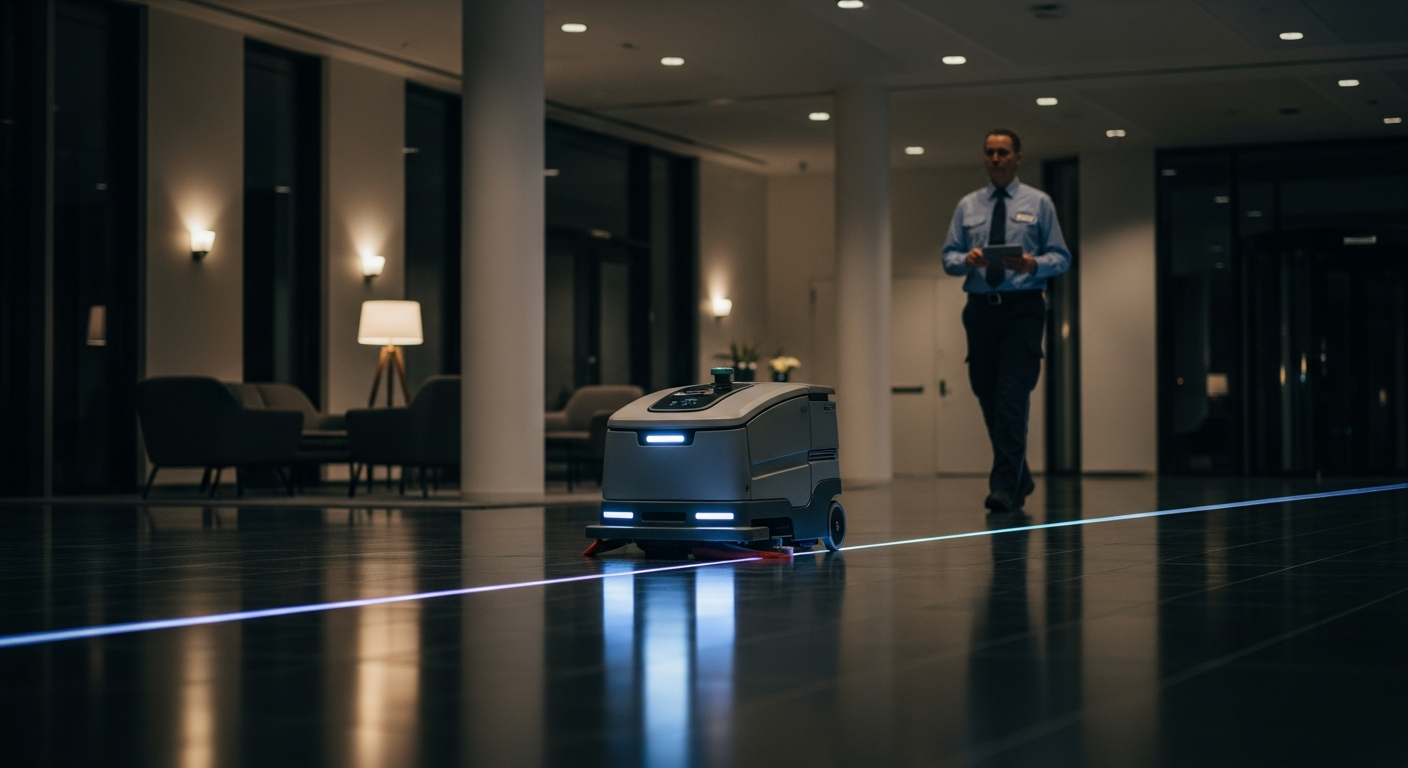
Logistics center, 03:15. The night shift in the outdoor warehouse is running. An autonomous robot patrols the fence area, while two other units move pallets between Hall 4 and the loading area. No personnel effort, no fatigue. In logistics today, it is no longer the hardware specifications of individual devices that decide, but seamless integration into the existing stack and compliance with regulatory frameworks. Anyone investing in logistics robots today must consider the entire process from specification to live operation to achieve true operational excellence. werob translates these complex requirements into functional systems.
Key Takeaways
- 1Hardware agnosticism protects against vendor lock-in and enables access to over 44 leading OEM partners.
- 2Integration into SAP EWM or Genetec is decisive for automated and error-free workflows.
- 3The EU Machinery Regulation 2023/1230 requires an experienced integration partner from January 2027.
Why Hardware Agnosticism is the Key to Success
In the world of logistics robots, many companies make the mistake of committing too early to a specific manufacturer. A single OEM reseller will always only offer you the solution that is in their portfolio. werob breaks this model. As a hardware-agnostic systems integrator, we evaluate over 44 OEM partners and more than 280 different robot models against your specific requirements. This prevents vendor lock-in and ensures that the chosen hardware matches your floor covering, lighting conditions, and throughput rates exactly.
The selection includes specialized systems from partners such as ANYbotics for demanding terrain, Clearpath Robotics for industrial transport, or Robotnik for mobile manipulation. Instead of adapting to a manufacturer's limitations, we choose the hardware that best maps your workflow. This approach is particularly important because the technological landscape in robotics is developing rapidly. A system that is leading today may already be outdated in two years. Through a hardware-agnostic platform, you remain flexible and can supplement your fleet with more modern units at any time, without having to rebuild the entire infrastructure.
From Process Analysis to Specification in 48 Hours
Traditional consulting houses often spend three to six months creating discovery decks and process analyses. In operational logistics, this loss of time is not acceptable. werob uses the Spec Engine to translate your workflow into a ready-to-deploy robot specification within 48 hours. This engine has been trained on the basis of over 35,000 projects and immediately recognizes which robot types are suitable for tasks such as yard patrol or in-house transport.
You simply describe to us your shift schedules, the condition of the paths, and the type of loads to be moved. The Spec Engine generates a precise requirements catalog from this, comprising technical parameters such as payload, battery life, sensors for obstacle detection, and necessary connectivity. This automated process drastically shortens the time to the first offer. While others are still philosophizing about synergies, after five days you already have a concrete offer based on real market data and available OEM capacities.
Integration into the Logistics Stack: SAP EWM and Genetec
A logistics robot that operates in isolation is only half as valuable. True efficiency arises from the connection to your existing software systems. werob offers pre-built connectors for leading platforms such as SAP EWM (Extended Warehouse Management) and Genetec for security applications. This integration ensures that the robot receives its orders directly from the warehouse management system and reports status updates back in real time. No manual intervention by dispatchers is required.
When goods receipt is booked in SAP EWM, the system can automatically request a transport robot to bring the pallet to the destination. In the area of security, integration into Genetec enables patrol robots to automatically drive to the scene in case of alarms from stationary cameras and transmit live images to the control center. This seamless communication between hardware and software is the foundation for scalable operations. We do not build island solutions, but integrate robotics as a permanent component of your digital process landscape.
Economic Key Figures: EUR 68,000 in Annual Cost Relief
Automation in logistics must pay off. We are not talking about vague efficiency increases, but about hard numbers. For a typical yard patrol in a logistics center, we realize annual cost relief of EUR 68,000 per location. This saving results from the reduction of personnel costs for monotonous monitoring tasks, the avoidance of property damage through seamless control, and the optimization of deployment times. In the area of retail patrol for large warehouse areas, the relief is about EUR 58,000 per year.
werob's commercial model is consistently focused on the operator's success. We pursue an outcome-only approach. This means you only pay when the robot is productively running in your operation. There are no hidden list prices or high upfront investments for feasibility studies. This transparency allows you to precisely calculate the return on investment (ROI). In many cases, the investment amortizes in the first year of operation, as the robots are able to take over tasks during off-peak hours or under difficult conditions that would otherwise require expensive premiums or additional personnel.
Regulatory Certainty: The EU Machinery Regulation 2023/1230
An often underestimated factor when introducing logistics robots is compliance. From 20 January 2027, the new EU Machinery Regulation 2023/1230 becomes binding. This regulation imposes significantly higher requirements on the safety of autonomous systems and their interaction with people. werob acts as your compliance path here. We ensure that all deployed systems, especially those from non-European OEMs, go through the necessary conformity assessments and meet all safety standards.
In addition to the Machinery Regulation, we consider standards such as IEC 62443 for industrial cybersecurity and the GDPR for the processing of sensor data. A robot that moves through your warehouse with cameras and lidar sensors continuously collects data. We ensure that this data is processed securely and that your company is protected from legal risks. Without an experienced integrator, operators run the risk of implementing systems that have to be shut down again shortly after commissioning due to new regulatory requirements. With werob, your fleet is set up to be future-proof.
Fleet Management via the werob Cockpit
Once more than one robot is in use, monitoring becomes a challenge. The werob Cockpit is the central control layer for your entire fleet, regardless of how many different manufacturers you deploy. The system uses a four-dimensional traffic light system to visualize the status of hardware, infrastructure (such as Wi-Fi and charging stations), regulation, and adherence to specifications. Thus, you see at a glance whether all units are working as planned or whether intervention is required.
The Cockpit delivers detailed reports on the performance of the robots, kilometers driven, tasks completed, and downtime. This data is essential for the continuous optimization of your logistics processes. If, for example, a robot is repeatedly delayed at a certain place in the warehouse, the Cockpit provides the necessary data to identify the cause, whether it is a blocked path or a problem with network coverage. This transparency creates trust in the technology and enables data-based scaling of your automation strategy.
To Productive Deployment in Eight Weeks
Speed is a decisive competitive advantage. While classical automation projects often take years, werob brings logistics robots into live operation in just eight weeks. This tight schedule is possible because we rely on standardized processes and pre-built connectors. After the 48-hour specification phase and the Supplier Match, physical provisioning and integration into your stack take place. We take over the configuration on site and train your staff in handling the new technology.
In the eighth week, the robot takes over its first productive tasks. This rapid rollout minimizes disruption to your ongoing operations and provides immediate relief to your team. Our goal is to eliminate complexity for the operator. You do not need to be a robotics expert to benefit from the advantages of automation. werob takes over the technical depth, the regulatory protection, and the fleet management, so that you can focus on your core business. The path to autonomous logistics has never been so direct and low-risk.
Comparison: Logistics Robot Types and Application Areas
To make the right decision for your location, a comparison of the common robot types is helpful. Depending on the use case, the requirements for mobility, payload, and sensors vary considerably. The following table provides an overview of the primary deployment areas in logistics.
| Robot type | Main task | Advantage | Integration |
|---|---|---|---|
| AMR (autonomous mobile robots) | In-house transport | Flexible without guidelines | SAP EWM |
| Yard patrol (outdoor) | Security & monitoring | Weatherproof, 24/7 use | Genetec |
| Retail patrol (indoor) | Inventory & security | High sensor precision | ERP / WMS |
| Heavy-load robot | Pallet transport | Replaces forklift | SAP EWM |
The choice of the right type at werob is always based on the Spec Engine. We ensure that the hardware not only theoretically fits, but stands up to daily multi-shift operation. We also consider factors such as the charging infrastructure and the interaction with manually operated vehicles in your warehouse.
FAQ
- How long does the implementation of a logistics robot take?
- At werob, the process from the first specification to productive deployment usually takes eight weeks. The specification is available after 48 hours.
- What cost savings are realistic with logistics robots?
- For a yard patrol, the verified cost relief is EUR 68,000 per location and year. For retail patrols, it is about EUR 58,000.
- Do I have to adapt my existing software for the robots?
- No, werob delivers pre-built connectors for systems such as SAP EWM, Genetec, and others, so the robots are seamlessly integrated into your existing stack.
- What happens in case of technical problems with the robots?
- The entire fleet is monitored live via the werob Cockpit. A four-dimensional traffic light system reports malfunctions immediately, so that quick reactions are possible.
- Are the robots safe in dealing with employees?
- Yes, all systems we integrate meet the highest safety standards and are already prepared for the upcoming EU Machinery Regulation 2023/1230.
- Does werob also offer humanoid robots for logistics?
- Yes, we include humanoid systems from partners such as Apptronik or Unitree in our catalog and check their suitability for your specific workflows.
Related reading
AMR Robots: Autonomous Systems for Operational Excellence
AMR robots transform operational efficiency in care, hospitality, and logistics through intelligent navigation. As a hardware-agnostic partner, werob integrates these systems into your existing software stack within eight weeks.
3 June 2026logistics security robot providerLogistics Security Robot Provider: Integration Instead of Hardware Purchase
The choice of the right logistics security robot provider determines the long-term compliance and economic viability of your plant security. As a hardware-agnostic integrator, werob offers the direct path from operational requirement to live fleet in eight weeks.
11 June 2026autonomous floor cleaning large areaAutonomous Floor Cleaning for Large Areas: Efficiency for FM Operators
Automating floor cleaning on large areas reduces operating costs and sustainably solves staff shortages. This is how werob, as a systems integrator, realizes the process from specification to live operation in eight weeks.
3 June 2026ek robotics integration partnerek robotics Integration Partner: Efficiency in logistics
The implementation of ek robotics systems often fails due to the IT interface or lengthy planning phases. werob translates your logistics workflows into a technical specification in 48 hours and ensures productive live operations.
7 July 2026boston dynamics stretch logistics partnerBoston Dynamics Stretch Logistics Partner: Integration in 8 weeks
Boston Dynamics Stretch automates truck unloading at the ramp. werob is the system integrator that translates this hardware into your operational workflow, connects it to SAP EWM and ensures compliance.
6 July 2026