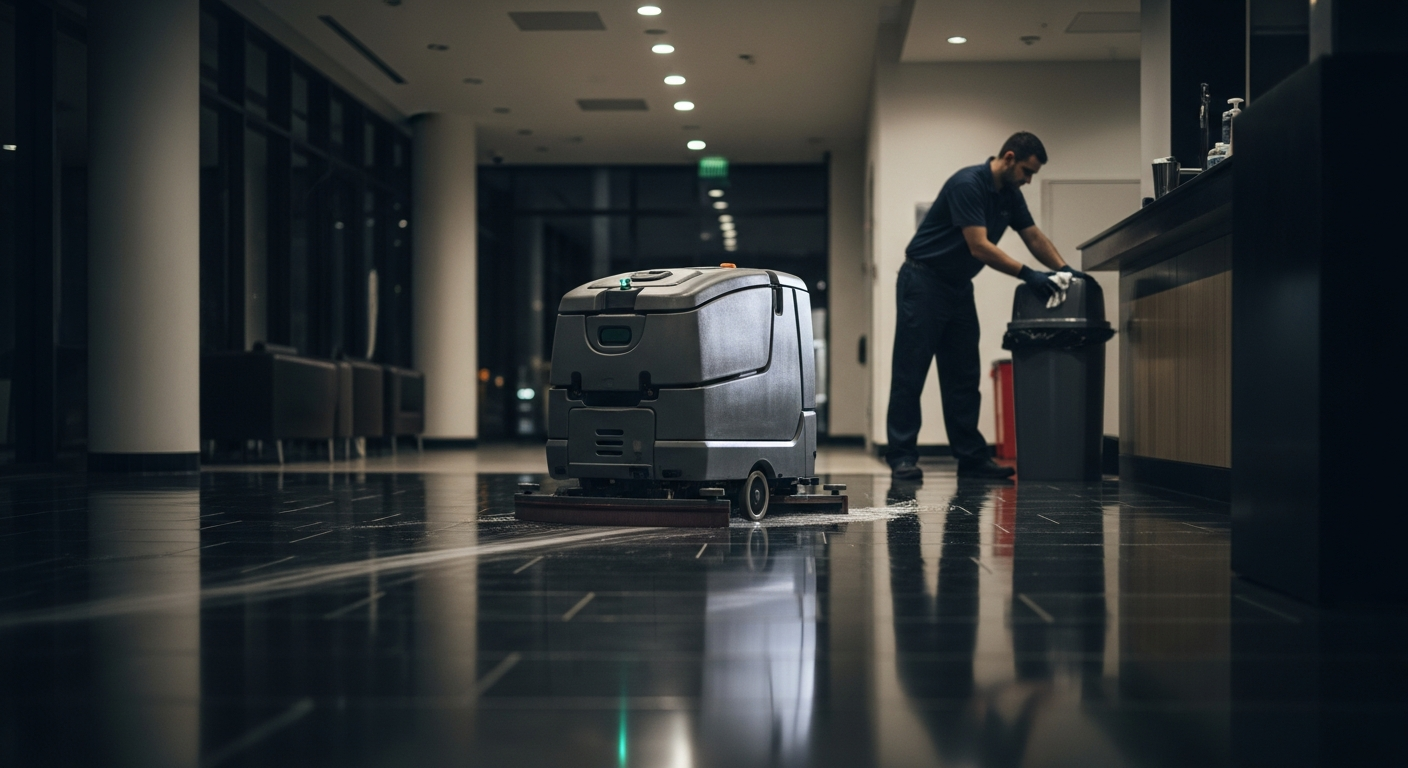
Cleaning Robots in B2B Use: Efficiency and Compliance
Manual floor cleaning ties up valuable skilled workers in repetitive tasks. werob integrates hardware-agnostic cleaning robots into existing workflows and ensures measurable cost relief.
Monday, 4:30 AM. A logistics center in Hamburg. While the early shift has not yet begun, the cleaning robot is already running its paths through the high-bay aisles. It has wet-cleaned and polished 8,000 square meters of floor space in the last four hours. No staff was present. The data flows in real time into the werob cockpit. For the facility manager, this means a clean handover at the shift change without staff deployment at night. werob translates such operational requirements into a deployable specification within 48 hours.
Key Takeaways
- 144,000 euros in annual cost relief through automated kitchen floor cleaning in the F&B area
- 2Full compliance with the EU Machinery Regulation 2023/1230 from January 2027 guaranteed
- 3Hardware-agnostic selection from over 44 OEM partners prevents vendor lock-in
The Difference Between Hardware Purchase and System Integration
Many companies make the mistake of viewing a cleaning robot as an isolated hardware product. However, a single robot does not solve any operational problem if it is not embedded in the existing infrastructure. werob is not a robot manufacturer and not a simple reseller. As a systems integrator, werob closes the gap between the hardware and the operator's operational workflow.
While conventional providers often need months for the needs analysis, werob uses a Spec Engine trained on data from over 35,000 projects. Within 48 hours, a technical specification is created from a simple description of the cleaning task. This process ensures that the chosen hardware fits exactly the floor coverings, obstacles, and safety requirements on site. werob ranks over 44 OEM partners for this purpose in order to find the objectively best solution.
Economic Viability: 44,000 Euros in Annual Cost Relief
The investment in autonomous cleaning systems is primarily driven by the reduction of operating costs. In gastronomy and at F&B chains, the use of robots for kitchen floor cleaning leads to verified cost relief of 44,000 € per site and year. This sum results from the saving of working hours that were previously spent on repetitive cleaning cycles.
In facility management, automation enables scaling without additional staff. An FM service provider can serve more sites with the same staffing pool through the use of a robot fleet. The commercial model of werob is success-oriented. The outcome-only principle means that customers only pay when the robot is productively deployed. There are no hidden list prices or upfront fees for planning.
Hardware Agnosticism and the Supplier Match System
The market for cleaning robotics is fragmented. Manufacturers such as Pudu, Ecovacs, or Avidbots offer specialized solutions. werob remains hardware-agnostic and selects from a catalog of over 280 deployable robots. The Supplier Match system evaluates the OEMs against the specific requirements of the customer site.
| Criterion | Significance for Operations | werob Solution |
|---|---|---|
| Area performance | Square meters per hour | Matching based on site layout |
| Sensors | Safety in public areas | Compliance check according to ISO 13482 |
| Connectivity | Connection to building management | Pre-built connectors |
| Maintenance cycle | System availability | Monitoring in the live cockpit |
Through this approach, the operator avoids vendor lock-in. Should a manufacturer no longer meet the requirements, the werob platform allows a seamless change of hardware, while the software layer and data integration remain in place.
Regulation: EU Machinery Regulation 2023/1230
A critical factor for the use of robotics in Europe is legal security. From January 20, 2027, the EU Machinery Regulation 2023/1230 becomes mandatory. Many Asian OEMs currently do not have the necessary conformity assessments for the European market. werob acts here as a compliance pathway.
Every robot deployed by werob is checked for compliance with this regulation and relevant standards such as ISO 13482 for personal care robots. This protects the operator from liability risks and regulatory shutdowns. Particularly in sensitive areas such as nursing homes or public hotels, this regulatory coverage is essential. werob integrates the compliance check directly into the hardware selection process.
Integration into the IT Stack: SAP EWM and More
A cleaning robot must not be a data island. To achieve maximum efficiency, the systems must communicate with the existing IT landscape. werob offers pre-built connectors for leading systems such as SAP EWM, Opera PMS, or Mews. In the area of facility management, integration into ERP systems is decisive for the automated logging of cleaning performance.
When a robot has cleaned a surface, this status is automatically updated in the operator's system. This enables seamless documentation for audits or quality controls. The connectors drastically reduce the implementation time. Instead of individual programming, werob uses standardized interfaces that are ready for use within a few days.
The werob Cockpit: Real-Time Fleet Management
Once the robots are in use, the werob cockpit takes over the monitoring. The system uses a four-dimensional traffic light system to display the status of the fleet. Hardware condition, infrastructure stability, regulatory compliance, and adherence to the original specification are monitored.
For an operations director, this means full transparency across all sites. Whether in Berlin, Paris, or Warsaw. werob is operationally active in 11 European countries and enables centralized management. The cockpit proactively detects when a robot cannot fulfill its task due to a blocked route or a technical defect. This minimizes downtime and secures the return on investment.
Use Cases in Different Industries
The cleaning requirements vary greatly depending on the industry. In hospitality, the focus is on discretion and the cleaning of carpeted floors in corridors. Here, integration with Opera PMS makes it possible for the robot to clean only when no guests are disturbed. The cost relief in the hotel bar and breakfast preparation is approximately 54,000 € per year.
In the retail and security area, robots often take on dual functions. While they clean the floor, they simultaneously conduct patrols. werob supports compliance with the German Guard Regulation (BewachVO) here. By combining tasks, profitability rises further. werob already has 200 robots in live operation and plans to increase this number to 2,000 by 2028.
The Path to Autonomous Operation in Eight Weeks
Speed is a core promise of werob. The process from the initial inquiry to the robot on the surface usually takes only eight weeks. After the 48-hour specification phase, a binding offer follows within five days. The implementation takes place without lengthy consulting phases.
Since werob accesses a network of over 44 OEM partners, the availability of the hardware is also secured in the case of global supply chain issues. The goal is to bring the operator into the cost relief phase as quickly as possible. The focus is always on the operational result, not on the technology itself. Start your spec in 48 hours at werob.de/en/onboarding.
FAQ
- What does a cleaning robot cost at werob?
- werob works on an outcome-only model. This means you only pay when the system is productively running. There are no flat list prices, as the costs depend on the specific application and the chosen hardware.
- How long does the implementation take?
- From the initial contact to the ready-to-use robot, it usually takes eight weeks. The specification is already available after 48 hours, an offer after five days.
- Which systems can be connected?
- werob offers pre-built connectors for SAP EWM, Opera PMS, Mews, Toast, MatrixCare, and PointClickCare.
- Is the deployment legally secure?
- Yes, werob ensures that all deployed systems meet the EU Machinery Regulation 2023/1230 and standards such as ISO 13482.
- Who maintains the robots?
- Monitoring takes place live via the werob cockpit. Maintenance and service are part of the integration package and are centrally coordinated.
- Can werob also integrate humanoid robots?
- Yes, werob already has the first pilots with humanoid robots in operation, including in a Hamburg care facility.
Related reading
Cleaning Robots in Hospitals: Efficiency in Clinical Facility Management
Hospitals are under massive cost pressure while hygiene requirements simultaneously rise. Autonomous cleaning robots relieve specialist staff from repetitive floor cleaning tasks and ensure seamless documentation of cleaning cycles.
16 June 2026cleaning robot clinic providerCleaning Robot Clinic Provider: System Integration for Daily Clinical Operations
The selection of the right cleaning robot for clinics often fails due to hardware fixation. werob solves this problem as a systems integrator through a 48-hour specification and manufacturer-independent ranking of over 44 OEM partners.
16 June 2026scrubber vacuum robotScrubber vacuum robots: Efficiency in industrial floor cleaning
The automation of floor cleaning is no longer an optional innovation project for facility managers and operations managers, but rather an economic necessity. Find out how werob, as a hardware-agnostic system integrator, goes from the first specification to live operation in eight weeks.
18 June 2026facade cleaning robotFacade Cleaning Robot: Automation for Facility Management
Manual facade cleaning is risky and cost-intensive. werob translates your requirements into a deployable robotics specification in 48 hours and delivers measurable results within eight weeks.
5 June 2026commercial cleaning robots autonomyCommercial Cleaning Robots: Beyond the Pilot Phase
Discover why commercial cleaning robots have moved from pilot projects to standard equipment, and how operators are integrating autonomous fleets at scale.
24 August 2026