Scrubber vacuum robots: Efficiency in industrial floor cleaning
The automation of floor cleaning is no longer an optional innovation project for facility managers and operations managers, but rather an economic necessity. Find out how werob, as a hardware-agnostic system integrator, goes from the first specification to live operation in eight weeks.
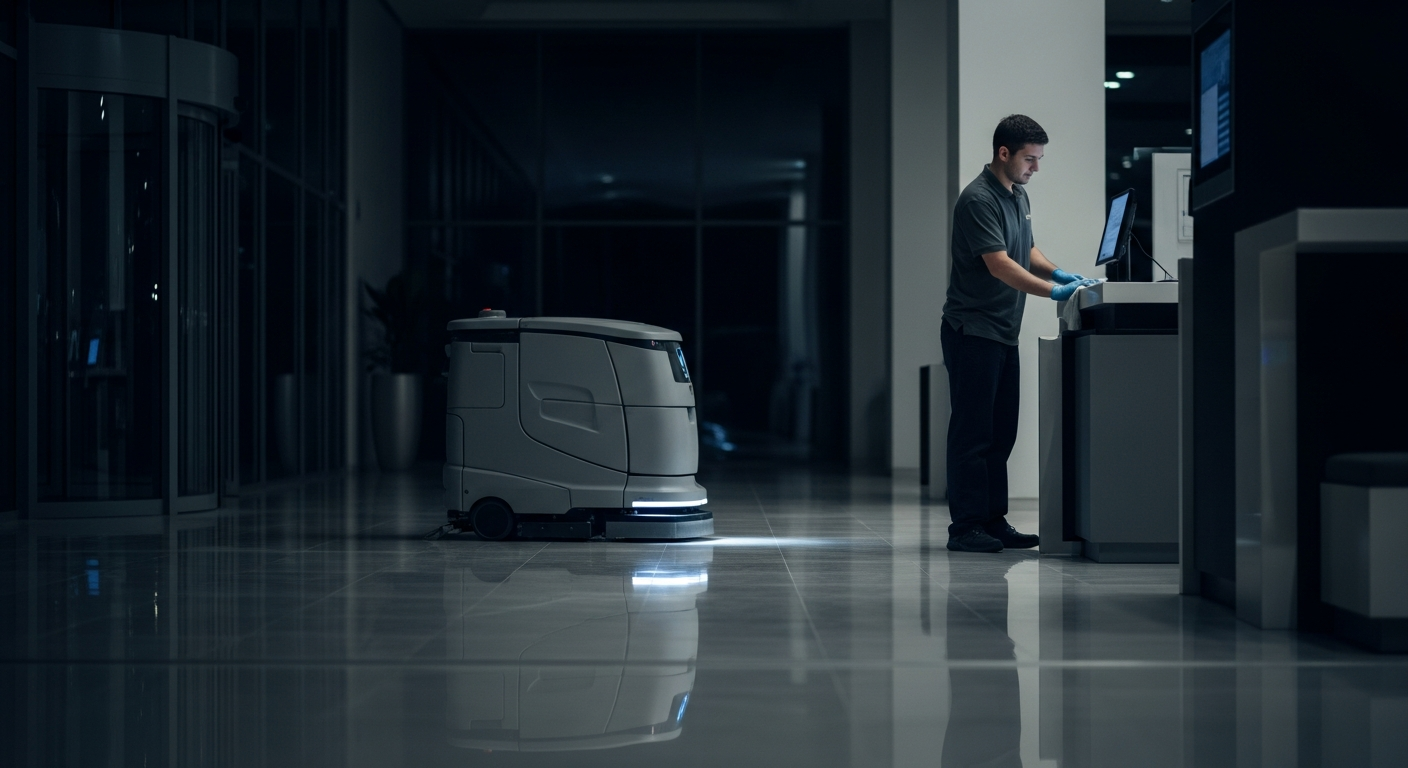
Monday, 4:30 a.m. An FM job in an office complex in Frankfurt City. While the staff is not yet on site, two autonomous cleaning robots have already processed 12,000 square meters of floor space. The sensors detect obstacles precisely, while the scrubbing and vacuum units ensure a streak-free result. What previously required hours of manual work and high personnel costs is now controlled via a central cockpit. This transition from manual cleaning to an autonomous fleet is not a technical experiment, but the result of precise system integration that translates operational processes into measurable results.
Key Takeaways
- 1Verified cost reduction of 44,000 euros per year in F&B kitchen cleaning through autonomous systems
- 2Full compliance with the EU Machinery Regulation 2023/1230 secured by the deadline of January 20, 2027
- 3Hardware-agnostic approach with access to over 44 OEMs prevents vendor lock-in and optimizes performance
The role of the system integrator in modern cleaning
In the current market landscape, facility managers are faced with an unmanageable selection of hardware manufacturers. werob does not act as a seller of a single brand, but as the key system integrator in Europe. The goal is to translate an operator's workflow into a usable robot specification within 48 hours. While traditional consulting firms take months to analyze, werob uses a spec engine that has been trained on over 35,000 projects.
A scrubber-dryer robot alone does not solve problems if it is not integrated into the existing stack. werob therefore offers ready-made connectors for systems such as SAP EWM or common PMS solutions. This makes the hardware an integral part of the operational level. The focus is always on the result. werob's commercial model is outcome-only, meaning that customers only pay when the robot is in productive use. This eliminates the financial risk of bad investments in unsuitable hardware.
Economic efficiency: 44,000 euros in cost savings per year
The economic validation of autonomous cleaning systems is carried out using hard key figures. In the F&B industry, especially when cleaning kitchen floors, companies achieve annual cost savings of 44,000 euros per location by using specialized scrubber-drying robots. This sum results from the reduction of manual work hours, optimized use of cleaning chemicals and the avoidance of downtime due to accidents on wet floors.
Compared to manual processes, robotics offers consistent quality that is independent of staff shortages or shift schedules. An FM service provider that supports 50 locations can achieve economies of scale that would not be achievable with human labor through central control via the werob Cockpit. The amortization of the systems usually occurs within the first year of operation, as we use the supplier match process to select from over 44 OEMs exactly the hardware that offers the best price-performance ratio for the specific floor condition and area size.
Hardware agnostics: The freedom of choice
A key mistake many companies make is vendor lock-in, i.e. being tied to a single robot manufacturer. werob breaks down this model. With over 280 maneuverable robots in the catalog and partnerships with leading OEMs such as Pudu, Ecovacs or Avidbots, werob offers an objective selection. The Spec Engine evaluates the requirements of the location against the technical data of the manufacturer and creates a ranking.
This agnosticism is particularly important because the requirements differ fundamentally between a hospital, a logistics center and a hotel lobby. While noise emissions and design are the focus in the hotel industry, robustness and area performance are what count in logistics. By having access to a broad portfolio, werob ensures that the selected hardware exactly fits the task. If a model proves to be suboptimal in live operation, the platform structure enables a quick change within the werob ecosystem.
Regulatory information: EU Machinery Regulation 2023/1230
An often underestimated aspect of the introduction of cleaning robots is the legal framework. From January 20, 2027, the new EU Machinery Regulation 2023/1230 will be binding. Many Asian OEMs currently do not have the necessary conformity assessments for the European market. werob acts as a compliance path here. We ensure that all systems used meet the strict security requirements before they go into operation.
In addition to the machine regulations, aspects such as the GDPR for camera-based systems, ISO 27001 for information security and industry-specific standards such as HACCP in the food sector must be taken into account. The werob Cockpit monitors these regulatory parameters in real time via a four-dimensional traffic light system. This gives operators the security that their fleet not only operates efficiently, but also in a legally compliant manner. This protects the company from liability risks and regulatory sanctions.
Technical integration and the live cockpit
The true power of an automated cleaning solution lies in its connectivity. A scrubber-dryer robot that works in isolation creates islands of data. werob integrates the fleet directly into the operator stack. Whether it's about the connection to SAP EWM for coordination with the flow of goods or integration into facility management software, werob's connectors are prefabricated and ready for use. This shortens the implementation time to just eight weeks.
The werob Cockpit serves as the central control unit. Not only are hardware status messages displayed here, but performance is also measured against the original specification. The system monitors the infrastructure, such as the availability of charging stations and water connections, as well as compliance with cleaning cycles. This visibility allows operational managers to make informed decisions and continually optimize the fleet. The cockpit is the link between the physical hardware and the digital management level.
Comparison of cleaning systems
| Criteria | Manual cleaning | Single OEM robot | werob system integration |
|---|---|---|---|
| Planning duration | Days | 3-6 months | 48 hours (Spec Engine) |
| Hardware Selection | N/A | Limited (1 brand) | 44+ OEMs (Agnostic) |
| Compliance 2023/1230 | N/A | Manufacturer dependent | Integrated Path |
| Cost Model | Labor Costs | List Price / Leasing | Outcome-only |
| Integration | None | Bespoke / Expensive | Prebuilt Connectors |
The path to an autonomous fleet: 8 steps to success
The process begins with a simple intake procedure. Werob translates the shift schedules and tasks into a technical specification within 48 hours. After five days, a concrete offer is available that is based on the supplier match. The selection of hardware is purely data-based in order to guarantee the best performance for the respective location. As soon as the decision has been made, werob takes over the entire logistics and configuration.
In the eighth week, the robot is already in use on the site. During this time, the connectors are activated in the customer's IT systems and the on-site staff are instructed. The goal is a smooth transition where the operator does not have to make any upfront investments before the system delivers measurable value. This accelerated workflow differs massively from classic consulting approaches, which often get stuck in long discovery phases.
Future security through scalability
The requirements for building cleaning are constantly changing. A system designed for a warehouse today may need to survive in a production environment tomorrow. The modular structure of the werob platform means the operator remains flexible. New robot models can be easily added while central management via the cockpit remains consistent. This is particularly crucial for growing medium-sized companies.
Werob plans to have over 2,000 robots in live operation in Europe by 2028. This scaling allows us to continually incorporate best practices from various industries into the Spec Engine. Customers therefore benefit from collective knowledge from thousands of projects. Investing in an integrated solution from werob is therefore not only an answer to today's shortage of skilled workers, but also a strategic positioning for the automated future of facility services.
FAQ
- How much does a scrubbing robot cost at werob?
- werob works according to an outcome-only model. This means there are no classic list prices. You only pay when the robot is running productively on your site and delivers the agreed service.
- How long does it take to implement a cleaning robot?
- At werob, it usually only takes eight weeks from the first specification to live operation. The specification itself is available after just 48 hours.
- Are the robots safe for use in public areas?
- Yes, all robots integrated by werob meet the necessary safety standards, including ISO 13482 for use near people and the upcoming EU Machinery Regulation 2023/1230.
- Can the robot be integrated into my existing IT?
- Yes, werob offers ready-made connectors for systems such as SAP EWM, Opera PMS, Mews and Toast to enable seamless data transfer and control.
- What maintenance do the autonomous scrubber dryers require?
- Daily maintenance such as emptying the dirty water and cleaning the brushes can usually be carried out by on-site staff. Technical monitoring is carried out remotely via the werob cockpit.
- What happens when the robot detects an obstacle?
- Modern scrubber vacuum robots are equipped with LiDAR and 3D cameras. They detect obstacles in real time, brake or avoid them autonomously to avoid collisions.
Related reading
Cleaning Robots in B2B Use: Efficiency and Compliance
Manual floor cleaning ties up valuable skilled workers in repetitive tasks. werob integrates hardware-agnostic cleaning robots into existing workflows and ensures measurable cost relief.
15 June 2026autonomous floor cleaning large areaAutonomous Floor Cleaning for Large Areas: Efficiency for FM Operators
Automating floor cleaning on large areas reduces operating costs and sustainably solves staff shortages. This is how werob, as a systems integrator, realizes the process from specification to live operation in eight weeks.
3 June 2026robot integrator MunichRobot Integrator Munich: Automation in eight weeks
werob is the hardware-agnostic system integrator for Munich companies. We translate your workflows into a usable specification in 48 hours and bring robots into live operation within eight weeks.
30 June 2026robotics integrator CopenhagenRobotics Integrator Copenhagen: Automation in 8 weeks
werob is the hardware-agnostic system integrator for robotics in Europe. We translate complex workflows into usable specifications in 48 hours and bring robots into live operation in eight weeks.
4 July 2026system integrator roboticsSystem integrator robotics: Scaling in eight weeks
A robotics systems integrator bridges the gap between OEM hardware and operational reality. werob translates workflows into usable specifications in 48 hours and integrates fleets into existing IT stacks.
5 July 2026