Cleaning Robots in Hospitals: Efficiency in Clinical Facility Management
Hospitals are under massive cost pressure while hygiene requirements simultaneously rise. Autonomous cleaning robots relieve specialist staff from repetitive floor cleaning tasks and ensure seamless documentation of cleaning cycles.
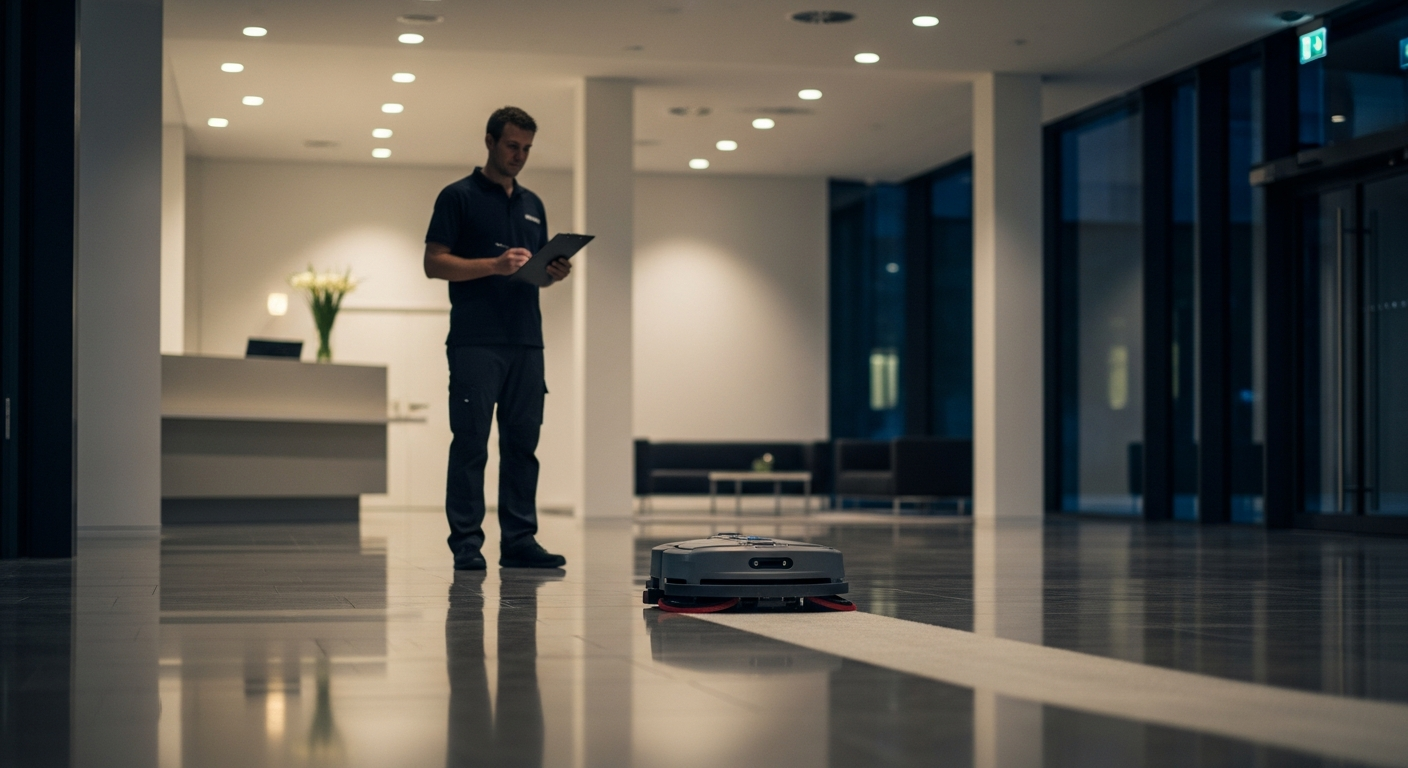
Ward 4. 3:15 AM. While the night staff prepares the medication distribution, the cleaning robot silently runs its paths through the 120-meter-long main corridor. It detects obstacles in real time and seamlessly documents every cleaned surface in the central cockpit. What used to bind valuable working hours of the cleaning team now takes place autonomously and validated. In an environment where hygiene decides over lives and the skilled labor shortage determines daily routine, robotics is no longer an experiment, but an operational necessity for modern hospital management.
Key Takeaways
- 1Hardware-agnostic selection from 44+ OEMs secures the optimal solution for every clinic zone without vendor lock-in.
- 2The EU Machinery Regulation 2023/1230 becomes mandatory from January 2027; werob offers the integrated compliance pathway for this.
- 3Verified cost relief of 44,000 euros per year in floor cleaning secures economic viability from day one.
The Operational Reality in Hospital Facility Management
Operating a hospital requires a precision that goes beyond purely medical care. Facility Management (FM) bears responsibility for germ freedom and cleanliness across thousands of square meters. Conventional cleaning procedures reach their limits here, since fluctuation among cleaning staff is high and the availability of skilled workers is low. A cleaning robot in the hospital takes over the time-intensive, large-area floor cleaning in corridors, entrance halls, and logistics areas.
This allows the human staff to focus on the critical areas that require manual disinfection, such as patient rooms or OR airlocks. werob does not see itself as a seller of individual devices, but as a systems integrator that analyzes the entire workflow. With over 200 robots in live operation and a presence in 11 European countries, werob has the necessary experience to automate complex clinic structures. The goal is measurable relief that is directly reflected in the operating cost statement.
Hardware Agnosticism: The Right Robot for Every Clinic Zone
A common mistake when introducing robotics in healthcare is focusing on a specific model from a single manufacturer. Hospitals, however, have heterogeneous requirements: the requirements for a robot in the representative entrance hall differ drastically from those in the narrow corridors of nursing wards or the sterile logistics paths of the central kitchen. werob solves this problem through a hardware-agnostic approach.
The werob catalog contains over 44 OEM partners and more than 280 different robot models, including systems from Pudu (such as the CC1), Ecovacs, or specialized industrial solutions. The werob Supplier Match algorithm ranks these options against the specific requirements of the site. Factors such as battery life, water tank capacity, climbing ability on ramps, and sensor sensitivity in busy areas are considered. This process ensures that no vendor lock-in arises and that the clinic always receives the technologically best solution for the respective use case.
The Spec Engine: From Requirement to Deployable Specification in 48 Hours
Traditional consulting projects for the introduction of robotics often take three to six months and end in extensive PDF documents without operational impact. werob has radically shortened this process. The Spec Engine translates a clinic operator's workflow into a technical specification within 48 hours. Data from over 35,000 projects feeds into this process to exclude typical sources of error already in the planning phase.
Instead of discussing abstract concepts, werob delivers a precise requirements profile that can be directly converted into an offer. Within five days, a concrete offer is available, and just eight weeks later the robot is deployed on the surface. This speed is decisive for clinics that suffer from acute staff shortages and need immediate solutions. The focus is always on the outcome: the robot must clean the defined surface in the specified time without disrupting clinical operations.
Regulation and Compliance: Security According to EU Standards
In a hospital environment, compliance with regulatory standards is not optional. Particularly critical is the EU Machinery Regulation 2023/1230, which becomes mandatory from January 20, 2027. werob acts here as a compliance pathway for operators. Many Asian OEMs do not meet the strict European requirements without additional adjustments or conformity assessments by a local integrator.
In addition, cleaning robots in hospitals must comply with the requirements of ISO 13482 for personal care robots and the strict requirements of GDPR, since camera systems are used for navigation. werob ensures that all deployed systems clear these hurdles. Information security according to IEC 62443 and ISO 27001 is also part of the integration package. The werob cockpit monitors the fleet in real time and offers a four-dimensional traffic light system that depicts hardware, infrastructure, regulation, and adherence to the specification. This way, the clinical management retains full control over compliance with all safety standards at all times.
Integration into the Operator Stack and SAP EWM
A robot that operates as an isolated point solution generates, if anything, more administrative effort than it saves. The true efficiency arises through the seamless integration into the existing IT infrastructure of the hospital. werob offers pre-built connectors into the operator stack. These include integrations with systems such as SAP EWM for logistics control or specialized FM software solutions.
Through these connectors, the cleaning robot becomes part of the digital ecosystem of the clinic. It reports full dirty water tanks directly to facility management, receives cleaning orders based on the actual use of premises, and delivers data for quality management. This depth of integration distinguishes werob from pure resellers. The robots are not just placed, but operationally integrated into the processes so that they function without manual intervention by the staff.
Economic Viability: 44,000 Euros in Cost Relief per Area
The investment in robotics must be economically justified. werob works with an outcome-only model: the customer pays only when the robot is actually running and delivering the promised performance. For the cleaning of kitchen floors and adjacent logistics surfaces in large facilities such as hospitals, verified cost relief of 44,000 euros per site and year is documented.
These savings result from the reduction of overtime, the lowering of sickness rates through physical relief, and the optimization of cleaning agent consumption. In larger hospital groups, this effect scales massively. A practical example shows that through the use of only five robots at four sites in the care sector, annual relief in the seven-digit range can be achieved. werob offers full transparency on amortization periods, without hidden costs for maintenance or software updates.
The Live Cockpit: Fleet Management for Hospital Groups
For the head of facility of a large hospital or a hospital group, an overview of all active systems is essential. The werob cockpit serves as the central control unit for the entire robot fleet, regardless of the manufacturer. It enables cross-site monitoring and reporting. If a problem occurs at a site, for example a blocked charging station or a sensor error, this is immediately signaled in the cockpit.
This system drastically reduces the need for on-site checks. The data is prepared in such a way that it can be directly used for hygiene audits or management reports. The cockpit monitors not only the technical availability but also compliance with regulatory requirements. This way, werob offers an operational layer that goes far beyond what individual robot manufacturers can deliver with their proprietary apps.
In Eight Weeks to Productive Deployment
The path to automation with werob follows a proven eight-stage onboarding process. After the initial contact, the shift schedule and the task at hand are recorded in detail. The Spec Engine creates the requirements profile from this. After the Supplier Match and the selection of the optimal hardware, the integration of the connectors into the IT stack of the hospital follows.
Within eight weeks, the system is ready for deployment. This tight timeline is possible because werob relies on standardized processes and in-depth expertise in system integration. Clinics such as Korian Germany already use this approach successfully to realize double-digit cost relief in the first year. Entry takes place without financial risk, as the commercial model is based on the actual success of the implementation. Start your spec in 48 hours at werob.de/onboarding.
FAQ
- Which areas in the hospital can cleaning robots take over?
- Cleaning robots are excellent for public areas, long corridors, entrance halls, cafeterias, and logistics paths. In these zones, floor cleaning is repetitive and time-intensive. Sensitive areas such as operating rooms still require specialized manual disinfection procedures, although robots can be used here as support for floor cleaning after sterilization.
- How safe are the robots in busy hospital corridors?
- Modern cleaning robots use LiDAR, 3D cameras, and ultrasonic sensors to detect obstacles such as patients, beds, or medical equipment within milliseconds. They safely stop or drive around the obstacle. werob ensures through compliance with ISO 13482 that the interaction between humans and machines takes place safely.
- Is integration into existing IT systems complicated?
- No, werob offers pre-built connectors for common systems such as SAP EWM or FM software. The integration is carried out within the eight-week implementation process by werob experts, so that no high technical in-house effort arises for the clinic operator.
- What happens in case of technical malfunctions of the robot?
- The werob cockpit monitors all robots in real time. Malfunctions are immediately reported and can often be resolved remotely. Since werob works in a hardware-agnostic manner, the exchange of components or entire devices via the partner network is also quick and uncomplicated.
- Do the robots meet the strict hygiene regulations in Germany?
- Yes, the systems integrated by werob are designed for use in hygienically demanding environments. They support seamless documentation of cleaning runs, which is essential for audits and compliance with hygiene plans. They can also be equipped with special disinfection modules.
- How high are the acquisition costs for a cleaning robot?
- werob pursues an outcome-only model. This means that the commercial structure is based on the success of the solution rather than on high upfront investments for hardware. This preserves the clinic's budget and ensures that costs are only incurred when the operational relief is realized.
Related reading
Cleaning Robot Clinic Provider: System Integration for Daily Clinical Operations
The selection of the right cleaning robot for clinics often fails due to hardware fixation. werob solves this problem as a systems integrator through a 48-hour specification and manufacturer-independent ranking of over 44 OEM partners.
16 June 2026cleaning robotsCleaning Robots in B2B Use: Efficiency and Compliance
Manual floor cleaning ties up valuable skilled workers in repetitive tasks. werob integrates hardware-agnostic cleaning robots into existing workflows and ensures measurable cost relief.
15 June 2026facade cleaning robotFacade Cleaning Robot: Automation for Facility Management
Manual facade cleaning is risky and cost-intensive. werob translates your requirements into a deployable robotics specification in 48 hours and delivers measurable results within eight weeks.
5 June 2026autonomous floor cleaning large areaAutonomous Floor Cleaning for Large Areas: Efficiency for FM Operators
Automating floor cleaning on large areas reduces operating costs and sustainably solves staff shortages. This is how werob, as a systems integrator, realizes the process from specification to live operation in eight weeks.
3 June 2026robotic hull cleaning biofoulingRobotic hull cleaning: biofouling, fuel and the rules in port
What growth on the hull really does to fuel consumption, what the IMO framework actually requires, where in-water cleaning is permitted, and what separates a system with capture from one without.
22 July 2026