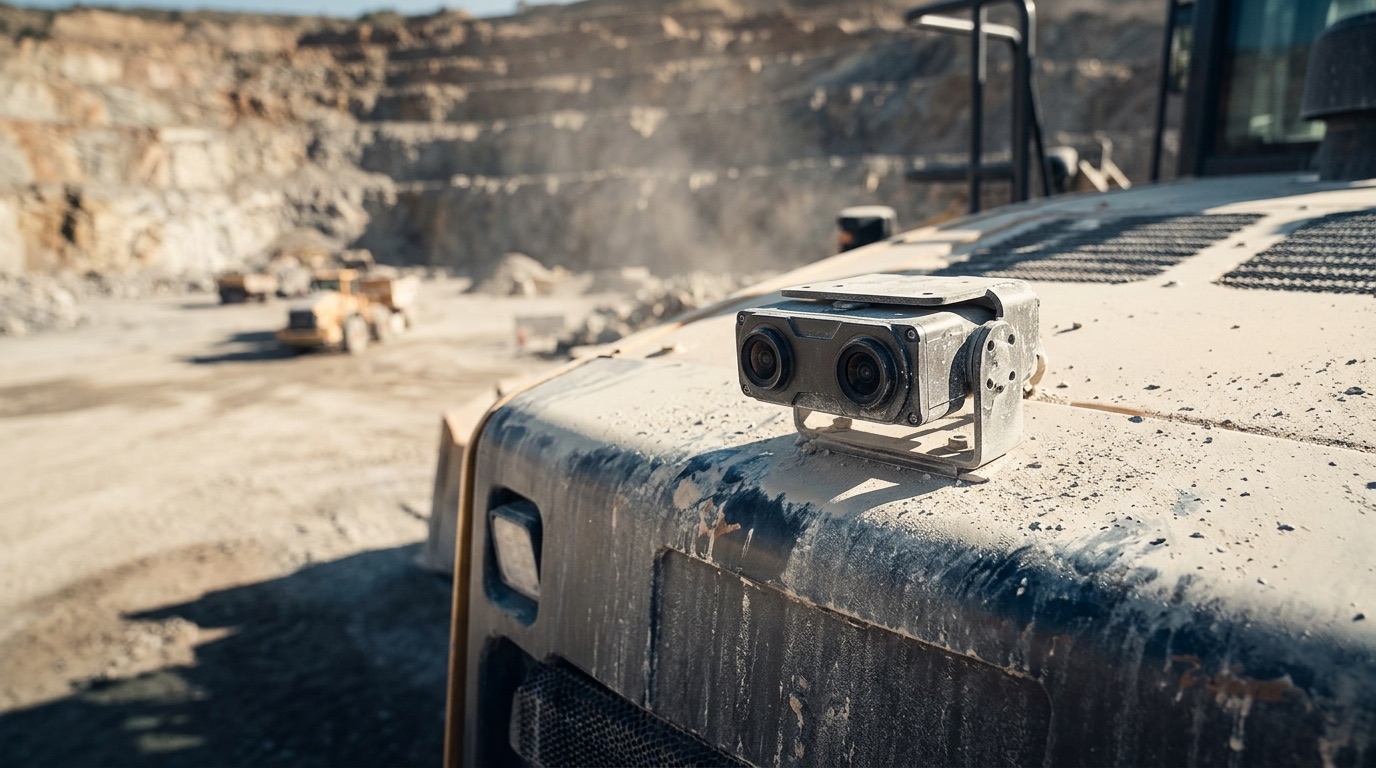
Pedestrian detection on excavators and wheel loaders: what the camera is documented to do, and what no datasheet says
Two routes lead today to a camera on the back of a construction machine that tells a person from a pallet: a brand-independent retrofit kit that has been in series production for years, and a factory option that brakes a wheel loader to a standstill on its own. Both manufacturers document what their system detects and where it runs. Neither documents at what distance, in how many milliseconds, or to what safety level. That is exactly where the site walk begins.
The question whether an older construction machine can be retrofitted with camera sensing has a short answer: yes, for years, and the best-known retrofit kit is brand-independent. The longer answer begins after that. What such a camera detects can be read on the manufacturers' product pages; what it does not detect, at what distance it reacts and how fast, is not there, and for the safety function behind it none of the pages read names a safety level. This article sets two documented systems side by side, the Blaxtair retrofit kit and Liebherr's active personnel detection with brake assistant for wheel loaders, records what both manufacturers commit to in writing, and derives from that the questions an operator asks before ordering. It is an article about two datasheets, not about a test.
Key Takeaways
- 1Blaxtair is a camera with embedded AI that, according to its maker, detects and locates pedestrians in any posture, standing, crouching or partly hidden, in real time, computes on board, is compatible with all makes and types of excavators and wheel loaders and is retrofitted as a plug-and-play system; the sensor is rated IP69K with a temperature range of minus 40 to plus 85 degrees.
- 2Liebherr's active personnel detection for wheel loaders, with a brake assistant since April 2021, distinguishes according to the maker between persons and objects in the rear area without transponders, warns at a greater distance for persons than for obstacles, and brakes the machine to a standstill; every warning sends a GPS point into the manufacturer's LiDAT system, from which a hazard map of the site is built.
- 3None of the product pages read gives detection range, reaction time, false-alarm rate, behaviour at night and in rain, or a performance level to ISO 13849 for the braking function. Those are the numbers an acceptance needs, and they come from a demonstration on the operator's own site or from the contract, not from the datasheet.
- 4The question about the images belongs before the order: a system that detects on board and stores nothing is a different data-protection case from one that uploads events with images to a cloud. Blaxtair offers cloud connection as an add-on product; what is transmitted has to be in the contract.
- 5The detection part is learned, the reaction is deterministic: warning tone, display, braking. That split is the same one that applies to every learned component on a machine, and it is the reason the safety function needs its own evidence, which the camera does not supply.
Two routes, the same task
The task is the same on every site: behind a wheel loader or beside an excavator stands a person the driver cannot see from the cab, and the machine should know that before the driver does. Two documented routes lead there. The first is a retrofit. Blaxtair, a product of the French manufacturer Arcure, is a camera with embedded artificial intelligence that the maker has had in the field since 2009 and that, by its own account, is compatible with all makes, sizes and types of excavators, wheeled or tracked, and likewise with wheel loaders and forklifts. The second route is a factory option. Liebherr offers active personnel detection for its mid-sized wheel loaders and extended it in April 2021 with a brake assistant and a hazard map; the trade press reported on it on 7 April 2021.
Both routes solve the same task with the same basic idea, a camera whose analysis distinguishes persons from objects, and they differ in almost everything that matters for procurement: whether the machine is already in the yard or still to be ordered, whether the reaction is a warning or a braking intervention, and where the data goes. This article reads both manufacturers' product pages as of September 2026, and only those.
What Blaxtair commits to in writing
Blaxtair's product pages call the camera the only on-board AI system that accurately detects and locates pedestrians in real time; that is a manufacturer's claim and is reported here as one. Documented is detection in any posture, standing, crouching or partly visible, forwards as well as in reverse. Processing runs on board; a cloud is not required for detection itself. The sensor is rated IP69K with an operating temperature range of minus 40 to plus 85 degrees Celsius, designed for strong vibration and impacts. The maker describes installation as plug-and-play, compact and simple. Around pedestrian detection, Arcure offers further modules under the same name: detection of specific obstacles, vehicle detection, shock detection, a zoning function, a checklist function, a perception technology for original equipment manufacturers, and a cloud-based IoT connection called Blaxtair Connect, which the maker says divides the coexistence of vehicles and pedestrians by three. That too is a manufacturer's figure without a published method.
That is an honest list, and it is honest also in what it leaves out. On the pages read there is no detection range in metres, no reaction time in milliseconds, no statement on detection performance in darkness, rain or backlight, no false-alarm rate, no statement on whether and for how long images are stored, and no standard or certification for the function. A system designed to warn the driver need not state any of that; an operator who procures it still needs to know.
What Liebherr commits to in writing
Liebherr's active personnel detection warns the operator, according to the maker, visually on the display and acoustically of hazards in the rear area of the wheel loader. To warn specifically of injury to persons, the assistance system automatically distinguishes between persons and objects, using camera technology and without persons having to carry transponders or transmitters; for persons it warns at a greater distance than for static obstacles such as walls or pillars. The brake assistant added in 2021 automatically slows the machine as soon as personnel detection identifies a hazard in the rear area, down to a standstill, and so intervenes earlier than a driver whose reaction time is removed from the chain. The second extension is the hazard map: every time the system detects a hazard and warns, it transmits a GPS point to Liebherr's data transmission and location system LiDAT, and the operator receives from that a map of those points showing where on the site the warnings cluster.
This description too leaves out what an acceptance would need: no distance at which braking begins, no deceleration in metres per second squared, no performance level or category to ISO 13849 for the braking function, no statement on whether the machine reacts differently to a warning in forward travel, and no statement on whether images are stored or only event points transmitted. The hazard map is the detail that raises the data question: one GPS point per warning is an event without an image, and whether it stays that way the description does not say. Whether the function is standard equipment or an option, and whether it can be retrofitted to older machines of the series, is likewise not clear from the coverage read; that is a question for the dealer.
The numbers that are in no datasheet
Set the two descriptions side by side and a list emerges of what is missing for the decision and can only be had on site or in the contract. Range: from what distance a person is detected, standing and crouching, and from what distance the system warns or brakes. Time: how long passes between detection and warning, and with the factory option between detection and the start of braking. Light: what is detected at night, in low sun, with rain on the lens and in dust; the IP69K rating says the sensor survives that, not that it then sees. False alarms: how often the system triggers on puddles, traffic cones, fence panels or a discarded overall, because a driver warned ten times a day for nothing stops listening after a week. And safety level: for a function that brakes a machine on its own, the question of the performance level to ISO 13849-1 is not a formality but the difference between a comfort function and a safety function, and none of the pages read answers it.
The route to those numbers is the same as for any machine with sensing: a demonstration on the operator's own site, in its own light, with its own load carriers and an employee in its own high-visibility clothing, crouching behind the rear; and a contract that records the values the demonstration produces as warranted properties. A datasheet that does not state the numbers is not a failing of the manufacturer. It is an instruction to measure them.
The question about the images
A camera that detects people is not a camera that identifies people, and that difference carries the decision whether such a system on a construction site is a data-protection matter or not. Both manufacturers describe their systems as on-board detection: the analysis establishes that a person is in the danger zone, not who. As long as nothing is stored and nothing transmitted, it stays that way. The case changes with every add-on that sends events outward: Blaxtair Connect is described as a cloud-based IoT solution, and Liebherr's hazard map transmits one GPS point per warning into LiDAT. Whether an image goes with it, a crop, only a coordinate or only a counter, none of the sources read says, and that is exactly the question that goes to the supplier before the order and belongs in the contract.
The answer decides who in the company has to be involved. A system that detects on board and only warns affects the employees on the site no differently from a reversing alarm. A system that transmits events with images to a cloud captures employees at their workplace, and the assessment then belongs to the data protection officer and, where there is one, to the works council, before the first machine drives with it. This article does not make that assessment; it records that it depends on a contract clause the datasheets leave open.
Learned detection, deterministic reaction
Both systems share the same architecture, and it is worth naming because it decides the evidence. The detection part is learned: a model decides from camera images whether the object behind the machine is a person. The reaction is deterministic: warning tone, display, and with Liebherr a braking sequence by fixed rules. For the learned part there is no enumerable list of cases to accept; one can only cover scenarios, crouching, half hidden, in backlight, and document the coverage. For the deterministic part the rules of machinery safety apply, and for a braking intervention that means the function itself needs evidence that does not follow from the camera's detection rate.
That is not a peculiarity of these two products. It is the split that applies to every learned component on a machine, and it is the reason a personnel detection that detects well is not yet a safety function that brakes well. Anyone buying both in one purchase is buying two pieces of evidence, and the second is in none of the product descriptions read.
What an operator does with this
For an existing fleet the retrofit is the route, and the question is not whether it works but which numbers the demonstration on the operator's own site produces and whether they are in the contract. For a new purchase the factory option is the route if the manufacturer offers it for the series in question, and the question is then whether the braking function is evidenced as a safety function or sold as assistance. In both cases the question about the images goes before the order. werob is a manufacturer-independent systems integrator; Arcure and Liebherr appear here as publicly documented market examples and not as confirmed partners, and werob has neither accepted nor measured either system. What werob records in a specification for a site are the scenarios the demonstration has to cover and the values the contract should warrant; the measurement itself takes place on the operator's site.
Limits: what is documented here and what is not
The Blaxtair details come from the product pages of the manufacturer Arcure (category pages for excavators and loaders, product page for pedestrian detection), read in September 2026; manufacturer claims such as the only system of its kind or the division by three are marked as such and unverified. The Liebherr details come from trade-press coverage of 7 April 2021 of the brake assistant and hazard map for the mid-sized wheel loader series; series designations, equipment status and retrofittability were not verified with the manufacturer. None of the sources gives range, reaction time, false-alarm rate, image storage or a performance level; where this article names those quantities it names them as missing, not as measured. No measurement, acceptance or customer project of werob's underlies this article, and no figure on this page is werob's own.
FAQ
- Can I retrofit an older excavator or wheel loader with a pedestrian-detection camera?
- Yes. Blaxtair by Arcure is, according to the maker, compatible with all makes, sizes and types of excavators and wheel loaders and is retrofitted as a plug-and-play system; detection runs on board. What is detected on your own site, at what distance and how fast, has to be shown in a demonstration; the datasheet does not state it.
- What does Liebherr's active personnel detection do differently from a retrofit camera?
- It is a factory option for Liebherr wheel loaders and since 2021 intervenes in the machine: the brake assistant slows it to a standstill as soon as a person is detected in the rear area, and every warning sends a GPS point into the manufacturer's LiDAT system, from which a hazard map of the site is built. A retrofit kit warns the driver; it does not brake.
- Which numbers are missing from the datasheets?
- Detection range, reaction time, behaviour at night, in rain and in backlight, false-alarm rate, statements on image storage, and a performance level to ISO 13849-1 for the braking function. Those values come from a demonstration on the operator's own site and belong in the contract as warranted properties.
- Is a pedestrian-detection camera a data-protection matter?
- As long as it detects on board and only warns, no: it establishes that a person is in the danger zone, not who. As soon as events with images are transmitted outward, for instance into a cloud connection, employees at their workplace are captured and the assessment belongs to the data protection officer. Whether an image goes with it, none of the sources read says; that is the contract question.
- Is a good detection rate enough as safety evidence?
- No. The detection part is a learned model whose coverage you document; the reaction, especially a braking intervention, is a deterministic function that needs its own evidence under the rules of machinery safety. Both pieces of evidence are to be demanded separately; none of the product pages read supplies the second.
Related reading
Retrofit vs Replace: SoftBank's Signal for Excavators
SoftBank's $200 million investment in Gravis Robotics signals a shift toward retrofitting existing heavy excavators with autonomous AI kits.
18 August 2026cleaning robot sensors lidar depth camera limits20 millimetres and a glass wall: what a cleaning robot's sensors are documented not to see
A catalogue scrubber-dryer robot drives on a 2D laser scanner, 3D depth cameras, an RGB camera and drop sensors. The datasheet gives one number to go with them: obstacles from 20 millimetres in height. What lies below that, what is made of glass and what is black is not in the datasheet, but it is in two measurement studies anyone can read.
14 September 2026uas defense detection tracking and mitigation methodsUAS defense: detection, tracking, and mitigation methods
Explore how modern Counter-Unmanned Aircraft System (C-UAS) technology integrates radar detection, optical tracking, and non-kinetic mitigation methods.
6 August 2026retrofit autonomy kits investment trendRetrofit Autonomy: Why Capital Backs Kits Over New Machines
Discover why capital is flowing to retrofit autonomy kits over new machines, with a deep dive into the recent Gravis Robotics and Mariana Minerals deals.
18 August 2026