Multi Robot Coordination Platform: Efficiency for Fleets
The management of different robot models often fails due to isolated systems. A central multi-robot coordination platform closes the gap between hardware and operational processes.
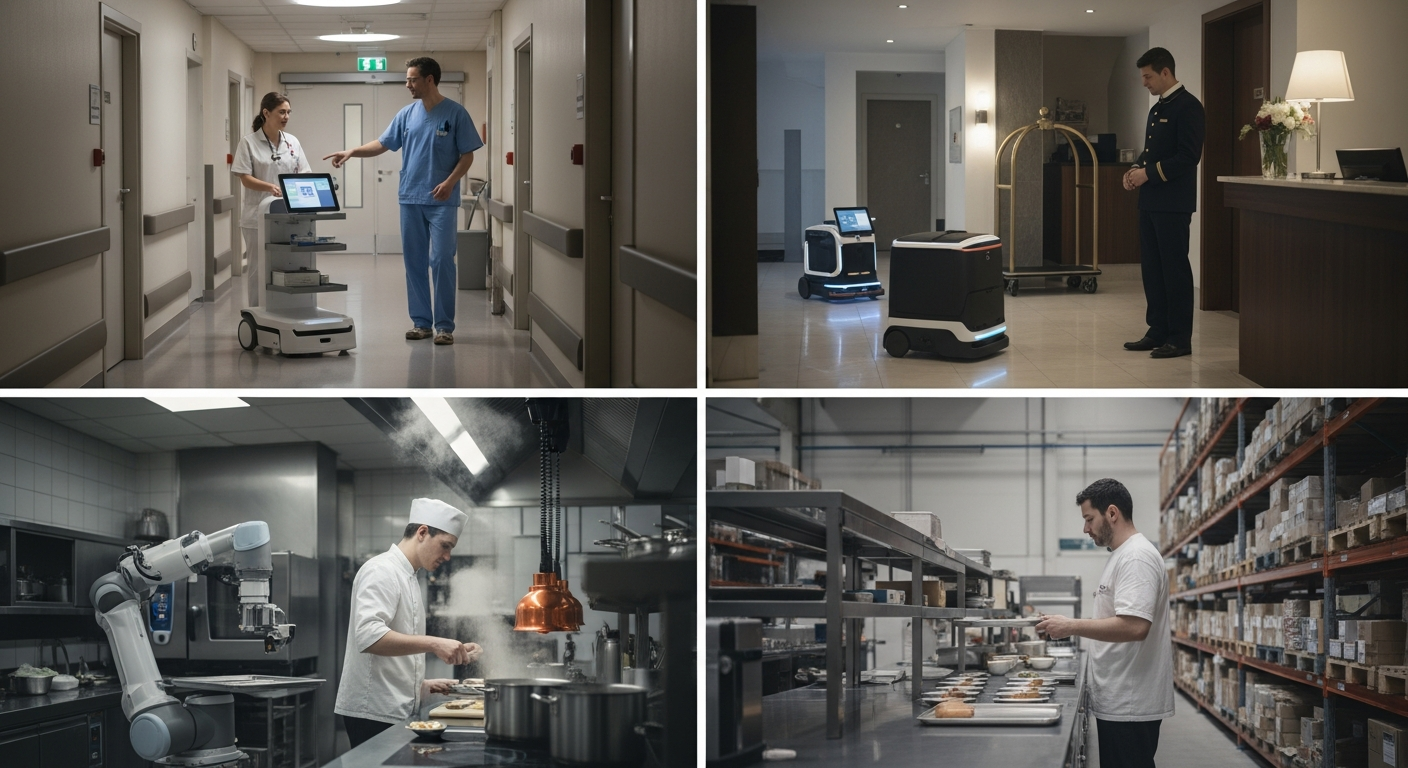
Station 4. 3:15 a.m. A transport robot delivers fresh laundry while a cleaning robot mops the hallway. Both machines come from different manufacturers. Without an overarching multi-robot coordination platform, they would block each other or require manual intervention. At werob we see this scene every night in over 200 live companies in 11 European countries. We are not a robot manufacturer, but rather the system integrator that translates your workflow into a usable specification in 48 hours. Manage heterogeneous fleets while maintaining full control over your operational costs.
Key Takeaways
- 1Hardware agnostics prevents vendor lock-in and provides access to 44+ OEMs and 280 robot models.
- 2Integration into the operator stack (SAP, Opera, Mews) is crucial for measurable cost reductions of up to €112,000 per year.
- 3The EU Machinery Regulation 2023/1230 makes a professional compliance path mandatory for all operators from January 2027.
The need for cross-vendor control
In modern business management, it is no longer enough to view a single robot as an isolated solution. Companies in the care, hotel or logistics industries face the challenge that different tasks require different hardware. A robot that carries out medication rounds in a nursing home has different technical requirements than a device that transports dirty laundry. This is where the Multi Robot Coordination Platform comes in. It is the brain behind the individual machine apps.
The main problem for many operators is the so-called vendor lock-in. Anyone who relies on the software of a single manufacturer is tied to their hardware. werob breaks down this model. With over 44 OEM partners in the catalog and the ability to shunt 280 different robot models, we offer a hardware-agnostic solution. A multi-robot coordination platform ensures that a Pudu robot in the kitchen knows where the Keenon robot in the hallway is currently standing. This prevents collisions and optimizes lead times in real time.
Users also ask: What is the advantage of a manufacturer-independent platform? The biggest advantage is flexibility. When a new, more efficient robot comes onto the market, it can be integrated into the existing fleet without replacing the entire software infrastructure. This protects investments and ensures scalability across different locations.
The four levels of the werob platform for fleet management
Controlling a fleet of robots requires more than just a WiFi connection. werob has developed a four-stage architecture to shorten the path from idea to live operation. The first level is the Spec Engine. Here, your workflow, such as the medication round at 10 p.m., is translated into a technical specification. For us, this process only takes 48 hours, whereas traditional consulting firms often need months for this. The engine is trained on data from over 35,000 projects.
The second level is the supplier match. Based on specification, we rank the best solutions from our catalog of 44+ OEMs. You don't receive a standard product, but the machine that exactly fits your floor covering, your door widths and your elevators. The third level is the connectors. These pre-built integrations connect the robots directly to your operator stack, be it PointClickCare in care or SAP EWM in logistics.
The fourth and crucial level for daily operations is the cockpit. This is where the actual multi-robot coordination takes place. A four-dimensional traffic light system monitors hardware, infrastructure, regulations and compliance with the specification. If a robot is stuck on floor 3, the cockpit reports this immediately before there are delays in operations. This transparency is the prerequisite for the cost reduction we have achieved, for example €92,000 per year for medication rounds in nursing care.
Integration into the operator stack: SAP, Opera and more
A robot that does not communicate with the rest of the IT system is just an expensive isolated solution. A powerful multi-robot coordination platform must be deeply integrated into the existing systems. werob supplies ready-made connectors for this. In the hotel industry this means a direct connection to Opera PMS or Mews. When a guest orders an additional pillow through the system, that order is automatically delegated to the available room service robot. This leads to a verified cost reduction of €112,000 per location and year in the area of hotel room service.
In logistics and facility management, the connection to SAP EWM or Genetec is crucial. The platform not only coordinates movement, but also data exchange. A security robot that patrols stores its sensor data directly in the building's security system. This integration eliminates manual interfaces, which are often error-prone and expensive.
Users also ask: How secure is the data on a cloud platform? werob relies on the highest security standards such as IEC 62443 for industrial cybersecurity and ISO 27001. Since we operate in 11 European countries, GDPR compliance is an integral part of our connectors. Data sovereignty always remains with the operator, with all results backed up with full source tracking down to the document level, while the platform only processes the necessary telemetry data.
Regulatory information: The EU Machinery Regulation 2023/1230
An often underestimated aspect of multi-robot coordination is legal security. From January 20, 2027, the EU Machinery Regulation 2023/1230 will be binding. This regulation places high demands on conformity assessment, especially when robots from different manufacturers work in a common system. werob acts as your compliance path here. We ensure that the entire fleet complies with European safety standards.
Especially with Asian OEMs, who often supply excellent hardware but do not reflect the complex EU regulations in detail, a local system integrator like werob is indispensable. We assume responsibility for regulatory acceptance as part of our cockpit. This also includes specific requirements such as ISO 13482 for service robots in the direct human environment, which is particularly relevant in the care and hotel industries.
Without a central platform that maintains this compliance data, operators risk severe penalties or the shutdown of the fleet in the event of accidents or inspections by home inspectors. werob integrates regulatory monitoring directly into live management. This means you can see the compliance status for each individual device in your fleet in the cockpit at any time. This is an essential part of our promise: You only pay when the robot runs safely and compliantly.
Economic efficiency: Verified cost relief through fleets
The use of a multi-robot coordination platform is not an end in itself, but must be economically viable. werob focuses on the measurable success of the implementation, so that the investment correlates directly with operational productivity. By centrally controlling and optimizing processes, our customers achieve significant savings that go far beyond the pure purchase costs of the hardware.
In care, a coordinated fleet massively relieves the burden on staff. Eine automatisierte Medikamentenrunde spart pro Standort und Jahr rund 92.000 €. Simply transporting goods within a facility brings a further €71,000 in relief. In the catering industry, the use of tray bots in the dishwashing chamber results in savings of €76,000 annually. These numbers are not estimates, but are based on our 200 live operations, including at a leading European nursing home operator.
Users also ask: How is the ROI of a robot fleet calculated? The return on investment results from the difference between the operating costs of the platform and the saved working time of the specialist staff, who are now available for value-adding activities. Since werob does not add list prices for hardware, but rather focuses on the success of the integration, the projects usually pay for themselves in the first year. In the hotel industry we see savings of €54,000 per year on bar and breakfast preparations.
The path to the fleet in eight weeks
Speed is a crucial competitive advantage. While classic automation projects often take 12 to 18 months, werob brings robots into live operation in eight weeks. This process begins with the 8-step onboarding. You will receive a finished specification of your workflow within 48 hours. After five days, you will have a binding offer based on the supplier match from 44+ OEMs.
The implementation phase uses our prefabricated connectors to connect the multi-robot coordination platform to your IT without lengthy programming. In week 8 the first robots will roll onto your site. An example of this is a nursing facility in Hamburg, where we brought the first humanoid pilot project into full operation within 12 weeks. This speed is only possible because we rely on a standardized platform instead of viewing each project as an individual development.
Users also ask: Can I start small and scale later? Yes, that is the core of our philosophy. Many customers start with two or three robots for a specific task. As soon as the processes are running stably and the cost reduction becomes visible in the cockpit, the fleet can be easily expanded via the platform. Since werob is already operational in 11 countries, we also seamlessly support the international rollout for hotel chains or logistics groups.
Comparison: Single system vs. werob multi-platform
To illustrate the advantages of central coordination, a direct comparison with conventional approaches helps. Many operators initially try to buy robots directly from the manufacturer and control them via their app. However, this quickly leads to operational dead ends as soon as a second manufacturer comes into play or deep system integration becomes necessary.
| Feature | Single system (OEM app) | werob Multi-Platform |
|---|---|---|
| Hardware selection | Tied to one manufacturer | 44+ OEMs, 280 models |
| Integration depth | Mostly only isolated app | Direct connectors (SAP, Mews, etc.) |
| Fleet logic | No cross-manufacturer planning | Central coordination & collision protection |
| Compliance | Operator's own responsibility | EU 2023/1230 path included |
| Cost model | High upfront investment / list price | Outcome-only (payment if successful) |
This comparison shows that the multi robot coordination platform shifts the risk from the operator to the system integrator. While you bear full responsibility for the function and integration with an individual purchase, werob guarantees operational success. This is particularly important for companies that do not want to build their own highly specialized robotics department, but are looking for a turnkey solution to their operational problems.
Case studies: success in practice
The theory of the multi robot coordination platform proves itself in practice every day. A prominent example is a leading European nursing home operator. In this care scenario, we were able to achieve double-digit cost savings in the first year. By coordinating different types of robots for transport and cleaning, the staff was freed from repetitive tasks. The cockpit provides the necessary data for home supervision and management to prove the success of the measure in black and white.
Another example is the use in a Hamburg care facility, where we integrated the world's first humanoid robot into the regular operation of a ward. In week 12 of operation, it became clear that acceptance among staff and residents increased because the robot was perfectly integrated into the shift schedules thanks to the central platform. He did not act as a foreign body, but as a digital colleague whose tasks were clearly defined and could be controlled at any time via the cockpit.
These cases show that the technological maturity is there. The limiting factor today is no longer the hardware from OEMs such as Boston Dynamics or Keenon, but the ability to coordinate this hardware in a meaningful way. werob closes this gap as largest system integrator in Europe. With the goal of having over 2,000 robots in live operation by 2028, we are continually expanding the platform to map even more complex scenarios in logistics and facility management.
Future security through RaaS and outcome-only
Investment in robotics is often held back by fear of outdated technology. A multi-robot coordination platform in conjunction with a Robotics-as-a-Service (RaaS) model solves this problem. Since werob operates in a hardware-agnostic manner, we can adapt the fleet to technological progress at any time. When a new sensor or more efficient drive becomes available, it becomes part of the next hardware cycle without having to reinvent software integration.
Our commercial model is radically focused on customer success. Our model ensures that the success of the integration comes first. This eliminates the financial risk of pilot projects that fizzle out. We only earn money if our platform actually delivers the promised cost relief, be it the €68,000 for yard patrol in logistics or the €38,000 for ball collection on the golf course.
The Multi Robot Coordination Platform is the foundation for any serious automation strategy. It offers the necessary flexibility, security and cost-effectiveness to survive in a dynamic market environment. Start your specification in 48 hours and let us take the efficiency of your operational processes to a new level together. As a partner at a Big Four consultancy reported, due diligence could be shortened from three weeks to five days by using specialized analysis platforms - werob brings this efficiency to your live operations in eight weeks.
FAQ
- How much does it cost to use the werob platform?
- Pricing is based on the individual project scope and operational success. For details, please arrange a demo appointment.
- Which IT systems can be connected?
- We offer pre-built connectors for PointClickCare, MatrixCare, Opera PMS, Mews, Toast, Lightspeed, GolfNow, Genetec and SAP EWM.
- How long does it take to implement a robot fleet?
- It usually takes eight weeks from the first specification to live operation. The technical spec is created within just 48 hours.
- Is the platform compliant with the new EU Machinery Regulation?
- Yes, werob offers an integrated compliance path for the EU Machinery Regulation 2023/1230, which is binding for all operators in Europe from January 20, 2027.
- Can robots from different manufacturers be controlled at the same time?
- This is the core function of our multi robot coordination platform. We coordinate heterogeneous fleets from over 44 different manufacturers centrally via our cockpit.
- In which countries does werob operate?
- We currently operate over 200 robots in 11 European countries including Germany, Austria, Switzerland, France, Italy, Spain, Netherlands, Denmark, Sweden, Poland and the UK.
Related reading
Robotics platform for operations: integration instead of hardware
A modern robotics platform is much more than a control unit for individual machines. It acts as an operational layer that combines hardware agnostics, regulatory compliance and deep software integration in one system to realize measurable cost reductions.
5 July 2026multi tenant robot connector platformMulti-tenant robot connector platform for companies
Companies do not need isolated robot solutions, but rather an integrated operational level. A multi-tenant robot connector platform enables the central control of heterogeneous fleets across different locations.
25 June 2026rbac robotics platform ssoRBAC Robotics Platform SSO: Security for fleets
Scaling robot fleets requires centralized identity management. Learn how RBAC and SSO increase operational security and reduce administrative hurdles in multi-OEM scenarios.
27 June 2026learned robot policy acceptanceLearned Robot Policies: Acceptance and the Safety Case
You can accept a deterministic AMR route by route. You cannot do that with a learned policy. What therefore belongs in the specification, the acceptance protocol and the contract.
31 August 2026VDA 5050 mixed fleetVDA 5050 and the mixed fleet: what the standard covers and what it does not
Running two OEMs in one building does not make their robots cooperate. What VDA 5050 actually standardises, what its own Scope section excludes, and the list you have to agree in writing.
28 August 2026