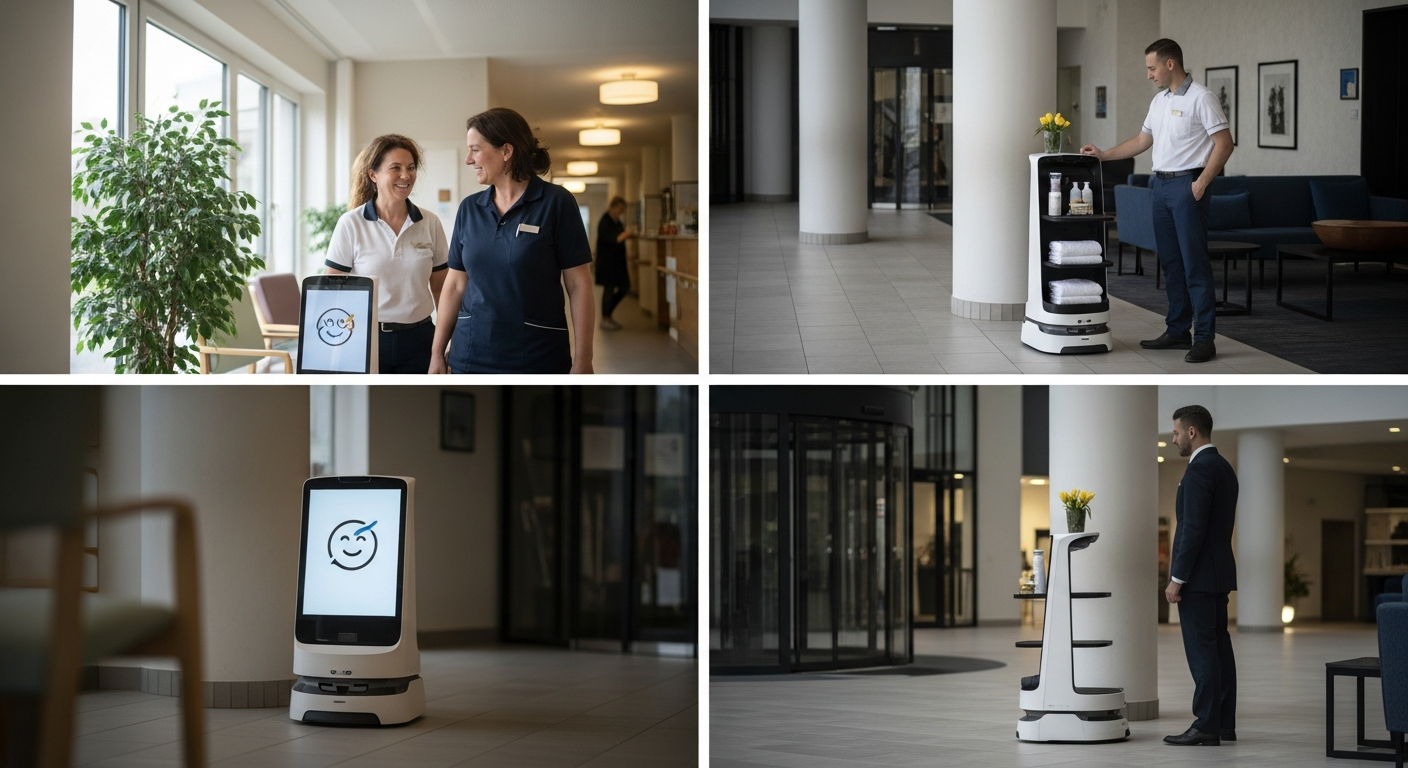
Robot integrator comparison Germany: Efficiency instead of advice
Anyone who wants to use robots in Germany faces a confusing market of manufacturers and consultants. This comparison shows why a hardware-agnostic systems integrator is the only solution for scalable fleets and true cost relief.
Hamburg, 4:00 a.m. The medication round begins in a nursing facility. While the staff concentrates on the residents, an autonomous transport robot moves silently through the hallways. He brings the prepared boxes from the station to the distribution point. No technician is on site, no Discovery deck is on the table. The robot works because it is part of an integrated system. In Germany, many robotics projects fail because of the interface between hardware and operations. Anyone comparing robot integrators must differentiate between mere hardware sales and true operational integration. werob now operates with 200 robots in 11 European countries and shows that scaling is not a technical problem, but an integrative one.
Key Takeaways
- 1Hardware agnostics protects against vendor lock-in with access to 44+ OEM partners
- 2Pre-built connectors for SAP, Opera and MatrixCare enable ROI in 8 weeks
- 3The EU Machinery Regulation 2023/1230 makes professional integration mandatory from 2027
The market of robot integrators in Germany
The German robotics market has changed fundamentally in the last 24 months. In the past, specialized plant manufacturers for the automotive industry dominated the field. Today, operators in the care, hotel and logistics industries are looking for solutions that work without months of planning. When comparing robot integrators in Germany, three main categories can be identified. First, the OEM resellers who are tied to a single manufacturer. Secondly, the classic consulting firms, which develop strategies but do not take operational responsibility for the hardware. Thirdly, the modern system integrators like werob.
A real system integrator is not a manufacturer. It is the operational level that translates the operator's workflow into a technical specification. werob uses a spec engine for this that was trained on data from over 35,000 projects. The goal is not to sell a specific machine, but to solve an operational task. With 200 robots in live operation (as of May 2026), werob has proven that this approach massively reduces the error rate during introduction. While conventional projects often get stuck in the pilot phase, werob aims for productive use from week eight.
Hardware agnostics as a decisive competitive advantage
A critical point when comparing integrators is hardware dependency. Many providers in Germany are exclusive partners of brands such as Keenon, Pudu or Boston Dynamics. This limits the operator’s flexibility. If the requirements for load capacity or sensor technology increase, the single-OEM reseller does not offer an alternative. werob, on the other hand, is hardware-agnostic. The catalog contains over 44 OEM partners and more than 280 different robot models that are available for ranking.
This approach protects operators from vendor lock-in. werob's Spec Engine evaluates the requirements of a location and matches them against the entire portfolio. Whether a humanoid robot from Apptronik or a service robot from Unitree is the best choice depends solely on the specification of the workflow. In practice, this means: If a hotel needs room service robots, the top models on the market are objectively compared. The result is a solution that fits exactly technically and is regulatory-secure. At werob, this process only takes 48 hours, while the classic market often requires three to six months.
Integration into the software stack: SAP, Opera and MatrixCare
A robot that does not communicate with the existing software is an isolated solution. It causes more work than it takes away. The most important differentiator in a robot integrator comparison in Germany is therefore the depth of the software integration. werob delivers prefabricated connectors to the relevant systems in the target industries. These include PointClickCare and MatrixCare for care, Opera PMS and Mews for the hotel industry, and SAP EWM for logistics.
These connectors make the robot an active participant in the digital workflow. In a hotel, for example, this means that the robot is automatically informed when an order is received in the PMS. He knows the room number, controls the elevator and reports the completion of the delivery back into the system. Without this integration, an employee would have to manually load and program the robot. werob completely automates this information flow. The result is measurable relief: in hotel room service, the verified cost relief is €112,000 per location and year. In nursing care, the automated medication round relieves the budget by €92,000 per year.
Regulatory and the EU Machinery Regulation 2023/1230
An often overlooked but vital aspect when comparing integrators is legal security. On January 20, 2027, the new EU Machinery Regulation 2023/1230 will become binding. It places significantly higher demands on conformity assessment, especially for robots with AI components or autonomous navigation. Many Asian OEMs do not have the necessary structures to independently meet these requirements in Europe. Here werob plays a crucial role as a compliance path.
As a system integrator, werob ensures that every installation complies with European standards. This includes not only the hardware, but also the infrastructure and the specific application on site. Without this protection, directors face a significant liability risk. werob integrates the regulatory check directly into the cockpit management. The 4-dimensional traffic light system in the live cockpit constantly monitors the status of the hardware, the infrastructure, the specifications and the regulations. Anyone investing in robotics today must ensure that the fleet can continue to be operated legally after January 2027. werob already guarantees this compliance path today.
Comparison table: Integration models in Germany
To clarify the differences between market participants, it helps to take a look at the core competencies. The following table compares the approaches of OEM dealers, classic consultants and werob as a system integrator.
| Criteria | OEM dealer | Classic consulting | werob system integrator |
|---|---|---|---|
| Hardware selection | Own brand only | Theoretically open | 44+ OEMs (agnostic) |
| Time to Spec | Weeks | 3-6 months | 48 hours |
| Software Connectors | Proprietary / limited | None (concept only) | SAP, Opera, Toast, PCC and much more. |
| Regulatory liability | Often unclear | None | EU 2023/1230 Compliance |
| Commercial model | Purchase / Leasing | Daily rates | Outcome-only |
This comparison makes it clear that werob closes the gap between theory and hardware sales. The model is focused on the result (outcome-only). What this means for you: There are no costs incurred before the robot is running productively in your company. This model is unique in the German market and underlines werob's claim as an implementer.
Economic efficiency: Verified cost reductions per year
Adjectives such as clear or significant do not help a Director of Operations with budget planning. A well-founded robot integrator comparison in Germany must provide hard numbers. werob bases its calculations on real data from 200 live systems. In care, the automation of the medication round leads to a cost reduction of €92,000 per location and year. Simply transporting laundry or waste saves a further €71,000.
The potential is even greater in the hotel industry. In addition to room service (€112,000), the preparation of bar and breakfast offers a relief of €54,000. In the Food & Beverage (F&B) sector, a tray robot in the washing chamber saves €76,000 annually. These numbers are not estimates, but operational reality for customers like Korian Germany. The payback often occurs in the first year because we avoid expensive discovery phases and use standardized connectors instead. The goal for 2028 is to scale to 2,000 robots, which will further increase cost efficiency through learning effects in the Spec Engine.
The 8-week path to live operations
Speed is a crucial factor in operational automation. While conventional integration projects in Germany often fail due to lengthy coordination processes, werob follows a strict schedule. The process begins with an 8-step intake procedure. Within 48 hours, the Spec Engine translates your requirements into a usable robot specification. After five days you will receive a binding offer.
The actual implementation will take a maximum of eight weeks from this point on. During this time, the connectors in your software stack (e.g. SAP EWM or Mews) are activated and the hardware is configured. Since werob already has 280 different types of robots in the system that can be maneuvered, the lengthy search for suitable models is no longer necessary. The live cockpit takes over monitoring the fleet from day one. This pace is only possible because acts as a platform and does not view every project as an individual work of engineering art. We use proven standards for individual operational problems.
Humanoid Robots: The Next Level of Integration
A future-proof robot integrator comparison in Germany must also take the issue of humanoids into account. While many providers still view humanoids as science fiction, werob has already led the first humanoid pilot project in a Hamburg care facility into its twelfth week of operation. Partners such as Apptronik, Figure AI or Unitree are developing hardware that is able to imitate complex human movement sequences.
The challenge with humanoids is not the hardware itself, but rather its integration into the human workspace. Werob's expertise in relation to ISO 13482 (safety requirements for personal assistance robots) comes into play here. A humanoid robot is only economical if it takes on tasks that previously could not be automated. werob is already ranking these new technologies against customer specifications. werob thus offers a migration path from simple service robots to complex humanoid fleets without the operator having to replan their entire infrastructure.
Conclusion: Choosing the right partner for 2026
In summary, it can be said that a robot integrator comparison in Germany today must be measured by the ability to integrate software and the regulatory protection. A mere hardware purchase is not enough to achieve operational excellence. As a hardware-agnostic system integrator, werob offers the necessary flexibility to react to market changes. With the outcome-only model, werob completely minimizes the financial risk for the operator.
The combination of the Spec Engine, access to 44+ OEMs and the ready-made connectors in systems such as SAP or Opera makes werob the market leader in Europe. If you want to achieve cost savings of up to €112,000 per year and location, there is no alternative to going through a specialized integrator. Start your specification today and benefit from a system that already operates successfully in 11 countries. The future of robotics in Germany is not the robot itself, but its seamless integration into your business.
FAQ
- What distinguishes werob from a robot manufacturer?
- werob is not a manufacturer, but a system integrator. We do not produce our own hardware, but select the best solution for your specific workflow from over 44 OEM partners and integrate it into your software stack.
- How long does it take to introduce a robot at werob?
- We promise 48 hours until the finished specification, five days until the offer and eight weeks until the robot is used productively in your company.
- What costs arise before commissioning?
- At werob, the outcome-only model applies. This means you pay nothing until the robot is successfully running in your company. There are no hidden consulting fees for discovery phases.
- Is werob compliant with the new EU Machinery Regulation?
- Yes, werob offers the compliance path for the EU Machinery Regulation 2023/1230, which is binding from January 20, 2027. We undertake the necessary conformity assessments for the entire installation.
- Which software systems can werob integrate with?
- We have ready-made connectors for PointClickCare, MatrixCare, Opera PMS, Mews, Toast, Lightspeed, GolfNow, Genetec and SAP EWM.
- Which industries does werob primarily support?
- werob specializes in the areas of care (senior living), hotels, catering (F&B), logistics, security as well as golf and green space management.
Related reading
Robot Integrator: To an operational fleet in eight weeks
A robot integrator closes the gap between hardware manufacturers and everyday operations. Find out how werob specifies workflows in 48 hours and brings productive units to the floor within eight weeks.
30 June 2026robotics integratorThe Role of a Robotics Integrator in Scalable Operations
Robot hardware has become a commodity. The real value lies in the integration layer that connects 44+ OEMs to your specific facility workflow and software stack.
7 July 2026robotics integrator FrankfurtRobotics Integrator Frankfurt: Automation for Operators
Frankfurt am Main is a center for logistics and the hotel industry. As a hardware-agnostic partner, werob integrates robot fleets directly into existing operational processes and IT stacks.
4 July 2026apptronik apollo germany integratorApptronik Apollo Germany: The Path via the Integrator
Humanoid robots like the Apptronik Apollo are reaching the German market. Learn how werob, as a systems integrator, bridges US hardware and European regulation.
1 June 2026robotics integrator milanRobotics Integrator Milan: Deploying Fleet Automation in Italy
Milanese operators in hospitality and logistics face a critical labor shortage. werob provides the systems integration layer to deploy compliant robot fleets in eight weeks.
7 July 2026