Robotics Integrator Milan: Deploying Fleet Automation in Italy
Milanese operators in hospitality and logistics face a critical labor shortage. werob provides the systems integration layer to deploy compliant robot fleets in eight weeks.
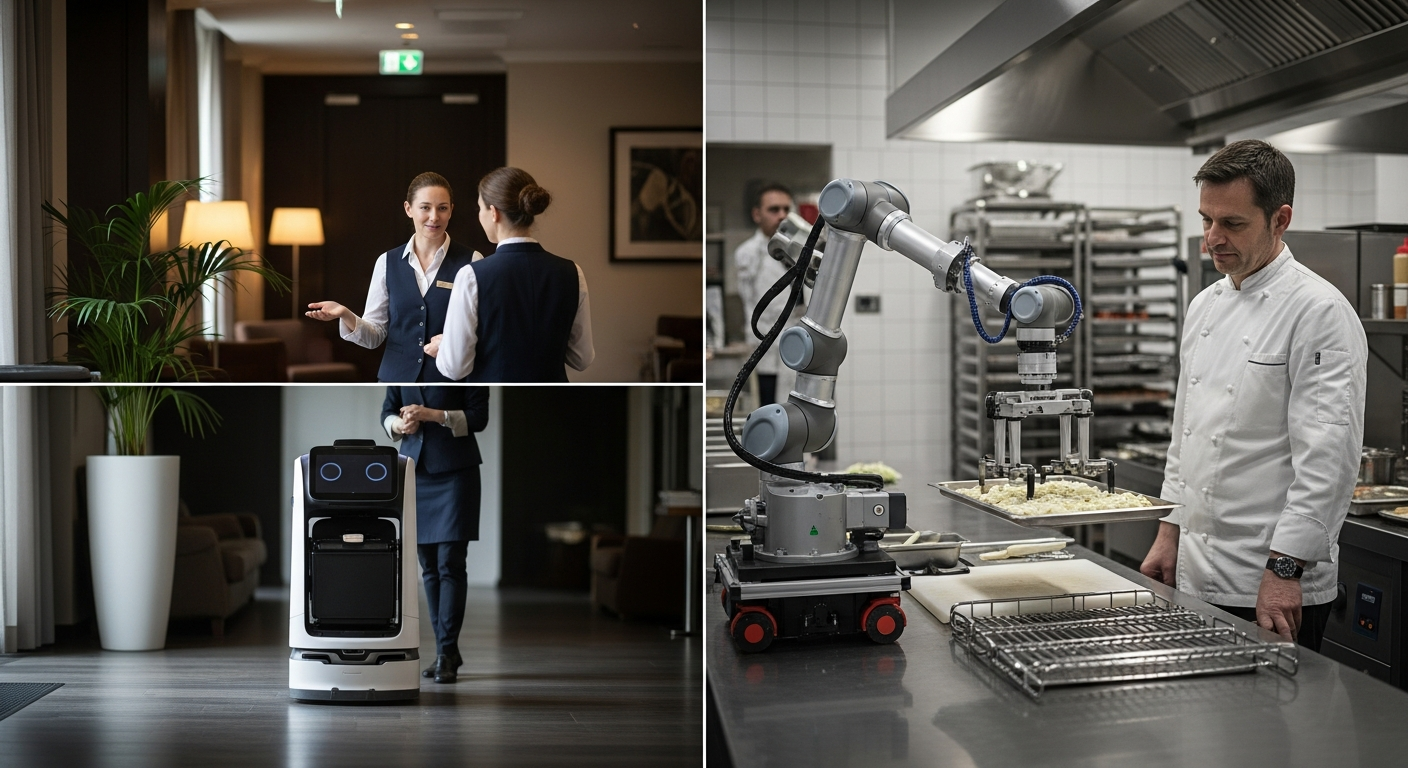
Via della Moscova, Milan. 04:00. The night shift at a major hospitality site is finishing. A room service robot navigates the corridor to deliver a late-night order, while in a nearby logistics hub in Segrate, a yard patrol unit completes its third perimeter check of the hour. These are not experimental pilots or marketing stunts. They are production-grade deployments managed by a systems integrator. In the high-pressure environments of Milanese industry and service, the robot itself is secondary to the integration layer that keeps it running. Operators no longer have the luxury of six-month discovery phases. They need a spec in 48 hours and a live fleet in eight weeks.
Key Takeaways
- 1werob is a hardware-agnostic systems integrator, not a manufacturer, ranking 44+ OEMs to find the best fit for your specific Milanese workflow.
- 2The EU Machinery Regulation 2023/1230 becomes mandatory on January 20, 2027, and werob provides the built-in compliance pathway for all deployments.
- 3Deployments are fast: 48 hours to spec, 5 days to quote, and 8 weeks to a live robot on the floor.
The Role of a Robotics Integrator in the Milanese Market
Milan serves as the industrial and logistical heartbeat of Italy. From the luxury hotels of the Quadrilatero della Moda to the massive distribution centers surrounding Malpensa, the demand for automation is surging. However, purchasing a robot is not the same as solving an operational problem. A robotics integrator acts as the essential bridge between raw hardware and a functional workflow. Most manufacturers, particularly those based in Asia, provide excellent hardware but lack the localized integration capabilities required by European operators. This is where werob differentiates itself as a hardware-agnostic systems integrator.
Instead of pushing a single brand, werob maintains a catalogue of over 44 OEM partners and 280 different robot models. This allows for a objective ranking based on the operator's specific needs. In Milan, where facility layouts can range from historic architecture to modern high-tech warehouses, this flexibility is critical. An integrator manages the entire lifecycle: from the initial Spec Engine analysis to the Supplier Match, through to the live fleet management in the Cockpit. This approach eliminates vendor lock-in and ensures that the technology serves the business outcome, rather than the other way around.
The complexity of the Italian regulatory environment, combined with the technical requirements of local software stacks, makes a specialized integrator mandatory. Operators in Milan are increasingly moving away from the 'reseller' model, which often leaves them with unsupported hardware, and toward the 'integrator' model, which guarantees uptime and compliance. werob currently operates 200 robots live across 11 European countries, including Italy, providing the scale and experience necessary for high-stakes deployments.
The Spec Engine: From Workflow to Action Graph in 48 Hours
The traditional procurement cycle for robotics often involves months of discovery decks and consulting sessions. For a Director of Operations in Milan, this delay represents lost revenue and continued labor gaps. werob has compressed this timeline using its proprietary Spec Engine. This AI-assisted platform converts an operator's description of a shift, a floor, and a task into a deployable robot action graph within 48 hours. The engine is trained on over 35,000 projects, allowing it to identify the most efficient path to automation without the need for lengthy on-site audits.
The Spec Engine asks the critical questions that define a successful deployment: What is the shape of the task? What are the site's infrastructure constraints? What are the regulatory requirements? By answering these questions through an eight-step intake process, the operator receives a technical specification that is ready for the matching phase. This speed promise-48 hours to spec-is a core differentiator in an industry where the norm is three to six months of discovery. For a Milanese logistics yard or a senior living facility, this means moving from a problem to a technical solution in less than a business week.
Once the action graph is defined, it serves as the blueprint for the entire deployment. It dictates not just which robot is chosen, but how that robot interacts with elevators, automatic doors, and human staff. This level of detail ensures that when the robot arrives on the floor, it is already configured for the specific nuances of the Milanese site, reducing the 'time to value' significantly.
Supplier Match: Ranking 44+ OEMs Against the Spec
The robotics market is fragmented. With hundreds of manufacturers producing everything from humanoid service robots to autonomous floor scrubbers, choosing the right hardware is a daunting task for any CTO. werob's Supplier Match layer removes the guesswork by ranking 44+ OEM partners against the specific requirements generated by the Spec Engine. This ranking is not based on marketing claims but on technical performance data and real-world reliability metrics from werob's live fleet.
In the Milanese context, this might mean comparing a Keenon T9 against a Pudu unit for a high-traffic restaurant in Brera, or evaluating an ANYbotics unit against a Boston Dynamics Spot for an industrial inspection task in Sesto San Giovanni. Because werob is hardware-agnostic, the recommendation is always driven by the best fit for the operator's workflow. The platform considers 280 different robots, ensuring that the final selection is optimized for cost, capability, and compliance.
This matching process also accounts for the availability of spare parts and local service support. A robot that cannot be serviced in Italy is a liability, regardless of its technical specs. By leveraging a broad network of partners, werob ensures that the chosen hardware is backed by a robust support structure. This is particularly important for large-scale deployments where a single point of failure can disrupt an entire operation. The Supplier Match provides a quote within five days, moving the project rapidly toward the implementation phase.
Connectors: Integrating into the Milanese Software Stack
A robot that operates in a silo is of limited value. To achieve true operational efficiency, the robotics fleet must be integrated into the existing software stack. werob provides pre-built Connectors that link the robotics layer directly into the systems that Milanese businesses already use. For the hospitality sector, this includes direct integrations with Opera PMS and Mews. In a luxury hotel near the Duomo, this allows a room service robot to receive orders directly from the property management system, navigate to the correct floor, and notify the guest upon arrival without manual intervention.
In the logistics and industrial sectors, werob's Connectors interface with SAP EWM and other warehouse management systems. This ensures that autonomous mobile robots (AMRs) are synchronized with the broader supply chain, optimizing picking routes and inventory movement in real-time. For security and facility management, integrations with platforms like Genetec allow patrol robots to feed data directly into the central security cockpit, enhancing situational awareness without adding complexity for the operators.
These connectors are not bespoke, one-off integrations. They are standardized, hardened software links that are part of the werob platform. This approach significantly reduces the risk of software conflicts and ensures that the robotics fleet remains stable even as the underlying business systems are updated. For a Milanese operator, this means a seamless transition to automation with minimal disruption to existing IT infrastructure.
Regulatory Compliance: EU Machinery Regulation 2023/1230
Compliance is the single biggest hurdle for robotics deployments in Europe. The upcoming EU Machinery Regulation 2023/1230, which becomes mandatory on January 20, 2027, introduces strict new requirements for autonomous systems. Many robots currently on the market, particularly those manufactured outside the EU, do not yet meet these standards. For a business in Milan, deploying non-compliant hardware is a significant legal and operational risk. werob provides a built-in compliance pathway, ensuring that every robot in its catalogue is assessed against the latest EU regulations.
This regulatory cover extends beyond the Machinery Regulation. In senior living facilities, compliance with ISO 13482 for personal-care robots is essential. In the F&B sector, robots must adhere to HACCP standards for food safety. For security applications, the BewachVO and IEC 62443 standards for cybersecurity are paramount. werob's platform tracks these requirements in real-time, providing an audit trail that satisfies both internal compliance departments and external regulators.
By acting as the local integrator, werob takes on the responsibility of conformity assessment. This is a critical service for Milanese operators who may not have the in-house expertise to navigate the complex landscape of EU safety standards. As the 2027 deadline approaches, the ability to guarantee compliance will be the deciding factor in which robotics projects move forward and which are shut down by regulators. werob ensures that every deployment is future-proofed against these changing legal requirements.
Economic Impact: Cost Offsets in Milanese Verticals
The primary driver for robotics in Milan is the measurable cost offset. In an environment where labor costs are high and staff retention is a constant challenge, robotics provides a predictable and scalable solution. werob's deployments are focused on high-impact use cases with verified economic outcomes. For example, in the hospitality sector, a hotel room service robot can generate a cost offset of €112,000 per site per year. This is achieved by automating low-value delivery tasks, allowing human staff to focus on guest experience and high-value services.
In the logistics sector, a yard patrol robot can offset €68,000 per year by providing continuous, autonomous surveillance of large perimeters. This reduces the need for manned guarding during night shifts and improves overall site security. In the senior living sector, which is under immense pressure across Italy, a robot dedicated to the medication round can offset €92,000 per year, while transport robots can save an additional €71,000. These are not theoretical figures; they are based on live operations within the werob network.
The commercial model is equally important. werob operates on an outcome-only basis, meaning the operator pays nothing until the system is running on the floor. This removes the capital expenditure risk and aligns the integrator's incentives with the operator's success. For a Milanese business, this model provides a clear path to ROI without the need for large upfront investments. The focus is entirely on the annualized cost offset and the operational stability of the fleet.
The Cockpit: Live Fleet Management and Uptime
Once a robot fleet is live, the focus shifts to management and uptime. werob's Cockpit is the central nervous system for the entire operation. It provides a live view of every robot in the fleet, using a four-dimensional traffic light system to monitor hardware health, infrastructure connectivity, regulatory status, and spec adherence. If a robot in a Milanese warehouse encounters an obstacle it cannot clear, or if a sensor begins to fail, the Cockpit alerts the operator and the werob support team immediately.
This proactive monitoring is essential for maintaining the high levels of uptime required in production environments. The Cockpit also serves as the primary interface for fleet-wide updates and configuration changes. If a hotel in Milan decides to change its room service workflow, the new action graph can be pushed to the entire fleet via the Cockpit without the need for on-site technicians. This level of control is what allows werob to manage 200 robots across 11 countries with high efficiency.
Furthermore, the Cockpit generates the data necessary for continuous improvement. By analyzing the performance of different OEM models in real-world conditions, werob can refine its Supplier Match algorithms and provide operators with insights into how to further optimize their workflows. For a Director of Operations, the Cockpit provides the transparency and control needed to manage a modern, automated facility with confidence.
The Eight-Week Promise: From Intake to Live Floor
Speed is the ultimate competitive advantage in the Milanese market. werob's entire platform is designed to move from an initial intake to a live robot on the floor in just eight weeks. This timeline is made possible by the integration of the Spec Engine, Supplier Match, and pre-built Connectors. The process begins with an eight-step intake that captures the essential details of the operation. Within 48 hours, the operator has a technical spec. Within five days, they have a quote. By week eight, the hardware is delivered, integrated, and operational.
This rapid deployment cycle is a stark contrast to the industry standard, which often stretches into months or even years. For a Milanese business facing an immediate labor shortage or a regulatory deadline, the eight-week promise is a game-changer. It allows for a fast-fail or fast-scale approach, where automation can be tested and expanded without the risk of long-term project stagnation. werob's experience in 11 European countries ensures that the local nuances of the Italian market-from labor laws to technical standards-are handled efficiently.
The goal is to reach 2,000 robots by 2028, and this growth is driven by the repeatability of the werob model. By standardizing the integration process, werob makes robotics accessible to a wide range of industries that were previously deterred by the complexity and cost of automation. For Milan, this means a more resilient and efficient economy, powered by a fleet of robots that are integrated, compliant, and managed for maximum performance.
FAQ
- What does a robotics integrator in Milan actually do?
- A robotics integrator like werob translates your operational workflow into a technical specification, selects the best hardware from 44+ manufacturers, integrates it into your software stack (like SAP or Opera), and manages the live fleet via a central cockpit.
- How does werob handle the EU Machinery Regulation 2023/1230?
- werob acts as the compliance pathway, ensuring all robots meet the mandatory standards effective January 20, 2027. This includes conformity assessments for Asian OEMs that may lack local documentation.
- Can werob integrate with my existing hotel or warehouse software?
- Yes, werob has pre-built connectors for PointClickCare, MatrixCare, Opera PMS, Mews, Toast, Lightspeed, GolfNow, Genetec, and SAP EWM.
- What is the cost of a robotics deployment in Milan?
- werob uses an outcome-only commercial model. There are no list prices; you pay based on the successful operation and the cost offsets achieved, such as the €112k offset for hotel room service.
- How long does it take to get a robot running on my floor?
- The werob promise is 48 hours for a specification, five days for a quote, and eight weeks for a live, integrated robot on your floor.
- Is werob a robot manufacturer like Boston Dynamics or Keenon?
- No, werob is a systems integrator. Boston Dynamics and Keenon are partners. werob's value lies in the operating layer that makes these robots work within your specific business environment.
Related reading
The Role of a Robotics Systems Integrator in Modern Operations
A robotics systems integrator bridges the gap between raw hardware and operational ROI by managing the entire deployment lifecycle. This guide explores how werob uses a four-layer platform to deliver live robots in eight weeks.
7 July 2026robotics integrator FrankfurtRobotics Integrator Frankfurt: Automation for Operators
Frankfurt am Main is a center for logistics and the hotel industry. As a hardware-agnostic partner, werob integrates robot fleets directly into existing operational processes and IT stacks.
4 July 2026largest systems integrator roboticsThe Largest Systems Integrator for Robotics in Europe
Robotics is no longer about the machine; it is about the integration. Discover how the world's largest systems integrator translates complex workflows into live robot fleets across 11 countries.
3 July 2026robotics integrator services germanyRobotics Integrator Services Germany: Scaling Operational Fleet
Robotics integration in Germany is shifting from experimental hardware tests to software-driven operational deployments. This guide examines how systems integrators bridge the gap between OEM hardware and enterprise software stacks.
7 July 2026apptronik apollo germany integratorApptronik Apollo Germany: The Path via the Integrator
Humanoid robots like the Apptronik Apollo are reaching the German market. Learn how werob, as a systems integrator, bridges US hardware and European regulation.
1 June 2026