Commercial Cleaning Robots: Beyond the Pilot Phase
Discover why commercial cleaning robots have moved from pilot projects to standard equipment, and how operators are integrating autonomous fleets at scale.
Commercial cleaning is the first service-robotics vertical where autonomy is no longer a pilot project, but standard operational equipment. From automated docking to simple ROI math, here is why floor care matured first, and what facility operators need to know to integrate it.
Key Takeaways
- 1Commercial floor scrubbers now represent mature robotic fleets, with leading manufacturers reporting tens of thousands of units in routine commercial service worldwide.
- 2The business case rests on simple square-metre-per-hour arithmetic in a labour market where cleaning roles are persistently hard to fill.
- 3Integration now focuses on facility logistics, such as automated docking and water handling, rather than core autonomous navigation.
The End of the Science Project Phase
For the past decade, enterprise service robotics has often appeared stuck in an endless loop of exploratory trials, executive demonstrations, and university proof-of-concept studies. In most commercial sectors, mobile robots still carry the burden of being treated as novelties rather than dependable plant assets. Commercial floor cleaning is the distinct exception where this dynamic has permanently inverted. Across European transport hubs, logistics warehouses, retail centers, and healthcare facilities, autonomous scrubbers and sweepers are no longer accompanied by engineering handlers or media crews. They execute scheduled third-shift cleaning blocks, return to base, and generate compliance audit trails without fanfare.
The shift from speculative technology to standard utility is evident in verified global deployment volumes. Autonomous cleaning equipment manufacturers such as Gausium have deployed over 40,000 autonomous units across more than 70 countries[1]. These machines do not represent experimental field testing; they are standard capital assets operating under multi-year facility management contracts. For operations leaders evaluating the broader automation landscape, commercial floor care serves as the empirical blueprint for how autonomous hardware transitions from bleeding-edge innovation into an unglamorous, indispensable operational standard.
- Fleet management migrates from bespoke engineering consoles into standard building management and maintenance software stacks.
- Procurement shifts from speculative innovation budgets to standard operational leasing and capital expenditure lines.
- Service level agreements specify guaranteed replacement parts availability, preventative maintenance intervals, and predictable response times.
- Frontline janitorial teams operate, route, and supervise machines directly after short on-site operational onboarding.
Understanding why floor cleaning reached this milestone years ahead of other service verticals requires examining the physical dynamics of the task, the low-risk profile of the operating environment, and the financial pressures facing facility managers.
Why the Cleaning Vertical Matured First
The primary reason commercial floor care crossed the chasm from pilot to permanent infrastructure is environmental predictability. Unlike complex manipulation tasks or outdoor navigation, commercial interiors present structured, two-dimensional planes. Concrete distribution floors, vinyl healthcare corridors, and polished airport concourses are engineered for rolling traffic. They are flat, level, and geometrically consistent, which suits the sensor stacks now shipped on commercial machines: Gausium, for example, describes a suite combining 360-degree 3D LiDAR with 360-degree camera arrays to localise the robot and detect obstacles such as people, vehicles, escalators, carpets, wires, and glass doors[2].
Equally critical is the operational risk profile. In autonomous material handling or outdoor perimeter security, a navigation failure or obstacle collision can cause human injury, structural property damage, or immediate operational shutdowns. In floor scrubbing, the consequence of a navigation pause or minor path deviation is exceptionally low. If an autonomous scrubber encounters an unmapped obstacle, misidentifies a reflection, or pauses safely, the immediate failure mode is simply a dry patch of unwashed floor. This forgiving error margin allowed manufacturers to deploy early algorithmic generations into live commercial environments safely.
| Operational Dimension | Commercial Floor Cleaning | Variable Service Verticals |
|---|---|---|
| Task Definition | Repetitive floor coverage with fixed passes | Dynamic physical manipulation and object handling |
| Operating Surface | Flat, structured interior flooring | Multi-level, uneven terrain or outdoor environments |
| Failure Consequence | Unwashed floor section or scheduled pass delay | Property damage, safety hazard, or production stall |
| Human Interaction | Isolated night shifts or passive obstacle avoidance | Direct physical handoffs and close collaborative contact |
Because the task is repetitive, bounded, and largely separated from active human workflows, engineering teams could optimize navigation around coverage efficiency rather than complex social reasoning. This structural simplicity accelerated software stability years ahead of more complex robotic categories.
The Coverage Math and Labor Dynamics
Beyond physical feasibility, commercial cleaning succeeded because the underlying economic arithmetic requires no speculative assumptions. The business case rests on direct square-metre-per-hour productivity. A human operator pushing a manual walk-behind scrubber typically achieves 6,000 to 9,000 square feet of effective cleaning per hour once obstacles, doorways, lifts, and rest breaks are accounted for[3]. An autonomous scrubber does not necessarily beat that hourly rate, but it can repeat it across off-peak hours, weekends, and additional shifts without adding labour, which is where the arithmetic actually turns.
This throughput directly addresses severe structural labor shortages across Europe. According to workforce research, annual employee turnover in commercial cleaning and janitorial services regularly exceeds 50%, with many contract cleaning providers reporting turnover exceeding 100%[4]. Facility directors face continuous recruitment, onboarding, and training costs for roles that remain difficult to fill. Deploying autonomous cleaning robots does not replace human departments; it offsets repetitive floor tasks so limited staff can focus on higher-value work.
- Automated baseline coverage: The autonomous machine absorbs repetitive linear travel across open concourses and wide aisles during off-peak hours.
- Task re-allocation: Human cleaners transition from walking behind scrubbers to detailed sanitization, vertical surfaces, and restroom hygiene.
- Supervised fleet workflows: Existing custodial supervisors oversee the machines as everyday power tools, conducting daily inspections and clearing recovery tanks.
By automating a specific physical task rather than attempting to automate an entire job description, facility operations avoid organizational friction and achieve rapid operational stability.
What Mature Operations Look Like in Practice
In an operationally mature facility, autonomous cleaning is indistinguishable from standard mechanical plant operations. Multi-tenant logistics hubs, retail superstores, and transit terminals run autonomous scrubbers across two or three shifts daily. The equipment operates within designated time windows, navigating around night restocking teams and material handling equipment without active supervision.
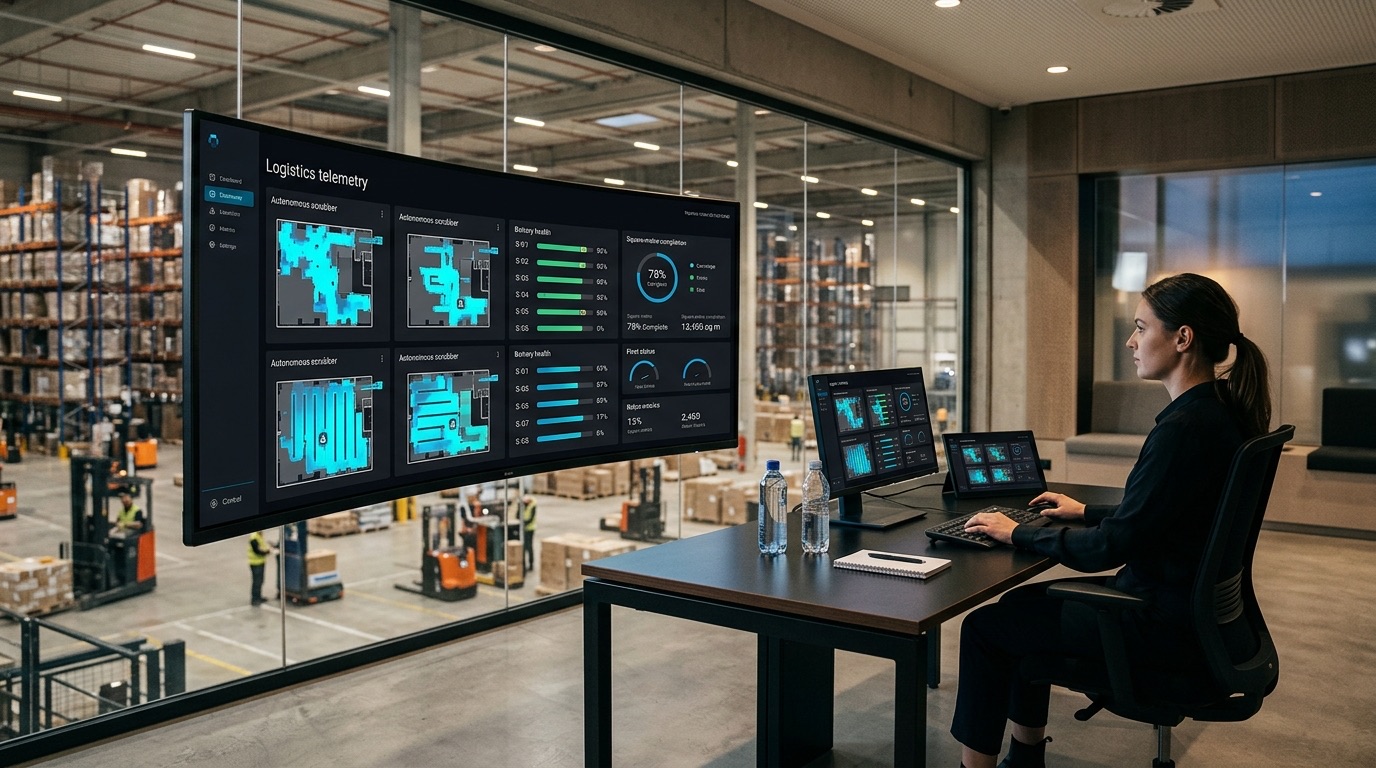
Maturity has also transformed operational governance and quality assurance. Facility managers no longer rely on paper logs or periodic visual inspections to verify service delivery. Autonomous fleets feed telemetry directly into centralized building management systems, generating timestamped heatmaps, water consumption metrics, and square-metre coverage records that serve as auditable proof of service. In industry benchmarking surveys, 36% of facility supervisors planning technology acquisitions identify robotic and autonomous equipment as their primary investment target[5].
Operator onboarding has contracted from multi-week engineering engagements to operational training measured in hours. Custodial teams learn zone selection, emergency stop recovery, and daily maintenance within a single shift, integrating the equipment into standard daily routines.
The Real Integration Work: Facility Logistics
As navigation algorithms and sensor hardware stabilized, the primary bottleneck in commercial robotics shifted from software engineering to facility-side infrastructure. Enterprise robotics projects rarely fail because a machine cannot calculate a path; they struggle when site utilities cannot support automated operational cycles. Reliable multi-shift execution requires physical infrastructure alignment: high-volume water supply, drainage connections, and dedicated charging installations.
Modern autonomous floor scrubbers rely on specialized docking stations. Gausium's Phantas, for instance, pairs with an optional WS-03-S workstation that handles automatic charging, water refill, and sewage discharge on docking, and that also rinses the squeegee and suction pipe to prevent clogging and secondary contamination[6]. Without automated docking utilities, human personnel must spend hours manually draining sludge and refilling tanks, eroding the labor offsets that justified the initial deployment.
- Dedicated utility stations: Clean water inlet pressure, gravity drainage lines for greywater disposal, and high-amperage charging circuits.
- Vertical and spatial transitions: Integration with automated elevator controllers, roll-up shutter triggers, and electronic door strikes.
- Off-shift facility access: Automated badge clearance, security system coordination, and motion sensor masking along active cleaning routes.
- Operational escalation paths: Automated alerts routing through mobile channels when a machine encounters path blockages or requires brush maintenance.
Managing these site-level interdependencies requires a structured managed robotics service approach, ensuring architectural, electrical, and plumbing requirements are resolved well before hardware arrives on site.
The Unsolved Edges: Where Humans Remain Essential
Pragmatism is essential when evaluating robotics capabilities. Despite aggressive vendor marketing claiming total facility autonomy, commercial cleaning robots remain specialized machines with distinct operational boundaries. Autonomous scrubbers excel at open floor expanses, but they cannot navigate staircases, maneuver through crowded breakrooms, or adapt to dynamic spaces where layout configurations change hourly.
Detail cleaning and hygiene verification remain strictly human responsibilities. Perimeter edge scrubbing along skirting boards, cleaning behind narrow shelving, sanitizing sanitary fixtures, and wiping high-touch architectural surfaces require physical dexterity and contextual judgment that mobile bases do not possess. In healthcare and food production environments, validated surface disinfection is a documented, judgement-dependent step, so it stays with trained staff rather than the machine.
| Cleaning Scope | Autonomous Execution | Human Execution Required | Operational Division |
|---|---|---|---|
| Open concourse and aisle scrubbing | Full autonomous coverage | Periodic quality audit | Mostly machine, human spot checks |
| Restroom sanitation and fixture cleaning | Not supported by mobile bases | Full manual sanitization | Human only |
| Perimeter edging and tight corners | Partial edge brush pass | Manual detail mopping and wiping | Shared: machine pass, manual finish |
| High-touch surface disinfection | Not supported by floor scrubbers | Manual chemical wipe down | Human only |
Recognizing these operational boundaries is critical for realistic shift scheduling. Effective facility operators deploy a hybrid model: machines maintain the continuous floor baseline, freeing skilled custodial staff to concentrate on sanitization, waste handling, and customer-facing detail work.
The Integrator Reality: Fleet Deployments at Scale
Because commercial cleaning robotics has achieved operational maturity, the enterprise procurement conversation has fundamentally changed. Facility directors no longer ask whether an autonomous scrubber can navigate a hallway. The decisive buying questions now focus on lifecycle execution: who provides on-site field maintenance within agreed response windows, how does machine telemetry integrate with existing building management systems, and how do multi-OEM fleets coordinate across regional property portfolios?
This pragmatic maturity contrasts sharply with hype-stage robotics categories, such as humanoid robots, where general-purpose manipulation remains constrained by high capital costs, complex physics, and unproven return on investment. Scaling real-world autonomy requires working with an experienced robotics systems integrator capable of unifying hardware, site infrastructure, and enterprise software.
The werob Platform addresses this operational challenge by orchestrating the complete deployment lifecycle. Using the Spec Engine, facility leaders convert plain-language shift requirements into formally verified operational plans within 48 hours. Supplier Match evaluates operational criteria across more than 44 qualified OEM partners to select the optimal hardware for specific facility layouts, while pre-built Connectors link fleet telemetry directly into enterprise ERP and facility management stacks. Centralized through Cockpit, operations teams track cross-fleet availability, preventative maintenance cadences, and service verification across every site from a single pane of glass.
Commercial cleaning demonstrated how robotics moves from experimental pilot to permanent infrastructure: by solving a bounded, repetitive task with transparent economics and disciplined facility integration. For operations leaders planning broader automation strategies, that pragmatic trajectory provides the only dependable roadmap.
FAQ
- How much area can a commercial cleaning robot cover?
- Coverage depends on the machine, the floor layout, and how much of the route is genuinely open. A useful benchmark is that a person pushing a manual walk-behind scrubber achieves roughly 6,000 to 9,000 sq ft per hour once obstacles, doorways, lifts, and breaks are counted. An autonomous unit works in the same broad range but can repeat it across additional off-peak shifts without extra labour.
- Do autonomous floor scrubbers replace janitorial staff?
- No, they augment existing teams by taking over the repetitive task of open-floor cleaning. With annual turnover in commercial cleaning regularly exceeding 50%, and many contract cleaners reporting even higher rates, robots offset chronic labour shortages and let staff focus on restroom detailing and other judgement-dependent work.
- What are the main integration challenges for cleaning robots?
- The core challenges have shifted from robotics research to facility infrastructure. Successful integration requires planning for automated docking stations, fresh water supply points, wastewater drainage, and ensuring the robot has unobstructed lift and night access.
- Can cleaning robots navigate complex environments like airports?
- Yes. Modern units combine 360-degree 3D LiDAR with camera arrays and AI-based obstacle recognition to move safely around passengers, luggage carts, and changing barriers in high-traffic areas without constant human intervention.
- What maintenance is required for commercial cleaning robots?
- While autonomous docking handles recharging and water cycles, human intervention is still required for periodic maintenance. Operations staff must clean sensors, replace worn brushes or squeegees, and manage any unexpected escalations if the machine stops during a shift.
- Are there tasks that cleaning robots still cannot perform?
- Robots excel at open floors but struggle with stairs, tight edges, highly cluttered dynamic spaces, and restrooms. Tasks that require human judgment, such as high-touch surface disinfection to a validated standard, remain outside their capabilities.
Related reading
What a robot pilot proves - and what it does not
Discover why most service robot pilots fail to predict rollout success and learn how operators can design trials that deliver defensible baseline metrics.
27 August 2026service robots against the labour shortage how facilityService robots against the labour shortage: how facility operators automate cleaning
Discover how facility operators use independent service robotics and flexible rentals to beat the cleaning labor shortage and stabilize workflows.
6 July 2026cleaning robots hospitalCleaning Robots in Hospitals: Efficiency in Clinical Facility Management
Hospitals are under massive cost pressure while hygiene requirements simultaneously rise. Autonomous cleaning robots relieve specialist staff from repetitive floor cleaning tasks and ensure seamless documentation of cleaning cycles.
16 June 2026IEC 63327 cleaning robot standardIEC 63327: which standard an autonomous cleaning machine is actually built to
Specifications for autonomous scrubbers almost always cite ISO 3691-4. That is the standard for driverless industrial trucks. The floor treatment machine has had one of its own since 2021 — and it rarely appears in the enquiry.
3 September 2026robotic hull cleaning biofoulingRobotic hull cleaning: biofouling, fuel and the rules in port
What growth on the hull really does to fuel consumption, what the IMO framework actually requires, where in-water cleaning is permitted, and what separates a system with capture from one without.
22 July 2026