Retrofit Autonomy: Why Capital Backs Kits Over New Machines
Discover why capital is flowing to retrofit autonomy kits over new machines, with a deep dive into the recent Gravis Robotics and Mariana Minerals deals.
Capital is shifting aggressively toward retrofit autonomy. Massive August 2026 investments in Gravis Robotics and Mariana Minerals show that the future of industrial automation lies in upgrading existing fleets with smart kits, rather than buying entirely new machines.
Key Takeaways
- 1SoftBank invested $200 million into Gravis Robotics to scale autonomy kits for existing excavators.
- 2Mariana Minerals raised $310 million to deploy autonomous trucks and unlock stranded copper mines.
- 3Retrofit kits bypass the manufacturing lead times and high capital costs of buying new machines.
- 4Systems integrators provide the flexibility to source and deploy the best OEM kits for any fleet.
The capital shift towards retrofit autonomy
The heavy machinery and industrial automation sectors are undergoing a notable shift in how capital allocators back physical artificial intelligence. For years, robotics investments prioritized clean-sheet original equipment manufacturers seeking to design entirely new autonomous platforms from the ground up. Today, major venture and growth investors are increasingly directing substantial capital into modular autonomy kits that bolt directly onto established machines.
This pattern is demonstrated by two significant funding events announced in August 2026: SoftBank's record-setting Series A investment into excavator automation and a major capital injection into autonomous mining haulage. While these two distinct data points represent specific market segments rather than a comprehensive industry census, they clearly illustrate how industrial operators and growth investors view fleet modernization.
- Preservation of existing heavy machinery assets across long operational lifecycles
- Bypassing multi-year supply chain and factory backlogs for newly manufactured equipment
- Lower capital barriers to deploying terrain-aware autonomous software on active worksites
- Rapid validation of autonomous routines on proven mechanical chassis architectures
For commercial site managers, civil contractors, and industrial operators, this shift validates a pragmatic upgrade pathway. Instead of waiting years for bespoke autonomous machines to achieve volume production, industrial buyers can modernize their existing fleets by integrating specialized autonomy kits sourced from leading OEM partners.
Gravis Robotics: Scaling AI on existing excavators
On August 17, 2026, SoftBank announced a $200 million Series A investment in Gravis Robotics at a $1 billion valuation, a round Gravis describes as the largest Series A ever raised in construction robotics. The size and valuation of the round highlight strong institutional conviction in retrofit-first construction technology.
Founded in 2022 as an ETH Zurich spinout, Zurich-based Gravis Robotics develops software and hardware computing kits that convert conventional excavators into self-operating machines. Rather than attempting to manufacture heavy machinery, Gravis focuses on physical AI models trained to process hydraulic resistance, vibration, and subterranean forces at microsecond speeds.
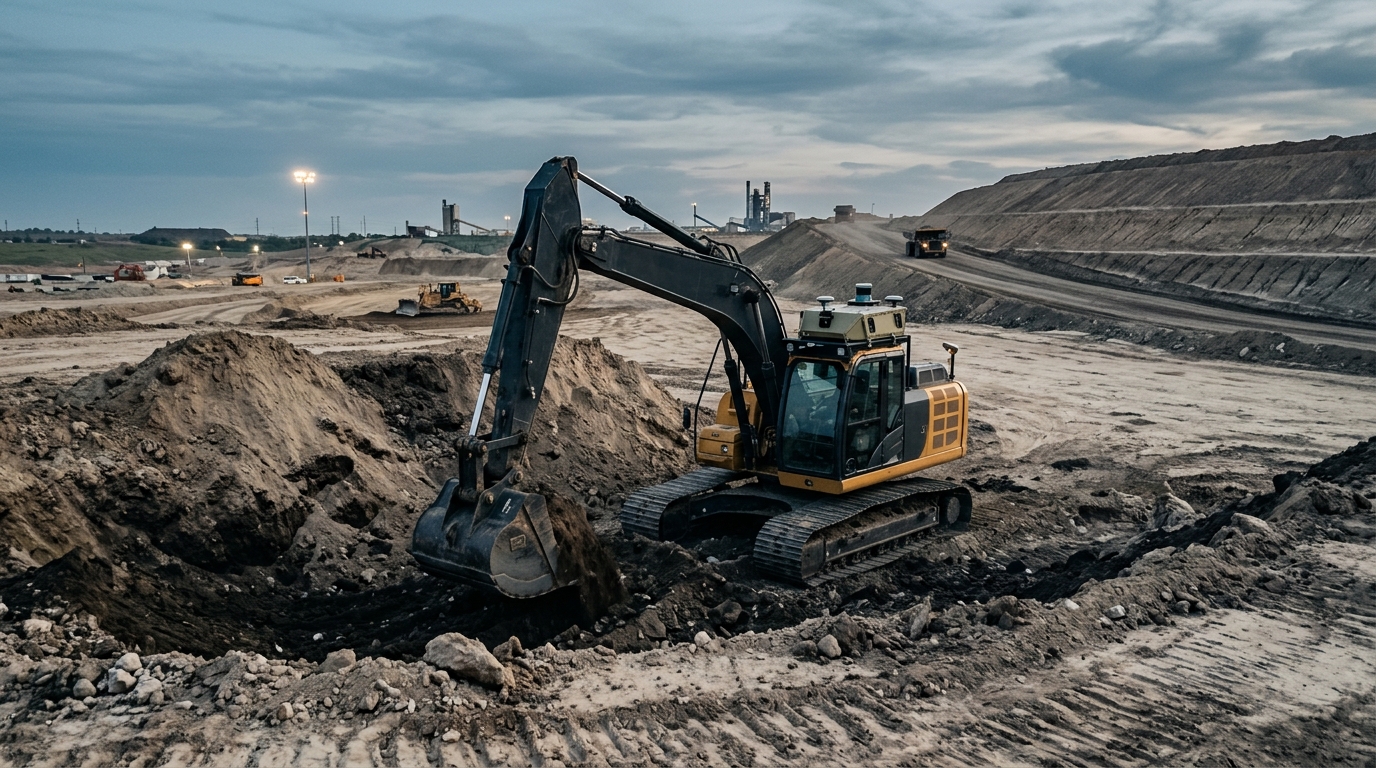
- Gravis Rack computing appliance mounted directly to the host machine's cabin roof
- Integrated camera and lidar sensing suites combined with dual rear-mounted sensor masts
- High-precision GNSS RTS positioning technology delivering centimeter-grade satellite accuracy
- Compatibility across primary excavator brands including Caterpillar, John Deere, Volvo, JCB, and Hitachi
By engineering retrofit kits compatible with major machinery brands, Gravis allows earthmoving contractors to deploy construction robots across their active fleets immediately. This approach tackles the critical skilled-operator shortfall on infrastructure projects without requiring civil engineering firms to decommission their reliable, depreciating diesel or hybrid machines.
Mariana Minerals: Unlocking mines with autonomous trucks
In parallel with developments in heavy civil construction, large-scale extraction is demonstrating a similar focus on autonomous haulage retrofits. On August 12, 2026, MarketScale reported that Mariana Minerals secured $310 million in funding to advance autonomous trucks in copper mining operations.
The core economic thesis behind Mariana Minerals' capital raise is project viability rather than simple headcount reduction. Many mineral deposits sit in remote geographic areas where conventional, human-staffed operations cannot run profitably or safely: at the Utah copper site Mariana acquired, mining had been suspended in late 2024 because of rising operating costs and difficulty recruiting workers, and operations have since restarted with autonomous haulage, autonomous drilling, and robotic sensing coordinated by a single operating platform, with the company's chief executive stating it is producing now and ramping output aggressively.
- Unlocking complex or low-grade deposits that cannot support standard manned shift models
- Ensuring continuous haulage operations in extreme climates and remote territories
- Mitigating severe regional labor shortages for heavy industrial drivers and operators
- Creating high-skill remote supervisory roles centered on autonomous fleet management
The Mariana Minerals deployment underscores that the economic unlock of autonomy does not require waiting for next-generation haulage chassis. By pairing proven heavy transport platforms with specialized automation kits and control layers, resource operators can expand production and extract critical minerals immediately.
The economic advantage of upgrading existing fleets
When industrial buyers evaluate automation, the capital calculus between purchasing newly manufactured autonomous machinery versus retrofitting an existing fleet is stark. Heavy machinery represents significant balance-sheet capital, with service lifespans routinely exceeding a decade.
| Evaluation Dimension | New-Machine Manufacturing | Retrofit Autonomy Kit |
|---|---|---|
| Capital Expenditure | High baseline purchase cost for entire mechanical chassis | Targeted investment in compute, sensing, and control hardware |
| Deployment Timeline | Subject to long factory lead times and delivery backlogs | Rapid bolt-on installation on existing, active fleet units |
| Asset Utilization | Requires early decommissioning of functional machines | Maximizes return on invested capital for existing equipment |
| Fleet Uniformity | Introduces disjointed, single-purpose machine models | Preserves familiar chassis types and existing maintenance workflows |
Purchasing new autonomous machines forces operators to absorb steep upfront capital expenditure, scrap functional mechanical value, and retrain maintenance technicians on unfamiliar chassis platforms. Retrofit autonomy kits bypass these operational hurdles by preserving the operator's underlying investment in hydraulics, powertrains, and structural steel, while upgrading only the perception and decision-making stack.
Why systems integration beats vendor lock-in
While the modular kit model offers clear economic advantages, it introduces operational complexity for buyers. The industrial robotics landscape is highly fragmented, with different kit developers specializing in specific machine types, sensor configurations, and software environments. Contracting directly with a single kit vendor often results in costly vendor lock-in, leaving the buyer vulnerable if that vendor cannot support other machine classes across the site.
To navigate this complexity, forward-thinking buyers work with an independent systems integrator. Rather than manufacturing hardware or pushing a proprietary single-brand ecosystem, an integrator maintains a hardware-agnostic stance. The integrator analyzes the operator's operational requirements, specifies the exact compute and sensor payload needed, sources verified kits from diverse OEM partners, and manages the field integration.
- Vendor neutrality ensuring objective selection of the best autonomy kit for each machine type
- Elimination of single-supplier dependency across multi-brand excavator and truck fleets
- Comprehensive site-level safety assessments and regulatory compliance engineering
- Unified integration frameworks that standardize data flows across heterogeneous machines
Operating with radical transparency regarding technical realities and system boundaries ensures that industrial operators deploy automation where it creates measurable value, rather than adopting closed systems that restrict future expansion.
Connecting autonomous kits to operator workflows
Installing perception sensors and compute racks onto a machine is only one part of successful field autonomy. For an autonomous excavator or haul truck to create tangible productivity gains, it must communicate cleanly with existing site management systems, enterprise databases, and dispatch engines.
Without robust middleware integration, autonomous machines become isolated technology silos that require manual intervention to assign tasks or extract operational telemetry. Standardized integration layers, such as Connectors, bridge the gap between robotic controllers and existing enterprise resource planning, warehouse management, and dispatch stacks.
- Bidirectional dispatch sync translating job tickets into real-time machine tasks
- Telemetry pipelines feeding hydraulic, engine, and payload metrics into maintenance systems
- Automated incident escalation protocols with multi-tiered human-in-the-loop oversight
- Audit-grade logging for safety verifications and regulatory reporting
Alongside software middleware, site operations require centralized visibility. Dashboards like Cockpit provide operators with multi-dimensional status monitoring across hardware health, site infrastructure, regulatory compliance, and specification metrics. This structured coordination is fundamental to effective robotics fleet planning.
How to evaluate a fleet upgrade step by step
For industrial operators evaluating fleet automation, transitioning from exploratory interest to live deployment requires a disciplined, structured evaluation process. An integrator-led platform approach provides the end-to-end framework needed to plan, source, integrate, and operate multi-OEM autonomous fleets without taking on manufacturing risk or vendor lock-in.
The deployment journey begins with Spec Engine. Operators provide natural-language descriptions of their operational shifts, site conditions, and task parameters. Spec Engine converts these requirements into formally verified, ROS-compatible technical specifications and executable deployment plans within 48 hours, establishing concrete safety boundaries and operational envelopes.
Once technical specifications are defined, Supplier Match evaluates and ranks candidate hardware and retrofit kits across a supplier network of over 44 robotics manufacturers. The engine scores options based on regulatory readiness, regional maintenance coverage, physical integration footprint, and total cost of ownership, matching the site's exact machine models with optimal OEM autonomy kits.
- Define shift parameters and operational requirements through Spec Engine within 48 hours
- Match and rank OEM retrofit kits against site machines using Supplier Match
- Connect autonomous hardware into enterprise dispatch and ERP systems via pre-built Connectors
- Monitor real-time fleet health, safety alerts, and task progress using Cockpit
By partnering with werob to specify, source, and integrate proven OEM autonomy kits, industrial buyers upgrade their existing fleets with advanced physical AI, maximizing return on existing assets while maintaining a flexible, vendor-neutral automation strategy.
Both deals point the same direction: capital is backing the integration layer, not new iron. That is werob's own position in the market -- we specify, source, and integrate retrofit autonomy kits and robots from OEM partners for outdoor and industrial buyers, rather than manufacturing machines ourselves, so operators keep the OEM hardware relationships they already trust while gaining autonomous capability.
Read more: Construction robots against the skilled labour shortage · What makes a systems integrator the largest in robotics · Hardware markup and OEM robots: system integration instead of vendor lock-in.
FAQ
- What is a retrofit autonomy kit?
- A retrofit autonomy kit is a package of hardware sensors and software that can be installed on existing heavy machinery to enable autonomous or semi-autonomous operation, without requiring the purchase of a completely new vehicle.
- How much did Gravis Robotics raise in their Series A?
- Gravis Robotics raised $200 million in their Series A funding round, led by SoftBank, achieving a $1 billion valuation.
- Which machines does Gravis Robotics retrofit?
- Gravis Robotics retrofits existing heavy excavators from manufacturers including Caterpillar, John Deere, and Volvo.
- Why did Mariana Minerals raise $310 million?
- Mariana Minerals raised $310 million to advance the use of autonomous trucks in copper mining, which allows them to make previously inaccessible mines viable.
- Does werob manufacture robots?
- No, werob is a systems integrator. The company specifies, sources, and deploys robots and autonomy kits from OEM partners rather than manufacturing new machines itself.
- What are the economic benefits of retrofitting heavy equipment?
- Retrofitting maximizes the lifespan of existing fleet investments and provides a faster path to autonomy, avoiding the high costs and long delivery lead times associated with entirely new autonomous machines.
Related reading
Retrofit vs Replace: SoftBank's Signal for Excavators
SoftBank's $200 million investment in Gravis Robotics signals a shift toward retrofitting existing heavy excavators with autonomous AI kits.
18 August 2026largest systems integrator roboticsThe Largest Systems Integrator for Robotics in Europe
Robotics is no longer about the machine; it is about the integration. Discover how the world's largest systems integrator translates complex workflows into live robot fleets across 11 countries.
3 July 2026construction robots skilled labour shortageConstruction Robots Against the Skilled-Labour Shortage: Which Tasks Pay Off in 2026
Discover which construction robots pay off in 2026 as general contractors in the DACH region deploy automated layout, rebar, and drilling systems.
17 July 2026hardware markup oem robotHardware markup OEM robots: system integration instead of vendor lock-in
The choice of robot hardware is secondary to process integration. werob explains how hardware markup for OEM robots paves the way from requirement to productive fleet in eight weeks.
23 June 2026pedestrian detection excavator wheel loader AI camera retrofitPedestrian detection on excavators and wheel loaders: what the camera is documented to do, and what no datasheet says
Two routes lead today to a camera on the back of a construction machine that tells a person from a pallet: a brand-independent retrofit kit that has been in series production for years, and a factory option that brakes a wheel loader to a standstill on its own. Both manufacturers document what their system detects and where it runs. Neither documents at what distance, in how many milliseconds, or to what safety level. That is exactly where the site walk begins.
16 September 2026