$310M Bet: Autonomous Trucks Make Stranded Mines Viable
Mariana Minerals raised $310 million to advance autonomous trucks in copper mining. Discover how autonomous haulage makes stranded mines economically viable.
Mariana Minerals recently raised $310 million to advance autonomous trucks in copper mining. As reported by MarketScale, the stated aim is to make previously-inaccessible and stranded mines economically viable, marking a major shift for industrial operators.
Key Takeaways
- 1Mariana Minerals raised $310 million to advance autonomous trucks in copper mining, reported by MarketScale on August 12, 2026.
- 2The stated aim of the investment is to make previously-inaccessible and stranded mines economically viable for operators.
- 3Mining autonomy is reaching scale, with operators like Freeport-McMoRan converting 33 Cat 793 haul trucks to self-driving systems.
- 4Modern sensor fusion and private networks grant these heavy vehicles sub-10 cm positional accuracy in dynamic open-pit environments.
The Validation of Autonomous Mining
The transition toward heavy industrial robotics reached a defining milestone as Mariana Minerals raised $310 million to advance autonomous trucks in copper mining. Reported by MarketScale, dated August 12, 2026, the deal underscores how institutional capital views robotics not merely as an incremental operational efficiency tool, but as a foundational prerequisite for extracting critical minerals.
For industrial operators and mining fleet managers, this investment represents a clear validation of autonomous haulage. While autonomous mobile equipment has operated in controlled pilots for years, deploying multi-ton haulage fleets at scale requires shifting from experimental hardware trials to repeatable systems integration underground mining robotics. As an independent systems integrator, werob works with industrial buyers to specify, source, and deploy proven autonomy kits and mobile platforms from leading original equipment manufacturers (OEMs), ensuring that complex field operations translate into dependable production runs.
- Capital scale: $310 million committed specifically to scale autonomous trucking for mineral extraction.
- Strategic focus: Unlocking deposits previously classified as uneconomical or physically inaccessible.
- Integrator imperative: Bridging OEM machinery with site dispatch, sensors, and telemetry infrastructure.
Making Stranded Copper Mines Economically Viable
The stated aim of Mariana Minerals' funding round is to make previously-inaccessible and stranded mines economically viable. In conventional surface and open-pit mining, establishing a viable operation requires immense upfront capital expenditure for human infrastructure, including remote worker camps, daily transport logistics, health facilities, and shift rotation overheads. When a deposit has lower ore grades or sits in harsh, isolated terrain, these fixed baseline costs often render development unprofitable.
Autonomous haulage fundamentally alters that baseline calculation. By eliminating the requirement for continuous physical operator presence in high-hazard extraction zones, operations can run continuous haulage cycles across multiple shifts. This unlocks resource reserves that were previously abandoned or left undeveloped due to prohibitive personnel and logistics costs.
| Operational Dimension | Conventional Mining Operations | Autonomous Haulage Deployment |
|---|---|---|
| Infrastructure footprint | Extensive worker camps, mess halls, and daily transport routes | Compact remote monitoring stations and automated service bays |
| Shift transitions | Scheduled truck stoppages during operator shift changes | Continuous vehicle operation across shift cycles |
| Hazard exposure | Operators physically seated inside haulage trucks in active pits | Supervisors manage vehicle missions from safe control rooms |
| Site viability threshold | Restricted to high-grade deposits capable of absorbing heavy overhead | Viable for remote and lower-grade deposits through lower ongoing overhead |
When industrial operations shift from manual haulage to automated mobile systems, the economic hurdle rate drops. Fleet buyers evaluate capital investments through the total cost of ownership across the operational lifecycle, where reliable field robotics provide steady, predictable production without the volatile cost spikes associated with staffing remote locations.
Surging Demand for Critical Minerals
The urgency behind deploying autonomous fleets is driven by macroeconomic structural deficits in critical minerals. The global transition to electrification and clean energy infrastructure requires unprecedented volumes of refined copper for power grids, electric vehicle powertrains, and renewable generation installations.
Renewable power systems require significantly higher mineral intensity than conventional energy generation. According to data from the International Copper Association, renewable power generators use 8 to 12 times more copper than traditional generators, with wind power generators requiring between 2.5 to 6 tonnes of copper per megawatt of capacity. As high-grade greenfield sites become increasingly difficult to discover and permit, mining operators must extract ore from secondary, lower-grade, or geographically constrained deposits.
- Grid expansion: Massive transmission network buildouts require continuous supplies of refined copper conductors.
- Renewable intensity: Copper-usage intensity per megawatt of new capacity is typically four to six times higher for renewable generation than for fossil fuel or nuclear plants.
- Permitting bottlenecks: Developing entirely new greenfield mines can take over a decade, forcing operators to maximize existing or previously stranded assets through automation.
Because greenfield development cycles are long, operators are adopting robotic retrofits and autonomous haulage kits to reactivate legacy deposits. Autonomous trucking turns marginal reserves into viable supply streams, directly buffering against anticipated supply deficits.
The Hardware Enabling Self-Driving Haulage
Navigating multi-ton haulage vehicles across rugged, constantly shifting terrain requires a robust and redundant physical technology stack. Open-pit haul roads present severe dust, vibration, extreme temperature fluctuations, and steep gradients, demanding specialized perception and positioning systems that operate without continuous human steering.
Autonomous haulage systems combine sensor fusion with high-precision positioning. According to industry analysis from PatSnap, open-pit autonomous operations leverage differential GPS and real-time kinematic (RTK) corrections to achieve sub-10 cm positional accuracy. This centimeter-level precision ensures that massive vehicles can follow exact lane corridors and safely clear pit edges without human intervention.
- High-precision positioning: RTK-corrected GNSS receivers fused with inertial measurement units (IMUs), so trucks keep dead-reckoning through short satellite outages instead of stopping.
- Perception fusion: Solid-state LiDAR, long-range radar, and ruggedized optical cameras designed to penetrate dust, rain, and low-light environments.
- Drive-by-wire actuation: Electronically controlled braking, steering, and throttle modules engineered with mechanical fail-safes.
- Industrial networking: Private 5G or industrial mesh wireless networks delivering low-latency mission updates and live telemetry.
Rather than building custom vehicles from the ground up, modern deployments rely on standardized integration kits. These kits integrate directly with existing hydraulic and electronic control units, transforming proven industrial machinery into autonomous assets.
Scaling Fleet Conversions at Active Sites
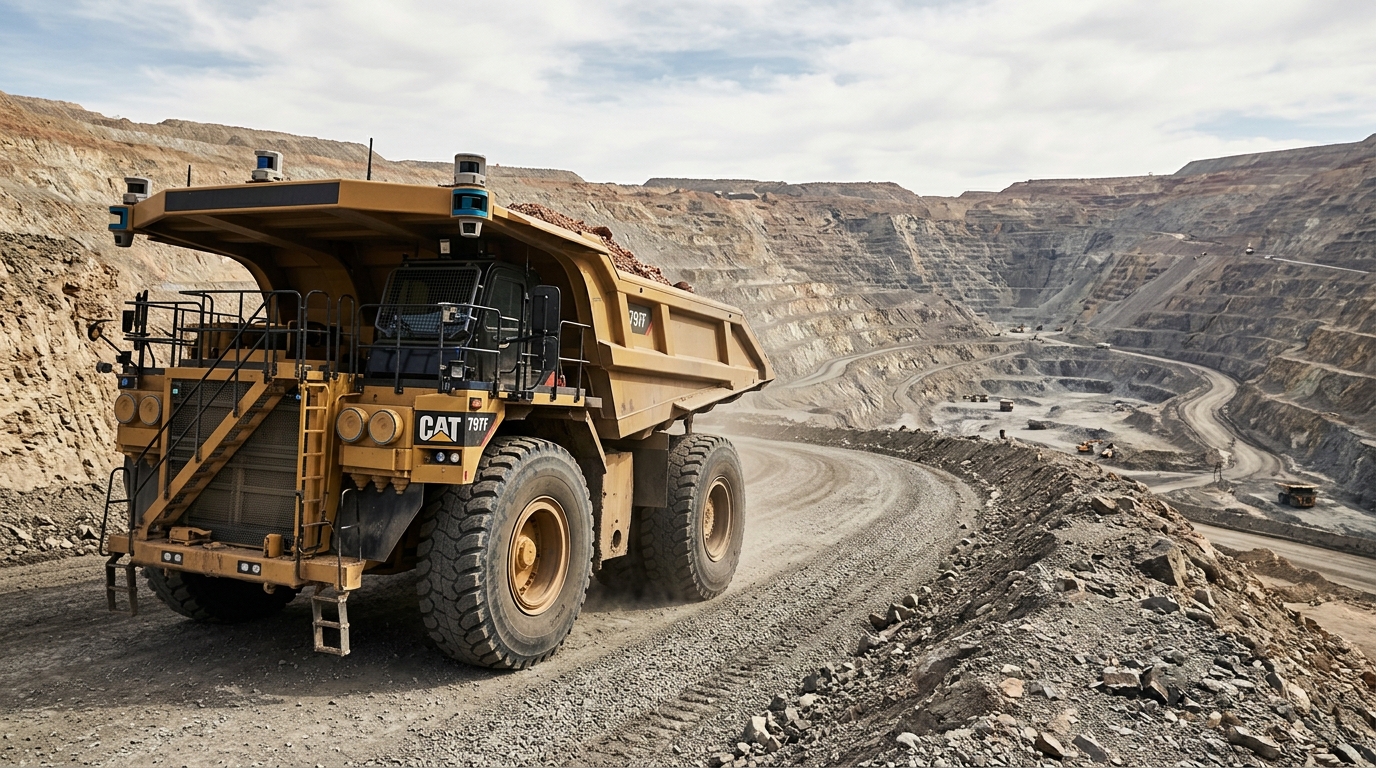
The transition toward autonomous haulage is already visible across established industry leaders. A prominent example of fleet-level automation in active operations is Freeport-McMoRan's project to convert its entire fleet of 33 Cat 793 haul trucks at the Bagdad copper mine in Arizona to autonomous haulage using Caterpillar's Command for hauling system.
This large-scale conversion demonstrates that mine operators do not need to wait for entirely new vehicle architectures to gain the benefits of autonomy. Retrofitting active, field-tested haulage trucks with OEM-certified autonomous kits allows industrial enterprises to preserve their capital investments in existing fleets while capturing the safety, tire wear, and fuel efficiency advantages of automated dispatch.
- Fleet conversion: Upgrading existing heavy machinery, such as 33 Cat 793 haul trucks at the Bagdad mine, to autonomous operation.
- Extended asset life: Retrofit kits maximize return on capital by modernizing proven mechanical platforms.
- Safety record: Commercial autonomous haulage systems globally have moved billions of tonnes of material without operator-involved haulage injuries.
For industrial procurement teams, fleet conversion represents the most viable path to autonomous adoption. Engaging a vendor-neutral systems integrator allows operators to evaluate hardware kits across different machinery brands and select the ideal retrofit architecture for their site's specific physical topography.
Overcoming the Remote Workforce Gap
A primary catalyst accelerating heavy equipment autonomy is the acute labor shortage facing industrial operations in remote regions. Heavy mining, earthmoving, and quarrying sites are frequently located hundreds of kilometers away from major population centers, making recruitment and retention of experienced heavy-vehicle operators an ongoing operational bottleneck.
Autonomous trucks solve the physical staffing constraint by removing the need for round-the-clock manual steering in isolated cabs. However, autonomy does not eliminate the human element; instead, it shifts human roles toward higher-value, remote operational responsibilities.
- Remote fleet supervision: Technicians monitor telemetry, manage dispatch logic, and resolve exceptions from regional command centers.
- Predictive maintenance: Specialized field teams service sensors, calibrate RTK basestations, and maintain drive-by-wire actuators.
- Autonomous safety monitoring: Site safety personnel oversee digital geo-fencing, road conditions, and automated perimeter monitoring across operational boundaries autonomous outdoor robots.
This workforce transformation improves operational continuity. Instead of managing high turnover and costly fly-in-fly-out rosters for haul truck drivers, industrial operations build a resilient team of technical specialists managing fleet orchestration software from centralized control hubs.
Integrating Autonomy into Your Operations
Deploying autonomous trucks and outdoor mobile robotics requires bridging raw OEM hardware with existing mine management, dispatch, and safety networks. Industrial buyers need a structured, vendor-agnostic systems integration process to specify, source, and deploy autonomy kits that fit their operational workflows.
The werob Platform provides the complete operational infrastructure to take autonomous industrial deployments from initial specification to live site execution. Rather than locking into a single vendor's closed ecosystem, operators can evaluate multi-brand solutions and match hardware capabilities directly to site requirements.
- Spec Engine: Formally verifies shift descriptions, haul routes, and cycle specifications into ROS-compatible deployment plans.
- Supplier Match: Evaluates and scores OEM autonomy kits and robotic hardware against regulatory readiness, footprint, and operating conditions.
- Connectors: Pre-built integration middleware that connects robotic telemetry directly into enterprise dispatch, ERP, and fleet management databases.
- Cockpit: Real-time operational dashboard monitoring hardware health, infrastructure connectivity, safety rules, and task escalations across the fleet.
By taking a hardware-agnostic systems integration approach, industrial operators can confidently deploy autonomous haulage systems, unlock stranded assets, and scale high-performance fleet operations across challenging environments.
Turning a stranded deposit into a producing site means specifying autonomous haulage and drilling systems against the site's actual geology and workforce constraints, sourcing hardware from a fragmented vendor field, and integrating fleet telemetry into a single operating picture. werob specifies, sources, and integrates autonomous fleets and retrofit kits from OEM partners for outdoor and industrial operators -- mining included -- without manufacturing the underlying hardware itself.
Read more: Underground mining robotics: what autonomous vehicles do today · Hardware markup and OEM robots: system integration instead of vendor lock-in.
FAQ
- Why did Mariana Minerals raise $310 million?
- Mariana Minerals raised $310 million in August 2026 to advance autonomous trucks in copper mining. This capital will accelerate the deployment of self-driving fleets to extract critical minerals.
- How do autonomous trucks help stranded mines?
- The stated aim of deploying autonomous trucks is to make previously-inaccessible or stranded mines economically viable. By removing the need for on-site crew facilities and shift logistics, remote deposits become profitable to operate.
- Are autonomous haulage systems already deployed at scale?
- Yes, major operators are actively converting their fleets. For instance, Freeport-McMoRan is collaborating with Caterpillar to convert 33 Cat 793 haul trucks to an autonomous haulage system at its Bagdad mine.
- What level of precision do autonomous mining trucks achieve?
- Modern autonomous mining vehicles utilize advanced sensor fusion and differential GPS to achieve sub-10 cm positional accuracy. This allows them to navigate safely around obstacles and active blast zones.
- Does werob manufacture autonomous mining trucks?
- No, werob does not manufacture robots. Instead, it operates as a systems integrator that helps industrial buyers specify, source, and deploy autonomy kits and hardware from established OEM partners.
Related reading
Underground mining robotics: what autonomous vehicles and inspection robots do today
Where autonomous haulage is actually installed in Europe, why ATEX equipment group I decides the hardware list, what the documented German cases are, and what stays with the mine surveyor.
23 July 2026hardware markup oem robotHardware markup OEM robots: system integration instead of vendor lock-in
The choice of robot hardware is secondary to process integration. werob explains how hardware markup for OEM robots paves the way from requirement to productive fleet in eight weeks.
23 June 2026autonomous construction site surveyAutonomous Ground Survey with Legged Robots: As-Built and Progress as a Time Series
Discover how autonomous legged robots and high-precision laser scanners turn isolated site surveys into repeatable weekly progress time series.
17 July 2026deploying autonomous perimeter monitoringDeploying Autonomous Perimeter Monitoring: A Buyer's Guide
Securing sprawling industrial perimeters against intrusion is costly and prone to human error. By deploying IP66-rated autonomous outdoor robots, facility leaders can ensure continuous fenceline monitoring that integrates seamlessly into existing VMS workflows.
13 August 2026IEC 63327 cleaning robot standardIEC 63327: which standard an autonomous cleaning machine is actually built to
Specifications for autonomous scrubbers almost always cite ISO 3691-4. That is the standard for driverless industrial trucks. The floor treatment machine has had one of its own since 2021 — and it rarely appears in the enquiry.
3 September 2026