Rebar-Tying Robots: What Construction Sites Automate First
Discover why rebar-tying robots are the first automation target for construction sites, offering proven ROI, safety, and up to 1,200 ties per hour.
Rebar tying is construction's most practical automation target, offering immediate ROI on large slab-on-grade projects. By deploying autonomous tying robots, contractors can eliminate severe ergonomic risks and multiply intersection output.
Key Takeaways
- 1Autonomous rebar-tying robots can complete over 1,200 ties per hour, covering the output of a four- or five-person tying crew.
- 2Manual tying yields just 200 to 300 intersections per hour while causing severe back strain; automation moves workers to safer tasks.
- 3Autonomous tying is recommended on continuous project areas of roughly 20,000 square feet or larger, with benefits growing as the area grows.
- 4Vendor-neutral integrators match specific site prerequisites to the optimal OEM hardware from a broad supplier ecosystem.
Why rebar tying leads construction robotics ROI
Construction robotics adoption often stumbles when general contractors attempt to automate highly dynamic, unstructured site workflows. Complex tasks such as autonomous excavation, robotic demolition, or multi-story framing introduce volatile variables: unpredictable soil mechanics, shifting obstacles, and non-repetitive path planning. In contrast, rebar tying provides the cleanest operational profile on a jobsite. It is a high-volume, highly repetitive task executed across a predictable horizontal plane, making construction automation straightforward to quantify, schedule, and financially justify.
The financial return on rebar automation is directly tied to countable physical units: intersection density and total square footage. Rather than relying on speculative productivity multipliers, capital expenditure models for rebar tying calculate return on investment directly from the cost per completed tie. Advanced Construction Robotics, the supplier of the TyBOT rebar-tying robot, has offered the machine through a robotics-as-a-service model with usage-based per-tie pricing, alongside direct purchase since 2024[1]. A commercial slab or bridge deck containing hundreds of thousands of rebar intersections therefore offers clear labor offsets, allowing estimators to model labor reduction, cycle time compression, and equipment amortisation against a fixed unit price.
| Workflow Type | Environmental Structure | Path Predictability | Primary Economic Value |
|---|---|---|---|
| Rebar Tying | Structured grid, flat plane | Fixed coordinate grid across slab or deck | Direct labor-hour reduction per tie |
| Earthmoving & Excavation | Unstructured soil, changing depths | Continuous dynamic re-planning | Fuel efficiency and grade precision |
| Layout & BIM Printing | Semi-structured slab surface | 2D CAD coordinate translation | Elimination of manual chalk rework |
| Vertical Masonry | Dynamic multi-level vertical envelope | Complex spatial positioning | Scaffold labor and block placement |
Because the task is mechanical, localized, and geometrically regular, contractors do not need to overhaul entire site logistics to realize value. Working with a vendor-neutral systems integrator enables contractors and rebar subcontractors to scope the exact hardware requirements, evaluate commercial feasibility, and integrate autonomous tying machinery into active site schedules without proprietary hardware lock-in.
The structural case for mat foundations and slab-on-grade
The geometric simplicity of large-scale concrete foundations makes horizontal flatwork the ideal operational environment for construction robotics. Mat foundations, industrial slab-on-grade pours, data center footings, and bridge decks share a critical structural feature: massive horizontal surface areas with uniform rebar mats laid out in rigid, orthogonal grids. This structural uniformity removes the primary obstacle that disables most field robotics: environmental chaos.
In vertical construction or intricate architectural formwork, robotic arms must constantly adjust for variable angles, tight clearances, and changing spatial envelopes. Horizontal slabs, by contrast, allow autonomous gantries and wheeled rovers to operate on fixed coordinate axes. The machine moves along straight parallel lines, using edge forms or screed rails as reference tracks, while vision systems detect perpendicular intersections with minimal computational overhead.
- Orthogonal grid consistency: Standard spacing (such as 6-inch, 8-inch, or 12-inch centers) creates a repeatable target matrix for robotic tie heads.
- Linear track navigation: Gantry systems utilize existing bridge deck screed rails or modular jobsite rail assemblies, eliminating complex simultaneous localization and mapping (SLAM) errors.
- Massive intersection volume: Expansive logistics slabs and infrastructure decks concentrate tens of thousands of ties within a single continuous zone, maximizing continuous operational uptime.
- Decoupled trades: Horizontal rebar tying can occur during dedicated site windows or night shifts without competing for crane picks or vertical hoist access.
This scale advantage turns rebar tying into a high-throughput factory process deployed directly on the jobsite. By focusing automation on large horizontal slabs rather than irregular vertical elements, trade contractors capture immediate productivity gains while keeping site logistics reliable.
The ergonomic toll and labor limits of manual tying
Manual rebar tying is widely recognized as one of the most physically punishing jobs in the construction industry. Ironworkers (commonly referred to as rodbusters) spend entire shifts stooped over horizontal mats, placing thousands of manual wire ties using pliers or handheld trigger-operated tying tools. This sustained posture creates extreme biomechanical stress on the lumbar spine and upper extremities.
The National Institute for Occupational Safety and Health (NIOSH) evaluated reinforcing ironworkers' exposures to risk factors for low-back and hand disorders while they tied rebar on a freeway bridge deck, and found that power tying tools reduced those exposures[2]. CPWR, the Center for Construction Research and Training, notes that stooped postures from bending over to tie rebar can cause low-back disorders such as muscle strain or disc herniation, while stressful hand and wrist activity from repetitive tying can cause tendonitis or carpal tunnel syndrome. That physical strain shortens trade careers and contributes to the shortage of skilled rodbusters across commercial construction.
| Operational Metric | Manual Rodbuster Baseline | Autonomous Robotic System |
|---|---|---|
| Average Output Rate | 200 to 300 intersections per hour per worker | 1,200+ ties per hour running uninterrupted |
| Postural Risk Exposure | Continuous deep trunk flexion (stooping) | Upright equipment supervision and wire reload |
| Hand-Wrist Biomechanical Strain | High repetitive twisting and grip stress | Automated motorized wire feed and cut mechanism |
| Shift Endurance | Declines significantly over a long shift | Continuous operation for up to 10 hours without refueling |
A skilled manual ironworker typically averages between 200 and 300 ties per hour under standard site conditions[3]. Sustaining that pace across an entire eight-hour shift is physically unsustainable, leading to fatigue-related slowdowns and inconsistent tie tension. Automating the bulk tying phase takes ergonomic risk out of the schedule, and the value contractors report is the ability to redeploy the workers who would have been tying rebar onto more critical-path items such as carrying and framing out steel.
Autonomous performance benchmarks and TyBot capabilities
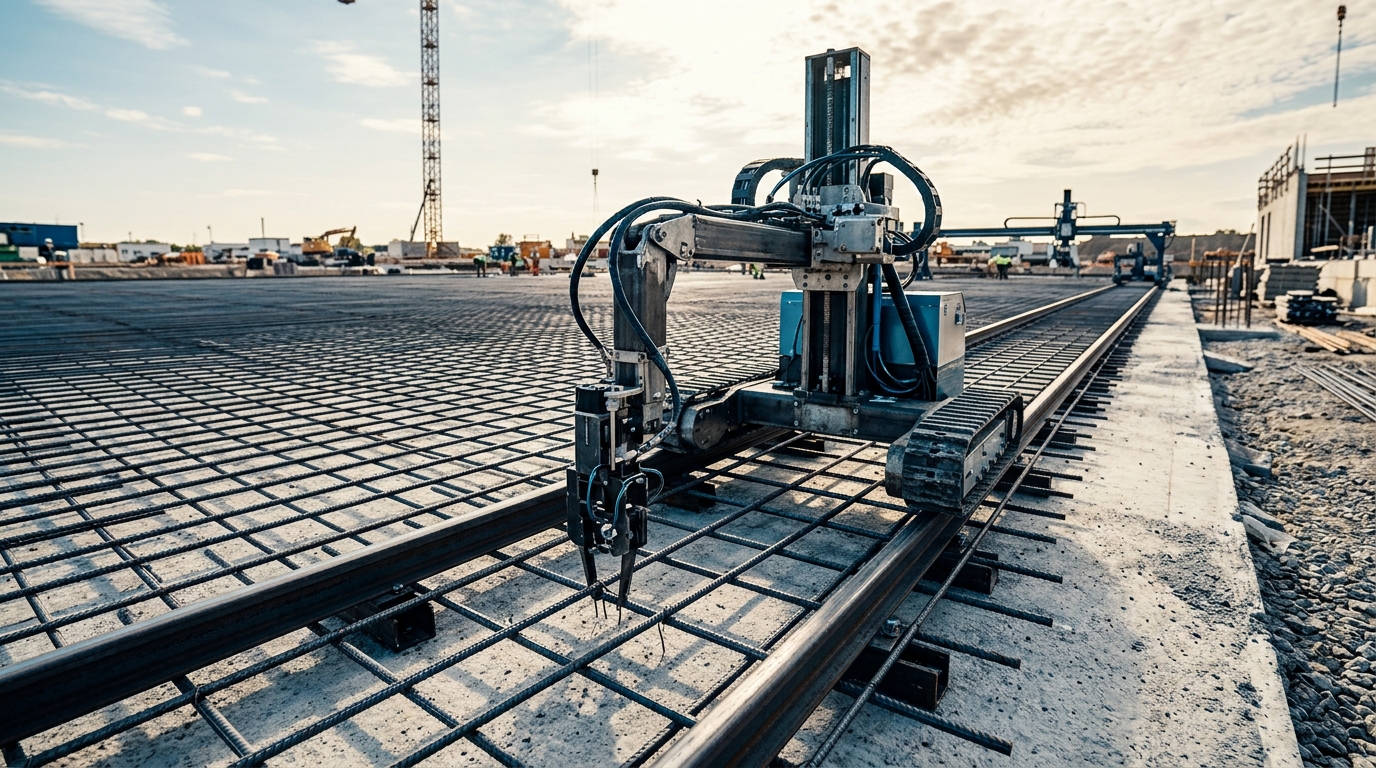
Modern purpose-built rebar robots have transformed tying from an experimental concept into a field-proven production standard. The primary benchmark in heavy civil and large-scale horizontal concrete construction is TyBot, developed by Advanced Construction Robotics (ACR), which brought the machine to commercial market. Engineered as a gantry system that spans bridge decks and structural slabs, it autonomously navigates the deck and identifies and ties rebar intersections using robotics and computer vision, with no pre-programming or calibration required.
In production environments, TyBOT delivers an active tying rate of 1,200+ ties per hour and runs continuously for up to 10 hours without refueling, day or night and in all weather. Contractors report that a single autonomous gantry covers the work of four to six ironworkers tying at manual pace[3]. On the Florida Department of Transportation's Gateway Expressway project near Tampa, rebar contractor Shelby Erectors set a 2022 production record with a single TyBOT tying 11,044 rebar intersections in one 10-hour shift, and the machine has since averaged roughly 36,000 ties across a standard 40-hour week[3]. The machine ties black, epoxy-coated, galvanized, stainless, and fiberglass rebar up to #8 by #9 intersections, using 16.5 AWG plastic-coated or 16 AWG black annealed wire on 15-pound spools.
- Initial Site Positioning: The gantry is assembled onto existing edge forms or screed rails at working widths expandable from 10 to 117 feet, and is operational within about two hours of arriving on site.
- Autonomous Optical Scan: The machine locates the reinforcing steel intersections itself, without pre-programming or calibration.
- High-Speed Execution: The tie module positions itself over each intersection, then feeds, wraps, twists, and cuts the tie wire before the tram advances to the next target.
- Pattern Flexibility: The system executes alternating-intersection tie patterns in 100%, 50%, and 33% configurations to match owner and state DOT specifications.
- Supervised Continuation: A single supervisor monitors performance and reloads the tie wire spool when necessary, swapping the 15-pound wire spools three or four times in a 10-hour shift[3].
Field experience points to a rule of thumb that autonomous rebar tying pays back on jobs of roughly 20,000 square feet or greater, growing more attractive as the area expands[3]. Suppliers report that contractors average a minimum of 25% schedule savings on deck and slab work, eliminating trade bottlenecks ahead of concrete pour schedules.
Site prerequisites and integrator scoping
Deploying an autonomous rebar robot requires structured operational planning and rigorous site readiness validation. While the hardware operates autonomously once initiated, the physical jobsite environment must meet specific structural parameters to ensure uninterrupted machine travel, secure bar stability, and full code compliance.
Before mobilizing machinery, a robotics systems integrator assesses site geometry, rail tolerances, and reinforcement specifications. Prior to robotic tying, the placement crew must place the bars and spot-tie roughly 10% of the intersections to secure the mat in position, and on the TyBOT class of machine the gantry runs on the screed rail supports installed for the concrete finishing machine, which CPWR notes must be in place before the robot arrives on the jobsite.
- Screed rail and edge support: Verification that edge forms or pipe rails support gantry wheel bogies across the full working width without structural deflection.
- Bar size and coating compatibility: Confirmation that reinforcing bar combinations fall within machine limits, which on the TyBot class of machine means compatibility up to #8 by #9 bar, with matching tie wire in black annealed, epoxy, or plastic-coated form.
- Grid clearance and chairing: Inspection of rebar chairs and standoffs to guarantee that lower and upper mats maintain rigid separation during tying cycles.
- General contractor sequencing: Alignment of crane pick schedules, delivery staging, and pour windows so that tying automation finishes directly ahead of concrete pumping crews.
To streamline this pre-deployment engineering, integrators increasingly rely on automated specification workflows. A spec engine converts plain-language shift requirements, structural drawings, and site constraints into formally verified, ROS-compatible action graphs, so that site teams receive an actionable operational plan before equipment arrives on-site.
Sourcing hardware for specific project parameters
No single robotics OEM manufactures a machine suited for every concrete reinforcement scenario. A bridge replacement project spanning a wide river canyon demands a wide-span gantry system, whereas an interior data center slab with dense column penetrations may require compact, rover-based tying units. Committing capital to a single proprietary hardware vendor exposes general contractors to utilization gaps and vendor lock-in.
Commercial terms have matured alongside the hardware. Advanced Construction Robotics has long offered TyBOT through a robotics-as-a-service model billed per completed tie, and began offering the machine for direct purchase as well following the TyBOT 3.0 announcement, at a manufacturer-listed base price starting around $425,000 for the standard 67-foot working width and $455,500 for the extended 117-foot configuration. That gives contractors with sustained deck or slab volume a capital-purchase path alongside the pay-per-tie option.
A vendor-neutral systems integrator evaluates hardware based entirely on project-specific constraints: geometry, production deadlines, local regulatory standards, and service logistics. Rather than pushing proprietary machinery, the integrator selects optimal hardware from a broad ecosystem of global robotics manufacturers.
| Evaluation Dimension | Assessment Metric | Operational Impact |
|---|---|---|
| Regulatory Readiness | CE marking, OSHA machinery safety compliance, emergency stop architecture | Prevents jobsite safety shutdowns and ensures trade union acceptance |
| Span and Payload Capacity | Gantry truss span (10 to 117+ ft) or autonomous ground rover footprint | Determines physical fit across slab boundaries and screed rail setups |
| Regional Service Coverage | Proximity of certified field technicians and rapid spare part logistics | Minimizes unplanned downtime during critical pre-pour tying windows |
| Tie Wire Flexibility | Compatibility with 16 AWG / 16.5 AWG black, epoxy, and stainless spools | Ensures compliance with structural engineering DOT and ACI tie specifications |
| Commercial Model | Robotics-as-a-Service (RaaS) per-tie pricing vs capital equipment lease | Aligns project cash flows directly with subcontracted bid items |
To match project requirements against available technologies, werob utilizes Supplier Match. The software scores and ranks a supplier graph of over 44 robot manufacturers based on regional service availability, regulatory compliance, operational footprint, and price band. This ensures that contractors deploy machinery matched specifically to their structural drawings, tie schedules, and regional operating conditions.
Fleet deployment and ongoing site monitoring
Securing the right robotic hardware is only the initial step; successful site execution depends on integrating the machine into everyday construction management operations. Jobsite supervisors, project managers, and quality inspectors need real-time visibility into tie counts, machine status, battery health, and safety interlocks without needing deep robotics engineering expertise.
Integration middleware bridges the operational gap between field robotics and enterprise construction software. Connectors provide pre-built integration layers that link robotic telemetry directly into project management platforms, ERP systems, and subcontractor scheduling tools. By feeding real-time tying counts into daily progress reports, site managers can confirm mat completion percentages and schedule concrete deliveries with precise timing.
- Real-time progress telemetry: Live tracking of completed tie counts, square footage covered, and cycle time per intersection.
- Four-dimension health tracking: Instant status indicators covering hardware status, site infrastructure readiness, regulatory parameters, and operational spec alignment.
- Spool and consumable monitoring: Predictive alerts for tie wire spool replenishment and battery or fuel levels to prevent mid-shift stoppages.
- Escalation and safety logging: Automated incident capture, obstacle alerts, and supervisor intervention logs stored for project quality assurance.
Centralized operational oversight is managed through Cockpit, a unified monitoring dashboard that provides use-case-level traffic lights across hardware, infrastructure, regulatory, and specification dimensions. Cockpit displays live supervisor task assignments, training records, and diagnostic logs in a single interface. By combining vendor-neutral procurement through Spec Engine and Supplier Match with continuous live orchestration via Cockpit and Connectors, the werob Platform delivers an end-to-end integration framework that turns rebar-tying automation into a predictable, repeatable jobsite standard.
FAQ
- What is the ROI threshold for a rebar-tying robot?
- Return on investment for autonomous rebar-tying robots typically begins on projects measuring 20,000 square feet or larger, where the sustained pace outstrips manual labor costs.
- How fast can a rebar-tying robot operate compared to a human?
- While a skilled human ironworker can complete 200 to 300 ties per hour, modern autonomous robots can consistently execute over 1,200 ties per hour without requiring breaks.
- Do rebar-tying robots require pre-programming or BIM input?
- Leading models use computer vision to self-navigate and identify intersections dynamically on the grid, requiring no prior BIM mapping or complex pre-programming from the crew.
- What site prerequisites are needed for a rebar-tying robot?
- The site generally requires a regular grid layout, such as a slab-on-grade or mat foundation, and existing edge forms or screed rails for the gantry to travel along.
- How does a systems integrator help deploy rebar robots?
- A vendor-neutral integrator uses tools like Spec Engine and Supplier Match to translate site requirements into technical specifications and source the optimal hardware from various OEMs.
Related reading
Crane Time Is the Scarcest Resource: Which Construction Robots Need No Pick
The crane sets the tempo of the site, and it is not going autonomous in this planning cycle. So the useful question is not which robot lifts, but which one works without booking crane time — and which one competes for the hook or the airspace anyway.
2 September 2026robot deployment spec automationRobot Deployment Spec Automation for Scalable Operations
Traditional robotics procurement takes months of discovery. werob uses a Spec Engine trained on 35,000 projects to deliver deployable specs in 48 hours.
5 July 2026largest systems integrator roboticsThe Largest Systems Integrator for Robotics in Europe
Robotics is no longer about the machine; it is about the integration. Discover how the world's largest systems integrator translates complex workflows into live robot fleets across 11 countries.
3 July 2026bricklaying robot masonry constructionBricklaying Robots 2026: Fastbrick Systems on Site
Evaluate masonry robotics for construction in 2026. Discover what truck-mounted systems like Fastbrick's Hadrian X actually deliver on real job sites.
21 August 2026construction site theft surveillance robot drone night2,156 thefts, one in ten solved: what a construction site can establish at night, and what is not its job
The Baden-Württemberg state criminal police office counted a good two thousand thefts from construction sites and building shells in 2023, with almost ten million euros of damage, and about one case in ten was solved. The nationwide figures circulating beside that differ by a factor of six. From the numbers that hold up follows a task for the technology, and it is not to recognise the thief: it is to establish that something is happening on the ground, and to send someone.
16 September 2026