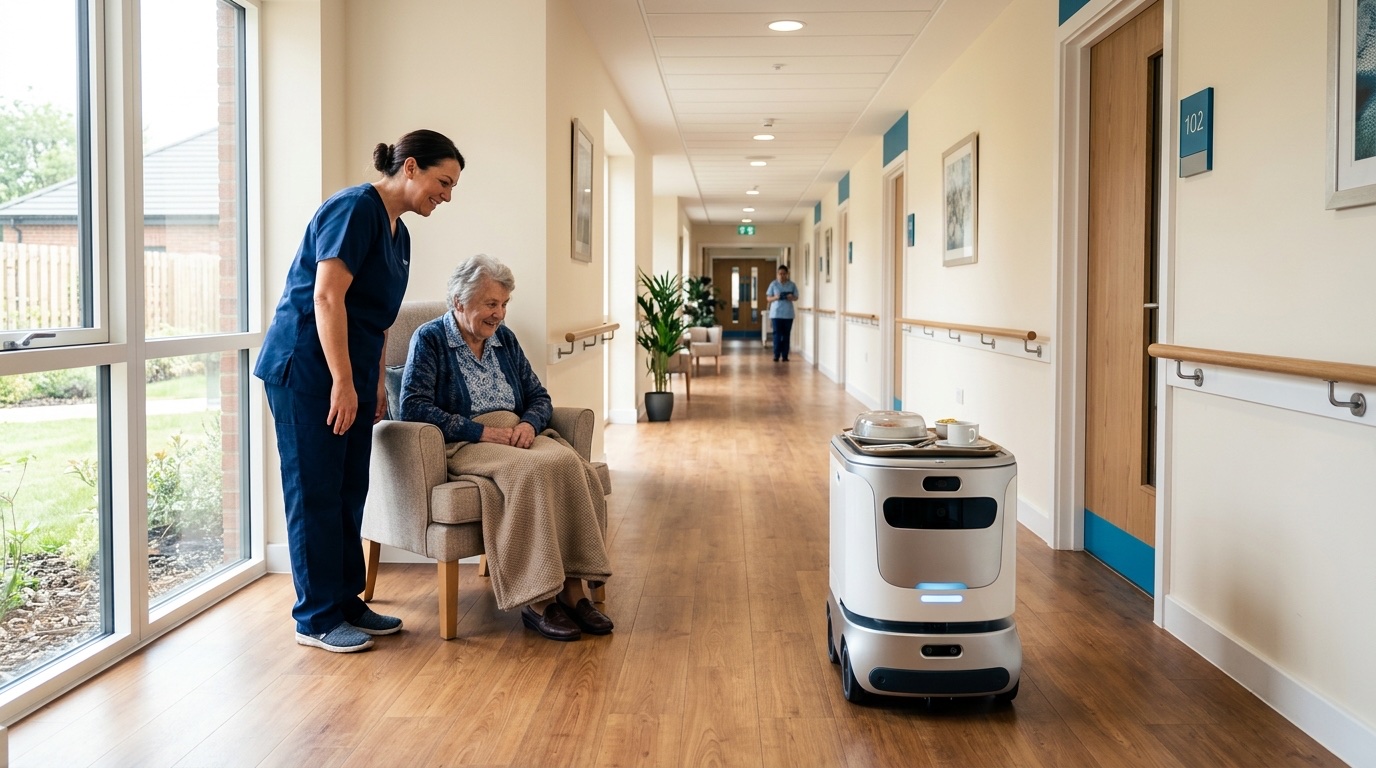
Care robot deployments: why acceptance decides success
Discover why care robot deployments fail over staff acceptance rather than technical limits, and how operators can design successful robotic pilot projects.
Care robot deployments rarely fail over technical limits; they fail when systems arrive without staff input. Drawing from a 2026 Swiss robotics module, this guide shows why acceptance is a design input, and how operators can navigate pilots and works council approvals.
Key Takeaways
- 1Care robot deployments fail due to poor staff acceptance, not technical limits.
- 2Acceptance is a design input that dictates routing and hardware, not a post-purchase communication exercise.
- 3A realistic pilot must run on actual routes at real operating hours, going beyond a scripted demo loop, to capture real operational friction.
- 4Resident opt-outs must be operationally supported with manual alternatives rather than framed as resistance.
- 5Involving the works council early to address shift structures and data privacy speeds up the specification process.
The FHNW module: Evidence for transport over care
Autonomous service units deliver operational value in care facilities when they take over repetitive internal transport, whereas direct clinical care remains firmly human. In a block module titled "Pflegerobotik", reported by the School of Engineering and Environment at FHNW (Hochschule für Technik und Umwelt FHNW, one of the 10 Hochschulen that make up the university of applied sciences in northwestern Switzerland) in June 2026, students examined how robotics, automation and AI could concretely support care institutions, explicitly as relief in daily work rather than as a replacement for human care[1]. Rather than running a theoretical laboratory experiment or a multi-year controlled trial, students worked directly on site across Swiss care institutions, observing workflows and speaking with staff. This was a teaching module analysing real situations, not a controlled trial.
The on-site work took place across multiple facilities, including Alterszentrum am Bachgraben in Allschwil, Alters- und Pflegeheim Reiden, Seniorenzentrum Untergäu, and Pflegezentrum Süssbach AG in Brugg, with a visit to Inselspital Bern adding a hospital-logistics perspective on where robots already move goods, materials, laundry and medication[1]. At Pflegezentrum Süssbach, students examined how a Pudu service robot could support care staff in everyday work. The tasks considered were simple and recurring, and sat in distribution and service rather than resident handling: transporting soiled laundry, dishes or beverages, supporting water rounds, accompanying room rounds, and distributing newspapers[1].
The conclusion the students recorded was straightforward: "So ein Roboter kann den Pflegealltag erleichtern, weil er Aufgaben übernimmt und dadurch mehr Zeit für die Bewohnerinnen und Bewohner bleibt" (A robot can relieve the daily care routine because it takes over tasks, leaving more time for residents)[1]. Prof. Dr. Roland Anderegg, Head of the Institute of Automation at FHNW, described where automation realistically fits: "Der Transport und gewisse Servicedienstleistungen können von Robotern übernommen werden" (Transport and certain service duties can be taken over by robots). Within care work itself he names exoskeletons as an important topic, and sees a possible role for social robotics[1].
| Task Category | Evaluated Use Case | Operational Boundary |
|---|---|---|
| Linen Logistics | Transporting soiled laundry bags to utility collection points | Point-to-point corridor transport without room entry |
| Catering Support | Delivering meal trays and clearing dining areas | Pre-programmed service stops in dining rooms |
| Hydration Rounds | Carrying water carafes and beverage crates | Accompanying care staff on scheduled corridor rounds |
| Material Distribution | Distributing daily newspapers and mail to ward stations | Fixed distribution route to central nurse stations |
Understanding these operational boundaries is essential when planning deployments in elderly care robotics. The Swiss findings demonstrate that service robots function as mobile utility carts that remove physical carriage from staff, rather than autonomous caregivers.
Acceptance as a design input, not just communication
Treating operational acceptance as a design input alters what hardware an operator procures, how routes are mapped, and when missions run. In traditional rollouts, management finalises hardware procurement and relies on post-purchase change management or internal marketing to persuade staff to use the machine. When staff input is collected only after delivery, operators cannot alter fundamental payload limits, turning radii, or acoustic profiles, leaving persuasion as the only remaining lever.
When operator teams treat staff and resident feedback as a core specification parameter before signing a lease, the technical design changes immediately. Nursing staff highlight pinch points, shift handover bottlenecks, and peak corridor traffic hours that external vendors cannot see on floor plans. As Prof. Dr. Roland Anderegg emphasized in the FHNW project: "Der wichtigste Unterschied besteht in der Einbindung der Pflegefachkräfte und auch der zu Pflegenden in den Entwicklungsprozess" (The decisive difference is involving both the care staff and the people being cared for in the development process)[1].
- Procurement Scope: Early staff feedback determines whether a facility needs enclosed lockable compartments for laundry or open multi-tiered trays for dining support.
- Mission Scheduling: Input from ward teams aligns autonomous runs with resident quiet hours and shift handovers rather than arbitrary clock intervals.
- Kinematic Parameters: Setting maximum speeds and audible announcements based on resident mobility profiles prevents corridor alarm and obstruction.
- Floor Routing Logic: Ward observations define whether robots navigate to individual room doors or hold at central drop-off bays.
Integrating frontline feedback into early planning prevents expensive retrofits and vendor lock-in, creating a technical deployment shaped around existing care routines rather than forcing wards to adapt to rigid machine behavior.
Who to consult and when to involve them
Successful robotic integration requires consulting specific operational groups long before a hardware shortlist is locked. Speaking only to ward managers or executive directors creates blind spots regarding shift-specific routines, sanitary boundaries, and physical building constraints. Every department that shares physical corridor space or utility infrastructure must participate in setting requirements.
- Ward Care Staff: Consult nurses and nursing assistants on the target ward before shortlisting hardware, focusing on physical strain points during morning and evening rounds.
- Night Shift Personnel: Engage night staff separately because nocturnal constraints involve reduced lighting, strict silence requirements, and solitary staffing levels where automated obstructions cannot be tolerated.
- Housekeeping and Kitchen Teams: Involve staff who manage laundry trolleys, food delivery carts, and cleaning equipment to establish corridor right-of-way rules and shared elevator priority.
- Residents and Relatives: Introduce concept plans during family advisory meetings before equipment delivery to explain the machine's role as a utility cart and address privacy questions.
- Works Council (Betriebsrat): Present technical logging parameters, data storage locations, and operational boundaries to the works council at the initial specification stage.
- Safety and Compliance Officers: Engage the facility hygiene officer and fire safety officer early to verify surface disinfection compatibility and emergency corridor clearance protocols.
Structuring stakeholder consultations prior to hardware procurement eliminates late-stage operational vetoes and ensures safety compliance across hygiene, fire safety, and labor regulations.
What to pilot for realistic deployment data
A pilot deployment must evaluate a single, recurring transport task with an assigned staff owner on a live route rather than running scripted demo loops. Demonstration tours in empty administrative hallways fail to uncover real operational friction, such as Wi-Fi dead zones, elevator timing mismatches, or localized corridor congestion during morning service.
The practical adjustments made during the FHNW module at Alterszentrum am Bachgraben illustrate this principle clearly. When testing table-clearing transport in the dining hall, the initial setup assigned a dedicated stopping point to almost every individual table. In practice, this made the robot stop frequently and the workflow became slower rather than faster. The students therefore adapted the approach by defining larger areas instead, for example "Tische A" and "Tische B", so that service staff could close out the job once an area was fully cleared and the robot moved automatically to its next destination[1].
Structured trials capture operational barriers that short demonstrations miss. An integrative review in BMJ Open, covering 17 studies on implementing robotic devices in nursing care, reports that the most frequently cited barriers sat in the socioeconomic and ethical domains and in implementation outcomes, while the facilitators related to the sociocultural context, the implementation process and the implementation strategies used[2]. The authors also note that systems which work as expected in laboratory settings have failed to show feasibility, acceptance or effectiveness in practice, and suggest one likely explanation is that the complexity of implementation was underestimated or insufficiently addressed[2]. A pilot evaluated on live routes is where those conditions become visible.
- Single Workload Focus: Limit initial testing to one measurable logistics flow, such as morning laundry return or post-lunch dish collection.
- Live Environment Timing: Run missions during peak operational hours when corridors contain carts, walking frames, and active staff.
- Zone-Based Waypoints: Group stopping locations into manageable departmental zones rather than programming micro-stops at individual room doors.
- Dedicated Shift Ownership: Assign one lead caregiver per shift who is trained to dispatch missions, clear obstacle halts, and record daily deviations.
Evaluating real service routes under live staffing conditions produces verifiable performance data, enabling facilities to refine task allocation before committing to full-scale rollouts.
How to handle a resident who opts out
Care home operations require robust, non-punitive opt-out mechanisms for residents who do not want robotic interaction. In a residential healthcare setting, refusal must never be treated as staff or resident resistance to be overcome through persuasion. Because a care facility is a home, resident autonomy and psychological comfort take precedence over automated routing efficiency.
An operational opt-out must be built directly into the facility's logistics workflow. If a resident in room 14 requests that the machine never approach their doorway, the software navigation map must incorporate a restricted exclusion zone, and internal rosters must assign manual tray and laundry delivery for that room. A deployment that only functions when every resident complies is fundamentally unsuitable for senior living environments.
- Configurable Exclusion Zones: Restrict navigation maps so autonomous units avoid specific room entrances, seating alcoves, or specialized memory-care corridors.
- Parallel Manual Workflows: Maintain standard manual delivery protocols for meals, linen, and hydration for residents who decline automated service.
- Named Contact Person: Designate a clear ombudsperson or head of care to whom residents and family members can register preferences without justification.
- Documented Resident Registry: Maintain an operational record within the ward coordination system to ensure shift rotations honor individual resident preferences.
Establishing clear opt-out workflows maintains dignity in care automation and ensures that technological deployments adapt to human vulnerability rather than forcing compliance.
Navigating the Betriebsrat conversation
Engaging the works council (Betriebsrat) early with documented technical facts prevents protracted labor disputes and accelerates deployment timelines. Employee representatives routinely evaluate service robotics to ensure that automation does not increase physical workloads, enforce covert performance monitoring, or destabilize shift staffing models. Presenting formal technical parameters at the specification phase builds institutional trust.
| Council Concern | Operational Risk | Documented Operator Commitment |
|---|---|---|
| Performance Tracking | Using robot telemetry to evaluate individual staff pacing | Binding agreement that telemetry logs track machine status only, with no individual staff identification |
| Workload Escalation | Reallocating logistical savings into unmanageable care quotas | Documenting that logistics automation offsets existing overtime and physical transport strain |
| Failure Management | Leaving nursing staff stranded with broken hardware during shifts | Establishing formal on-call technical response SLAs and immediate manual fallback protocols |
| Sensor Data Privacy | Cameras and LiDAR recording resident and staff movements | Local sensor processing without external video streaming, fully compliant with GDPR data minimization |
Works councils require verifiable documentation rather than verbal assurances. Providing formal data processing disclosures, showing that sensor feeds process localization data locally without cloud video recording, addresses statutory data protection obligations under EU GDPR. Involving employee representatives in defining stopping zones and shift schedules transforms the Betriebsrat into an active design partner.
Acceptance decides if technical systems run
Technical navigation, obstacle avoidance, and battery management are largely solved engineering challenges; operational acceptance remains the determining factor in whether a system is utilized or parked in a corridor closet. A machine that navigates reliably but creates friction with nursing routines, frightens residents, or triggers labor disputes will be switched off by ward staff within weeks of commissioning.
Capital investment in robotics technology continues to grow across Europe and Switzerland. For example, Zurich-based robotics startup Flexion raised a $50 million (€43 million) Series A round in late 2025 to develop advanced robotics intelligence stacks[3]. However, venture funding and advanced software architectures cannot bridge the gap between engineering benchmarks and real-world ward workflows. Operational success depends entirely on aligning machines with the human requirements of care staff and residents.
To manage these socio-technical complexities, systems integration approaches like the werob Platform coordinate hardware specification, stakeholder requirements, and operational deployment, ensuring that automation reliably supports daily care routines.
FAQ
- Why do care robotics deployments typically fail?
- Deployments usually fail because of poor staff acceptance, not technical limitations. When a robot arrives on a ward without prior input from the care staff, it disrupts established routines. Acceptance must be treated as a primary design input before the purchase order is signed.
- Which tasks should a care robot handle during a pilot?
- Pilots should focus on simple, recurring transport and service tasks with a clear owner, such as moving soiled laundry or delivering dishes. Direct care duties should be left to human staff. Even a short trial must run on actual routes during real shift hours to be valuable.
- When should the works council be involved in a robotics project?
- The works council (Betriebsrat) should be engaged early in the planning phase, well before a vendor shortlist is finalised. Discussing changes to shift structures, data protection, and performance monitoring early on prevents costly delays and builds trust with the staff.
- How should care homes handle residents who refuse robot interactions?
- Resident refusal must be respected and operationally supported. Facilities should establish alternative manual services, adjust the robot's routing to avoid certain areas, and designate a human contact person. Expecting every resident to comply is unrealistic for a care home environment.
- What did the FHNW care robotics module demonstrate?
- The June 2026 teaching module at the FHNW School of Engineering and Environment showed that service robots such as the Pudu model examined at Pflegezentrum Süssbach are best suited to recurring transport and service tasks. Its scientific lead stressed that involving both care staff and the people being cared for in the development process is the decisive difference.
- Are large investments in robotics solving the acceptance problem?
- No. Funding rounds advance the technology rather than ward-level acceptance. The human element of integrating robots into daily care routines remains the harder challenge.
Related reading
Robots in Elderly Care: Deployable Today vs Years Away
Discover which robotics solutions are genuinely ready for European elderly care facilities today, and why humanoid caregivers remain years away.
24 August 2026care robotsCare Robots in Practice: Operational Efficiency for Operators
The introduction of care robots often fails because of months-long discovery phases. werob shortens the path from workflow analysis to a ready-to-deploy fleet to eight weeks and secures regulatory compliance.
1 June 2026robot lift integrationLifts, Fire Doors and WiFi: What Decides Hospital and Hotel Robot Projects
Discover how to integrate service robots in hospitals and hotels by mastering elevator APIs, fire door hold-open systems, and seamless WiFi roaming.
25 August 2026amortization robot carePayback of robots in care: ROI analysis for operators
The payback of robots in care does not depend on the hardware, but on the integration into the workflow. Find out how you can save up to 92,000 euros per year through automated medication rounds and transport routes.
21 June 2026service robot deploymentService Robot Deployment: Why Wheeled Models Win
While humanoids capture funding headlines, discover why wheeled, task-specific service robots are the practical choice for hospitals and care homes today.
26 August 2026