2,156 thefts, one in ten solved: what a construction site can establish at night, and what is not its job
The Baden-Württemberg state criminal police office counted a good two thousand thefts from construction sites and building shells in 2023, with almost ten million euros of damage, and about one case in ten was solved. The nationwide figures circulating beside that differ by a factor of six. From the numbers that hold up follows a task for the technology, and it is not to recognise the thief: it is to establish that something is happening on the ground, and to send someone.
Anyone looking for the cost of construction-site theft in Germany finds three figures that do not fit together: 80 million euros a year, 300 to 500 million, 500 million attributed to the insurers. None of them can be traced to a published primary source, and a figure that swings by a factor of six is no basis for an investment. What does exist is a state figure with a sender: the Baden-Württemberg state criminal police office counted a good two thousand thefts from construction sites and building shells for 2023, with almost ten million euros of damage and a clearance rate of about ten percent. This article takes those figures as the starting point, derives from them what technology on a site should do at night and what it should not, sets the three hardware classes that come into question side by side, and takes over the boundary this website's aerial side drew for site security, without redrawing it.
Key Takeaways
- 1The state figure holds up: according to the LKA Baden-Württemberg there were 2,156 thefts from new builds and shells, site huts or construction sites in 2023, with more than 9.90 million euros of damage, 15.5 percent more than the year before at an almost unchanged case count; in 2019 the damage was 6.60 million. Only about one case in ten was solved.
- 2The nationwide totals circulating in guides and press releases range from 80 million to 500 million euros a year and cannot be traced to any published statistic. They are not used here; anyone who has to justify an investment takes their own state police figure or their own loss history.
- 3A clearance rate of ten percent says what the technology does not have to do: recognise the thief. It has to establish that something is happening on the ground and send someone before the van is loaded. That is the same boundary this website's aerial side draws for site security: establish that, not who.
- 4Three hardware classes come into question for the night: the mobile camera mast as the security trade's standard product, the ground patrol robot, and the drone-in-a-box. They differ in how they cope with ground that looks different every week, and in what their alarm contains.
- 5A construction site is not a factory yard: by day a workplace for employees, often without a closed fence, with edges onto public space. Assessing those edges and the employee question belongs in-house, before sensor selection; this article does not make that assessment and does not answer the signage question either.
The figures that have a sender
The Staatsanzeiger Baden-Württemberg published the state criminal police office's figures for 2023 on 21 November 2024: a total of 2,156 thefts from new builds and shells, site huts or construction sites, with material damage of more than 9.90 million euros. That is 15.5 percent more damage than the year before, in which the LKA had counted 2,182 cases and 8.57 million euros; four years earlier, in 2019, the damage stood at 6.60 million euros on a similar case count. The case count is stable, then, and the damage per case is rising. According to the LKA only about one case in ten was solved. What disappears the report lists: cable, tools, angle grinders, circular saws, cordless drills, batteries, plate compactors, welding machines, power cable, toilet bowls, a mini-excavator. One case in the report stands for the scale of a single raid: copper worth around 40,000 euros from one site, with a day's work lost.
Those figures are for one state, and they are the most robust thing publicly available. The nationwide amounts that appear in security firms' guides, in surveillance vendors' press releases and in trade articles lie between 80 million and 500 million euros a year, the latter attributed to the insurers' association, without a published statistic to be found for it. That spread is itself the information: there is no nationwide primary source, and anyone who has to justify an investment in night security takes the figure of their own state police office, where it publishes one, or their own loss history of the last three years. A figure from a press release that sells a product is no basis.
What ten percent clearance means for the technology
The clearance rate is the most useful figure in the report, because it fixes the technology's task. If nine cases in ten go unsolved even though cameras have long hung on many sites, then recognising a thief after the fact from recordings is not a route an operator should rely on; that is the police's business, and it rarely succeeds. What the technology can do is something else: establish that something is happening on the ground at night that should not be, and get that finding to a person so fast and so unambiguously that they intervene before the van is loaded. The damage does not occur at the moment someone climbs the fence, but in the twenty minutes after.
That is exactly the boundary this website drew on the aerial side for site security: the flight is there to establish that something is happening on an area, not who is there; person identification, biometric matching and crowd monitoring are expressly not part of what is specified, and that belongs in the requirement before sensors are chosen. For the building site that boundary is not redrawn here but taken over, and on a building site it is easier to keep than on a factory yard: at night nobody should be there. An alarm that says something larger than a fox is moving on the storage yard at three in the morning is the whole purpose. Whether it is a person and which one is irrelevant to the response.
Three hardware classes for the same night
Three hardware classes are available for this task, and they are not equivalent. The first is the mobile camera mast, a trailer or container with a mast, cameras, floodlight, loudspeaker and its own power supply, which the security trade has offered for years as the standard product for building sites and connects to a control room. It is the reference product everything else has to measure itself against: it stands where it was placed, sees what lies in its field of view, and reports movement to a person who looks at the images. Its limit is its position. A building site looks different every week, and what lies behind the new shell in week three the mast from week one no longer sees.
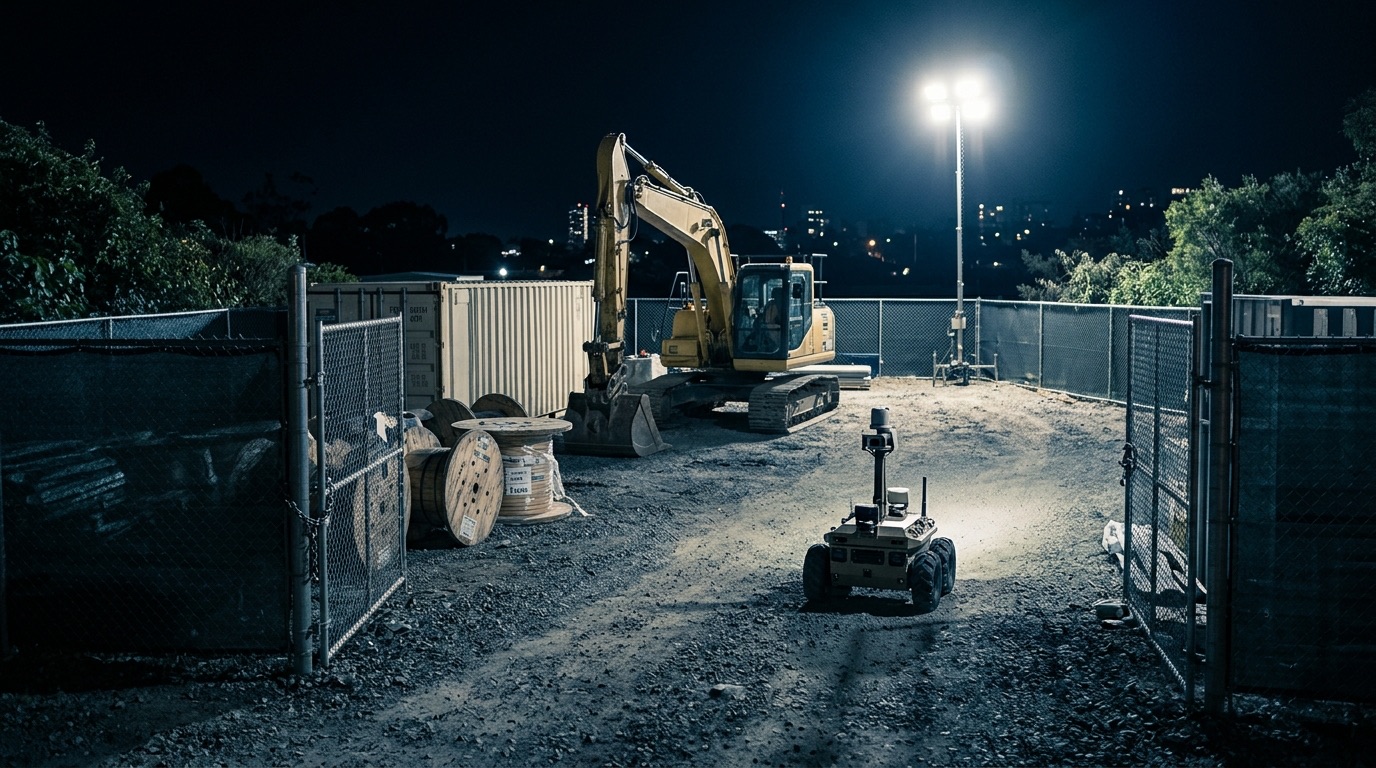
The second class is the ground patrol robot. It drives a round that can be changed when the ground changes, and it brings its camera to where the mast does not look. On factory and company premises that is an established pattern, and this website's security solution page lists an hourly yard lap as a live case. Its limit is the ground itself: a building site has trenches, gravel, mud, cable on the ground and places where yesterday there was still a path; a robot that drives reliably on a paved factory yard is a different machine on an earthworks site in week two than in week one, and the map it drives by has to be checked after every stage of construction. Where the site has a paved access road, a storage yard and a container area, those are the routes that carry a round; the rest of the ground mostly is not.
The third class is the drone-in-a-box, an aircraft in a fixed enclosure that launches on alarm or on schedule and sweeps the area from the air. It sees over the shell and does not care about construction progress. Its limits this website has described elsewhere: one enclosure, one aircraft, one flight at a time, and the second alarm during the first flight is the real constraint; plus the siting of the enclosure, which decides every route the drone will ever fly, and the aviation side, which is not trivial on a site with edges onto public space. For a site that stands for eighteen months and is large enough it can be the right layer on top; for a road works site that moves on in three weeks it is not.
What the alarm has to contain
All three classes fail at the same point if the alarm is not built right. An alarm that reaches a person at three in the morning has to contain three things: where on the ground, what kind of movement, and an image or a crop that lets them tell within seconds between a tarpaulin in the wind, a fox, rain on the lens and a van with its loading door open. An alarm without those three produces, after a week of false alarms, what this website's security articles describe as alert fatigue: the person at the other end stops looking. And it has to go to someone who may and can drive out. On a building site that is the question of the response service, that is, a licensed security company with a vehicle, or an arrangement with the foreman who lives twenty minutes away and should not be doing it.
Added to that are the preconditions that are missing more often on building sites than on factory premises: power that is not switched off at night; a mobile network that carries inside the shell; a fence that defines a boundary at all, at which an alarm begins; and a person responsible for adjusting the robot's round or the mast's field of view after every stage of construction. Without that last point, each of the three classes is securing, by week four, a site that no longer exists in that form.
A building site is not a factory yard
The boundary this page takes over from the aerial side is easy to keep on a building site as long as nobody is there at night. Three properties of a building site make the rest harder than on a fenced factory yard, and they belong before sensor selection. First, the site is a workplace by day. A system that reports movement at night often runs by day as well, and then it captures employees; whether it records then, whether it is switched off, who sees the recordings, are questions for the data protection officer and, where there is one, the works council, and they are to be answered before installation. Second, the site has edges onto public space, often without a fence: pavement, road, neighbouring plot. Video observation of publicly accessible spaces by optical-electronic devices is governed in Germany by section 4 of the Bundesdatenschutzgesetz, and this website's aerial side records for factory premises that a pure company site is as a rule not a publicly accessible space, but its edges often are and therefore have to be assessed in advance. On a building site the edges are a larger share of the whole. Third, the ground changes, and with it the edges: what was site in week one can be access road in week eight.
This article does not make that assessment, and it does not answer the question either of whether and where notice signs have to be put up. Both depend on the specific ground, its edges and on what the system does by day, and both belong in the operator's own house, not on a website. What can be said is the order: first the edges and daytime operation assessed, then the sensing chosen, not the other way round.
What werob contributes, and what it does not
werob is a manufacturer-independent systems integrator for the ground side; the aerial side is carried by wedrone, and neither flies nor guards itself. For a building site that means: whether any of the three hardware classes fits the ground at all, which routes carry a robot round, how the alarm is built and to whom it is routed, and how the round is adjusted after every stage of construction, is specification work before the hardware. The mobile camera mast remains the reference product, and for many sites it is the right answer; a robot or a drone is the right one where the ground is large and long-lived enough and the mast no longer sees what it would need to see. This article names no price, no detection rate and no response time, because none of those values exists without the ground.
Limits: what is documented here and what is not
The crime statistics come from the Staatsanzeiger Baden-Württemberg article of 21 November 2024 (Wolfgang Leja), which reproduces the state criminal police office's figures for 2023, 2022 and 2019; the underlying LKA report was not read directly. The figures apply to Baden-Württemberg and were not extrapolated to other states. The nationwide amounts between 80 and 500 million euros come from vendor and guide texts, were not traced to any primary source and are expressly not used here. The mobile camera mast is described as a product class without naming suppliers; for patrol robots and the drone-in-a-box the text relies on this website's existing pages and articles, not on a site installation reported on here. No customer project underlies this article, and no figure on this page is werob's own. The data-protection assessment of a specific site and the question of notice signs are not answered here.
FAQ
- How much does construction-site theft cost in Germany?
- Nationwide there is no published primary statistic; the circulating amounts lie between 80 and 500 million euros a year and come from vendor and guide texts. What holds up is the state figure: the LKA Baden-Württemberg counted 2,156 thefts from construction sites and building shells in 2023 with more than 9.90 million euros of damage, and about one case in ten was solved.
- What should surveillance technology on a building site do at night?
- Establish that something is happening on the ground and inform a person so fast and unambiguously that they intervene before the damage occurs. Not: recognise the thief. Person identification, biometric matching and crowd monitoring are not part of what is specified here; that is the same boundary as on this website's aerial side.
- Does a patrol robot replace the mobile camera mast?
- Rarely. The mast is the security trade's standard product for building sites and for many sites the right answer. A robot pays off where the ground is large and long-lived enough, paved routes carry a round and the mast no longer sees what it would need to see; its round has to be checked after every stage of construction.
- Can a drone guard the site at night?
- As a drone-in-a-box on large, long-lived sites, yes, with the limits this website has described: one aircraft, one flight at a time, the second alarm during the first flight is the constraint, and the siting of the enclosure decides every route. On a site with edges onto public space the aviation assessment comes on top.
- What about data protection and notice signs?
- A building site is a workplace by day and often has edges onto public space, whose observation falls under section 4 BDSG. Whether a system records by day, who sees the recordings and whether notice signs are needed depends on the specific ground and belongs to the data protection officer and, where applicable, the works council, before sensor selection. This article does not answer those questions.
Related reading
Layout robots on site: printing BIM onto the slab to the millimetre
Discover how layout robots print BIM models directly onto concrete slabs with millimetre precision to eliminate manual errors and coordinate all trades.
17 July 2026bricklaying robot masonry constructionBricklaying Robots 2026: Fastbrick Systems on Site
Evaluate masonry robotics for construction in 2026. Discover what truck-mounted systems like Fastbrick's Hadrian X actually deliver on real job sites.
21 August 2026construction robots crane time site logisticsCrane Time Is the Scarcest Resource: Which Construction Robots Need No Pick
The crane sets the tempo of the site, and it is not going autonomous in this planning cycle. So the useful question is not which robot lifts, but which one works without booking crane time — and which one competes for the hook or the airspace anyway.
2 September 2026rebar tying robot construction sitesRebar-Tying Robots: What Construction Sites Automate First
Discover why rebar-tying robots are the first automation target for construction sites, offering proven ROI, safety, and up to 1,200 ties per hour.
21 August 2026night watch robotNight Watch Robot: Operational Relief and Security
A night watch robot takes over repetitive rounds and logistics tasks while relieving specialist staff. werob integrates these systems into your operation in eight weeks.
12 June 2026