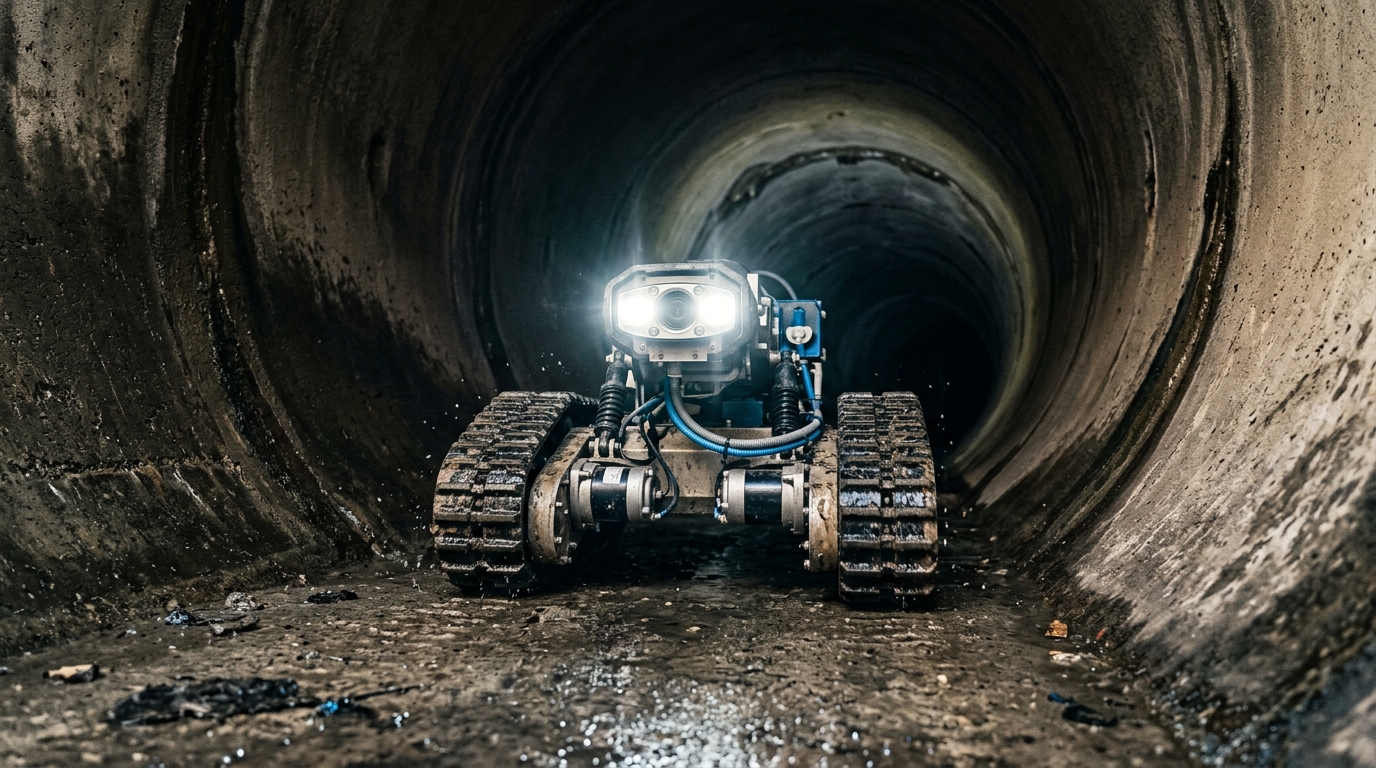
Sewers, treatment plants and the places nobody should enter
Inspection robotics in waste water is an occupational-safety measure before it is anything else. Why coded condition data beats video, and what has to be specified so findings land in the asset register.
Robotics in the sewer network is first and foremost an occupational-safety measure, meant to keep people out of confined spaces. What matters to the operator is the production of strictly coded data sets under DIN EN 13508-2, which replace plain video as the deliverable.
Key Takeaways
- 1The point of the robot is that nobody has to enter a gas-hazardous digester or shaft.
- 2A public sewer network needs structured condition data, not video files.
- 3DIN EN 13508-2 is what makes two inspection campaigns five years apart comparable at all.
- 4For certain pump stations and works, crawlers need ATEX approval as a hard requirement, not an option.
Occupational safety first: what the hazard in a sewer or digester actually is
The use of robotic systems in waste water infrastructure is usually discussed in terms of efficiency or process speed. For municipal drainage operators, city sewerage undertakings and industrial plant operators the primary motivation is a fundamentally different one: it is a mandatory protective measure under occupational safety. The aim is to avoid staff entering closed, toxic and oxygen-poor environments as far as is technically possible.
Entering shafts, gravity sewers, pump sumps and digesters carries substantial risk. Alongside mechanical hazards and the danger of a sudden surge of water, toxic gas concentrations dominate. Putrefaction in waste water produces highly toxic hydrogen sulphide (H2S), which paralyses the sense of smell at low concentrations, as well as asphyxiant gases such as carbon dioxide and flammable gases such as methane (CH4). Acute oxygen deficiency in poorly ventilated structures compounds it.
The German legal and statutory-insurance frame sets clear conditions on deploying people. Under DGUV Regel 113-004 (“Behälter, Silos und enge Räume; Teil 1: Arbeiten in Behältern, Silos und engen Räumen”, edition February 2019) and the sector-specific DGUV Regel 103-003 (“Arbeiten in umschlossenen Räumen von abwassertechnischen Anlagen”), entry is permitted only once strict organisational and technical safeguards are in place. Operators and their safety officers face a considerable organisational load:
- A written risk assessment and a binding permit-to-work for every single entry.
- Multi-stage gas testing of the atmosphere for toxic gases, explosion risk and oxygen content, before and during the work.
- A trained attendant stationed outside the entry point, in continuous visual or voice contact with the people inside.
- A workable emergency and rescue concept with pre-rigged lifting gear, tripod, fall-arrest and rescue equipment for immediate recovery of an incapacitated person.
At digesters, sludge stores and covered primary tanks the requirements tighten further through explosion protection. Under the European ATEX directives – 1999/92/EC for the workplace and 2014/34/EU for equipment – and the German Betriebssicherheitsverordnung, these areas are classified into explosion protection zones (Zone 0, Zone 1 or Zone 2), and the operator has to produce an explosion protection document. DWA-M 217 “Explosionsschutz für abwassertechnische Anlagen” (July 2014) gives the practical guidance for implementing this. Electrical equipment may only be operated there if it carries a corresponding type of protection, for example flameproof enclosure or intrinsic safety. Inspection crawlers and camera systems therefore need gap-free ATEX certification to be operated legally and safely inside those zones.
The limits of the technology: what crawlers actually deliver
Wheeled and tracked inspection robots (crawlers) and floating camera carriers are today the standard for condition capture in sewers and large profiles. Modern systems are modular: steerable chassis, pan-and-tilt camera heads, laser profilers for exact cross-section measurement, and integrated inclination sensors to determine pipe gradient. In main collectors and part-filled sewers with a high water level, floating inspection platforms are increasingly used, drifting with the flow or guided under control from a cable drum.
For all that maturity, the physical and operational limits of the robotics should not be understated. In the day-to-day reality of a sewer network, automation regularly meets obstacles a chassis cannot overcome. Robots take over standard inspection; they do not replace people in every complex fault. The same pattern shows up in other inaccessible asset classes, for instance in condition monitoring of subsea cables and pipelines, in robotic inspection of substations and tunnels, and in underground mining robotics.
| Situation / obstacle | What the robot can do | Limit of the technology / intervention |
|---|---|---|
| Pipes DN 150 to DN 2000 with standard deposits | Optical capture, laser geometry measurement, pan-and-tilt guidance | Achievable by crawler with no personnel entry. |
| Massive root masses, shard formation, collapse | Crawler stalls; climbing capability does not clear blockages | Prior high-pressure jetting, cutter robot or mined support required. |
| Heavy sludge and solids load, pronounced sanding | Loss of traction, chassis beds in the sediment | Mechanical clearing before a repeat run is unavoidable. |
| Impassable drops, tight bends, inverted siphons | Cable-bound crawlers snag at deflections and edges | Inspection sondes or separable special chassis required. |
| Turbidity and suspended solids in full pressure pipes | Optical cameras give no usable image in a turbid medium | Ultrasonic, carrier-frequency or pig systems required. |
For the operator this means robotic inspection needs structured preparation. Before a robot can deliver usable data, sections may have to be cleaned by high-pressure jetting. If a chassis wedges on an unforeseen structural collapse, direct intervention by trained personnel under the full occupational safety regime remains the last fallback – which is exactly the case the programme is designed to make rare, not to pretend away.
Data, not pictures: why a video is only an opinion
Many tenders and legacy contracts still specify the inspection deliverable as a “video of the reach”. From an engineering and asset accounting point of view an unstructured MP4 or AVI file is not enough. A video conveys a visual impression that depends on lighting, the crawler's travel speed and the operator's subjective camera work. Two engineers reviewing the same footage regularly reach different assessments of a crack or a joint displacement.
A video is not a data set. It cannot be filtered automatically in a GIS, cannot be compared algorithmically with the previous year, and cannot be turned into a rehabilitation plan without another time-consuming review. Where an operator manages hundreds of kilometres of network, unstructured footage produces a data graveyard on external drives from which no defensible maintenance decision can be derived.
- Unstructured video: subjective impression, no clean separation of observation from assessment, high effort on re-checks, not machine-readable.
- Coded condition finding: structured, tabular data set with exact positional reference, standardised damage codes and quantitative measurements.
- Automated rehabilitation planning: only coded findings allow direct classification into condition classes and automated calculation of remediation cost.
The value of an inspection campaign is not created by high-resolution pixels but by the structured abstraction of what was seen into standardised attributes. Transforming optical raw data into structured finding records is the core requirement on any current inspection process in waste water.
DIN EN 13508-2: the foundation of comparability
To eliminate subjective distortion in optical inspection, a binding coding system was created at European level. DIN EN 13508-2 (“Untersuchung und Beurteilung von Entwässerungssystemen außerhalb von Gebäuden – Teil 2: Kodiersystem für die optische Inspektion”, edition 2011-08) defines an unambiguous alphanumeric character set for describing every structural and operational condition in waste water pipes, sewers and manholes.
The coding system separates observation from later assessment systematically. A finding under DIN EN 13508-2 captures three basic dimensions:
- Main code and sub-code: identification of the defect type, for example cracking, deformation, positional deviation or root intrusion.
- Quantitative characterisation: exact crack widths in millimetres, deformation as a percentage of diameter, or displacement dimensions at pipe joints.
- Location reference: reach designation, running chainage in metres from the start manhole, and circumferential position given as a clock position from 1 to 12.
This coding is the actual foundation of any long-term asset management strategy. If a reach is inspected in 2026 and a crack at chainage 14.20 metres in the 12 o'clock position is recorded with a longitudinal crack code and a width of 1.5 mm, a re-inspection in 2031 can start at exactly the same coordinates. Only that normalisation makes it visible whether the crack has stayed stable or widened to 3.0 mm. Without uniform codes under DIN EN 13508-2 a defensible trend analysis is impossible – and trend, not the single image, is what a rehabilitation budget is built on.
The German frame: DIN 1986-30 and the DWA-M 149 series
In Germany the European framework standard is made specific by rules from DIN and from the Deutsche Vereinigung für Wasserwirtschaft, Abwasser und Abfall (DWA). DIN EN 13508-2 contains a number of national options as a result of European compromise; for the German market these are harmonised through the DWA-M 149 series. The joint publication DIN EN 13508-2 / DWA-M 149-2 is dated July 2014, in the supplemented version of September 2023.
A distinction worth getting right: DIN 1986-30 (“Entwässerungsanlagen für Gebäude und Grundstücke – Teil 30: Instandhaltung”, edition 2012-02) governs maintenance and inspection intervals for drainage on properties and in buildings – not the public sewer. DWA-M 149-2 governs the exact application of the coding system in the public and industrial network, and DWA-M 149-3 defines the assessment procedure that sorts coded individual findings into condition classes, which in turn drive the urgency of structural remediation.
The scale of the monitoring task is visible in the DWA's own survey. According to “Zustand der Kanalisation in Deutschland” (results published 2020, data year 2018), the public sewer network in Germany comprises “knapp 600.000 km”; the analysis evaluated data from 423 network operators representing around 30 million inhabitants. The DWA reports that 27 percent of sewers show no defects, while “gut 18 Prozent der Kanäle” require short- to medium-term rehabilitation. 13.5 percent of the reaches surveyed had never been inspected at all – extrapolated to Germany, 14.2 percent – the most common reason being inaccessibility. Standards-compliant condition capture is therefore the precondition for spending capital where it does something.
| Rule | Scope | Purpose |
|---|---|---|
| DIN EN 13508-2 | Europe; drainage systems outside buildings | Defines the alphanumeric base coding system for optical inspection. |
| DWA-M 149-2 | Germany; gravity sewers, manholes, special structures | National application rules and harmonisation of the codes under DIN EN 13508-2. |
| DWA-M 149-3 | Germany; public and commercial sewer networks | Assessment system sorting coded data into standardised condition classes. |
| DIN 1986-30 | Germany; properties and commercial premises | Requirements for maintenance, tightness testing and inspection intervals. |
Specifying for the asset register
So that inspection data does not end up on isolated storage media, operators have to specify the data handover precisely, technically and contractually, before any campaign begins. In the German market this is normally done on the basis of DWA-M 149-8 (“Zusätzliche technische Vertragsbedingungen ZTV – Optische Inspektion”), which sets binding rules on how data is captured, validated and exported.
Standardised exchange formats are indispensable for clean transfer into the sewer information system and the overarching GIS. In Germany the XML-based ISYBAU exchange format has become established for this. A sound specification has to cover:
- Standardised data format: mandate the ISYBAU XML schema interface to keep proprietary formats out.
- Unambiguous master-data reference: every finding must be tied to the official reach designation and to the start and target manhole from the operator's own network inventory.
- Georeferencing and chainage: zero point defined at the manhole inner wall, centimetre-accurate distance measurement by calibrated odometer on the crawler.
- Media linkage: defined relative file paths for still images of significant individual defects, linked directly in the record.
This interface is where integration earns its place. As the link between inspection hardware and enterprise IT, connectors check inspection records, measurements and condition assessments automatically for schema conformity and move them into ERP systems, GIS platforms or the asset register – rather than leaving them as an export somebody has to remember to run.
Procurement and operation from the integrator's seat
As a vendor-independent systems integrator, werob supports operators of drainage networks and industrial plants in introducing and running ground-based robotic systems. The task is to select, from the range of crawlers, floating carriers and platforms on the market, exactly the combination that matches the site's pipe diameters, materials and above all its explosion protection obligations.
That assessment weighs technical parameters, interface openness and ATEX approvals across OEM systems, so operators procure vendor-independently the systems that meet their operational and regulatory requirements without ending up in a proprietary island.
In operation, central management covers the deployment status of the robot fleet, preventive maintenance intervals for the sensitive sensor packages, and the calibration cycles of the odometry and laser units – and makes sure every inspection data set is archived in the operator's asset register in a form that survives an audit. The honest limit stands: there are places a crawler will not reach, and for those a person still has to go in, under the full permit regime. The purpose of the programme is to make that the exception it should be.
FAQ
- Why is an ordinary camera video not enough for sewer inspection?
- A plain video gives an optical impression but cannot be evaluated automatically or transferred into the sewer information system. Assessing the condition of the asset objectively requires structured data sets containing defined defect codes.
- What does DIN EN 13508-2 govern?
- DIN EN 13508-2 defines the European coding system for optical inspection of drainage systems. It sets out how defects and observations are classified uniformly, which is what makes later inspections directly comparable and removes room for interpretation.
- When is explosion protection required for waste water inspection?
- Digester gas from waste water and sludge can create explosive atmospheres in digesters and certain shafts. Robotics deployed there has to meet the ATEX requirements for the relevant zone, and the operator has to hold an explosion protection document.
- Where do current sewer inspection robots reach their limits?
- Crawlers and floating platforms stall at massive blockages, deep structural collapses or heavily convoluted pipe geometry. In those cases manual intervention with specialist recovery equipment is still required.
- What does occupational safety require for confined spaces?
- Entering vessels, silos and confined spaces requires a detailed risk assessment beforehand, together with gas testing, a clear rescue concept and an attendant stationed outside for the whole duration of the work.
Related reading
Robotic inspection of substations and tunnels: the legged robot on its round
Discover how legged robots like Spot and ANYmal X automate visual and thermal rounds in substations and tunnels, ensuring repeatable inspection data.
17 July 2026subsea cable pipeline inspectionSubsea cables and pipelines: how condition monitoring actually works
Burial depth is not fixed by a single legal metre value, and permanent fibre sensing does not replace a survey. What operators actually measure on cables and pipelines, and why the interval is now a compliance question.
23 July 2026underground mining robotics automationUnderground mining robotics: what autonomous vehicles and inspection robots do today
Where autonomous haulage is actually installed in Europe, why ATEX equipment group I decides the hardware list, what the documented German cases are, and what stays with the mine surveyor.
23 July 2026inspection robot process industry operator requirementsWhat six chemical operators ask of a round-walking robot — and what of that is not on the datasheet
In January 2023 BASF, Evonik, Currenta, Nobian, Covestro and Merck wrote down what an inspection robot has to be able to do in their plants. The paper is seven pages long, and the word certificate appears only at the margin. What it says instead decides operation after the pilot.
11 September 2026ATEX certified inspection robots chemical plant downtimeATEX-Certified Inspection Robots: The Cost of Unplanned Downtime
Germany has 4,049 operating areas under the Störfall-Verordnung (major-accident ordinance). An early warning sign that reaches the regular round too late rarely stays a footnote — it becomes unplanned downtime.
18 September 2026