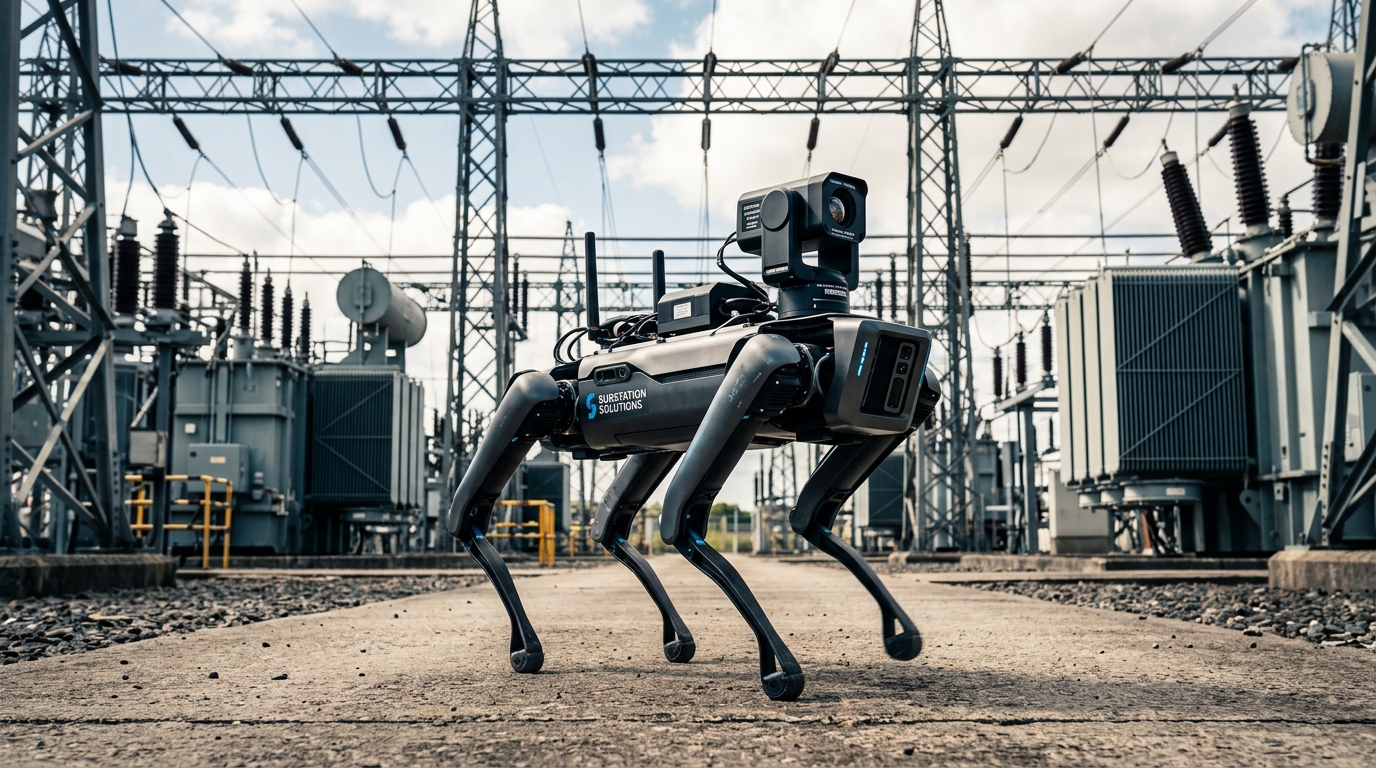
Robotic inspection of substations and tunnels: the legged robot on its round
Discover how legged robots like Spot and ANYmal X automate visual and thermal rounds in substations and tunnels, ensuring repeatable inspection data.
Legged robots equipped with thermal and visual sensors are transforming routine inspections in substations and utility tunnels. While they do not replace statutory physical inspections, they provide the continuous, repeatable data stream needed to prevent critical failures.
Key Takeaways
- 1Repeatability is the core benefit: autonomous legged robots execute identical routes, ensuring consistent thermal and visual historical data.
- 2Robotic rounds do not replace statutory inspections, but they bridge critical resource gaps in maintaining high-voltage transmission networks.
- 3A manufacturer-independent integrator helps utilities navigate the diverse capabilities of robots like ANYmal X, Spot, and Taurob Inspector.
- 4Integration with existing databases via dedicated middleware transforms raw sensor readings into automated work orders.
The challenge of maintaining critical energy and utility infrastructure
Industrial operators face a growing maintenance burden across extensive transmission networks. A prominent example is Germany's 37,900 km extra-high-voltage grid, which requires continuous, meticulous monitoring to prevent costly outages and ensure grid reliability. Historically, utilities have relied on human technicians to conduct manual inspection rounds. However, as infrastructure ages and operational demands grow, manual rounds are becoming increasingly difficult to scale. The challenge is further exacerbated by a severe labor crisis; according to a 2022 forecast by the Hauptverband der Deutschen Bauindustrie (HDB), Germany faces a forecast 100,000+ skilled-worker shortage by 2030, which threatens utility workforce capacity. To address these systemic labor shortages without exceeding operating budgets, automated ground solutions provide a reliable alternative.
Repeatable ground robotics as a strategic alternative
Deploying legged ground robots provides a highly repeatable, autonomous alternative for visual and thermal rounds in challenging environments like substations, tunnels, and plant rooms. Ex-certified platforms, such as the ANYbotics ANYmal X, Boston Dynamics Spot, and the Taurob Inspector, walk fixed routes under extreme conditions to capture thermal anomalies, gauge readings, and structural changes. This repeatability is the core benefit of robotic rounds, providing operators with a precise baseline for predictive maintenance. While these autonomous patrols safeguard grid reliability, they do not replace statutory inspections but rather complement them by filling the intervals between certified human audits.
- Fixed-route navigation: Walking precise paths through tunnels and substations to ensure identical sensor viewpoints on every round.
- Visual and thermal monitoring: Deploying high-resolution and infrared cameras to detect early-stage hotspots or fluid leaks.
- Manufacturer-independent integration: Utilizing a specialized systems integrator like werob to connect diverse hardware to existing control systems. As an independent integrator rather than a manufacturer, werob matches the optimal robot to the operator's specific route requirements.
Legged robots on the round: Spot, ANYmal X, and Taurob Inspector
Utility infrastructure across Germany faces unprecedented maintenance demands, especially given the scale of the 37,900 km extra-high-voltage grid recorded at the end of 2024 by the Bundesnetzagentur (BNetzA). Managing substations, narrow tunnels, and complex plant rooms requires continuous physical surveillance to prevent critical failures. This is where legged mobile ground robots represent the cutting edge of industrial inspection. Rather than replacing statutory inspections, these quadrupedal platforms establish high-frequency, highly repeatable rounds. As a manufacturer-independent robotics integrator, werob does not manufacture these systems but designs and deploys optimized fleets tailored to specific operational environments.
Key Robotic Platforms and Safety Certifications
Deploying autonomous platforms in hazardous utility environments requires strict safety compliance. Different operational areas demand specific structural designs, from general industrial spaces to explosive-gas atmospheres. Rather than relying on a single hardware manufacturer, operators benefit from selecting the platform that matches their technical requirements.
- The Ex-certified ANYbotics ANYmal X is designed as an ATEX Zone 1 compliant legged robotic solution for hazardous, gas-heavy atmospheres.
- The rugged Taurob Inspector features an ATEX-certified build tailored for demanding data collection in harsh industrial environments.
- The agile Boston Dynamics Spot offers exceptional mobility on stairs and narrow plant room paths, executing automated inspection missions with high precision.
Equipped with advanced visual cameras and thermal imaging payloads, these robots execute identical routes day and night. They capture precise temperature readings of up to 400 degrees Celsius, allowing maintenance teams to identify early thermal anomalies, overheating components, or electrical faults before they cause failures. This absolute repeatability in data collection ensures that subtle deviations are flagged instantly. While these automated rounds do not replace official statutory inspections, they significantly lower operational risk and optimize scheduled maintenance intervals across utility networks.
The core benefit: data repeatability over replacement
The primary value of ground-based robotic inspection in utility and industrial settings does not lie in the deregulation of safety standards or the complete elimination of human staff, but in unmatched data repeatability. When managing vast systems such as Germany's 37,900 km extra-high-voltage grid (as monitored by the BNetzA at the end of 2024), maintaining continuous asset visibility is a major challenge. Autonomous legged systems are designed to bridge this gap by executing visual and thermal rounds on fixed routes through substations, tunnels, and plant rooms with millimeter-level physical precision. As a manufacturer-independent robotics integrator rather than a hardware developer, werob helps operators establish these systematic routines. However, it is critical to recognize that while these automated patrols provide deep operational insights, they do not replace statutory physical inspections required by national regulatory frameworks.
- Identical Camera Angles: The legged robot positions its visual and thermal sensors at the exact same spatial coordinate on every round, eliminating perspective shifts that can distort visual comparison.
- Standardized Thermal Baselines: Capturing thermal profiles of high-voltage transformers or cable terminations from identical standoff distances and angles ensures that any temperature increase indicates genuine equipment degradation, not sensor placement variance.
- Continuous Trend Analysis: Maintaining highly consistent historical datasets allows analytical software to automatically detect subtle structural changes, SF6 gas leaks, or thermal hot spots over weeks, months, or years.
By deploying specialized legged platforms such as the ANYbotics ANYmal X, the Boston Dynamics Spot, or the Taurob Inspector, infrastructure operators gain access to a highly standardized data stream. Instead of replacing the legal necessity of statutory human walkdowns, these ground robots act as an invaluable early-warning layer. They continuously track the real-time health of energized equipment, ensuring that human specialists can target their statutory efforts exactly where degradation has already been verified.
Navigating substations and plant rooms
Utility infrastructure across Germany spans vast distances, including a 37,900 km extra-high-voltage grid (BNetzA, end 2024). Managing the countless substations and indoor plant rooms connected to this network presents unique physical and electromagnetic challenges. Active high-voltage assets generate powerful electromagnetic fields that can disrupt standard electronic equipment, while the physical layouts of these facilities are filled with narrow corridors, tight turns, and multi-level platforms. To perform routine inspections safely and consistently, operators require highly specialized mobile platforms that can withstand these environments.
This is where advanced quadruped systems come into play. Legged platforms are engineered with high electromagnetic compatibility (EMC) to operate safely around active, high-voltage equipment without interference. Unlike traditional wheeled or tracked platforms that fail when encountering obstacles, legged robots easily climb industrial stairs, negotiate grated metal flooring, and maneuver within confined facility layouts. As a manufacturer-independent robotics integrator, not a manufacturer, werob specializes in helping utility operations directors deploy these agile systems on standardized inspection routes.
- Visual and Thermal Imaging: Carrying high-definition and infrared thermal cameras to detect overheating components, gas leaks, and physical wear on a fixed route.
- High Repeatability: Enabling exact-path replication for consecutive rounds, making it easier to identify subtle changes or anomalies over time.
- Intrinsically Safe Options: Utilizing Ex-certified platforms like the ANYbotics ANYmal X and Taurob Inspector for explosive or hazardous plant room atmospheres.
- Operational Safety: Allowing operators to remotely monitor hazardous zones via the unified Cockpit dashboard without putting personnel in harm's way.
While these automated systems significantly improve data collection frequency and reliability, they do not replace statutory inspections. Instead, integrating platforms like the Boston Dynamics Spot or ANYmal X serves to augment human teams, providing continuous predictive monitoring that alerts engineers to maintenance needs before they escalate into costly failures. Through the werob Platform, operators can rapidly specify and deploy these robotic solutions to keep critical infrastructure running safely and efficiently.
Tunnels and hazardous environments
Utility tunnels and hazardous industrial zones present severe access and safety challenges that demand specialized ATEX-certified or explosion-proof (Ex-proof) robotic hardware. In environments where combustible gases or dust are present, standard mobile systems cannot operate safely. For these high-risk areas, the ATEX Zone 1 certified Taurob Inspector and the intrinsically safe ANYbotics ANYmal X provide rugged, sealed platforms. These robots walk dark, damp cable tunnels and plant rooms autonomously, navigating complex layouts such as open grated stairs and steep inclines of up to 45 degrees.
The core benefit of deploying systems like ANYbotics ANYmal X or the Boston Dynamics Spot is the high repeatability of their rounds. Fitted with pan-tilt payloads, zoom cameras, and thermal sensors, these ground robots execute inspection routes along identical paths day after day. For instance, in supervising vast infrastructure such as the 37,900 km extra-high-voltage grid (BNetzA, end 2024), legged robots offer a highly repeatable layer of continuous monitoring. By capturing objective data from the exact same angle on every round, operators can detect micro-developments in thermal signatures before they escalate into catastrophic failures in hard-to-reach locations.
- Autonomous gas sensing: Option to continuously measure combustible and toxic gas concentrations, triggering warnings from a safe distance.
- Continuous thermography: Precise monitoring of high-voltage cable runs, transformer terminals, and steam lines.
- Unbiased data collection: Capture of high-definition imagery and acoustic recordings from identical physical coordinates on every route.
It is important to emphasize that autonomous inspections do not replace statutory, legal inspections required by safety regulations. Instead, they act as an operational early-warning system. As a manufacturer-independent robotics integrator, werob does not manufacture these systems. Instead, we use software tools like the Spec Engine to design ROS-compatible plans within 48 hours and help operators select the optimal hardware through our Supplier Match OEM database. This independent integration ensures utility operations teams can deploy the right Ex-certified platforms, connecting robotic telemetry directly into their existing systems.
The role of manufacturer-independent integration
Modern utility infrastructure, such as Germany's 37,900 km extra-high-voltage grid (BNetzA, end 2024), requires relentless monitoring across complex layouts. Legged robots like Boston Dynamics Spot, ANYbotics ANYmal X, and Taurob Inspector provide high repeatability for physical visual and thermal substation and tunnel rounds. They execute these inspection routes reliably to identify hotspots or anomalies, although they do not replace statutory inspections. Because no single robotic platform fits every operational layout, a manufacturer-independent robotics integrator is essential to select and integrate the optimal hardware for each specific environment.
The werob Platform simplifies this transition for substation managers and utility operations directors. As a dedicated integration platform, it offers software that configures, matches, and connects robotic hardware to existing operational systems. Instead of dealing with fragmented vendor ecosystems, operators use three key software layers to manage the deployment lifecycle:
- Spec Engine translates plain language shift descriptions into formally verified, ROS-compatible action graphs and deployable plans within 48 hours, ensuring the robot understands its designated path.
- Supplier Match scores and ranks a supplier graph of over 44 robot manufacturers based on regulatory readiness, regional service coverage, integration footprint, and price band to find the best OEM.
- Connectors act as pre-built, multi-tenant integration layers that connect robotic systems with existing operator databases and enterprise software stacks.
This structured approach ensures that infrastructure maintenance engineers can implement autonomous legged fleets without vendor lock-in or integration friction. By collaborating with a manufacturer-independent robotics system integrator rather than a specific manufacturer, utilities can dynamically scale their visual and thermal inspection routes. This model establishes consistent, repeatable data collection while keeping operational control in the hands of the utility.
Continuous monitoring and the future of utility maintenance
Scaling physical rounds across utility networks requires transitioning from manual scheduling to systematic, automated data collection. As a manufacturer-independent robotics integrator, werob supports utility operators in deploying autonomous fleets that act as dedicated, repeatable eyes on the ground. Legged systems like the Boston Dynamics Spot, ANYbotics ANYmal X, and Taurob Inspector navigate substations, tunnels, and plant rooms on fixed visual and thermal inspection routes. Repeatability represents the core benefit of these deployments, delivering a reliable, consistent diagnostic baseline.
- Continuous visual diagnostics of analog gauges, valve positions, and structural integrity
- Real-time thermal monitoring of high-voltage transformers and thermal junctions to prevent overheating
- Autonomous route execution inside hazardous or hard-to-reach tunnels and substation basements
- Verification of safety perimeters and physical security barriers without human exposure
While these autonomous inspection systems scale across critical infrastructure, including Germany's 30,906 wind turbines at the end of 2025 and 40,264 bridges on federal trunk roads as of March 2026, they do not replace statutory inspection requirements. Furthermore, they remain distinct from heavy-duty remote-controlled demolition robots, which are operator-steered and not autonomous. Instead, autonomous legged robots focus strictly on visual and thermal telemetry.
Operating a fleet of autonomous inspection robots requires a unified operational view. Real-time fleet health is managed via the Cockpit dashboard, which tracks hardware status, network infrastructure, and regulatory parameters. If a legged robot encounters a path blockage or a low-battery state, the operator receives a direct alert in Cockpit. By combining robust hardware integration with this centralized monitoring dashboard, utility operators can transition from reactive troubleshooting to highly structured, predictive maintenance.
FAQ
- Can autonomous legged robots completely replace statutory physical inspections?
- No. Autonomous legged robots do not replace statutory or regulatory inspections. Instead, they act as continuous monitoring systems that perform daily visual and thermal rounds to detect anomalies between official regulatory inspection intervals.
- What are the primary robot platforms used for substation and tunnel inspections?
- The leading platforms include Boston Dynamics Spot, the Ex-certified ANYbotics ANYmal X, and the ATEX-certified Taurob Inspector. Each robot offers specific mobility, environmental protection, and sensor payloads.
- How do Ex-certified robots like the ANYmal X operate safely in explosive areas?
- Ex-certified robots are engineered with sealed enclosures and specialized electrical systems to prevent sparks. For example, the ANYbotics ANYmal X is fully certified for explosive atmospheres, allowing it to perform visual and thermal monitoring in high-risk zones up to 400 degrees Celsius.
- What is the length of the German extra-high-voltage transmission grid?
- According to the Federal Network Agency (BNetzA), the extra-high-voltage transmission grid in Germany reaches a length of 37,900 km as of the end of 2024, presenting a massive infrastructure footprint that requires automated monitoring.
- How does a manufacturer-independent integrator assist with robotic deployment?
- An integrator like werob provides software and systems engineering rather than building hardware. Using tools like the Supplier Match engine, operators can select the optimal robot from a database of manufacturers to match their site-specific requirements.
- Are demolition robots also autonomous like inspection quadrupeds?
- No, demolition robots are remote-controlled by human operators to ensure safety on hazardous sites, whereas inspection quadrupeds walk pre-planned, fixed routes autonomously.
Related reading
Sewers, treatment plants and the places nobody should enter
Inspection robotics in waste water is an occupational-safety measure before it is anything else. Why coded condition data beats video, and what has to be specified so findings land in the asset register.
28 August 2026subsea robotics rov auv inspectionSubsea robotics: what ROV and AUV inspection delivers today
German offshore wind sits in 31 m of water on average. That single figure decides which underwater vehicle, which vessel and which approval an inspection campaign really needs.
22 July 2026drone bridge inspectionDrone-based bridge inspection: reaching the soffit without a closure
Learn how drone bridge inspection accesses soffits and bearings under DIN 1076 without closures, helping overcome construction skilled worker shortages.
17 July 2026inspection robot process industry operator requirementsWhat six chemical operators ask of a round-walking robot — and what of that is not on the datasheet
In January 2023 BASF, Evonik, Currenta, Nobian, Covestro and Merck wrote down what an inspection robot has to be able to do in their plants. The paper is seven pages long, and the word certificate appears only at the margin. What it says instead decides operation after the pilot.
11 September 2026ATEX certified inspection robots chemical plant downtimeATEX-Certified Inspection Robots: The Cost of Unplanned Downtime
Germany has 4,049 operating areas under the Störfall-Verordnung (major-accident ordinance). An early warning sign that reaches the regular round too late rarely stays a footnote — it becomes unplanned downtime.
18 September 2026