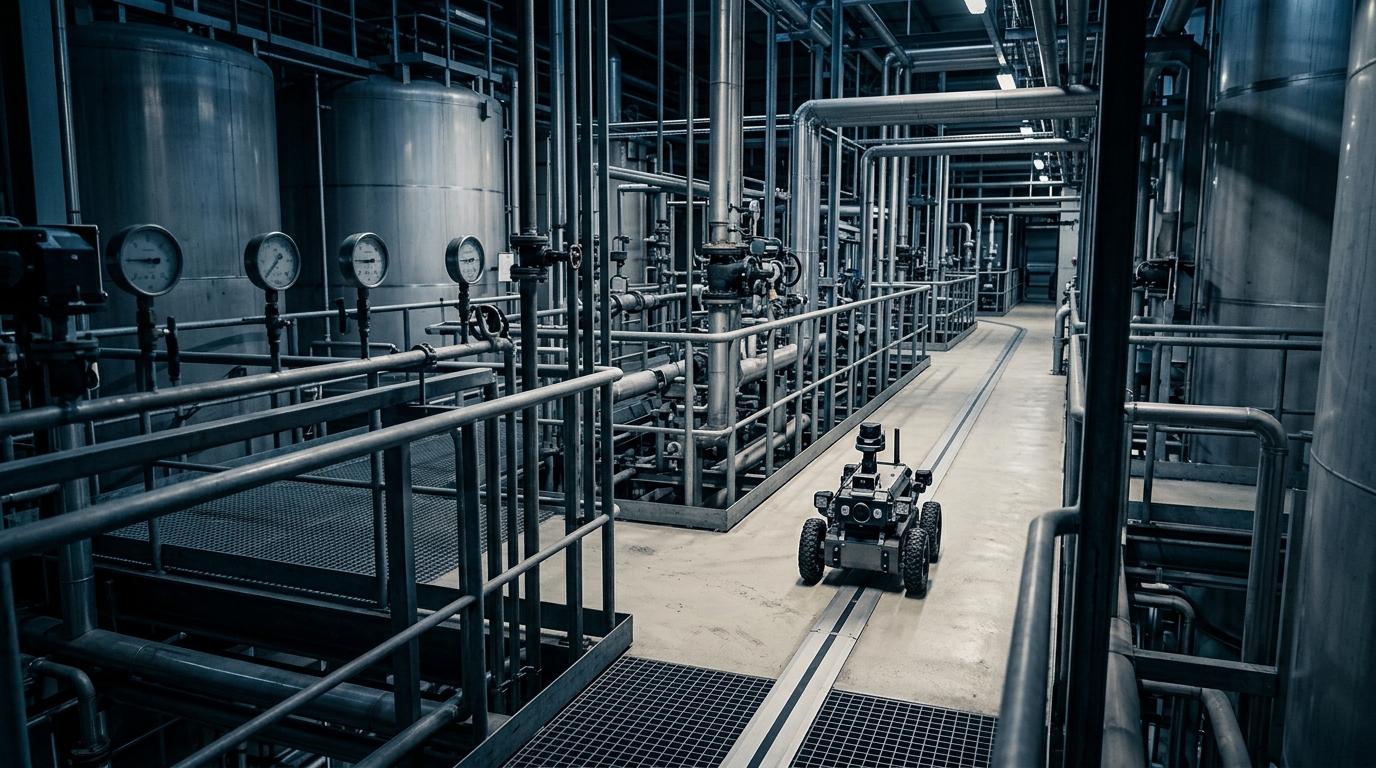
ATEX-Certified Inspection Robots: The Cost of Unplanned Downtime
Germany has 4,049 operating areas under the Störfall-Verordnung (major-accident ordinance). An early warning sign that reaches the regular round too late rarely stays a footnote — it becomes unplanned downtime.
Germany counted 4,049 operating areas under the Störfall-Verordnung (Umweltbundesamt, ZEMA count, reference year 2024, data state 27 July 2026). Every one of them has at least one area classified as an Ex zone under ATEX Directive 2014/34/EU — where a standard robot is not permitted. When an early warning sign there, a drifting temperature, a beginning leak, only reaches the next regular round, the difference between a footnote and unplanned downtime is often just a question of how long until the next walk-through.
Key Takeaways
- 1Germany had 4,049 operating areas under the Störfall-Verordnung (Umweltbundesamt/ZEMA, reference year 2024, as of 27.07.2026), each with Ex zones under ATEX 2014/34/EU.
- 2ANYbotics ANYmal X, Taurob Inspector and ExRobotics ExR-2 are real, catalogued, Zone 1-certified platforms — no standard robot is permitted there.
- 3The real cost driver is not the round itself but the delay until the next one, when a permit, a second person and gas detection slow the manual walk-through.
4,049 operating areas, a recurring Ex-zone reality
Three certified platforms for Zone 1
What unplanned downtime actually triggers
The full solution
FAQ
- Does the robot replace Ex-protection documentation?
- No. The certificate, the zone map, the route and the explosion protection document still have to agree with each other. That agreement is the actual deliverable, not the robot alone.
- Which platform fits which zone?
- The spec decides that from the zone map, not the catalogue. ANYmal X, Taurob Inspector and ExRobotics ExR-2 cover different Zone 1 requirement profiles.
- What does a robot cost compared to the manual round?
- That depends entirely on the plant; werob does not name a flat figure without a spec. What can be said beforehand is whether the plant is a case for this at all.
Related reading
Subsea robotics: what ROV and AUV inspection delivers today
German offshore wind sits in 31 m of water on average. That single figure decides which underwater vehicle, which vessel and which approval an inspection campaign really needs.
22 July 2026robotic substation and tunnel inspectionRobotic inspection of substations and tunnels: the legged robot on its round
Discover how legged robots like Spot and ANYmal X automate visual and thermal rounds in substations and tunnels, ensuring repeatable inspection data.
17 July 2026sewer inspection robotSewers, treatment plants and the places nobody should enter
Inspection robotics in waste water is an occupational-safety measure before it is anything else. Why coded condition data beats video, and what has to be specified so findings land in the asset register.
28 August 2026automated gauge rounds plant costWhat a missed gauge round actually costs a plant
In 4,049 operating areas across Germany, the gauge round through the Ex zone is mandatory — and its failure is usually invisible, until it isn't. A fixed round on wheels is insurance against exactly that moment.
11 September 2026subsea cable pipeline inspectionSubsea cables and pipelines: how condition monitoring actually works
Burial depth is not fixed by a single legal metre value, and permanent fibre sensing does not replace a survey. What operators actually measure on cables and pipelines, and why the interval is now a compliance question.
23 July 2026