Robotics for ageing at home: what actually works in 2026
Germany cares for 4.9 million people at home. The IFR counted 536 robots sold worldwide for care at home in 2024. An honest look at where robotics pays off around the ageing population, and where it does not.
Two numbers frame every honest conversation about robotics and the ageing population. In December 2023, 4.9 million people in Germany were cared for at home. In 2024, the International Federation of Robotics recorded 536 robots sold worldwide for care at home. Not 536 in Germany. 536 in the world. The distance between those numbers is not a gap you close by buying a machine, and it does not lead into the living room. It leads into the building around it.
Key Takeaways
- 1Destatis counted almost 5.7 million people in need of care in Germany in December 2023, and 86 percent of them, 4.9 million, were cared for at home.
- 2IFR World Robotics 2025 recorded 536 units sold worldwide in 2024 for care at home. The consumer care robot is a category, not yet a market.
- 3The near-term leverage sits in the assisted-living building, the common areas and the depot of an ambulatory service.
- 4A transport robot in a corridor is assessed against ISO 3691-4, not ISO 13482, and Regulation (EU) 2023/1230 applies from 20 January 2027.
Two numbers that settle the argument
The German care statistics are unusually clear about where care actually happens. At the end of December 2023, almost 5.7 million people needed care under SGB XI. 86 percent of them, that is 4.9 million, were cared for at home. Of those, 3.1 million received care allowance only and were looked after mainly by relatives, while 1.1 million lived in private households and were supported by one of 15,549 ambulatory care services. 800,000 people, or 14 percent, lived in a nursing home. All of that is Destatis, press release 478 of 18 December 2024, reporting year 2023.
Against that stands one line from IFR World Robotics 2025, published on 7 October 2025: 536 units sold worldwide in 2024 for care at home. The same report counted almost 200,000 professional service robots sold in 2024 overall, up 9 percent, with medical robots up 91 percent to around 16,700 units. So robotics is not stalling. Care at home is simply not where it is happening.
The pressure is real regardless. Destatis projects demand for employed nursing staff rising from 1.62 million in 2019 to 2.15 million by 2049, leaving a gap of 280,000 in its trend variant and up to 690,000 in its status-quo variant. Y Combinator, in its Request for Startups entry on AI for the ageing population, puts the American version of the same problem at one in five citizens over 65 by 2030 and 53 million relatives already providing unpaid care. Those are US figures and a venture firm's framing, but the direction is not in dispute.
Why the private flat is the hardest room in robotics
A warehouse aisle is a designed environment. A private flat is the opposite of one, and almost every assumption a mobile robot depends on fails there at once.
- Thresholds, loose rugs and door sills that were never meant to be crossed by a wheel.
- Stairs, and buildings where the lift either does not exist or has no interface.
- Furniture that moves, because someone lives there.
- No service technician, no spare unit, and nobody to lift the machine off an obstacle at three in the morning.
- Charging, which sounds trivial until you ask who plugs it in on a bad day.
- And a camera in someone's home, which is a data-protection question long before it is a technology question.
None of that is solved by a better navigation stack. It is solved by not putting the machine there yet. The systems that do get through a private front door today are the ones that sense the least: voice assistants of the kind Tinybots builds with Tessa, which prompt medication, appointments and messages, carry no arms and no camera, and are configured remotely by the care team. That is a narrow capability, and it is exactly why it is deployable.
A word on the humanoids in the launch videos: they are pre-order and pilot stage. There is no household humanoid you can order today, deploy into German assisted-living stock next quarter and have serviced under contract. When that changes, an integrator will integrate it. Until then, planning around it is planning around a press release.
What works today, one floor up
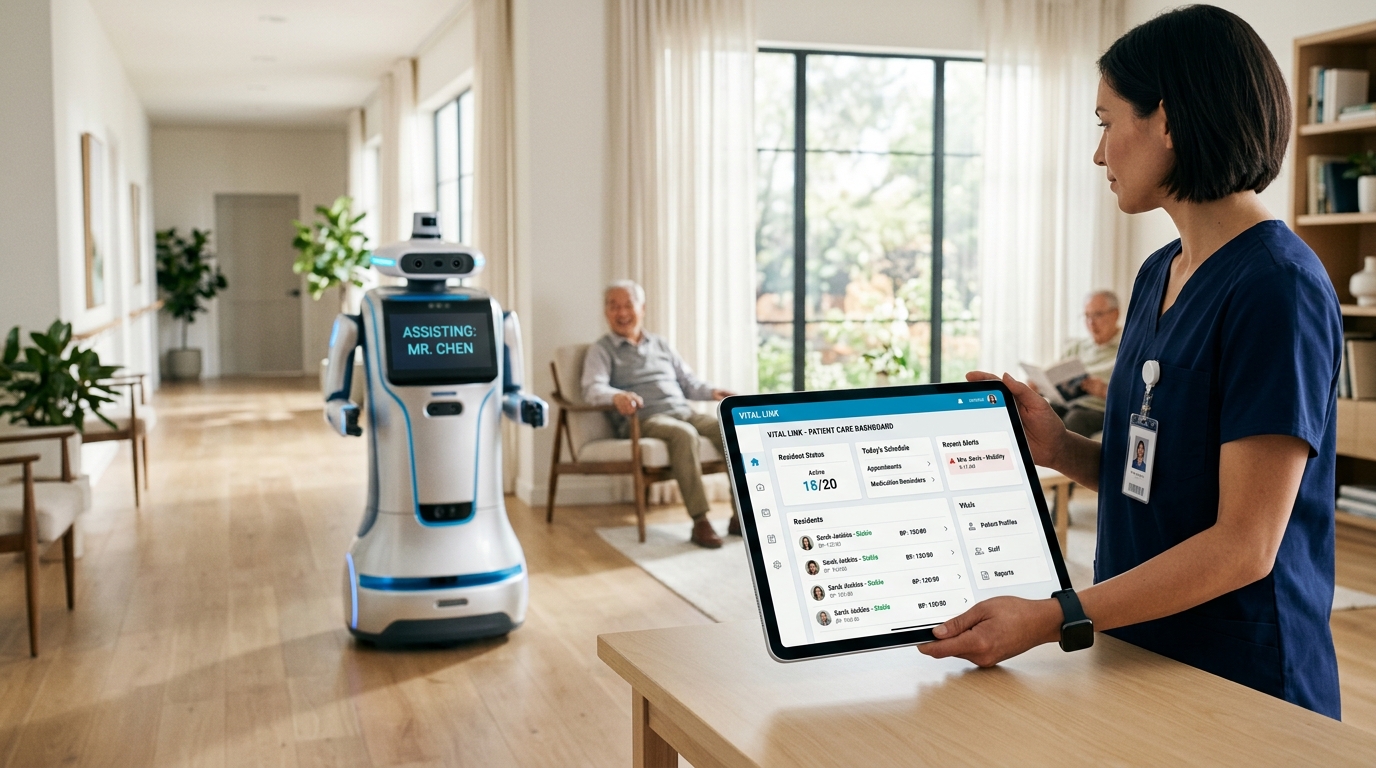
Move up one level, from the flat to the building around it, and the picture inverts. Assisted-living stock, service living and the operational back end of an ambulatory service are structured, staffed, powered environments with repeatable routes. That is where deployable robotics already is.
- Transport in the building. Meals, laundry, consumables and parcels between the service kitchen, the store and the floors. Lockable compartments with PIN handover, cooled where food is involved. Robotise builds JEEVES in Munich for exactly this class of route; Keenon and comparable platforms cover the lighter transport case.
- Common areas. Corridors, entrance halls and community rooms cleaned overnight on a fixed schedule. Worth stating precisely, because the market keeps blurring it: a cleaning robot cleans, it does not disinfect. Fraunhofer IPA has said so plainly, and wipe disinfection stays with the team.
- The depot. The unglamorous half of ambulatory care. Picking tour boxes, moving consumables, keeping the store in order so a shift starts with a loaded car instead of a search.
- Day structure by voice. In the flat itself, the assistant that speaks and does not watch.
Notice what these four have in common. None of them touch a person, none of them require a manipulator, and each of them removes a task that a qualified carer is currently doing for no clinical reason.
What AI changes first, and it is not the hardware
If you are an operator deciding where the next 24 months of budget goes, the honest answer is that software will return more than hardware. Scheduling and route planning across a distributed team, intake and triage of calls, documentation that writes itself from what actually happened, coordination between an ambulatory service and the relatives who provide most of the care. All of that is available now, none of it needs a machine to cross a threshold, and it addresses the 3.1 million people whose care runs entirely through relatives.
That is not an argument against robotics. It is an argument about sequence. The buildings where transport and cleaning robots pay off are the same buildings where better scheduling pays off, and the operator who does the software first has a cleaner problem definition when the hardware question arrives.
The integration questions nobody answers
Every serious deployment in residential stock fails or succeeds on four things, and none of them appear on a datasheet.
- The lift. No manufacturer publishes a lift protocol or names a lift-maker partner. In older stock the lift has no interface at all, and connecting it is a per-building engineering item.
- Fire doors. They close across the route by design. Whether the robot can request them, wait for them, or must be routed around them is a building-specific answer.
- The network. A stairwell in 1970s housing stock was not built to carry WLAN, and coverage gaps look exactly like hardware faults from the dashboard.
- Operations. Who charges it, who clears it, who is reachable when it stops at 03:00, and what happens to the round in the meantime.
This is the part werob does, and it is the reason the company describes itself as an integrator rather than a vendor. The operator describes the building and the round in plain language, werob writes the specification, selects hardware across more than 44 manufacturers and connects it to the systems already in use. First specification in 48 hours, first deployment in about eight weeks. The home care solution sets out the scope; the senior living solution covers the inpatient home.
A short checklist before the first deployment
Six questions worth answering before anyone signs anything.
- Which single task, on which route, at which time of day? A robot without a defined task is a pilot without an end.
- What happens when it fails halfway? The fallback path is the actual product.
- Does anything sense inside a private dwelling? If yes, the data-protection assessment comes before the hardware choice, not after.
- Which standard applies? ISO 3691-4 for a driverless truck or mobile robot in a corridor, ISO 13482 only where there is physical contact with a person, and Regulation (EU) 2023/1230 for machinery from 20 January 2027.
- Who owns the machine operationally, in writing, per shift?
- How will you know it worked? Completed tasks per shift, not machine uptime.
Answer those six and you can tell a deployable project from a demonstration. Most of what is currently marketed to care operators fails at the second question.
FAQ
- Is there a care robot for the living room yet?
- Not in any meaningful commercial sense. IFR World Robotics 2025 recorded 536 units sold worldwide in 2024 for care at home, against 4.9 million people cared for at home in Germany alone. Private dwellings are unstructured, unserviced and unsupervised, which is the hardest combination in mobile robotics.
- What about the household humanoids in the launch videos?
- They are pre-order and pilot stage. There is no humanoid you can order today, deploy into German assisted-living stock next quarter and have serviced under a contract. If that changes, a manufacturer-independent integrator will integrate it.
- Which standards apply to a robot in a care building?
- It depends on what the machine does. A transport or cleaning robot moving through a corridor falls under ISO 3691-4, the harmonised standard for driverless industrial trucks and autonomous mobile robots listed in the EU Official Journal since May 2024. ISO 13482 covers robots in physical contact with a person and is routinely quoted for machines it does not apply to. Regulation (EU) 2023/1230 on machinery applies from 20 January 2027.
- Do cleaning robots disinfect?
- No. They clean. Fraunhofer IPA has stated this plainly, and wipe disinfection remains a manual task carried out by the team. Any vendor claiming otherwise is describing a different product than the one being delivered.
- Where should an operator start?
- With one clearly bounded task in a building you control, a defined fallback path when the machine stops, and a written definition of what counts as a completed task. Transport in assisted-living stock and overnight cleaning of common areas are the two routes that most reliably survive contact with an operation.
Related reading
536 robots, one fast-growing gap
536 home-care robots were sold worldwide in 2024 — against 4.9 million people cared for at home in Germany alone. The growth is real. So is the gap.
11 September 2026robots in elderly care deployable todayRobots in Elderly Care: Deployable Today vs Years Away
Discover which robotics solutions are genuinely ready for European elderly care facilities today, and why humanoid caregivers remain years away.
24 August 2026care home robotCare Home Robot: Operational Efficiency and Compliance in Care
The use of robotics in residential care is no longer a vision of the future but an economic necessity to relieve staff. Learn how werob, as a systems integrator, paves the path from specification to live operation in eight weeks.
2 June 2026medication robot care homeMedication Robot in the Care Home: Efficiency and Compliance
Automating medication logistics relieves nursing professionals of time-consuming errands. werob integrates autonomous systems into existing workflows and secures regulatory compliance.
1 June 2026nursing home director roboticsNursing home director robotics: operational relief and ROI
The introduction of robotics in care often fails due to complex selection processes. werob shortens the path from requirements analysis to live operation to eight weeks and guarantees measurable cost reductions.
26 June 2026