Nursing home director robotics: operational relief and ROI
The introduction of robotics in care often fails due to complex selection processes. werob shortens the path from requirements analysis to live operation to eight weeks and guarantees measurable cost reductions.
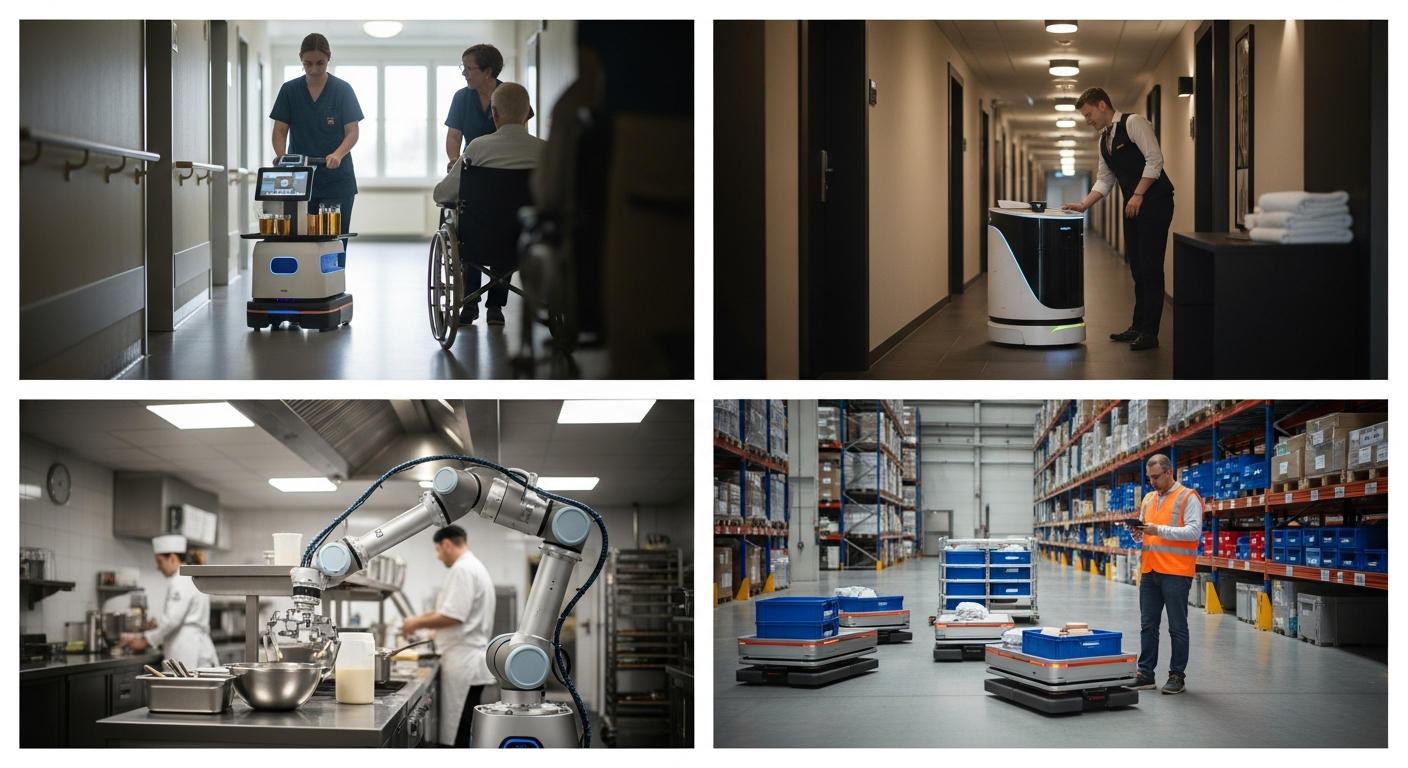
Station 3. 3:15 a.m. The night watch documents the last tour in the system. An autonomous transport robot glides silently across the corridor and delivers the prepared medicine boxes for the early morning shift directly to the base. What was considered a technical experiment just a few years ago will be an operational reality in over 200 facilities across Europe in May 2026. For a nursing home director, the question today is no longer whether robotics works, but rather how quickly it makes a positive contribution. werob has industrialized this process. As a system integrator, werob translates the specific workflows of a station into a usable specification within 48 hours and brings the appropriate robot into live operation in eight weeks.
Key Takeaways
- 1Robotics in care enables annual cost savings of up to 92,000 euros per location through the automation of routine tasks.
- 2werob reduces the implementation time to eight weeks from the first analysis to live operation using an AI-supported spec engine.
- 3Compliance with the EU Machinery Regulation 2023/1230 will be mandatory from 2027 and will be ensured by the werob compliance path.
The director's strategic role in robotics adoption
In modern care facilities, the requirement profile for facility management has changed. Today, a nursing home director increasingly acts as a process manager who must use technological solutions to stabilize operations. The shortage of skilled workers is not a temporary phenomenon, but a structural constant. Robotics offers the opportunity to free qualified personnel from logistical support tasks. It is crucial that the management does not take on the role of a hardware buyer. Selecting a single robot model is often the first step into a dead end of lack of compatibility and high maintenance costs.
werob positions itself here as a strategic partner who takes on the complexity of hardware selection. Instead of committing to a single manufacturer, werob uses a spec engine trained on data from over 35,000 projects. Within 48 hours, the current status of a station is translated into a technical requirement. This represents a massive time saving for the director. The classic discovery phase, which often takes three to six months in the industry, is shortened to two days. This enables a quick response to personnel shortages and precise budget planning based on outcome data instead of vague promises.
Economic efficiency: 92,000 euros in cost relief per year
Economic validation is at the core of every decision at management level. Margins are tight in the care industry and investments must pay for themselves in the short term. werob works with verified key figures that reflect real operations. An automated medication round leads to an annual cost reduction of 92,000 euros per location. This sum results from saving travel time and reducing errors in distribution, which frees up specialists more time for direct resident care. Another important factor is the internal transport of laundry, food or waste, which enables relief of 71,000 euros per year.
Werob's commercial model is consistently geared towards this success. It is an outcome-only model. For you as the operator, this means that payments are only due when the robot is actually in productive use. There are no hidden list prices or upfront investments in hardware that later sits unused in the corner. This shift in risk from the operator to the integrator is a decisive advantage for budget planning. In an industry characterized by cost pressure, werob offers a calculable solution to increase operational efficiency without upfront financial risk.
Hardware agnostics: Protection against vendor lock-in
A common mistake when implementing robotics is locking in to a single manufacturer (OEM). The market for service robotics is highly dynamic. Manufacturers like Keenon, Pudu and Apptronik are constantly developing new models, while others could disappear from the market. It would be fatal for a nursing home to base the entire infrastructure on a proprietary system from a single provider. werob solves this problem through total hardware agnosticism. The current catalog contains over 44 OEM partners and more than 280 different robot models that can be maneuvered for use in care.
Werob's Supplier Match process compares your specific requirements with the performance data of all available robots. Factors such as turning circle, load capacity, battery life and sensors are objectively evaluated. If a manufacturer no longer meets the requirements or a better model comes onto the market, the werob platform enables an easy change because the control level and the integrations remain identical. This protects your investment and ensures you always use the most efficient technology without having to rebuild your IT infrastructure every time.
Integration into the operator stack: PointClickCare and MatrixCare
A robot that acts as an isolated system creates additional effort instead of relief. True efficiency only comes from seamless integration into the facility's existing software landscape. werob supplies pre-built connectors for the leading systems in the care sector, including PointClickCare and MatrixCare. These integrations allow the robot to receive information directly from care documentation. When a round of medication is triggered in the system, the robot already knows which stations it needs to go to, in which order, and which security clearances are required.
This connectivity also extends to the physical infrastructure. werob robots communicate with elevators, automatic doors and call systems. The cockpit from werob serves as the central control unit. It monitors the fleet in real time via a four-dimensional traffic light system that checks hardware status, infrastructure connectivity, regulatory compliance and specification adherence. For the nursing home's IT department, this means a drastic reduction in integration effort, as the entire middleware level is provided and maintained.
Regulatory and compliance: EU Machinery Regulation 2023/1230
Legal security is a critical issue for nursing home directors, particularly when dealing with home supervision and liability issues. A key milestone is the new EU Machinery Regulation 2023/1230, which will be binding for all operators from January 20, 2027. This regulation places significantly higher requirements on the risk assessment and conformity assessment of robot systems, especially when they operate in close proximity to vulnerable people. Many Asian manufacturers currently do not have the necessary European certifications for this specific context.
werob acts as your compliance path here. We take responsibility for compliance with all relevant standards, including ISO 13482 for personal care robots. By using the werob platform, you ensure that your robotics fleet not only functions technically, but is also operated in a legally compliant manner. This also includes data protection in accordance with GDPR, as our robots are configured so that they do not store or transmit personal image data without explicit permission. In a regulated environment like residential care, this built-in compliance protection is an essential part of risk management.
Case studies: Korian Germany and the path to becoming humanoid
The practical suitability of werob solutions is demonstrated by well-known customers such as Korian Germany. Korian's facilities achieved double-digit cost reductions in the first year. The focus here was on automating logistics routes that previously tied up nursing staff's valuable time. By implementing transport robots, employees' walking distances could be significantly reduced, which directly led to higher employee satisfaction and better quality of care for residents.
Another groundbreaking project is taking place in a Hamburg care facility, where werob piloted the first humanoid robot in live operation. In the twelfth week of operation, it is already clear that humanoid systems such as those from Apptronik or Figure AI have the potential to take on even more complex tasks that go beyond pure transport. These pilots are not isolated experiments, but part of a scalable strategy. werob uses the findings from these deployments to continuously improve the Spec Engine and accelerate the rollout for additional locations. The goal is to have a total of 2,000 robots in active operation by 2028.
The 8-week path: From idea to running robot
Speed is a crucial competitive advantage. While traditional consulting firms spend months creating strategy papers, werob relies on operational implementation. The process begins with an eight-step intake procedure. This involves collecting information about the shift schedules, the spatial conditions, the existing IT infrastructure and the regulatory requirements. werob delivers a finished specification within 48 hours. After another five days, you will receive a binding offer based on the outcome-only model.
As soon as the decision has been made, the eight-week implementation phase begins. During this time, the connectors to systems such as SAP EWM or care software are set up, the physical environment for the robot is mapped and the staff is trained. werob takes care of all coordination with the OEM partners and ensures that the hardware is delivered on time and ready for use. After eight weeks, the robot is active on the ward. This standardized process minimizes interruptions to ongoing operations and provides immediate relief for the team. It is the fastest way to go from a staffing shortage to stable, technologically supported care.
Future security through the werob cockpit
Operating a robot fleet does not end with installation. To be successful in the long term, continuous monitoring and management is required. The werob Cockpit offers you as a director full transparency about the performance of the systems. You can see at a glance how many kilometers the robots have traveled, how many tasks were successfully completed and where there may have been blockages in the infrastructure. This live fleet management is crucial for the continuous optimization of processes.
In addition, the cockpit enables predictive maintenance. Before a technical problem leads to a failure, the system detects irregularities and takes appropriate action. Since werob works in a hardware-agnostic manner, you can centrally manage different robot types via the cockpit. Whether cleaning robots in the foyer, transport robots in the wards or future humanoid assistants in therapy, all data flows together in one interface. This gives you the control and data you need to make informed decisions about further scaling your automation strategy.
FAQ
- What costs do a nursing home incur when introducing werob?
- werob uses an outcome-only model. This means there are no upfront investments or list prices to set up. Costs only arise when the robot is in productive use and delivers the defined added value.
- How long does it take for a robot to be ready for use in a nursing home?
- The entire process from the initial specification to live operation takes eight weeks at werob. The technical specification is created within just 48 hours.
- Is integration into existing care software such as PointClickCare possible?
- Yes, werob offers pre-built connectors for leading systems such as PointClickCare, MatrixCare and SAP EWM to ensure seamless data transfer and process control.
- What happens if a robot manufacturer goes bankrupt or the hardware becomes obsolete?
- Since werob works hardware-agnostic and has over 44 OEM partners in its catalog, a defective or outdated model can easily be replaced with a more powerful system without rebuilding the entire integration.
- Will the robot replace the nursing staff?
- No, the robot takes on logistical and repetitive tasks such as transporting medication or distributing food. This relieves the workload of specialists and frees up time for direct resident care.
- What legal requirements do nursing home directors have to comply with?
- The EU Machinery Regulation 2023/1230, which will be binding from January 2027, is particularly important. werob ensures that all systems used meet these and other standards such as ISO 13482.
Related reading
Robots in nursing homes: cost relief and operational safety
The use of robotics in inpatient care is no longer a vision of the future, but rather an economic necessity to relieve the burden on specialist staff. Find out how werob, as a system integrator, paves the way from workflow analysis to live operation in eight weeks.
17 June 2026Robots for rent nursing homeRenting robots in nursing homes: costs and integration
Renting robots in care is not just a procurement process, but rather a procedural decision. werob delivers ready-to-use solutions within eight weeks that are directly integrated into the care stack.
1 July 2026home care robot market Germany536 robots, one fast-growing gap
536 home-care robots were sold worldwide in 2024 — against 4.9 million people cared for at home in Germany alone. The growth is real. So is the gap.
11 September 2026robotics ageing at homeRobotics for ageing at home: what actually works in 2026
Germany cares for 4.9 million people at home. The IFR counted 536 robots sold worldwide for care at home in 2024. An honest look at where robotics pays off around the ageing population, and where it does not.
29 July 2026Robots used in nursing homesRobots in nursing homes: efficiency and compliance
The use of robotics in care is no longer a vision of the future, but rather an economic necessity to relieve the burden on specialist staff. Find out how werob, as a system integrator, deploys ready-to-use solutions within eight weeks that achieve significant cost savings.
29 June 2026