Care Home Robot: Operational Efficiency and Compliance in Care
The use of robotics in residential care is no longer a vision of the future but an economic necessity to relieve staff. Learn how werob, as a systems integrator, paves the path from specification to live operation in eight weeks.
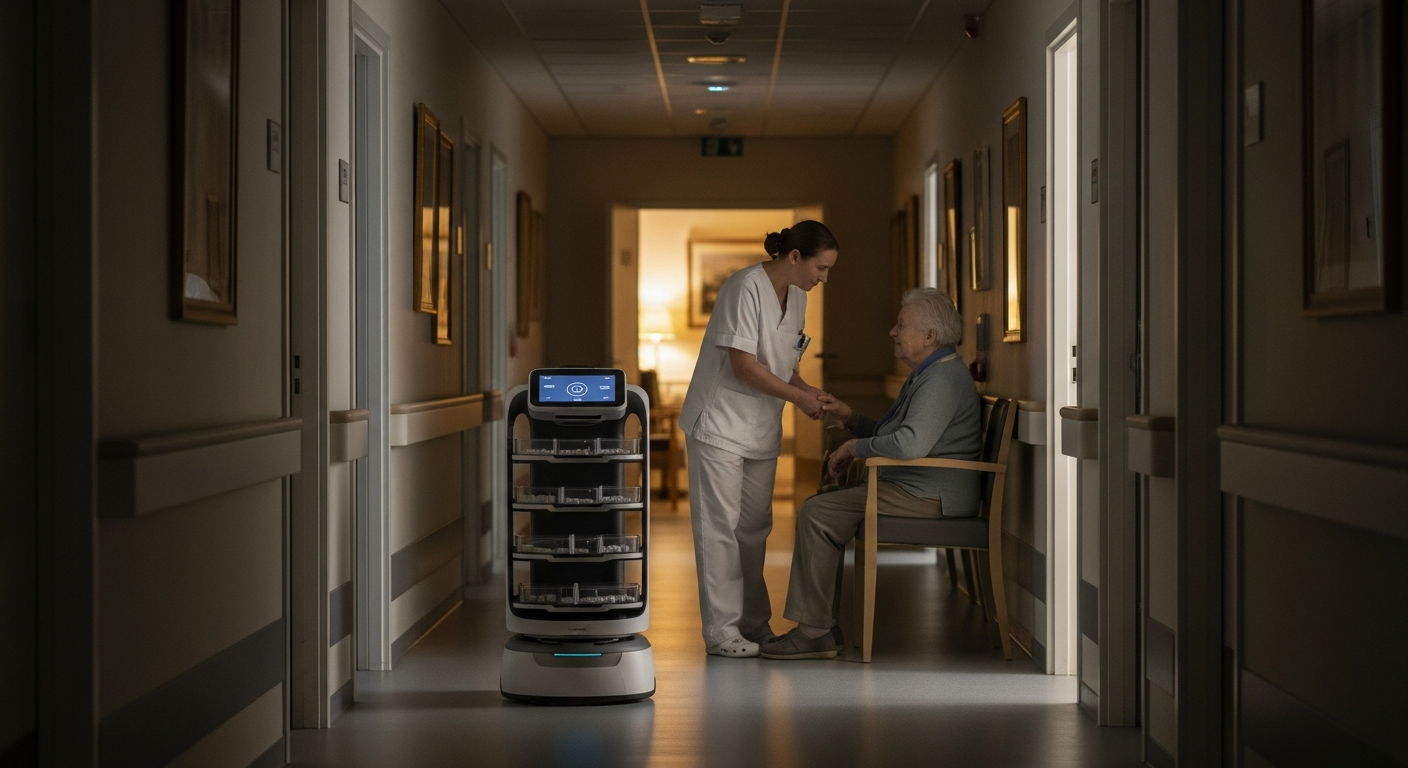
Ward 2. 10:00 p.m. The night shift has just begun, yet the medication cart is already on its way autonomously, without a nurse having to push it. While the team concentrates on direct resident interaction and complex care tasks, the robot navigates safely through the corridors. In a Hamburg care facility, this scenario has been lived reality for twelve weeks. This is not about the theoretical replacement of humans but about reclaiming valuable net care time by automating unproductive walking routes. werob translates these operational needs into technical specifications and brings robots into productive use within eight weeks.
Key Takeaways
- 1An automated medication round relieves a care site by approximately 92,000 euros annually.
- 2The EU Machinery Regulation 2023/1230 makes professional systems integration a legal obligation from January 2027.
- 3werob enables the productive deployment of robots in just eight weeks through pre-built connectors to systems such as PointClickCare.
The Systems Integrator as the Key to Scaling
In the current debate about robotics in care, the mistake is often made of regarding the robot as an isolated product. A care home robot, however, is only as capable as the system environment in which it acts. werob positions itself here not as a manufacturer but as a hardware-agnostic systems integrator. This means that we are not tied to a single OEM but select from a catalog of more than 44 partners and 280 different robot models the exactly matching solution for your facility.
The challenge in the care sector rarely lies in a lack of hardware but in the complexity of implementation. While classic consulting firms often need months for discovery phases, werob uses a specialized Spec Engine. This translates your workflows into a deployable robot specification within 48 hours. This approach eliminates vendor lock-in and ensures that the chosen hardware, whether from Keenon, Pudu, or specialized humanoids such as those from Apptronik, exactly meets the requirements of your wards. The goal is seamless embedding into operational daily life that delivers measurable added value from the very first day.
Measurable Cost Relief through Targeted Use Cases
Economics in care cannot be substantiated by vague adjectives but only by hard figures. The data from more than 200 robots in live operation show clear savings potential in specific areas of use. An automated medication round leads to annual cost relief of 92,000 euros per site. This sum results from reducing pure transport times that highly qualified staff previously had to cover on foot. The situation is similar for the general transport of laundry, meals, or consumables, where relief of 71,000 euros per year is realized.
A concrete example is Korian Germany. Through the use of robotics, double-digit cost relief was already achieved in the first year. These figures are not theoretical projections but are based on werob's outcome-only model. This means for you as the operator that costs only arise once the robot is working productively on the floor. For a care group with, for example, four sites and five robots each, the annual economic benefit adds up to around 1.8 million euros. These funds can be reinvested directly into the quality of resident care and the attractiveness of jobs.
Regulation and the EU Machinery Regulation 2023/1230
A critical aspect that is often underestimated is the legal framework. From 20 January 2027, the EU Machinery Regulation 2023/1230 becomes binding. This has massive implications for the operation of robots in publicly accessible spaces such as care homes. Many Asian OEMs currently do not have the necessary conformity assessments for the European market. werob acts here as your compliance path. We ensure that all deployed systems not only meet ISO 13482 for personal care robots but also comply with the strict requirements of the care home inspectorate and data protection.
Especially in handling sensitive resident data and navigating narrow corridors, legally compliant documentation is indispensable. Our live Cockpit monitors the fleet using a four-dimensional traffic-light system that, in addition to hardware and infrastructure, also checks regulatory compliance and adherence to the specifications in real time. We thus offer operators protection against liability risks that would arise from self-import or purchase via pure resellers without integration competence. At werob, compliance is not an optional extra but an integral part of the operational layer.
Seamless Integration into the Operator Stack
A robot that does not communicate with the existing software creates extra work instead of relief. werob delivers pre-built connectors into the common operator stack of the care sector. These include direct integrations into systems such as PointClickCare and MatrixCare. These interfaces enable the robot to receive information about ward schedules or specific delivery requirements directly from the leading system. When a medication order is triggered in the system, the robot already knows which ward it must travel to, without manual input being required on the device.
This depth of integration distinguishes a professional fleet solution from a pilot project. Through the connection to the Wi-Fi and the existing infrastructure, the robot becomes a digital employee that completes its tasks in the background. The Cockpit offers 24/7 monitoring and reporting functions that make transparent for the nursing service management how many kilometers and tasks the fleet has taken on. This data is essential for the continuous optimization of processes and for demonstrating efficiency to payers or investors.
From Specification to Live Operation in Eight Weeks
Time is a critical factor in care. While traditional automation projects often require six to twelve months of lead time, werob has shortened the process to eight weeks. It all begins with the Spec Engine. Within 48 hours, we translate your individual workflows into a technical specification. In doing so, we draw on the experience from more than 35,000 projects to rule out sources of error as early as the planning phase. After the specification, a binding quote follows within five days, based on the Supplier Match from more than 44 OEMs.
The rollout is standardized. Because the connectors already exist and the regulatory examinations are integrated into the werob process, the robot is on your floor after eight weeks at the latest. This speed advantage is decisive for being able to react to acute staff shortages or sudden absences. The commercial model supports this fast start, as no high upfront investments in the hardware are necessary; instead, the focus is on the operational outcome. You pay for the performance delivered, which massively lowers the barrier to entry into robotics.
Humanoid Robots: The Next Stage of Care Support
While service robots today primarily take over transport tasks, humanoid robots are increasingly coming into focus in the care sector. In a Hamburg care facility, the first humanoid is currently in a twelve-week pilot operation. Partners such as Apptronik, Figure AI, or 1X are developing systems that are able to carry out more complex interactions and move in environments that are difficult to access for classic wheeled robots. werob continuously observes and ranks these developments in order to include them in the Supplier Match as soon as they have reached the necessary maturity for the European market.
The use of humanoid systems requires an even more precise alignment of safety concepts and ethical guidelines. Here werob's expertise in the area of the EU Machinery Regulation and the AI Act comes into play again. We ensure that these state-of-the-art systems too can be seamlessly integrated into everyday care without unsettling residents or overwhelming staff. The future of care will be a mixed fleet in which specialized transport robots and versatile humanoids work hand in hand, controlled via a central werob Cockpit.
Comparison: Systems Integrator vs. Single-OEM Purchase
The decision in favor of a robotics solution should be based on a comparison of the long-term operating costs and flexibility. A direct purchase from a manufacturer ties you to its software and hardware development. If the manufacturer falls behind or changes its strategy, your investment is at risk. A systems integrator like werob offers decisive protection here. Through the hardware-agnostic approach, we can switch to more powerful models from other manufacturers at any time without you having to adapt your entire infrastructure or the software integrations.
| Criterion | Single-OEM Purchase | werob Systems Integration |
|---|---|---|
| Hardware selection | Limited to one portfolio | 44+ OEMs, 280+ models |
| Implementation time | 3-6 months | 8 weeks |
| Software connection | Often proprietary / isolated | Pre-built (PCC, MatrixCare) |
| Compliance path | Operator's own responsibility | Integrated EU standard 2027 |
| Cost model | List price / CAPEX | Outcome-only / OPEX |
This comparison makes clear that werob's added value lies in reducing operational complexity. We take on the risk of technology selection and regulatory conformity, while you can concentrate on the quality of care.
The Path to the First Robot: Success in Eight Steps
The entry into robot-assisted care follows a clear, eight-stage process at werob. First, we jointly define who you are and which specific shifts in your facility should be relieved. In doing so, you describe the workflow in your own words. Our Spec Engine takes over the translation into technical parameters. In the fourth step, we analyze the on-site infrastructure, such as elevators, door controls, and Wi-Fi coverage, in order to ensure smooth navigation.
Subsequently, the hardware matching and the examination of the regulatory requirements take place. In the seventh step, we set the commercial framework, which is always based on the outcome-only principle. The conclusion is the definition of the communication channel for ongoing operation. This structured onboarding process ensures that no details are overlooked and that the robot actually delivers the promised relief after eight weeks. Start your specification today and receive clarity about the potential in your facility within 48 hours.
FAQ
- What does a robot for a care home cost at werob?
- werob works according to an outcome-only model. This means there are no classic list prices. You only pay once the robot is running productively in your facility and delivering the defined performance.
- How long does introducing a care robot take?
- From the first contact to the robot in live operation, werob usually takes just eight weeks. The specification is available after just 48 hours.
- Do robots replace nursing staff?
- No, they take over unproductive logistics tasks such as transport routes. As a result, nurses regain time for direct work with the resident, which increases job satisfaction.
- Which technical prerequisites must be met in the home?
- Stable Wi-Fi coverage and level surfaces or controllable elevators are necessary. werob examines this infrastructure as part of the 8-stage onboarding process.
- Are the robots safe for the residents?
- Yes, all robots integrated by werob comply with ISO 13482 for personal care robots and have state-of-the-art sensor technology for obstacle avoidance.
- What happens in the event of technical malfunctions?
- Via the werob Cockpit, the fleet is monitored around the clock. Malfunctions are often detected proactively and resolved remotely or by on-site partners before they disrupt operations.
Related reading
Care Automation: Efficiency Gains Through System Integration
Automation in care is no longer a future vision but an operational reality. Learn how werob as a systems integrator paves the way from specification to live operation in eight weeks.
13 June 2026robots in elderly care deployable todayRobots in Elderly Care: Deployable Today vs Years Away
Discover which robotics solutions are genuinely ready for European elderly care facilities today, and why humanoid caregivers remain years away.
24 August 2026medication robotsMedication Robots in Care: Efficiency and Compliance
Medication robots take over the time-consuming distribution of medication boxes in care facilities. Through integration into existing EHR systems such as PointClickCare, they secure documentation and relieve specialist staff of logistical routine tasks.
11 June 2026care robotsCare Robots in Practice: Operational Efficiency for Operators
The introduction of care robots often fails because of months-long discovery phases. werob shortens the path from workflow analysis to a ready-to-deploy fleet to eight weeks and secures regulatory compliance.
1 June 2026medication robot care homeMedication Robot in the Care Home: Efficiency and Compliance
Automating medication logistics relieves nursing professionals of time-consuming errands. werob integrates autonomous systems into existing workflows and secures regulatory compliance.
1 June 2026