RaaS Robotics: Scalable Automation Without Investment Risk
RaaS robotics enables companies access to state-of-the-art automation without high upfront investments. Through a usage-based model, hardware, software, and maintenance are bundled into a monthly rate, which maximizes operational flexibility.
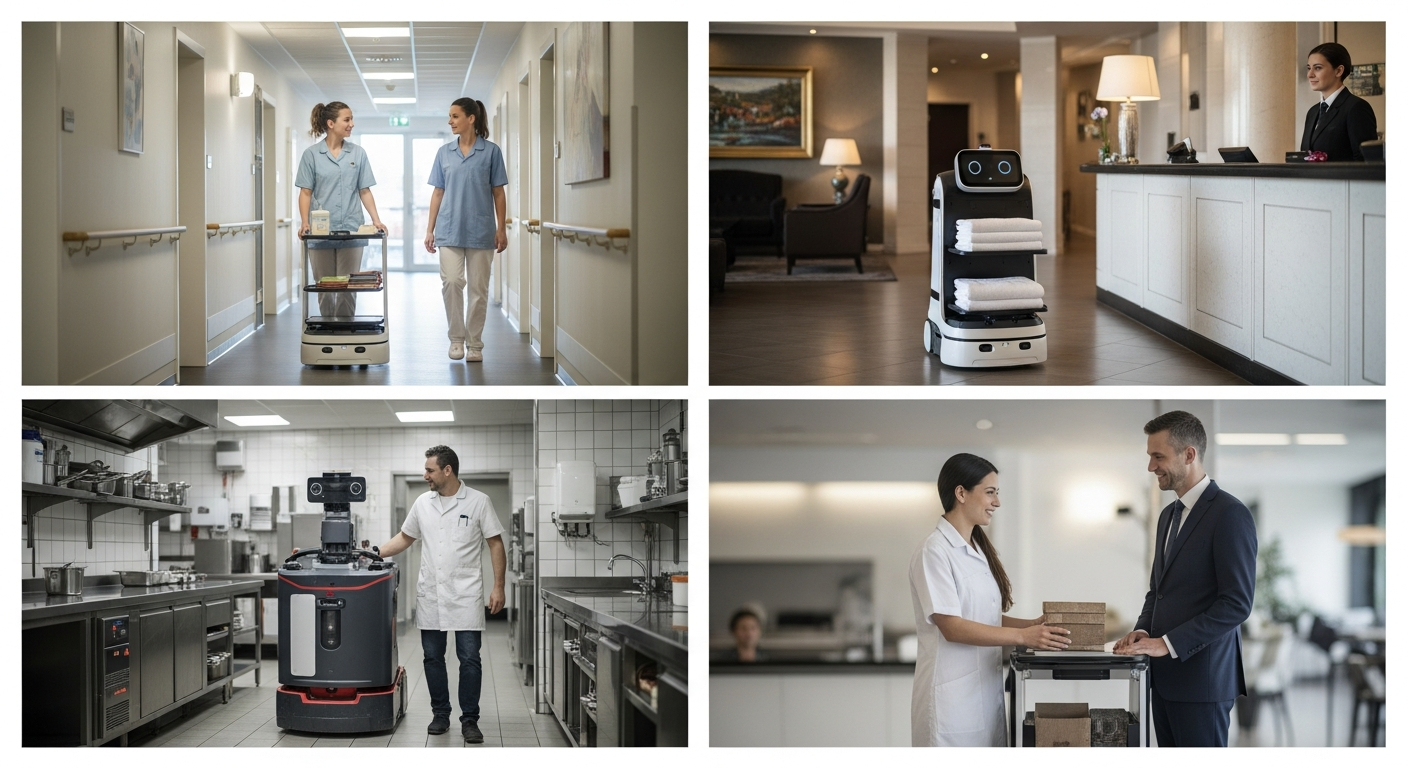
Ward 4. 3:15 AM. While the night shift completes the documentation, the transport robot autonomously delivers the medication trolleys for the morning. No staff member had to move this heavy load. In modern care and logistics, this is no longer a future scenario but operational reality. RaaS robotics makes this efficiency accessible by eliminating the complexity of procurement and operation. At werob, we translate such workflows into a deployable specification within 48 hours to ensure that the technology follows the process and not the other way around. With over 200 robots in live operation in eleven European countries, werob proves that scaling takes place through system integration rather than through hardware ownership.
Key Takeaways
- 1RaaS robotics converts high investment costs into predictable monthly operating costs and preserves liquidity.
- 2Hardware agnosticism prevents vendor lock-in and enables access to over 280 different robot models.
- 3Integration into existing systems such as SAP EWM or MatrixCare is decisive for operational success.
The Definition of RaaS Robotics in the B2B Context
Robotics as a Service (RaaS) describes far more than just a hardware rental model. At its core, it is the provision of a complete operational capability. For an operator in hospitality or care, this means that the focus is not on the robot as a physical object, but on the completed task, such as room service or the medication round. werob acts here as the decisive systems integrator that bridges the gap between robot manufacturers (OEMs) and the specific requirements of the operator. While classic purchase models entail high capital commitments and technological risks, RaaS shifts the responsibility for functionality to the integrator.
An essential aspect of RaaS robotics is the decoupling from hardware cycles. Since technology in the area of robotics and humanoids is advancing rapidly, the RaaS model protects companies from the obsolescence of their fleet. werob has access to a catalog of over 44 OEM partners and 280 different robot types. This hardware agnosticism ensures that the machine best suited for the specific workflow is always deployed. The focus is on the result: a smooth process that is directly integrated into the company's existing software stack, without the customer having to build up in-depth robotics expertise.
Economic Advantages: OPEX Instead of CAPEX
The economic logic behind RaaS robotics is based on the conversion of capital expenditures (CAPEX) into operating expenses (OPEX). This preserves liquidity and enables an immediate positive impact on the profit and loss statement. werob pursues a consistent outcome-only model here. This means that costs only arise when the robot is productively deployed. There are no hidden list prices or lengthy discovery phases that burden the budget before added value has been generated. This approach clearly distinguishes werob from classic consulting firms or pure resellers of individual brands.
The financial relief is proven by real deployment data. In care, the automation of the medication round leads to annual cost relief of 92,000 euros per site. In the hotel industry, the use of robots for room service enables savings of up to 112,000 euros per year. These numbers are not theoretical projections, but are based on the reduction of unproductive running times and the optimization of personnel resources. Through RaaS, these savings are realized from the first day of commissioning, as the monthly rate is usually significantly below the saved personnel costs for repetitive tasks.
Hardware Agnosticism as Strategic Protection
A common mistake in introducing robotics is the so-called vendor lock-in. Companies decide on a manufacturer and are bound to its software ecosystem and hardware limitations in the long term. werob breaks this pattern through strict hardware agnosticism. With access to over 280 deployable robot models from partners such as Boston Dynamics, Keenon, Pudu, or Apptronik, werob offers the freedom to adapt the hardware at any time to changed requirements. The werob Spec Engine uses data from over 35,000 projects to create the exact specification for a workflow within 48 hours and to rank the suitable OEMs against it.
This approach is particularly valuable in a market that is still in the consolidation phase. New players in the area of humanoids, such as Figure AI or 1X, enter the market, while established service robot manufacturers continuously improve their models. A RaaS model via an integrator like werob ensures that the operator does not get stuck with outdated hardware. Should an OEM no longer meet the requirements or a more powerful model become available, the platform layer of werob enables a seamless transition, since the process logic and integrations into the operator stack remain in place.
Integration into the Operator Stack: The Connector Layer
A robot that operates in isolation from the rest of the IT systems often creates more manual effort than it saves. The true strength of RaaS robotics is shown in the depth of integration. werob delivers pre-built connectors for the most common systems in the target industries. In care, these are integrations with PointClickCare or MatrixCare, in hospitality with Opera PMS or Mews, and in logistics with SAP EWM. These connectors ensure that the robot receives its orders directly from the existing workflow and reports its status back in real time.
For example, if a guest orders an additional towel via the PMS in a hotel, the system automatically triggers the robot, without a staff member having to intervene manually. In gastronomy, robots communicate directly with the kitchen via interfaces to Toast or Lightspeed. This seamless integration is the prerequisite for the speed promised by werob: five days to the offer and eight weeks until the robot is in operation. Without these standardized connectors, integration projects would take months and cause high development costs, which would negate the economic advantage of RaaS.
Regulatory Security and the EU Machinery Regulation 2023/1230
An often underestimated aspect when introducing robotics is compliance with legal regulations. The new EU Machinery Regulation 2023/1230 becomes mandatory from January 20, 2027. This sets stricter requirements for the safety and conformity assessment of machines, especially when they work in direct contact with humans, as is the case in care or hospitality. Many Asian OEMs do not have the necessary structures to independently cover these complex European regulations. werob acts here as the necessary compliance pathway.
By assuming system responsibility, werob ensures that all deployed solutions comply with applicable standards such as ISO 13482 for personal assistance robots or the German Guard Regulation in the security area. The werob cockpit also offers a four-dimensional traffic light system that monitors not only hardware and infrastructure but also the regulatory status of the entire fleet. For operators, this means a complete liability exemption regarding the technical conformity of the deployed systems. In an environment where the EU AI Act and cybersecurity guidelines such as IEC 62443 are becoming increasingly important, this integrated compliance protection is a decisive argument for the RaaS model from werob.
Vertical Use Cases and Real Savings
RaaS robotics develops its full potential in industries with high skilled labor shortages and repetitive tasks. In care, werob has already shown with customers such as Korian Germany that double-digit cost relief is possible in the first year. In addition to the medication round (92,000 euros in savings), the automation of transport tasks relieves staff by 71,000 euros annually per site. This time flows directly back into resident care, which significantly increases the quality of care.
In logistics and facility management, the levers are similarly large. An autonomous yard patrol saves 68,000 euros annually, while the automated cleaning of kitchen floors in gastronomy amounts to 44,000 euros. Even in niches such as golf, robots for ball collection (38,000 euros in savings) or for mowing the greens (31,000 euros in savings) pay for themselves within the shortest time via the RaaS model. The common denominator of all these use cases is the shift of 'Dull, Dirty and Dangerous' tasks to machines, while the human staff is used for value-adding activities. werob delivers not only the hardware for this, but the entire operating system for this transformation.
The werob Cockpit: Live Fleet Management
Operating a robot fleet requires continuous monitoring and optimization. The werob cockpit serves as the central control unit for all deployed systems, regardless of the manufacturer. It offers a real-time overview of the status of each individual robot and uses an intelligent traffic light system for the early detection of problems. Four dimensions are monitored: the physical hardware, the local infrastructure (such as Wi-Fi and elevator controls), compliance with regulatory requirements, and performance against the original specification.
This level of transparency is decisive for the success of RaaS robotics. Operators can always understand whether the promised efficiency gains are being realized. The cockpit also enables proactive maintenance. Before a robot fails due to a wear part, the system detects the irregularity and initiates appropriate measures. Since werob already operates over 200 robots in eleven countries, the insights from this live operation continuously flow into the optimization of the algorithms. This guarantees maximum availability of the fleet, which is in the direct interest of the integrator in an outcome-only model.
In Eight Weeks to Productive Deployment
The speed of implementation is a critical competitive advantage. While traditional automation projects often spend months or years in the planning phase, werob has compressed the process to eight weeks. It all begins with the Spec Engine, which creates a technical specification from a simple description of the workflow within 48 hours. This is followed by the Supplier Match, in which the optimal partners are selected from the catalog of 44+ OEMs. Within five days, the customer receives a binding offer based on the RaaS model.
The remaining weeks are used for the configuration of the connectors and the physical provision on site. Since werob relies on pre-built integrations, the time-consuming custom programming is largely eliminated. This standardized process minimizes the project risk and allows companies to introduce automation agilely and step by step. Entry often takes place via a pilot site, as the example of the Hamburg care facility shows, which already had the first humanoid in productive deployment in week 12. RaaS robotics is thus not a long-term IT project, but an immediately available operational solution.
FAQ
- What is the difference between RaaS and leasing?
- While leasing only covers the financing of the hardware, RaaS robotics at werob includes the entire integration, maintenance, software updates, and live fleet management. It is an all-around worry-free package for operational operation.
- How quickly is a RaaS robot ready for deployment?
- At werob, it usually takes only eight weeks from the first specification to the robot in live deployment. The specification itself is already available after 48 hours.
- What cost savings are realistic through RaaS robotics?
- The savings depend on the use case. In care, they are approximately 92,000 euros for medication rounds, in hospitality up to 112,000 euros for room service per year and site.
- Is RaaS robotics compliant with the new EU Machinery Regulation?
- Yes, as a systems integrator, werob ensures that all deployed solutions meet the requirements of the EU Machinery Regulation 2023/1230, which becomes mandatory from January 2027.
- Do I have to commit to a robot manufacturer?
- No, werob is hardware-agnostic. We rank over 44 OEM partners against your specific requirements, so that you always receive the best technology for your task.
- What happens in case of technical malfunctions of the robot?
- The werob cockpit monitors the fleet in real time. Malfunctions are often detected before they affect operations and are remedied at no additional cost within the RaaS model.
Related reading
Robot subscription: Scalable automation without investment risk
A robot subscription gives companies access to state-of-the-art robotics without high upfront investments. werob integrates these systems into existing workflows in a hardware-agnostic manner and guarantees operational success through a purely results-oriented billing model.
17 June 2026raas provider germanyRaaS Provider Germany: Robotics Integration Without Investment Risk
Robotics as a Service (RaaS) enables companies access to state-of-the-art automation without high upfront investments. werob acts as a systems integrator that combines hardware, software, and compliance in a scalable model.
15 June 2026rent robotsRent a robot: operational scaling without investment risk
Renting robots is evolving from a trend to an operational standard for European companies. Find out how werob, as a system integrator, combines hardware agnostics and regulatory security in an outcome-only model.
17 June 2026Rent service roboticsRent service robotics: operational efficiency without tying up capital
Renting service robot systems allows companies to scale quickly without high investment risk. As a hardware-agnostic system integrator, werob offers the direct path from workflow analysis to a productive fleet in eight weeks.
19 June 2026robot leasingRobot leasing for companies: models and ROI factors
Companies face the challenge of scaling automation without high CapEx hurdles. Robot leasing offers the necessary financial flexibility for this, provided that it is integrated directly into the existing operator stack.
17 June 2026