Renting a Golf Course Robot: Increasing Efficiency without Tying Up Capital
Automating golf courses often fails because of high acquisition costs and technical complexity. werob offers a hardware-agnostic path to integrate robots for ball collection and mowing into operations without an upfront investment.
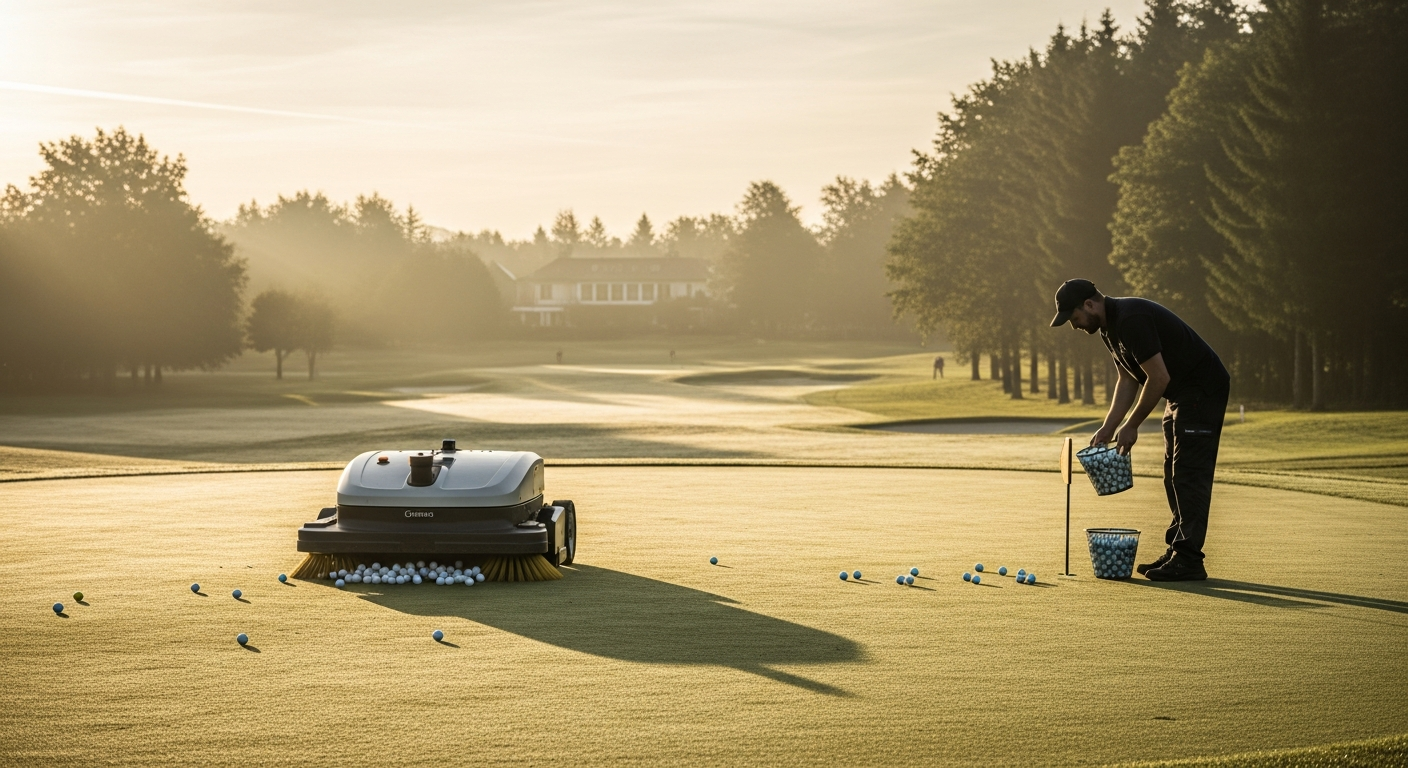
Tuesday, 5:30 a.m. Driving range, Munich area. While the dew still lies on the grass, the autonomous ball collector is already finishing its second round of the night. No employee had to work overtime for this monotonous task or maneuver in the dark. Over the first coffee, the head greenkeeper checks the tablet: 4,200 balls collected, battery charge at 85 percent, system status green. What used to be a logistical challenge amid an acute staff shortage today runs fully automatically in the background. werob translates these operational processes into a deployable specification in 48 hours and brings the hardware onto the course within eight weeks.
Key Takeaways
- 1Cost relief of up to €38,000 in ball collection and €31,000 in mowing per year and site.
- 2No investment risk through the outcome-only model: you only pay once the robot is running.
- 3Legal certainty guaranteed through compliance with the EU Machinery Regulation 2023/1230 from January 2027.
The Operational Pain Point: Staff Shortage and Seasonality on the Green
The management of golf facilities faces an unprecedented challenge. The skills shortage hits greenkeeping particularly hard, as the work often has to take place in the early morning or late evening hours and is heavily season-dependent. Traditional approaches to staff recruitment no longer work in many regions, which leads to an overload of the core team and a declining quality of course care. This is where robot-assisted automation comes in, not as a replacement for the greenkeeper but as a tool to relieve repetitive tasks.
Especially ball collection on the driving range and the large-area mowing of fairways and roughs tie up valuable working time that is missing for more qualified tasks such as the care of the greens or the maintenance of the irrigation systems. When operators rent a golf course robot, they address precisely this gap. It is no longer about whether the technology works but how it is seamlessly integrated into the daily workflow without overwhelming the existing team with complex IT hurdles. werob acts here as a translator between the operational requirement of the club and the technical reality of the robotics manufacturers.
Outcome-only: Why Renting Eliminates the Investment Risk
An essential obstacle to automation in the golf sector has so far been the high tying-up of capital. Acquiring a fleet of mowing robots or autonomous ball collectors requires six-figure investments that often have to be written off over years. In a market environment characterized by volatile member numbers and rising energy costs, this constitutes a considerable risk. werob breaks up this model through an outcome-only approach. This means for you as the operator: you only pay once the robot is actually performing its work on the course.
This model shifts the responsibility for the hardware functionality and the integration entirely to the systems integrator. Instead of tying yourself to a single manufacturer (OEM) and having to use its proprietary software solutions, werob offers hardware-agnostic access. From a catalog of more than 44 OEM partners, the hardware is selected that exactly fits your topography and your requirements. Whether Husqvarna, Echo, or specialized solutions for ball collection – the ranking is carried out objectively against your specification. This protects against vendor lock-in and ensures that you always use the most efficient technology without bearing the full ownership risk.
Verified Cost Relief: €38,000 and €31,000 per Year
The economic validation of robotics on the golf course can be pinned down to concrete figures. Based on live operating data, the use of an autonomous ball collector achieves annual cost relief of an average of €38,000 per site. This sum is composed of saved labor costs, reduced energy costs compared to combustion-engine vehicles, and a higher return rate of the balls, as the robot also works at times when the course would be closed to human employees.
For autonomous mowing of the greens and fairways, the verified relief amounts to €31,000 per year and site. Here, in addition to the pure working-time savings, the consistency of the cut pattern plays a decisive role. Robots can mow at considerably shorter intervals, which promotes grass health and can reduce the need for chemical fertilizers or pesticides. In total, automating these two core areas enables relief of the operating budget by almost €70,000 annually. These funds can be reinvested directly into improving the quality of the facility or into marketing measures for member acquisition.
Integration into the Stack: The Role of GolfNow and Connectors
A robot that acts in isolation from the rest of the club administration creates new manual effort. True efficiency only arises through integration into the operator's existing software stack. For this, werob delivers pre-built connectors that connect the robot with platforms such as GolfNow. This enables intelligent control based on actual play. When, for example, a tournament starts on hole 1, the mowing fleet automatically receives the command to avoid this area or to postpone the work to a different time window.
This connectivity is the heart of the werob platform. Instead of laboriously having their own interfaces developed, operators use the existing infrastructure in order to integrate the robot fleet into fleet management. The live Cockpit offers a four-dimensional traffic-light system that monitors not only the hardware status and the infrastructure but also ensures compliance with regulatory requirements and the original specification. This way, management retains full control over the operating costs and the performance of the autonomous systems at all times, without having to become a technology expert itself.
Regulation and Safety: EU Machinery Regulation 2023/1230
An often underestimated aspect when renting golf course robots is legal compliance. On 20 January 2027, the new EU Machinery Regulation 2023/1230 becomes binding. This imposes considerably higher requirements on the conformity assessment and the safety of autonomous systems in public spaces. Because golf courses are often publicly accessible or at least involve a high interaction between human and machine, compliance with these standards is liability-critical for operators.
werob acts here as a compliance path. As a systems integrator, we ensure that all deployed robots – regardless of whether they come from European or Asian OEMs – meet the strict EU requirements. This includes not only the physical safety of the hardware but also the cybersecurity of the networked systems in accordance with standards such as IEC 62443. Anyone who rents a robot today must ensure that the system can be operated in a legally compliant manner even beyond the year 2027. werob takes over this regulatory monitoring as part of the Cockpit, so that the club manager remains protected from liability risks.
To Live Operation in 8 Weeks: The werob Workflow
Speed is decisive in the seasonal golf industry. A project that requires six months of planning often misses the critical phase of the playing season. werob has radically accelerated the process of robot introduction. It all begins with the Spec Engine: within 48 hours, we translate your verbal or written description of the workflows – such as the size of the driving range, the ground conditions, and the desired deployment times – into a technical specification. This engine was trained on more than 35,000 projects and eliminates lengthy discovery phases.
After the specification, the concrete quote follows within five days based on the Supplier Match, in which 44+ OEMs are ranked against your requirements. As soon as the decision has been made, werob guarantees commissioning within eight weeks. This tight schedule is only possible because werob does not build individual solutions but operates on a standardized platform. From the first inquiry to the first mowed blade, less than two months thus pass, which enables implementation even during the ongoing season.
Comparison of the Operating Models: Rental vs. Purchase
For decision-making, a direct comparison of the commercial models is indispensable. While the purchase at first glance impresses through the elimination of monthly fees, on closer examination hidden costs and risks are revealed.
| Criterion | Purchase (Single-OEM) | Rental / RaaS (werob) |
|---|---|---|
| Investment costs (CAPEX) | High (upfront payment) | Zero (outcome-only) |
| Technology risk | Operator bears obsolescence risk | Hardware-agnostic / replaceable |
| Integration | Often isolated island solution | Direct connectors (e.g. GolfNow) |
| Compliance (EU 2023/1230) | Operator's own responsibility | Integrated compliance path |
| Maintenance & support | Additional contracts required | Included in the operating concept |
The rental model via a systems integrator such as werob thus offers not only financial flexibility but also an operational safeguard that goes far beyond pure hardware ownership.
The Future of Golf Course Automation through 2028
Robotics in the golf area is only at the beginning of an exponential development. While ball collection and mowing are in focus today, considerably more complex tasks will be automated by 2028. werob pursues the goal of operating 2,000 robots in live operation by then, which creates a massive data basis for the further optimization of the algorithms. Future systems will be able to measure ground moisture in real time and control the irrigation with pinpoint accuracy, or autonomously remove weeds without chemical aids.
For club operators this means that the infrastructure created today – the werob Cockpit and the connectors – forms the basis for all future expansions. Anyone who begins today with renting a robot for the driving range lays the foundation for a fully automated outdoor facility. The key to success lies not in the hardware itself but in the ability to integrate this hardware into a stable, legally compliant, and economically measurable process. werob delivers precisely this operational layer that makes it possible to use technology as a genuine operational lever.
FAQ
- What does it cost to rent a golf course robot at werob?
- werob works according to an outcome-only model. There are no classic list prices or high upfront investments. The costs are based on the performance delivered and the operational relief. You only pay once the system is in productive use.
- Which robot manufacturers does werob offer?
- werob is hardware-agnostic and carries more than 44 OEM partners in its catalog, including brands such as Husqvarna, Echo, and Toro. We rank more than 280 different robot models against your specific requirements in order to find the best solution.
- How is the robot integrated into my existing software?
- werob offers pre-built connectors for common industry software such as GolfNow. As a result, the robot fleet can be synchronized directly with play, which minimizes manual control effort.
- Is operating the robots on the golf course safe for players?
- Yes, all systems integrated by werob meet the highest safety standards. We ensure that the hardware complies with the current standards and actively prepare our customers for the EU Machinery Regulation 2023/1230.
- What happens in the event of a technical malfunction of the robot?
- Via the werob Cockpit, the entire fleet is monitored live. A 4-dimensional traffic-light system reports problems with hardware, infrastructure, or regulatory compliance immediately. Because werob is responsible for operations, we take care of the fast troubleshooting.
- How long does it take from the first inquiry to deployment?
- Our promise is: 48 hours to the finished specification, 5 days to the quote, and 8 weeks to the robot in live use on your golf course.
Related reading
Golf Robots: Increasing Efficiency for the Driving Range and Greenkeeping
Golf robots optimize the operation of golf facilities through autonomous ball collection and precise greenkeeping. As a systems integrator, werob delivers the turnkey solution including technical integration and regulatory safeguarding.
6 June 2026greenkeeper robotGreenkeeper Robot: Automating Golf Course Care
Automating golf course care solves the problem of seasonal skilled labor shortages at European golf facilities. Learn how werob, as a systems integrator, optimizes operations through hardware-agnostic solutions.
7 June 2026eu golf club robotics providerEU Golf Club Robotics Provider: Efficiency through Systems Integration
Meeting the skills shortage at European golf facilities through hardware-agnostic robotics integration. werob delivers deployable specifications in 48 hours and realizes measurable cost relief.
5 June 2026autonomous course care golfAutonomous Golf Course Care: Efficiency through Robotics Systems Integration
Automating course care addresses the acute skills shortage on the golf course and significantly lowers operating costs. werob integrates hardware-agnostic robotics solutions into existing club workflows and ensures measurable relief.
3 June 2026lawn robots golf courseLawn Robots for Golf Courses: Efficiency and Cost Relief
The automation of hole care on golf courses solves the acute skilled labor shortage in greenkeeping. werob integrates manufacturer-independent robot systems directly into your operational workflow and ensures measurable results.
15 June 2026