Greenkeeper Robot: Automating Golf Course Care
Automating golf course care solves the problem of seasonal skilled labor shortages at European golf facilities. Learn how werob, as a systems integrator, optimizes operations through hardware-agnostic solutions.
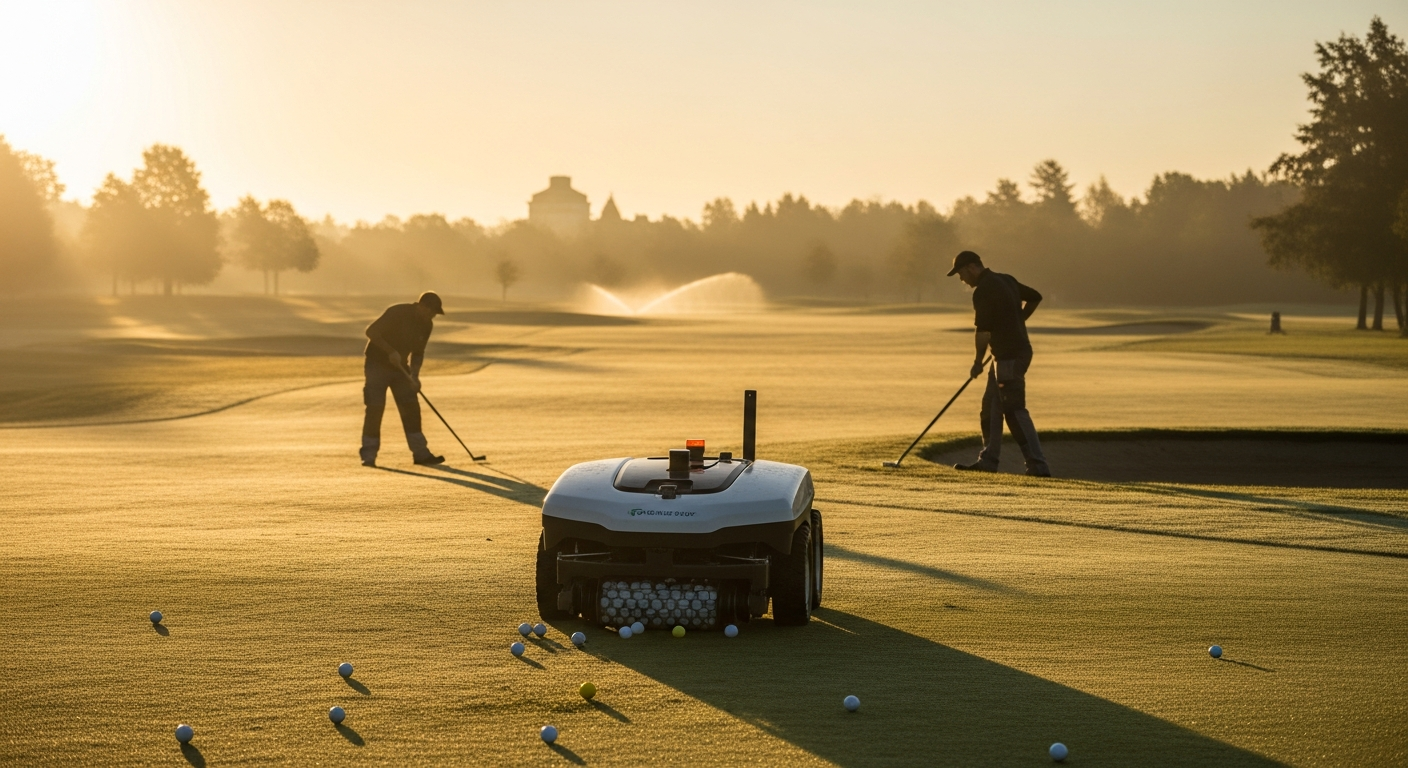
Sunday morning, 06:45. Greens 1 through 9 are already precisely mowed. As the first players arrive for early tee times, the autonomous mower quietly finishes its work on hole 10. The Head Greenkeeper checks the fleet status in the cockpit before assigning his team to specialized tasks such as bunker maintenance or course setup. While the robot fleet handles repetitive routine tasks, the greenkeeping team manages operations and focuses on the qualitative refinement of the course. werob translates these operational workflows into a technical specification and brings the systems into live operation without the operator having to make any upfront investment.
Key Takeaways
- 1Significant annual cost relief for ball collection and mowing per site.
- 2Full compliance with the EU Machinery Regulation 2023/1230 guaranteed from the cut-off date of 20 January 2027.
- 3Seamless integration into existing systems such as GolfNow through pre-built werob connectors.
The Operational Shift in Golf Course Care
The management of golf courses in Europe is at a turning point. With more than 9,500 clubs in the EU, the pressure to maintain care quality while wages rise and skilled labor shortages persist is growing. A greenkeeper robot is a business necessity. The challenge for club managers and head greenkeepers, however, lies in finding the right solution from among the many providers that integrates seamlessly into the existing machine fleet and software infrastructure.
werob acts as the central systems integrator here. We are neither a manufacturer nor a simple reseller of individual brands. Our approach begins with the analysis of the specific workflow on the course. Whether it concerns the driving range, the fairways, or the greens: we translate requirements into a precise robot specification. Within 48 hours, our Spec Engine delivers a ready-to-use profile based on data from over 35,000 projects. This shortens the conventional planning phase from several months to a few days and ensures that the chosen hardware fits the terrain and climatic conditions of the facility exactly.
Cost Relief through Autonomous Ball Collection
Ball collection on the driving range is one of the most repetitive and time-consuming tasks in golf operations. Automation offers the most immediate savings potential here. By deploying specialized ball collection robots, operators achieve significant, verified cost relief per year and per site. This sum results from the reduction of staff hours, fuel costs for conventional collectors, and the avoidance of downtime during peak hours.
An autonomous ball collector works continuously, even during active play. This increases ball availability for customers and reduces wear on the ball material, as the robots operate with lower weight and higher precision than heavy tractor rigs. werob integrates these systems directly into the club's operational stack. Through connectors to platforms such as GolfNow, the operational data of the robot fleet is synchronized with the booking system. This enables demand-based control: during periods of high utilization, the robot increases frequency, while during quiet periods it optimizes charging cycles. The operator retains full control of hardware performance and the fill level of the ball washing stations at all times via the werob Cockpit.
Precision Mowing and Course Maintenance
Mowing the greens and fairways is the calling card of every golf club. This is not only about appearance, but about the consistency of the playing surface. Autonomous mowing systems from partners such as Husqvarna, Echo, or Toro offer a precision that is hard to achieve manually. werob ranks over 44 OEM partners against the specific requirements of the facility to find the optimal system for the respective topography. The verified cost relief from autonomous mowing is significant.
This saving results primarily from the shift in working time. The greenkeeping team can focus on demanding tasks while the robot fleet handles routine work during the night or early morning hours. A key advantage is the reduction of soil compaction. Since autonomous mowers are significantly lighter than manned wide-area mowers, the turf is protected and the soil's drainage capacity is improved. werob ensures that the chosen systems meet strict noise emission requirements, which is particularly crucial for facilities near residential areas. Through werob's hardware-agnostic model, operators are not tied to a single manufacturer and can flexibly expand or adapt their fleet when requirements change.
Integration into the Operator Stack via GolfNow
A robot is only as efficient as its integration into existing processes. Many isolated solutions fail because they do not communicate with the existing management software. werob solves this problem with pre-built connectors. For the golf sector, integration with GolfNow is a central building block. This interface allows the status of the robot fleet to be directly linked with course management.
If, for example, a tournament starts or maintenance work on a specific hole is due, the robot fleet adjusts automatically. The data flows in real time into the werob Cockpit, which uses a four-dimensional traffic light system with full source traceability for every operating parameter. Here, hardware status, infrastructure parameters, regulatory requirements, and adherence to the original specification are monitored. This reduces the monitoring effort for management to a minimum. Instead of operating multiple apps from different manufacturers, the head greenkeeper controls the entire fleet via a single, central interface. This depth of integration is a unique feature of werob and ensures that automation does not lead to additional administrative effort, but effectively reduces it.
Regulation and EU Machinery Regulation 2023/1230
The legal framework for the use of autonomous systems on publicly accessible areas is becoming stricter. Particularly relevant is the new EU Machinery Regulation 2023/1230, which will be binding from 20 January 2027. This regulation imposes high requirements on the safety and conformity assessment of robots, especially when they operate near people. For golf course operators, this means considerable liability relevance.
werob offers the necessary compliance path here. As a systems integrator, we take responsibility for ensuring that the deployed systems meet all regulatory requirements. This includes not only hardware safety according to standards such as ISO 13482 for personal service robots, but also cybersecurity according to IEC 62443 and data protection under GDPR. Since many innovative robot manufacturers come from outside Europe, werob is the decisive partner on site, carrying out and documenting the necessary conformity assessments. Operators thus receive a turnkey solution that is legally secure and will also stand up to future audits or insurance reviews. Without a partner like werob, operators bear the risk of deploying systems that, after the 2027 cut-off date, will no longer have operating approval or will not be insured in the event of damage.
Outcome-only: The Commercial Model of werob
A major obstacle to adopting robotics is often the high initial costs and uncertainty about the actual benefit. werob removes these barriers through a consistent outcome-only model. This means: you pay nothing before the robot runs on your course and delivers the agreed performance. The model focuses on measurable results rather than non-transparent upfront investments.
This model perfectly aligns the interests of werob and the operator. Our goal is to bring the systems into productive operation as quickly and efficiently as possible. Our promise: 48 hours to specification, five days to a binding offer, and eight weeks to the robot in operation. This pace is enabled by our standardized processes and deep network of over 44 OEM partners. The club immediately benefits from cost relief without tying up capital in hardware whose technological half-life is often short. Through the RaaS model (Robotics as a Service), the facility always remains technologically up to date, while werob takes over operations, maintenance, and regulatory monitoring.
Comparison: Autonomous Systems vs. Conventional Care
To base the decision for automation on a solid data foundation, a direct comparison of operating costs and performance parameters is essential. While conventional care methods strongly depend on the availability and cost of seasonal labor, autonomous systems offer a calculable constant in the budget.
| Criterion | Conventional Care | Autonomous Fleet (werob) |
|---|---|---|
| Availability | Dependent on shift schedules | 24/7 ready for use |
| Cost structure | High variable wage costs | Fixed, performance-based rates |
| Soil load | High due to heavy machines | Minimal due to lightweight robots |
| Precision | Variable depending on operator | Consistently high (GPS/RTK) |
| Compliance | Manual documentation | Automated live reporting |
| Integration | No digital connection | Direct connector to GolfNow |
The comparison clearly shows that the advantages of automation go far beyond mere cost savings. Improved soil quality and the ability to shift noise-intensive work to the night significantly increase the attractiveness of the facility for members and guests. werob ensures that the transition from conventional to autonomous care takes place without interrupting play.
Implementation in Eight Weeks: The Path to an Autonomous Facility
The process of automation with werob is designed for maximum speed and minimal burden for the operator. In eight steps, we lead your golf facility into autonomous operation. It all starts with the capture of your specific workflows. Our Spec Engine processes your information on shifts, areas, and tasks and creates a digital twin of the requirements. Within 48 hours, you receive a detailed specification.
After the Supplier Match has selected the best robots from our catalog of over 280 models, the offer is created within five days. Once the decision has been made, we take over the entire logistics, the configuration of the connectors into your software stack, and the preparation of the compliance documents. After eight weeks, the fleet is ready for use on site. The werob Cockpit goes live and gives you full transparency about the savings achieved and operational performance from the very first minute. This structured approach eliminates the risks normally associated with complex technology projects and makes werob the reliable partner for the future of your golf facility.
FAQ
- What does the implementation of a greenkeeper robot cost at werob?
- werob works on an outcome-only model. This means there are no costs before the system is in productive operation. Billing is performance-based. For detailed information, please request a demo.
- How safe are the robots for players on the course?
- All systems integrated by werob meet the strict safety standards such as ISO 13482. Through state-of-the-art sensors, the robots detect obstacles and people in real time and stop or avoid them immediately.
- Which manufacturers are supported by werob?
- werob is hardware-agnostic and works with over 44 OEM partners, including Husqvarna, Echo, and Toro. We select the system that best fits your specific specification.
- Can the robot also work in bad weather?
- Yes, most professional greenkeeper robots are designed for year-round use in various weather conditions. The werob Cockpit monitors weather data and automatically adjusts deployment plans as needed.
- How long does it take from the first inquiry to deployment?
- werob guarantees a specification within 48 hours, an offer within five days, and full operational readiness of the robot fleet within eight weeks.
- What happens in the event of technical malfunctions on the robot?
- The werob Cockpit monitors the fleet in real time with a 4-dimensional traffic light system. Malfunctions are detected immediately and often resolved remotely. If necessary, werob coordinates on-site service through certified partners.
Related reading
Renting a Golf Course Robot: Increasing Efficiency without Tying Up Capital
Automating golf courses often fails because of high acquisition costs and technical complexity. werob offers a hardware-agnostic path to integrate robots for ball collection and mowing into operations without an upfront investment.
6 June 2026eu golf club robotics providerEU Golf Club Robotics Provider: Efficiency through Systems Integration
Meeting the skills shortage at European golf facilities through hardware-agnostic robotics integration. werob delivers deployable specifications in 48 hours and realizes measurable cost relief.
5 June 2026autonomous course care golfAutonomous Golf Course Care: Efficiency through Robotics Systems Integration
Automating course care addresses the acute skills shortage on the golf course and significantly lowers operating costs. werob integrates hardware-agnostic robotics solutions into existing club workflows and ensures measurable relief.
3 June 2026golf robotsGolf Robots: Increasing Efficiency for the Driving Range and Greenkeeping
Golf robots optimize the operation of golf facilities through autonomous ball collection and precise greenkeeping. As a systems integrator, werob delivers the turnkey solution including technical integration and regulatory safeguarding.
6 June 2026lawn robots golf courseLawn Robots for Golf Courses: Efficiency and Cost Relief
The automation of hole care on golf courses solves the acute skilled labor shortage in greenkeeping. werob integrates manufacturer-independent robot systems directly into your operational workflow and ensures measurable results.
15 June 2026