Autonomous Golf Course Care: Efficiency through Robotics Systems Integration
Automating course care addresses the acute skills shortage on the golf course and significantly lowers operating costs. werob integrates hardware-agnostic robotics solutions into existing club workflows and ensures measurable relief.
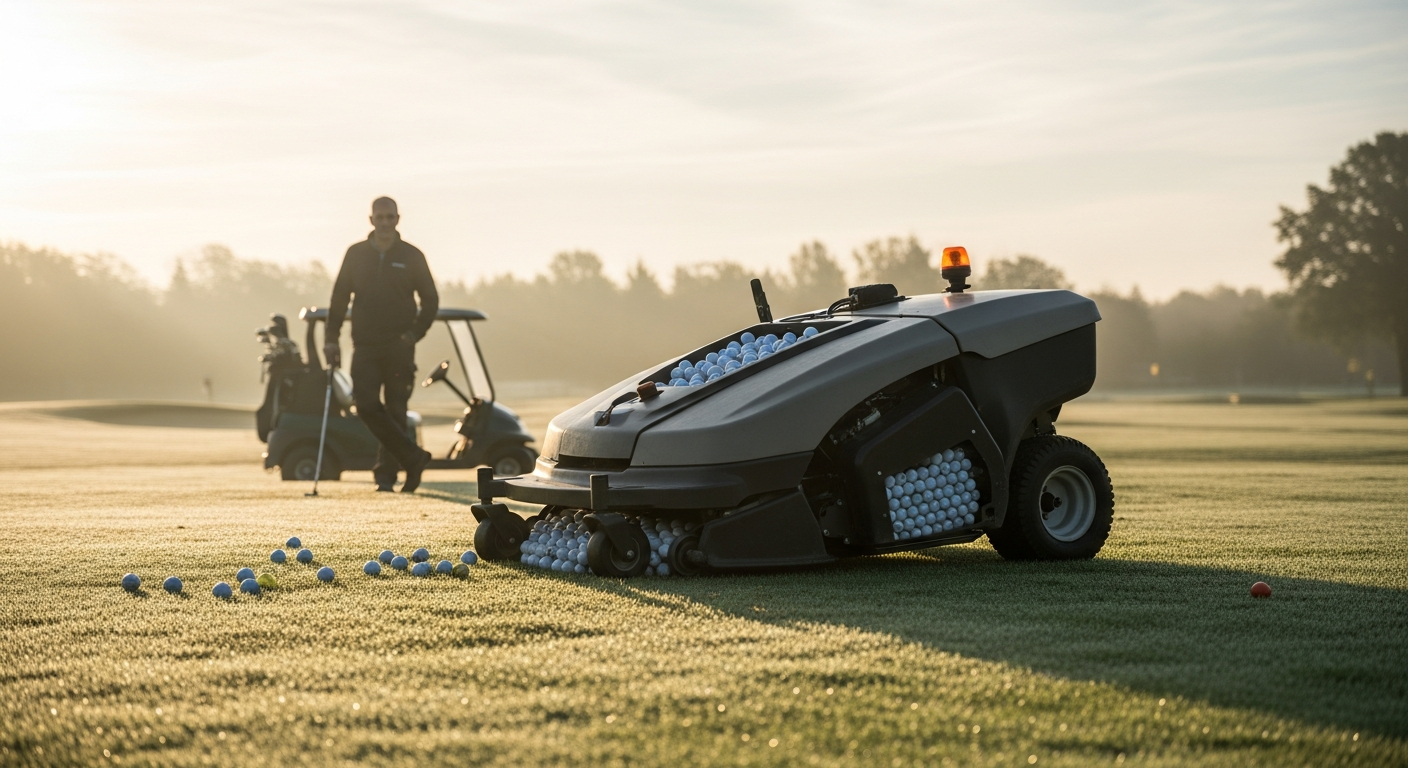
Tuesday, 5:30 a.m. The driving range of a facility on the outskirts of Munich is deserted. While the head greenkeeper finalizes the daily planning in the office, the autonomous ball collector is already finishing its fourth round of the night. On holes 1 to 9, the greens are already perfectly mowed, while the greenkeeping team is relieved. No engine noise disturbs the morning calm, no overtime burdens the budget. Autonomous course care is the answer for modern golf clubs to rising cost pressure and the shortage of qualified seasonal workers. werob translates these operational requirements into a deployable specification within 48 hours and brings the robot onto the course in eight weeks.
Key Takeaways
- 1Significant cost savings in mowing and ball collection per site.
- 2Fast implementation through the werob Spec Engine: to a specification in 48 hours and to live operation in 8 weeks.
- 3Future-proofing through compliance with the EU Machinery Regulation 2023/1230 and hardware-agnostic selection from 44+ OEMs.
The Economic Reality of Golf Course Care
Maintaining a golf course is one of the largest cost blocks in operations. Traditionally, mowing the fairways and collecting balls on the driving range tie up massive personnel resources that are often difficult to find. The skills shortage in greenkeeping has intensified in recent years, leading to rising labor costs and unfilled positions. Through the use of specialized robotics, these repetitive tasks can be automated while experts retain quality control.
Significant annual cost relief in mowing the greens and in ball collection on the driving range enables clubs to reallocate their budgets. These funds can instead be invested in the qualitative enhancement of the facility or in specialized staff for course construction. werob acts here not as a seller of individual machines but as a systems integrator that analyzes the entire workflow and selects the most economical solution from a catalog of more than 44 OEM partners.
From Workflow to Specification in 48 Hours
The planning phase for robotics projects is traditionally lengthy. Classic consulting approaches often need months to define requirements. werob accelerates this process through the Spec Engine. Within just 48 hours, werob translates the verbal or written workflows of a head greenkeeper into a technical robot specification. In doing so, factors such as terrain gradient, ground conditions, obstacles, and the existing charging infrastructure are taken into account.
This Spec Engine is based on the experience from more than 35,000 projects and ensures that the chosen hardware exactly matches the course profile. Instead of relying on the promise of a single manufacturer, werob uses a data-based ranking. More than 280 different robot models are stored in the system and can be examined against the specific requirements of the golf club. This enables an objective selection that covers both technical feasibility and regulatory requirements.
Hardware Agnosticism as Protection against Vendor Lock-in
The market for autonomous mowers and ball collectors is growing rapidly. Manufacturers such as Husqvarna, Echo, or Toro offer systems, yet for the operator the question of long-term compatibility often arises. werob pursues a hardware-agnostic approach. This means that the club is not tied to a single manufacturer. Should a different model prove more efficient for a particular hole, it can be seamlessly integrated into the overall fleet.
werob's Supplier Match system continuously evaluates the 44+ OEM partners according to performance, reliability, and support quality in Europe. For a golf course operator this means maximum security. He receives not the device a seller happens to have in stock but the system that scores best in the ranking for his specific course care. This flexibility is decisive for being able to react to technological leaps without having to replace the entire infrastructure.
Seamless Integration into the Operator Stack
A robot that works in isolation creates new administrative effort. Efficiency arises through integration into the club's existing software landscape. werob offers pre-built connectors, among others for GolfNow. Through this connection, the system knows at all times which holes are currently being played and where the autonomous units can operate safely. The coordination between play and care takes place automatically.
This connectivity also extends to fleet management. In the werob Cockpit, those responsible keep an overview of all active units. A four-dimensional traffic-light system informs in real time about the status of the hardware, the integrity of the infrastructure, compliance with regulatory requirements, and performance compared to the original specification. If a deviation occurs, this is reported immediately, before failures arise in play.
Regulation and the EU Machinery Regulation 2023/1230
Legal certainty is decisive for autonomous course care. From 20 January 2027, the new EU Machinery Regulation 2023/1230 becomes binding. It imposes considerably higher requirements on the safety and conformity of autonomous systems, especially when these operate in areas with public traffic. Many Asian OEMs currently do not have the necessary European certifications for this deadline.
werob acts here as a compliance path. We ensure that all deployed systems meet the strict requirements of the EU Machinery Regulation as well as relevant standards such as ISO 13482 for use in the vicinity of people. For the club manager this means liability security. werob takes responsibility for the regulatory conformity of the entire fleet, so that operations can be continued in a legally compliant manner even after 2027. This also includes data protection (GDPR) when using camera sensors for obstacle detection.
Outcome-only: Pay Only for Results
werob offers an alternative model to classic purchase or leasing contracts. We pursue an outcome-only approach. This means: you pay nothing before the robot is running on your course and delivering the defined performance. There are no hidden list prices or high upfront investments for feasibility studies. The risk of implementation lies with werob.
This model creates a clear alignment of interests. Because werob only earns upon successful operation, the focus is on selecting the most stable hardware and on precise integration into the club's processes. The monthly costs are based on the actual relief and are calculated so that they lie significantly below the previous personnel costs for the same tasks. This way, automation becomes cash-flow-positive from the very first day.
Comparison: Manual vs. Autonomous Course Care
| Criterion | Manual Care | Autonomous Course Care (werob) |
|---|---|---|
| Availability | Dependent on working hours/staff | 24/7 ready for use (night work) |
| Cost relief | None (rising labor costs) | Significant savings |
| Noise pollution | High (combustion engines) | Minimal (electric drive) |
| Precision | Variable by employee | Consistently high through GPS/RTK |
| Compliance | Manual documentation | Automated reporting (EU 2023/1230) |
To an Autonomous Golf Course in Eight Weeks
The path to the automated facility is structured into a clear schedule at werob. After the first contact, the creation of the specification takes place within 48 hours. Within five days you receive a binding quote based on the outcome-only model. As soon as the decision has been made, it usually takes only eight weeks until the first robots are in use on the course.
During this time, werob prepares the connectors, coordinates the safety zones, and integrates the systems into the live Cockpit. The greenkeeping team controls and monitors operations, which can be carried out via smartphone or tablet. The heavy, repetitive work is taken over by the machine, while the team can concentrate on the aesthetic refinement of the course.
FAQ
- How high is the actual saving from autonomous course care?
- The verified cost relief from automation significantly exceeds the operating costs of conventional methods. These figures are based on the reduction of personnel costs and increased operational efficiency.
- Which software integrations does werob support for golf clubs?
- werob offers pre-built connectors for industry software such as GolfNow. This enables synchronization between play (tee times) and the autonomous care units.
- Is the use of robots safe during ongoing play?
- Yes, through modern sensor technology and compliance with ISO 13482 as well as the upcoming EU Machinery Regulation 2023/1230, the systems are certified for use in the vicinity of people. In addition, working hours can be precisely controlled via the Cockpit.
- What happens in the event of technical problems with the robots?
- The werob Cockpit monitors the fleet live with a 4-dimensional traffic-light system. Malfunctions are detected immediately. Because werob acts hardware-agnostically, fast replacement or support through the broad OEM network is ensured.
- Do I have to buy or lease the robots?
- werob uses an outcome-only model. You pay for the performance delivered and the success of the integration. There are no high upfront investments for hardware list prices before the system is running productively.
- How do the robots react to difficult terrain or slopes?
- As part of the 48-hour specification, werob analyzes the course profile. From the catalog of more than 280 robots, exactly the model is selected that can handle the specific slopes and ground conditions of your holes.
Related reading
Greenkeeper Robot: Automating Golf Course Care
Automating golf course care solves the problem of seasonal skilled labor shortages at European golf facilities. Learn how werob, as a systems integrator, optimizes operations through hardware-agnostic solutions.
7 June 2026rent golf course robotRenting a Golf Course Robot: Increasing Efficiency without Tying Up Capital
Automating golf courses often fails because of high acquisition costs and technical complexity. werob offers a hardware-agnostic path to integrate robots for ball collection and mowing into operations without an upfront investment.
6 June 2026eu golf club robotics providerEU Golf Club Robotics Provider: Efficiency through Systems Integration
Meeting the skills shortage at European golf facilities through hardware-agnostic robotics integration. werob delivers deployable specifications in 48 hours and realizes measurable cost relief.
5 June 2026golf robotsGolf Robots: Increasing Efficiency for the Driving Range and Greenkeeping
Golf robots optimize the operation of golf facilities through autonomous ball collection and precise greenkeeping. As a systems integrator, werob delivers the turnkey solution including technical integration and regulatory safeguarding.
6 June 2026lawn robots golf courseLawn Robots for Golf Courses: Efficiency and Cost Relief
The automation of hole care on golf courses solves the acute skilled labor shortage in greenkeeping. werob integrates manufacturer-independent robot systems directly into your operational workflow and ensures measurable results.
15 June 2026