Golf Robots: Increasing Efficiency for the Driving Range and Greenkeeping
Golf robots optimize the operation of golf facilities through autonomous ball collection and precise greenkeeping. As a systems integrator, werob delivers the turnkey solution including technical integration and regulatory safeguarding.
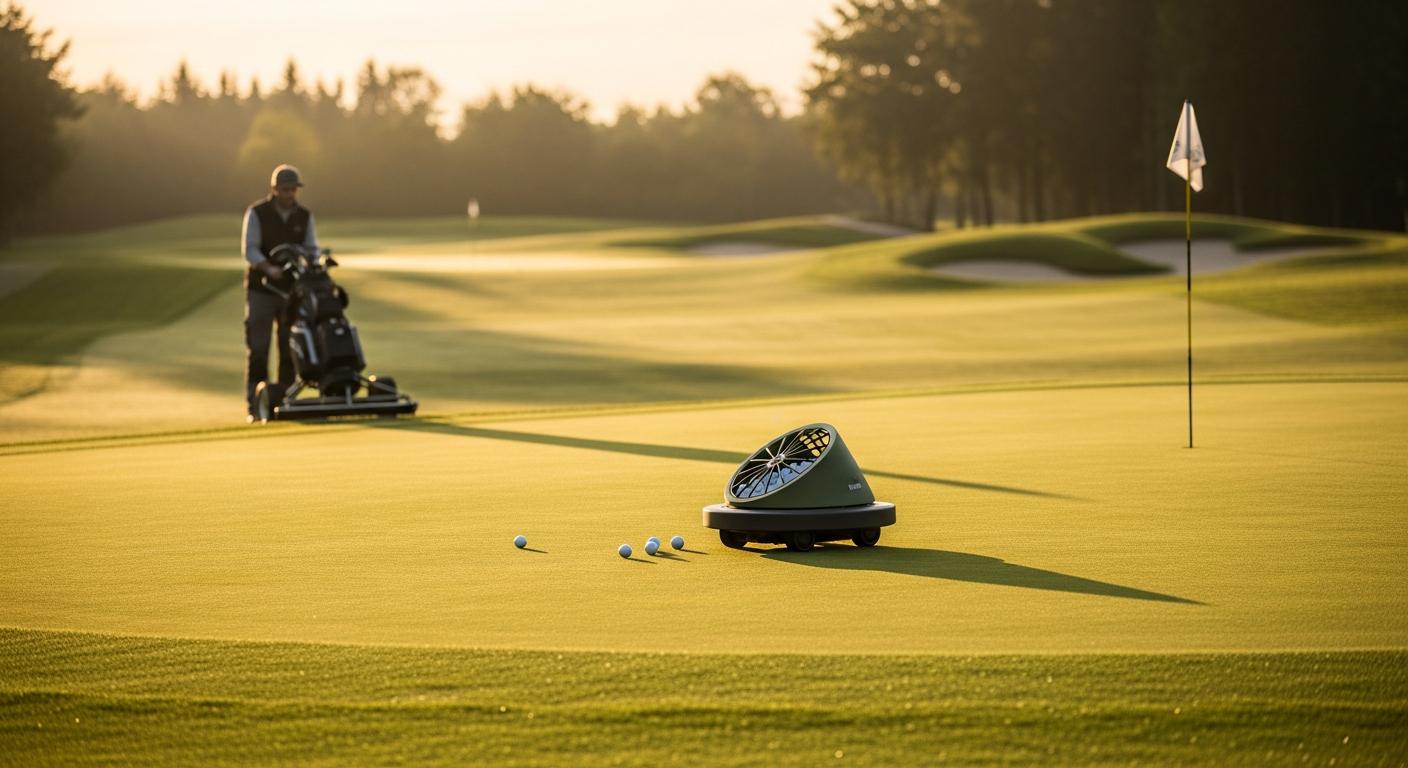
Tuesday, 5:30 a.m. Driving range, Munich area. The autonomous ball collector finishes the second round of the night. While the first players arrive, 4,000 balls are already washed and sorted, available in the dispenser. No employee had to go onto the course in the dark or in the rain. The head greenkeeper begins his working day not with the coordination of temporary staff for repetitive tasks but with a look into the werob Cockpit. Here he sees at a glance that the hardware, the infrastructure, and the regulatory parameters are in the green zone. Automation in golf is no longer a future scenario but an operational necessity to absorb rising labor costs and the massive shortage of seasonal workers.
Key Takeaways
- 1Cost relief of €38,000 in ball collection and €31,000 in mowing per year and site.
- 2Hardware-agnostic selection from more than 44 OEM partners guarantees the best solution for every topography.
- 3Full compliance with the EU Machinery Regulation 2023/1230 for maximum legal certainty.
The Operational Pressure on European Golf Facilities
Operating a golf facility in Europe, especially among the roughly 9,500 active clubs, faces a double challenge. On the one hand, members' expectations of course quality are rising; on the other hand, it is becoming increasingly difficult to find qualified personnel for greenkeeping and the driving range. Seasonal fluctuations further intensify the problem. This is where golf robots come in, which are to be understood not as a gimmick but as industrial tools. A systems integrator such as werob views the facility not through the lens of a hardware seller but translates the workflow into a technical specification.
The automation primarily concerns two core areas: ball collection on the driving range and the large-area mowing of fairways and greens. While conventional approaches often fail due to the lack of integration into the existing IT infrastructure, werob delivers the necessary connectors in order to synchronize data directly with GolfNow, for example. This enables complete monitoring of fleet performance and precise planning of maintenance intervals without the club manager having to maintain in-depth technical knowledge.
Autonomous Ball Collection: €38,000 Cost Relief per Year
Manually collecting golf balls is one of the most inefficient tasks in club operations. It ties up personnel resources in the early morning or late evening hours and causes continuous operating costs through the use of tractors or quads. An autonomous ball collector, on the other hand, operates almost silently and can be deployed 24 hours a day. The verified cost relief through werob-integrated systems amounts to €38,000 per site per year. This figure results from saving labor costs, reduced energy costs, and a longer lifespan of the balls, as robots handle them more gently than heavy collection machines.
The integration takes place via the werob Spec Engine, which creates a deployable specification within 48 hours. In doing so, factors such as the topography of the range, the ground conditions, and the existing washing infrastructure are taken into account. The robot does not act in isolation but is part of a networked system. As soon as the collection container is full, the robot navigates to the unloading station, which conveys the balls directly into the washing facility. This closed loop minimizes human intervention to an absolute minimum and ensures that the driving range is fully ready for use at all times.
Precise Greenkeeping through Autonomous Mowing
In addition to ball collection, mowing the lawn areas is the largest cost block in greenkeeping. Here, werob realizes cost relief of €31,000 per year. Autonomous mowers, such as those offered by partners such as Husqvarna, Echo, or Toro, work with GPS-supported precision. This leads to a more even cut pattern and a healthier lawn structure, as the lower weight of the robots reduces soil compaction. A decisive advantage is the ability to mow at night without disturbing residents or the quiet hours on the grounds.
The challenge for many operators lies in selecting the right hardware from a confusing market. werob acts here hardware-agnostically and ranks more than 44 OEM partners against the specific requirements of the golf facility. Whether steep-slope capability or cutting width – the Supplier Match ensures that only the robots that meet the specification 100 percent are deployed. Through the connection to the werob Cockpit, the head greenkeeper retains control over the cutting heights and the processed areas at all times, which considerably simplifies the documentation toward the board or the owners.
Integration into the Operator Stack: GolfNow and More
A robot that does not communicate with the rest of the IT remains an isolated tool. werob differs from pure resellers through the provision of pre-built connectors. For golf facilities, the integration into platforms such as GolfNow is especially decisive. This connectivity allows the status of course care to be transmitted in real time into the booking system. When a robot is active on hole 5, this can be noted in the system in order not to impair the flow of play or to inform green-fee players in advance.
This technical depth also extends to monitoring the infrastructure. The werob Cockpit uses a four-dimensional traffic-light system that monitors hardware status, network infrastructure, regulatory compliance, and adherence to the original specification. Should a robot stop due to an obstacle or lose the connection to the RTK network, an immediate notification takes place. This prevents long downtimes and secures the return on investment from the first day of deployment.
Regulation and the EU Machinery Regulation 2023/1230
An often underestimated aspect when introducing golf robots is the legal framework. From 20 January 2027, the new EU Machinery Regulation 2023/1230 becomes binding. This regulation imposes considerably higher requirements on the safety of autonomous systems and their conformity assessment. Many Asian OEMs currently do not have the necessary certifications for the European market. werob acts here as a compliance path and ensures that all deployed systems comply with the current and future standards.
This protects the operator from liability risks should accidents occur on the grounds. Because golf robots often operate in areas where people are also present, compliance with safety standards such as ISO 13482 for personal assistant robots or specific requirements for outdoor areas is essential. werob takes over the regulatory examination as part of the onboarding process, so that the club manager has the certainty of operating a legally compliant system.
Outcome-only: werob's Commercial Model
In contrast to classic investment models, in which high acquisition costs for hardware arise, werob relies on an outcome-only model. This means for the golf club: you only pay once the robot is actually running and fulfilling the defined tasks. There are no hidden costs for the consulting or the creation of the specification. This model considerably minimizes the financial risk for the operator and shifts the focus from hardware acquisition to the operational result.
The process is designed for speed. Within 48 hours, the specification is available; after five days, the quote follows; and within eight weeks, the robot is in use on the course. This speed is a decisive competitive advantage in an industry that is often characterized by months-long discovery phases. The club can thus react to staffing bottlenecks even within an ongoing season and increase efficiency without having to wait out lengthy budget cycles.
Comparison: Manual Care vs. werob Systems Integration
To illustrate the advantages of automation, a direct comparison of the operational parameters helps. While manual care depends heavily on the availability and reliability of seasonal workers, the robot-assisted solution offers a constant performance at calculable costs.
| Criterion | Manual Care | werob Systems Integration |
|---|---|---|
| Availability | Dependent on shift schedules | 24/7 operational |
| Cost of ball collection | High (wages + fuel) | €38,000 relief/year |
| Cost of mowing | High (specialist staff) | €31,000 relief/year |
| Precision | Variable | GPS-controlled (cm-accurate) |
| IT integration | None / manual | Direct (GolfNow, Cockpit) |
| Compliance | Occupational-safety focus | EU 2023/1230 compliant |
The Path to the Automated Golf Facility in 8 Weeks
The implementation begins with a simple eight-stage intake process. Here, the specific requirements of the facility are queried: from the size of the driving range through the ground conditions to the desired cutting intervals. The werob Spec Engine uses data from more than 35,000 projects in order to create a precise action graph from this. This process eliminates the need for expensive on-site consulting by external firms that often have no practical experience with hardware implementation.
After the Supplier Match has identified the optimal robot from the catalog of more than 44 OEMs, the technical integration takes place. The pre-built connectors ensure that the data streams flow immediately. Within eight weeks, the status changes from planning to live operation. From this point on, the werob Cockpit takes over the monitoring, so that the operator can concentrate on the core business – the experience for the golfers – while the robots ensure perfect course quality in the background.
FAQ
- What does a golf robot cost at werob?
- werob works according to an outcome-only model. You pay no list prices for hardware in advance but only once the system is running operationally and delivering results.
- Can the robots be used in any weather?
- Yes, the robots selected by werob are designed for outdoor use and work reliably even in rain or darkness.
- How safe are golf robots for the players?
- The systems have state-of-the-art sensor technology for obstacle detection and comply with strict safety standards such as ISO 13482 in order to avoid accidents.
- How long does installation on the golf course take?
- From the first contact to live operation, it usually takes just eight weeks, with the specification already available after 48 hours.
- Which IT systems are supported?
- werob offers direct connectors for industry software such as GolfNow in order to ensure seamless data integration.
- Do I have to rebuild my infrastructure for the robots?
- The Spec Engine examines your existing infrastructure. Often only minimal adjustments such as charging stations or unloading points for balls are necessary.
Related reading
EU Golf Club Robotics Provider: Efficiency through Systems Integration
Meeting the skills shortage at European golf facilities through hardware-agnostic robotics integration. werob delivers deployable specifications in 48 hours and realizes measurable cost relief.
5 June 2026rent golf course robotRenting a Golf Course Robot: Increasing Efficiency without Tying Up Capital
Automating golf courses often fails because of high acquisition costs and technical complexity. werob offers a hardware-agnostic path to integrate robots for ball collection and mowing into operations without an upfront investment.
6 June 2026autonomous course care golfAutonomous Golf Course Care: Efficiency through Robotics Systems Integration
Automating course care addresses the acute skills shortage on the golf course and significantly lowers operating costs. werob integrates hardware-agnostic robotics solutions into existing club workflows and ensures measurable relief.
3 June 2026greenkeeper robotGreenkeeper Robot: Automating Golf Course Care
Automating golf course care solves the problem of seasonal skilled labor shortages at European golf facilities. Learn how werob, as a systems integrator, optimizes operations through hardware-agnostic solutions.
7 June 2026lawn robots golf courseLawn Robots for Golf Courses: Efficiency and Cost Relief
The automation of hole care on golf courses solves the acute skilled labor shortage in greenkeeping. werob integrates manufacturer-independent robot systems directly into your operational workflow and ensures measurable results.
15 June 2026