20 millimetres and a glass wall: what a cleaning robot's sensors are documented not to see
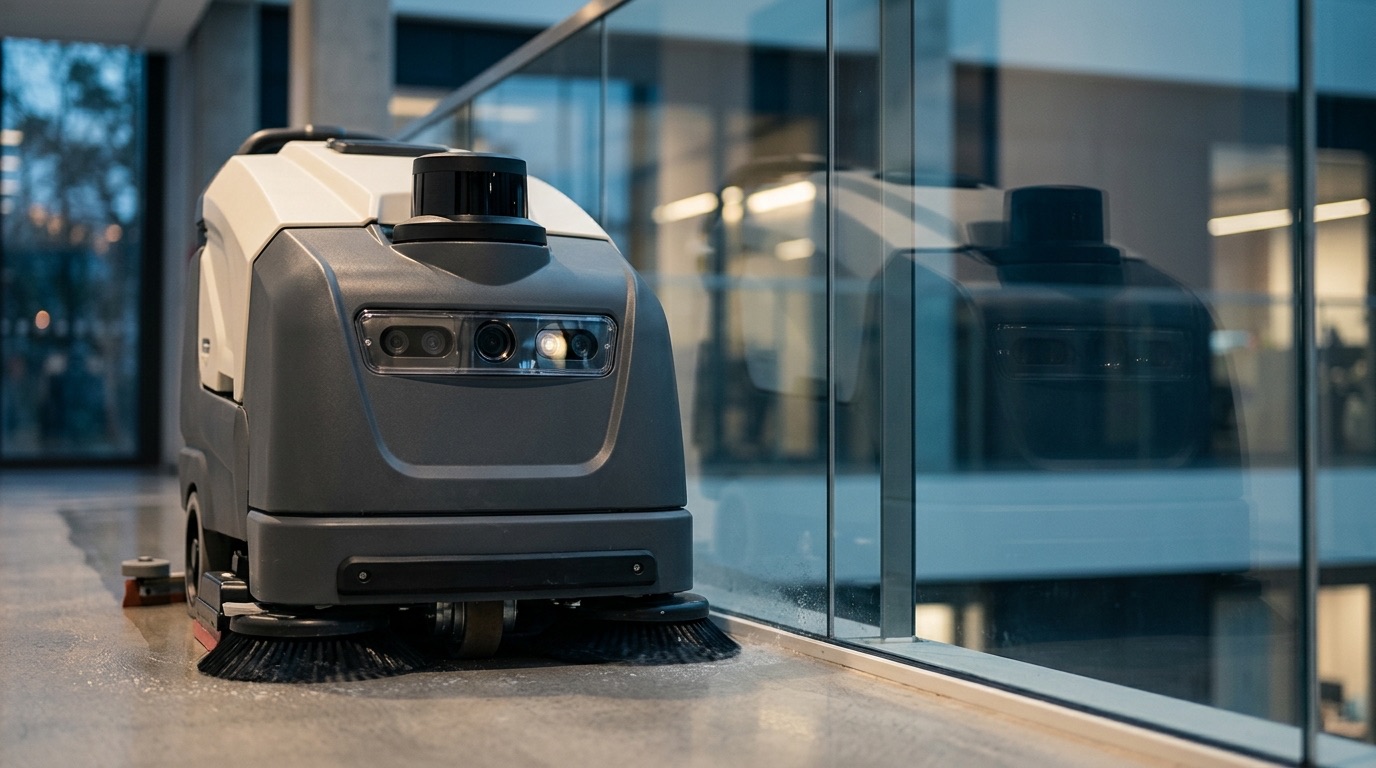
A catalogue scrubber-dryer robot drives on a 2D laser scanner, 3D depth cameras, an RGB camera and drop sensors. The datasheet gives one number to go with them: obstacles from 20 millimetres in height. What lies below that, what is made of glass and what is black is not in the datasheet, but it is in two measurement studies anyone can read.
Whether a cleaning robot suits a particular building is usually answered with area: so many square metres, so many hours. The question that decides operation is a different one: what is in the building that the machine cannot see? A scrubber-dryer robot as it stands in catalogues today drives on a sensor package of four layers, and each layer has a physical limit the manufacturer knows but only partly writes into the datasheet. This article takes one procurable machine, the Gausium Phantas, reads its specification line by line, and sets two independent measurement studies beside it: one on what a laser scanner measures at a glass wall, and one on what depth cameras of different designs return behind glass and in front of black surfaces. From the three sources comes a site walk-through list that is shorter than a brochure and more useful.
Key Takeaways
- 1The Gausium Phantas specification lists as sensing '2D LiDAR, 3D Depth Cameras, RGB Camera, Anti-drop, Anti-collision' and gives a single threshold: a minimum height of detected obstacles of 20 mm; plus 650 mm minimum pass width and height and 5 degrees gradeability. Anything below that is undocumented, and therefore not assured.
- 2A 2D laser scanner measures one plane at a fixed height. A study by Loughborough University London (Sensors, March 2021) records that glass is 'invisible' to LiDAR, that laser scanners only reliably account for diffuse surfaces, and that returns from glass occur only at perpendicular incidence; on top come ghost points from reflections.
- 3A study by the University of Coimbra (Sensors, September 2022) with three depth cameras of different designs shows: two glass panes in front of a wall disturbed none of the cameras; they measured the wall behind. A black card, by contrast, was 'a significant constraint' for the structured-light camera and for the LiDAR camera.
- 4The consequence for the site walk: floor-to-ceiling glass walls and glass doors, black or very dark floors and plinths, objects under 20 mm high, passages under 650 mm and ramps over 5 degrees belong on a list before the quote, not in the fault log after delivery.
- 5The manufacturer itself writes that the figures rest on its own tests and that actual performance may differ in specific applications. That is not boilerplate but an instruction to drive the limits in your own building.
What is on the machine: the datasheet, verbatim
The Gausium Phantas is a compact cleaning machine for indoor floors, 585 mm long, 445 mm wide, 619 mm high, 65 kg, with four cleaning functions. The manufacturer's specification page, read in September 2026, lists exactly five entries under 'Sensing': '2D LiDAR, 3D Depth Cameras, RGB Camera, Anti-drop, Anti-collision'. No ultrasonic, no figure for the number of cameras, their range or the mounting height of the scanner. Under 'Movement' are the numbers that count on a site walk: gradeability 5 degrees, minimum pass width 650 mm, minimum pass height 650 mm, and the one line this article carries in its title: 'Min. Height of Detected Obstacles 20 mm'.
That line is valuable precisely because it is so rare. It says from what height an object on the floor is treated as an obstacle by the sensors. It does not say which of the four layers detects it, and it does not say what happens to an object 15 mm high: a flat cable, a tile edge, a document, a coat hanger. Below the documented threshold there is no assurance, and the machine may drive over it. Beneath it stands the sentence every manufacturer writes and operators rarely read: 'The specifications are based on the test results conducted by Gausium; actual performance data may vary in specific applications.' For comparison, the second catalogue type, the Pudu CC1: its manufacturer page names, for the Pro variant, 'LiDAR + Visual Fusion Positioning' as navigation and 70 cm as minimum path clearance, but no threshold for obstacle height. Where the value is missing it is not zero; it is unknown.
Layer one, the 2D laser scanner: one plane, and glass is not a wall
A 2D laser scanner sends a rotating laser beam out in one plane and measures the distance to the nearest object from the time of flight. It is the layer with which the machine builds its map and localises itself in it. Two limits follow from the design. The first is geometric: it sees only in its plane. What lies below or above the scan height, a table top at chest height or a pallet with overhang, does not exist for this layer. The second is optical, and for that there is an independent source.
Tibebu, Roche, De Silva and Kondoz of Loughborough University London published a measurement study on glass detection with LiDAR in the journal Sensors in 2021. Their starting finding is in the first paragraph: 'most modern environments contain glass, which is invisible to LiDAR'. The reason is physics, not software maturity: 'LiDAR is expensive and has major drawbacks when scanning in a transparent or specular reflective surface, such as glasses and mirrors. Hence, LiDAR sensors only account for diffuse objects.' The laser light passes through the pane and measures whatever stands behind it. A return from the pane itself exists in one case only: 'intensity peaks on a glass surface are only detectable where the LiDAR laser beams are perpendicular to the glass surface'. And the pane additionally produces false points: 'a significant amount of noise caused by virtual cloud points created from the reflection of objects nearby the transparent materials'. The authors collected their data with a Velodyne VLP-16 on a vehicle, not on a cleaning machine; but the properties described are those of the measuring principle, not of the vehicle, and apply to the scanner on the robot just the same.
For a building that means: a glass partition that reaches the floor is, at most points, absent from the scanner's map. The robot plans its route through it, and whether it stops is decided by the next layer.
Layer two, the 3D depth cameras: seeing through glass and losing black
Depth cameras supply what the scanner lacks: an image with height. They are the layer that detects a low obstacle in front of the machine, and the 20-millimetre figure most probably traces back to them, even if the datasheet does not say so. There are three common designs, active stereo, structured light and time of flight, and all three work with infrared light that has to come back from the scene.
Curto and Araujo of the University of Coimbra measured, in 2022 and likewise in Sensors, three cameras of these three designs under controlled light in front of glass and black surfaces. Two of their conclusions are directly usable for a cleaning machine. First: 'The transparency due to the aquarium glass walls do not affect the depth estimation in the three cameras. The wall is detected by all the cameras in a consistent way.' Two glass panes with air between them did not disturb the cameras because they did not see the panes; they measured the wall behind. That is the same finding as for the scanner, with different light: the glass door is not a surface for the depth camera either. Second: 'The black cardboard was a significant constraint for the SR305 and L515 cameras, being more significant for the SR305.' A black card on the wall took the structured-light camera and the time-of-flight camera to their limits; for the third, an active stereo camera, the study does not name this constraint, and it comes out best in the authors' overall assessment. Which design is built into a particular cleaning machine no datasheet says, and that is why the question belongs in the demonstration: not in the dealer's corridor but in front of the black plinth in your own lobby.
Layers three and four: the camera that needs light, and the sensor that looks down
The RGB camera is the layer with which the machine classifies things, such as soiling or object types, and with which the manufacturer provides images to the operator. It delivers no distance and needs light; in a corridor where the lighting runs on motion sensors at night, it sees nothing between two triggers. The drop sensor, 'Anti-drop' in the datasheet, looks downward and is meant to stop the machine driving down a staircase or a loading ramp. The datasheet names neither the measuring principle, nor the step height at which it triggers, nor the floor colour it was tested on. The same goes for 'Anti-collision', usually a mechanical bumper: it is the last layer that engages when all the optical ones have failed, and it engages on contact, not before.
Four layers together make a machine that drives safely in an ordinary office building. The limits lie where two layers miss the same thing: a floor-to-ceiling glass wall is invisible to the scanner and transparent to the depth camera, and the bumper remains. A black floor covering in front of a staircase challenges the depth camera and the drop sensor at once, and for the second there is no documented assurance.
The walk-through list, from the three sources
From the datasheet and the two studies a list can be derived that is worked through before the quote. It is deliberately short. First, glass to the floor: glass partitions, glass doors, shop windows, display cases, glass balustrades, each with the question whether a skirting or frame exists at scan height; where not, the spot goes into the map as an exclusion zone or gets a marker. Second, black and dark: black plinths, dark carpet edges, anthracite tiles before steps, matt-black furniture feet; here the demonstration decides, not the datasheet. Third, under 20 millimetres: cable protectors, doormats with a flat edge, door thresholds, expansion joint profiles, anything flat enough to lie under the documented threshold; the question is not whether the machine sees it but whether it may drive over it. Fourth, under 650 millimetres: passages between shelving, furniture and posts, lift doors, door leaves that do not open fully. Fifth, over 5 degrees: ramps, transitions between building sections, gradients towards drainage channels. Sixth, drop edges: stair descents, loading ramps, platforms, with the question to the manufacturer at what height and on what floor colour the drop sensor was tested.
Every item has one of three answers: exclusion zone in the map, structural change, or proof in the demonstration that the machine handles the spot. What has none of the three answers is a fault in the first month of operation, and that costs more than the walk-through.
Limits: what is documented here and what is not
The sensor entries and limit values come from the Gausium Phantas specification page and the Pudu CC1 Pro product page, both read in September 2026; manufacturers change these pages without notice, and a quote should fix the values in the contract rather than point to the website. The two studies are Sensors 2021, 21(7), 2263 (Tibebu et al., LiDAR-Based Glass Detection for Improved Occupancy Grid Mapping) and Sensors 2022, 22(19), 7378 (Curto and Araujo, An Experimental Assessment of Depth Estimation in Transparent and Translucent Scenes for Intel RealSense D415, SR305 and L515). Neither was collected on a cleaning machine; both describe the measuring principles built into such machines, not the software with which a particular manufacturer covers their gaps. Which depth camera design sits in the Phantas or the CC1 the manufacturers do not say; attributing the 20-millimetre figure to the depth camera is an inference of this article, not a manufacturer statement. And there is no measurement cited here of how these machines' drop sensors behave on dark floors; that is exactly why the question is on the list.
FAQ
- What sensors does a cleaning robot like the Gausium Phantas have?
- The manufacturer's specification page lists five entries under 'Sensing': 2D LiDAR, 3D Depth Cameras, RGB Camera, Anti-drop and Anti-collision. The number, range and mounting height of the sensors are not given there. The datasheet's limit values are 20 mm minimum height of detected obstacles, 650 mm minimum pass width and height, and 5 degrees gradeability.
- Does a cleaning robot detect a glass wall?
- Not reliably with its optical sensors. A study by Loughborough University London (Sensors, 2021) records that glass is invisible to LiDAR, that laser scanners only account for diffuse surfaces, and that a return from glass occurs only at perpendicular incidence. A study by the University of Coimbra (Sensors, 2022) shows that depth cameras of three designs did not register two glass panes but measured the wall behind them. Floor-to-ceiling glass walls therefore belong in the map as exclusion zones or need a skirting at scan height.
- What does 'Min. Height of Detected Obstacles 20 mm' mean?
- The manufacturer assures that objects from 20 mm in height are detected as obstacles. For anything below that, such as flat cable protectors, door thresholds or mats with a flat edge, there is no assurance; the machine may drive over it. The practical question on the site walk is therefore not whether the machine sees such objects, but whether it may drive over them and whether they have to be removed from the route.
- Why are black floors and plinths a problem for depth cameras?
- Depth cameras work with infrared light that has to come back from the surface. In the University of Coimbra study a black card was 'a significant constraint' for the structured-light camera and for the time-of-flight camera; for the active stereo camera the study does not name this constraint. Which design is built into a particular cleaning machine the datasheet does not say. That is why the demonstration belongs in front of the darkest spot of your own building.
- What should be checked in the building before the quote?
- Six items: glass to the floor, black or very dark floors and plinths, objects under 20 mm high on the route, passages under 650 mm, ramps over 5 degrees, and drop edges such as stairs or loading ramps. Each item has one of three answers: exclusion zone in the map, structural change, or proof in the demonstration. The limit values should be carried from the datasheet into the contract, because manufacturers change their pages without notice.
Related reading
Cleaning Robots in B2B Use: Efficiency and Compliance
Manual floor cleaning ties up valuable skilled workers in repetitive tasks. werob integrates hardware-agnostic cleaning robots into existing workflows and ensures measurable cost relief.
15 June 2026cleaning robots hospitalCleaning Robots in Hospitals: Efficiency in Clinical Facility Management
Hospitals are under massive cost pressure while hygiene requirements simultaneously rise. Autonomous cleaning robots relieve specialist staff from repetitive floor cleaning tasks and ensure seamless documentation of cleaning cycles.
16 June 2026facade cleaning robotFacade Cleaning Robot: Automation for Facility Management
Manual facade cleaning is risky and cost-intensive. werob translates your requirements into a deployable robotics specification in 48 hours and delivers measurable results within eight weeks.
5 June 2026robotic hull cleaning biofoulingRobotic hull cleaning: biofouling, fuel and the rules in port
What growth on the hull really does to fuel consumption, what the IMO framework actually requires, where in-water cleaning is permitted, and what separates a system with capture from one without.
22 July 2026scrubber vacuum robotScrubber vacuum robots: Efficiency in industrial floor cleaning
The automation of floor cleaning is no longer an optional innovation project for facility managers and operations managers, but rather an economic necessity. Find out how werob, as a hardware-agnostic system integrator, goes from the first specification to live operation in eight weeks.
18 June 2026