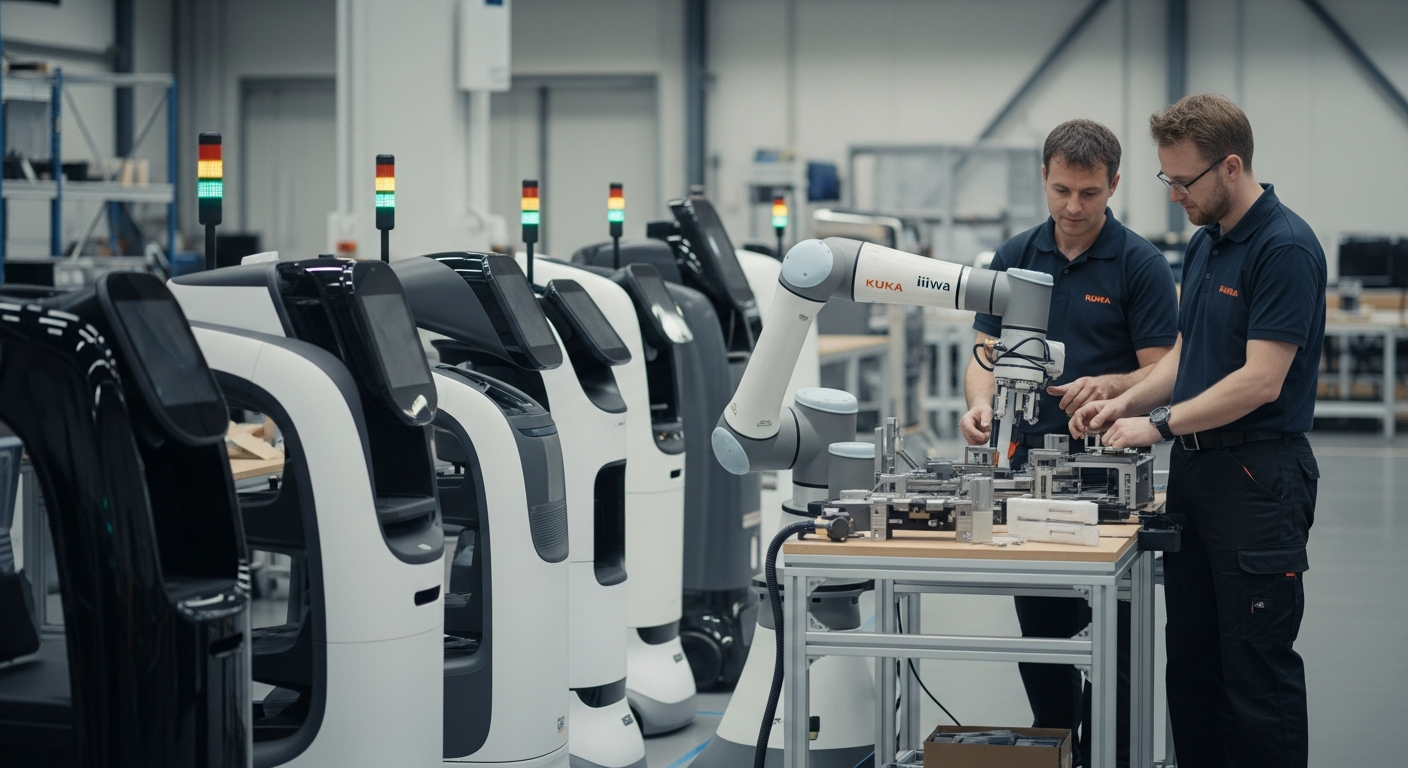
KUKA iiwa integration service provider: efficient implementation
The integration of collaborative robots like the KUKA LBR iiwa requires more than just hardware. As a hardware-agnostic system integrator, werob offers the fast path from specification to live operation.
Assembly hall 4. 3:15 a.m. The night shift has been running for six hours. A KUKA LBR iiwa carries out repetitive operations at the testing station while the shift manager monitors the performance data in the live cockpit. No fatigue, no margin for error. What used to take months of planning in consulting firms is now a reality. The way to get there wasn't through endless discovery decks, but rather through a clear specification of the workflow. At werob, integration doesn't start with the robot arm, but with understanding the task that needs to be done. We transform operational requirements into functional reality while others are still creating slides.
Key Takeaways
- 1werob delivers a ready-to-use specification within 48 hours and brings robots into live operation in eight weeks.
- 2The hardware-agnostic approach compares over 44 OEMs to find the objectively best solution for the workflow.
- 3The outcome-only model eliminates financial risks because payments are only due once the operation is successful.
The strategic choice of the KUKA iiwa integration service provider
The decision for a KUKA LBR iiwa is often the first step towards an automated future. But the hardware alone does not solve operational problems. A specialized KUKA iiwa integration service provider must be able to build the bridge between the physical mechanics and the digital processes of your company. werob acts as a system integrator that is not tied to a single manufacturer. We view the KUKA iiwa as one of many options in a catalog of over 44 OEM partners and 280 maneuverable robots.
In modern industry and logistics it is no longer just about installing a robot arm. It's about seamless integration into existing operations. While classic integrators often require months of lead time for planning, werob uses an AI-supported spec engine. This engine has been trained on over 35,000 projects and delivers a ready-to-use specification within 48 hours. This reduces the risk of poor planning and significantly accelerates the return on investment. Today, a KUKA iiwa integration service provider should no longer just tighten screws, but rather orchestrate data streams.
The Spec Engine: From workflow to technical requirement in 48 hours
The traditional path of robotics integration is characterized by lengthy discovery phases. Consultants spend weeks recording processes only to end up with a theoretical concept. werob breaks this pattern. Our Spec Engine translates your words, shift schedules and task descriptions into a precise technical requirements catalog. Whether it's about equipping machines or supporting quality control, the Spec Engine defines the necessary parameters for range, load capacity and sensors.
This process doesn't take months for us, but just 48 hours. By analyzing thousands of successful deployments, the platform identifies patterns and requirements that human planners often miss. This is particularly important when it comes to integrating highly sensitive systems such as the KUKA iiwa, which is designed for direct human-robot collaboration (MRK). The specification forms the basis for the subsequent supplier match, in which we test the hardware against the real requirements of your location. In this way, we ensure that the chosen solution is not only technically possible, but also makes operational sense.
Hardware agnostics: Why ranking 44+ OEMs is crucial
A key advantage of working with werob is our hardware agnosticism. We are not an extension of the workbench arm of a single manufacturer. If you are looking for a KUKA iiwa integration service provider, we will provide you with an objective assessment of whether this specific robot is actually the best choice for your application. Our Supplier Match compares the KUKA iiwa with alternatives from over 44 other OEMs. We rank hardware based on performance, availability, cost and regulatory suitability.
This approach prevents vendor lock-in. If another model from a partner such as ABB, FANUC or a specialized humanoid manufacturer such as Apptronik fits your requirements profile better, our system will show this transparently. We currently have over 200 robots in live operation in 11 European countries. This experience flows directly into the ranking. We know what hardware exists under real-world conditions and which integrations are most stable. This means maximum security for the operator: you invest in the result, not in a brand.
Seamless integration into the operator stack via connectors
A robot that works in isolation is a waste of potential. The real added value comes from the connection to the existing IT infrastructure. werob offers prefabricated connectors that connect the KUKA iiwa directly to your operator stack. In logistics, this often means deep integration into SAP EWM. In other industries we use interfaces to systems such as Opera PMS, Mews or Toast. These connectors are not individual tinkering solutions, but rather standardized software components.
Through this integration, the robot can receive orders in real time and return status reports directly to the ERP system. This eliminates manual interfaces and reduces the error rate. For example, if a KUKA iiwa is used in logistics for yard patrol or inventory, the data flows to the management level without any delay. This connectivity is a core part of our promise: within eight weeks, the robot is not only on site, but fully integrated into your digital processes. We deliver the operational level that harmonizes hardware and software.
Regulatory safety and the EU Machinery Regulation 2023/1230
The regulatory landscape for robotics in Europe is changing drastically. A decisive factor for every operator is the new EU Machinery Regulation 2023/1230, which will become binding from January 20, 2027. As your KUKA iiwa integration service provider, werob takes responsibility for the compliance path. We ensure that every installation meets strict security and cybersecurity requirements. This includes not only the physical safety of the robot, but also compliance with standards such as ISO 13482 for personal assistance robots.
Compliance with these regulations is particularly critical for collaborative robots such as the LBR iiwa, as they work in close proximity to humans. werob integrates the regulatory check directly into the cockpit management. We continually monitor whether the fleet operates within the legal framework. This protects you as an operator from legal risks and ensures smooth operations vis-à-vis supervisory authorities. In Germany, compliance with the BewachVO is also relevant for security applications or country-specific regulations such as home supervision in care. werob offers the necessary regulatory protection shield here.
Economic efficiency through the outcome-only model
One of the biggest obstacles to introducing robotics is the high initial investment and uncertainty about the actual benefits. werob removes these barriers with a consistent outcome-only model. What this means for you is that you only pay when the robot is running and fulfilling the defined tasks. We forego classic list prices and concentrate on the actual cost reduction per location. Our data shows significant savings in various sectors.
In logistics, for example, we achieve an annual cost reduction of 68,000 euros per location for a farm patrol. In nursing care, the automated medication round relieves the budget by 92,000 euros per year. These numbers are not estimates, but are based on real deployments, such as at Korian Germany or in a nursing facility in Hamburg, where we have already successfully put the first humanoid pilot project into operation. This model shifts the risk from the operator to the integrator. We are only successful if your automation works consistently and efficiently. This guarantees maximum alignment with your operational goals.
The live cockpit: fleet management at the highest level
As soon as the KUKA iiwa is in use, the phase of continuous operation begins. werob provides the Live Cockpit, a central management platform for your entire robot fleet. The cockpit uses a four-dimensional traffic light system to monitor the status of hardware, infrastructure, regulatory and specific task performance (Spec) in real time. If a robot deviates from the defined workflow, this is signaled immediately, even before an operational standstill occurs.
This level of transparency is essential for modern operations. You can see at any time how efficiently the systems are working and where there is potential for optimization. The cockpit also serves as an audit trail for compliance purposes. All movements and interactions are recorded in accordance with GDPR, which is particularly important in sensitive areas such as care or security services. By connecting to the cockpit, the KUKA iiwa becomes part of an intelligent network that is constantly improving. We operate the fleet for you so that you can concentrate on your core business. The goal is clearly defined: by 2028 we want to control 2,000 robots via this platform.
Comparison: Traditional integration vs. werob platform approach
To illustrate the advantages of working with werob, it is worth making a direct comparison with conventional integration methods. Traditional service providers often act as pure resellers of individual brands or as consulting firms with a focus on theoretical concepts. werob, on the other hand, is an operational platform that prioritizes speed and scalability. While others are still in the planning phase, we already have the first robots on site.
| Criteria | Traditional integration | werob system integration |
|---|---|---|
| Planning duration | 3 to 6 months | 48 hours (Spec Engine) |
| Hardware selection | Mostly limited to 1-2 OEMs | 44+ OEMs, hardware agnostic |
| Implementation time | 6 to 12 months | 8 weeks to go live |
| Commercial Model | High upfront investments | Outcome-only (payment upon success) |
| IT integration | Individual programming | Prefabricated connectors (SAP, etc.) |
| Compliance | Manual testing | Integrated path (EU 2023/1230) |
This comparison shows that the werob approach is designed to minimize operational hurdles. We don't just offer a robot arm, but a turnkey solution that is regulatory-secure and economically calculable. For a Director of Operations, this means planning security and a drastic reduction in time-to-value.
FAQ
- How much does it cost to integrate a KUKA iiwa via werob?
- werob works according to an outcome-only model. There are no classic list prices for integration. You only pay when the robot is operational and delivers the agreed service. This ensures that the investment correlates directly with the cost relief achieved.
- How long does it take until the robot is ready for use?
- Our promise is: 48 hours to specification, five days to offer and eight weeks to have the robot in use. Through our standardized processes and prefabricated connectors, we massively shorten the industry-standard times.
- Does werob support the connection to SAP EWM?
- Yes, werob has pre-built connectors into the operator stack, including SAP EWM. This enables seamless communication between the robot fleet and your warehouse management system without complex individual programming.
- Is the KUKA iiwa suitable for use in nursing?
- The KUKA LBR iiwa is a sensitive lightweight robot that was developed for human-robot collaboration. werob uses Supplier Match to check in each individual case whether it meets the specific requirements such as ISO 13482 or whether alternative models are better suited to the care context.
- How is compliance with the EU Machinery Regulation ensured?
- werob has firmly integrated the compliance path for the EU Machinery Regulation 2023/1230 into its platform. We carry out the necessary conformity assessments and continuously monitor compliance with all regulatory requirements via our live cockpit.
- Which industries benefit most from integration?
- Our focus is on care, hotels, logistics, security and facility management. Wherever repetitive tasks can be taken over by robotics, we achieve significant cost savings, such as 68,000 euros annually in logistics yard patrol.
Related reading
Robotics integration provider: A live fleet in 8 weeks
Find out how werob, as a leading system integrator, translates operational workflows into automated fleets. We do not deliver experiments, but rather ready-to-use robotics solutions within eight weeks.
4 July 2026fieldbus robot integration providerFieldbus Robot Integration Provider: Systems Integration for Professionals
The integration of robots into existing fieldbus infrastructures determines the success of automation projects. As a hardware-agnostic systems integrator, werob offers the necessary interface expertise for smooth operation.
5 June 2026Robot service provider CologneRobot service provider Cologne: System integration for operators
Companies in Cologne are not looking for robots, but for operational relief. As a system integrator, werob translates your workflows into a precise specification in 48 hours and brings the hardware to the site in eight weeks.
28 June 2026keenon t9 provider europeKeenon T9 Provider Europe: Integration and Compliance
Anyone looking for a Keenon T9 provider in Europe needs more than a hardware dealer. As a hardware-agnostic systems integrator, werob offers the direct path to implementation, including compliance check and stack integration.
10 June 2026Robotics service provider medium-sized companiesRobotics service provider medium-sized companies: automation in 8 weeks
Medium-sized companies do not need lengthy consulting projects, but rather usable robotics solutions. werob translates complex workflows into precise specifications in 48 hours and brings robots into live operation within eight weeks.
4 July 2026