Robotics service provider medium-sized companies: automation in 8 weeks
Medium-sized companies do not need lengthy consulting projects, but rather usable robotics solutions. werob translates complex workflows into precise specifications in 48 hours and brings robots into live operation within eight weeks.
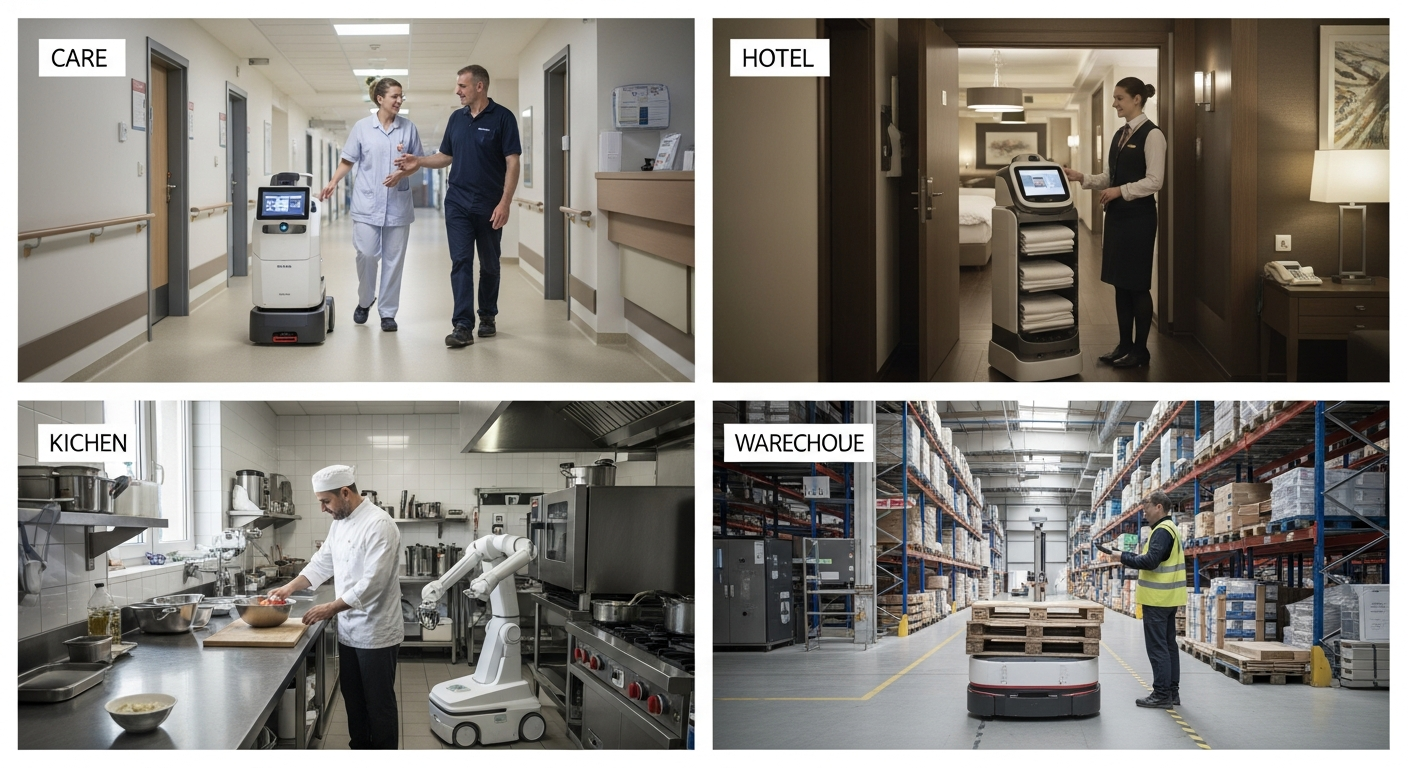
Tuesday, 4:30 a.m. The early shift begins in the logistics hall of a medium-sized supplier. As the workforce arrives, the autonomous yard patrol robot has already completed its third round. It reports the status of the loading zones directly to SAP EWM. No employee had to check the area when it rained. This scene is not a pilot project, but rather everyday operational life in one of 200 live companies that werob controls across Europe. Medium-sized companies don't need robotics research departments, but rather partners who can specify existing problems in 48 hours and solve them in eight weeks. werob is this partner who, as a hardware-agnostic integrator, builds the bridge between complex OEM technology and tough everyday work.
Key Takeaways
- 1Hardware agnostics protects against vendor lock-in with access to 44+ OEM partners.
- 2The Spec Engine delivers a ready-to-use specification for your processes in 48 hours.
- 3Ready-made connectors enable integration into SAP EWM, Opera PMS and other systems.
The difference between OEM manufacturers and system integrators
For medium-sized companies, choosing the right partner is crucial for the success of a robotics strategy. A common mistake is buying directly from a robot manufacturer (OEM). An OEM like Boston Dynamics, Keenon or Pudu produces excellent hardware, but is naturally limited to its own portfolio. A real robotics service provider for medium-sized businesses like werob, however, operates in a hardware-agnostic manner. This means that the focus is not on the robot, but on the operator's workflow.
werob acts as the operational level that sits between the hardware and the company. With a catalog of over 44 OEM partners and 280 maneuverable robot models, werob selects the technology that exactly fits the specification. While an OEM only delivers a machine, werob delivers an integrated solution. This includes connection to the existing software stack, compliance with regulatory requirements such as the EU Machinery Regulation 2023/1230 and long-term fleet management via a central cockpit. For medium-sized businesses, this means investment security: They are not tied to a single manufacturer (vendor lock-in) and can expand or adapt their fleet on a modular basis at any time.
The werob Spec Engine: From idea to specification in 48 hours
Time is the most critical resource in medium-sized businesses. Classic robotics projects often fail due to months of discovery phases and theoretical feasibility studies. werob has radically shortened this process using the so-called Spec Engine. This engine has been trained on over 35,000 projects and is able to translate an operations manager's verbal descriptions - such as shift schedules, floor layouts and tasks - into a usable robot specification within 48 hours.
This automated workflow ensures that no technical details are overlooked. Whether it's about the load capacity for medication rounds in nursing or the sensors for yard patrol in logistics: the Spec Engine generates a precise requirement profile. On this basis, the supplier match takes place, in which the 44+ OEMs are ranked against the specification. The result is a well-founded offer within just five days. This speed advantage enables companies to have a robot in production within eight weeks, while the competition is still discussing specifications.
Measurable cost relief: numbers instead of adjectives
A robotics service provider for medium-sized businesses must be measured by hard economic facts. At werob, the focus is on the outcome-only model: customers only pay when the robot actually runs and delivers the specified performance. The economic advantages have been validated across various industries and go beyond pure efficiency improvements.
| Area of application | Cost relief per location/year |
|---|---|
| Care: medication round | 92,000 € |
| Hotel: room service | 112,000 € |
| F&B: Washing chamber tray bot | 76,000 € |
| Logistics: yard patrol | 68,000 € |
| Care: transport tasks | 71,000 € |
| Security: Retail Patrol | 58,000 € |
These figures are based on real operations, such as at Korian Germany, where a double-digit cost reduction was achieved in the first year. The first humanoid robot has also been in pilot operation in a Hamburg care facility for twelve weeks to free skilled workers from repetitive logistics tasks. These savings enable medium-sized companies to actively address the shortage of skilled workers and to use their remaining employees for value-adding, human activities.
Seamless integration into the existing software stack
A robot that acts as an isolated isolated solution often causes more work in medium-sized businesses than it removes. The true strength of a system integrator lies in connectivity. werob offers prefabricated connectors for the most common industry systems. In nursing, these are integrations in PointClickCare or MatrixCare, in the hotel industry in Opera PMS or Mews and in logistics in SAP EWM.
Through these direct interfaces, the robot becomes an integral part of the digital process chain. A room service robot receives its order directly from the PMS, drives autonomously to the elevator and informs the guest upon arrival via the room telephone - all without manual intervention by the staff. In logistics, the robot communicates directly with the warehouse management system to update inventories in real time or confirm transport orders. This deep integration ensures that data flows remain consistent and operational transparency is guaranteed at all times through the werob Cockpit.
Regulation as a duty: The EU Machinery Regulation 2023/1230
An often underestimated aspect when using robotics is legal compliance. Liability risks can threaten the existence of small and medium-sized businesses in particular. From January 20, 2027, the new EU Machinery Regulation 2023/1230 will be binding. It places significantly higher demands on the safety and conformity assessment of machines, especially if they are AI-controlled or work in close proximity to people.
whoob acts as the necessary compliance path here. Many Asian OEMs do not have the in-depth certifications that are mandatory for the European market. As a system integrator werob assumes responsibility for compliance with these standards, including ISO 13482 for service robots and GDPR-compliant data processing. Thanks to the 4-dimensional traffic light system in the werob cockpit (hardware, infrastructure, regulations, spec), operators have proof at all times that their fleet is operating safely and in accordance with the law. This is a decisive advantage over importing yourself or buying from non-specialized dealers.
The werob Cockpit: Live fleet management for medium-sized businesses
As soon as the robots are on the site, the operational management phase begins. werob doesn't leave the customer to their own devices here, but rather offers a central control unit with the Live Cockpit. This tool monitors the entire fleet across 11 European countries in real time. It's not just about the battery status or the position of the robots.
The cockpit continuously analyzes whether the robots achieve the goals defined in the Spec Engine. If a robot in a hotel bar makes fewer deliveries than planned, the system immediately identifies whether the problem is due to hardware, Wi-Fi infrastructure or changed on-site processes. This proactive monitoring minimizes downtime and maximizes ROI. For medium-sized companies, this means: You don't need your own technical team to operate a robot fleet. werob provides the necessary intelligence and overview to make operations scalable and efficient.
Humanoid Robotics: The Next Level of Automation
While service robots for transport and cleaning are already established, humanoid robotics is increasingly becoming the focus of medium-sized businesses. werob works here with leading partners such as Apptronik, Figure AI and Unitree. Humanoid robots offer the advantage of being designed for environments that were built for humans - they can climb stairs, open doors and operate tools.
A Hamburg care facility is already investigating how humanoid systems can support professionals with the logistics of laundry or meals. However, werob classifies this new technology realistically: a humanoid robot is only recommended if it achieves the best ranking for the specific task in the supplier match phase. Thanks to werob's hardware-agnostic platform, medium-sized companies can test this future technology today without taking the risk of making a bad investment in a still young hardware category.
Eight steps to using robots
The path to automation with werob is standardized and transparent. It begins with a simple intake process that asks eight essential points: who you are, the description of the shift in your own words, the nature of the task, the on-site infrastructure, any hardware preferences, regulatory requirements, the commercial framework and the preferred contact channel.
After this intake, the Spec Engine 48-hour period begins. A binding offer will be made within five days. Delivery and integration take place within eight weeks. This pace is unique in the market and is made possible by the combination of AI-supported planning and pre-built software connectors. The goal for 2028 is clearly defined: 2,000 robots in live operation. For medium-sized companies, werob offers a scalable platform that grows with their requirements.
Conclusion: Why werob is the right partner for medium-sized businesses
The decision for a robotics service provider in medium-sized businesses should not be made on the basis of glossy brochures, but rather on the basis of operational excellence. werob offers the only platform that covers the entire lifecycle of a robot integration - from the initial specification to daily fleet management. With 200 robots in live operation and a presence in 11 countries, werob has the necessary experience to successfully implement projects.
The commercial model of the outcome-only approach takes the financial risk away from the customer and places it in the hands of the integrator. In combination with the deep integration into existing systems and the guaranteed compliance with the EU Machinery Regulation 2023/1230, werob offers a package that is specifically tailored to the needs and speed of medium-sized businesses. Anyone who invests in robotics today not only secures a competitive advantage, but also actively solves the most pressing problems in the labor market.
FAQ
- What distinguishes werob from a robot manufacturer?
- werob is a system integrator, not a manufacturer. We do not sell our own hardware, but select the best robot for your specific task from over 44 partners and integrate it into your software stack.
- How long does it take for a robot to be ready for use?
- Our promise is: 48 hours to specification, 5 days to quote and 8 weeks to live operation on your site.
- What costs will my company incur?
- werob works according to an outcome-only model. This means you only pay when the robot is running and providing the agreed service. There are no hidden upfront consultation fees.
- Is the new EU machinery regulation already relevant?
- Yes, the EU Machinery Regulation 2023/1230 will become binding on January 20, 2027. werob already ensures today that all solutions used meet these future requirements.
- Can the robots be integrated into my existing software?
- Yes, we have ready-made connectors for systems such as SAP EWM, Opera PMS, Mews, PointClickCare and MatrixCare to ensure seamless data exchange.
- In which countries is werob active?
- We currently operate robot fleets in 11 European countries including Germany, Austria, Switzerland, France, Italy, Spain and the UK.
Related reading
Automation partner service provider medium-sized companies: werob Guide
Medium-sized companies don't need months-long discovery phases, but rather measurable operational results. Find out how werob, as a hardware-agnostic system integrator, radically shortens the path from specification to live operation.
21 June 2026Robot service provider CologneRobot service provider Cologne: System integration for operators
Companies in Cologne are not looking for robots, but for operational relief. As a system integrator, werob translates your workflows into a precise specification in 48 hours and brings the hardware to the site in eight weeks.
28 June 2026Robot commissioning service providerRobot commissioning service provider: Live operation in 8 weeks
Simply purchasing hardware does not guarantee process optimization. As a specialized system integrator, werob closes the gap between robot purchases and operational added value through a hardware-agnostic platform.
29 June 2026fanuc robot integrator service providerFanuc robot integrator service provider: Going live in 8 weeks
A Fanuc robot integrator service provider has to do more than just deliver hardware. werob translates your workflows into a usable specification in 48 hours and seamlessly integrates Fanuc systems into your existing software stack.
7 July 2026room service automationRoom service automation: increasing efficiency in hotel operations
Automating room service significantly reduces personnel costs per location per year. By integrating into PMS systems such as Opera or Mews, robots become a seamless part of the hotel infrastructure.
20 June 2026