Robot service provider Cologne: System integration for operators
Companies in Cologne are not looking for robots, but for operational relief. As a system integrator, werob translates your workflows into a precise specification in 48 hours and brings the hardware to the site in eight weeks.
Cologne-Niehl, 3:45 a.m. There is a busy silence in the logistics hall of an industrial company. While the night shift prepares the last pallets, an autonomous transport robot makes its way between the high-bay warehouse and the goods issue area. It requires no breaks and no manual control. The operator did not buy this system from a traditional hardware dealer, but rather implemented it through a specialized integrator. The entire process, from the initial analysis of the shift plan to productive use, took exactly eight weeks. At a time when a shortage of skilled workers threatens operational continuity in Cologne and all of North Rhine-Westphalia, the focus is shifting from pure hardware to seamless system integration.
Key Takeaways
- 1To the specification in 48 hours: werob uses the Spec Engine to precisely translate workflows into technical requirements and avoid lengthy consulting phases.
- 2Hardware-agnostic approach: With access to 44+ OEM partners and 280 robot models, operators in Cologne receive the objectively best solution without manufacturer commitment.
- 3Measurable cost relief: Verified savings of up to 112,000 euros per year in the hotel industry or 92,000 euros in care ensure a quick ROI.
Why Cologne needs a system integrator instead of a robot dealer
The search for a robot service provider in Cologne often leads to manufacturers or specialized resellers. However, this approach falls short. A single robot does not solve an operational problem if it operates in isolation from the existing infrastructure. werob positions itself as the central system integrator in Europe, which does not focus on the hardware, but rather on the operator's workflow. In industries such as nursing, hotels or logistics, automation projects often fail due to a lack of compatibility between different systems or lengthy discovery phases that take months.
A modern service provider must be able to operate independently of manufacturers. werob accesses a catalog of over 44 OEM partners and can select the exact solution for the specific requirements in Cologne from around 280 different robot models. This prevents vendor lock-in and ensures that the selected hardware actually meets the requirements of the shift schedules and spatial conditions. The integrator's role is to abstract the complexity of robotics and provide the operator with a turnkey solution that generates measurable ROI from day one.
The Spec Engine: From workflow to specification in 48 hours
The traditional path to robotics implementation usually begins with months of consultations and vague discovery decks. werob breaks this pattern with the Spec Engine. In just 48 hours, this system translates the human description of a workflow into a technical robot specification. Whether it's the medication round in a Cologne nursing home or room service in a hotel near the cathedral, the Spec Engine uses data from over 35,000 projects to define precise requirements for sensors, load capacity and software interfaces.
This process eliminates the risk of planning errors. Instead of relying on the sales promise of a single manufacturer, the operator receives an objective list of requirements. This speed is crucial for companies that are under acute cost pressure. While competitors are still writing concepts, werob is already providing the basis for hardware matching. The Spec Engine not only takes into account the task itself, but also the on-site infrastructural conditions, such as elevator controls, door openers and network coverage, which forms the basis for a successful integration in eight weeks.
Hardware agnostics and the Supplier Match System
A decisive advantage of an independent robot service provider in Cologne is access to the entire global robotics market. werob is not a manufacturer like Boston Dynamics, Keenon or Pudu, but rather their partner. In the Supplier Match System, the requirements from the Spec Engine are checked against the performance data of 44+ OEMs. The result is a ranking of the most suitable robots for the specific location. This includes everything from service robots for the catering industry to complex humanoid systems for logistics.
This hardware-agnostic approach allows the operator to remain flexible. Should a manufacturer change its software strategy or stop producing a model, the integrator can quickly switch to alternatives from the catalog without having to adapt the customer's entire infrastructure. werob currently operates over 200 robots in live operation in eleven European countries. This experience flows directly into the ranking, so that only hardware that has already proven itself in real operational scenarios is recommended. For Cologne companies, this means maximum investment security through a well-founded, data-driven selection.
Cost reduction in care: 92,000 euros per location
In the Cologne care landscape, the staff shortage is not an abstract problem, but a daily reality. The value of targeted robot integration is particularly clear here. A verified example is the automation of the medication round. By using specialized transport robots that reduce the travel times of specialist staff, an annual cost reduction of 92,000 euros per location can be achieved. The staff is released from logistical auxiliary tasks and can once again devote themselves to direct resident care.
Another area of application is the general transport of laundry or food, which enables relief of 71,000 euros per year. werob has already successfully implemented projects with large providers such as Korian Germany, achieving double-digit cost reductions in the first year. Die Integration erfolgt dabei nahtlos in bestehende Systeme wie PointClickCare oder MatrixCare. This ensures that the robot does not act as a foreign body, but as a digital employee whose tasks and status reports are incorporated directly into the care documentation. This not only increases efficiency, but also acceptance among on-site employees.
Hotel and catering industry: increasing efficiency at the Cologne location
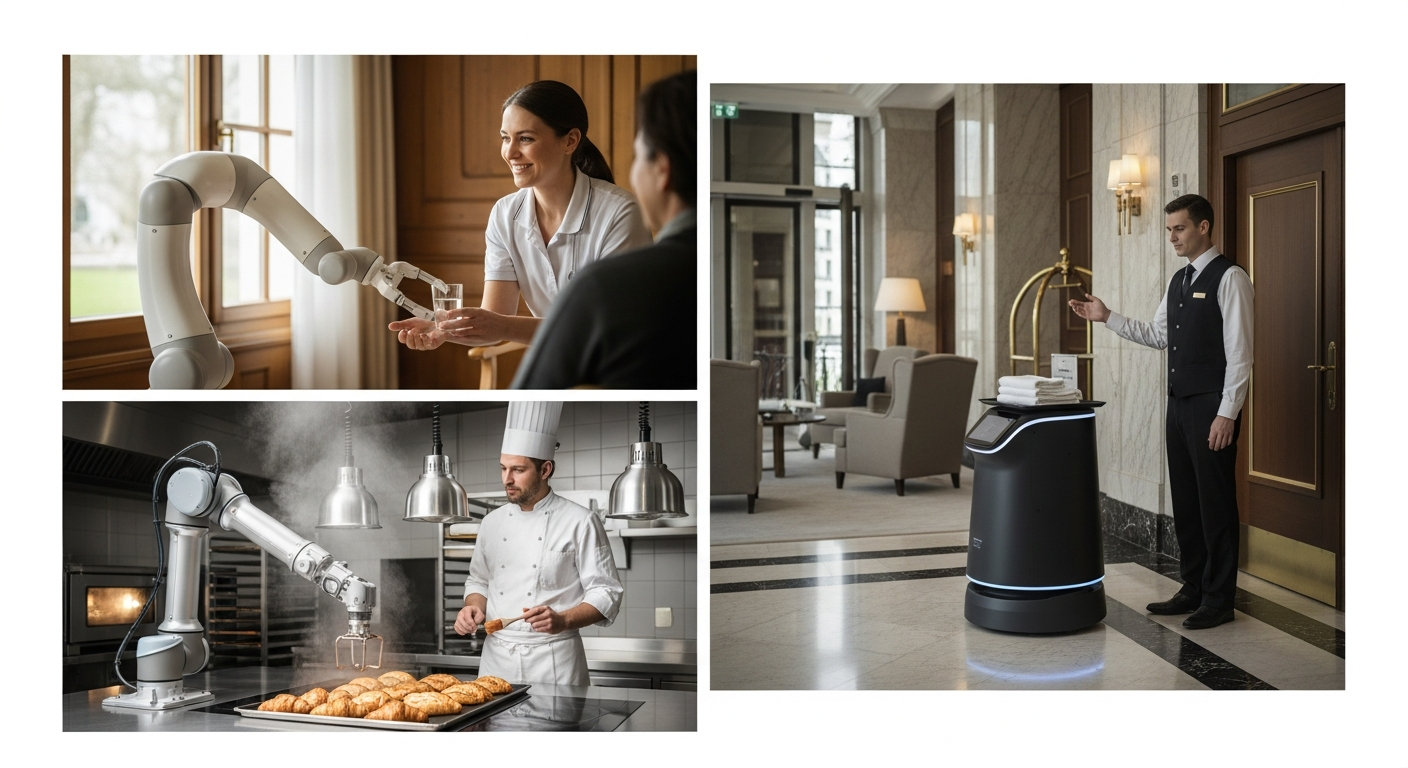
Cologne as a trade fair and tourism location places high demands on efficiency in the hotel industry. A robot service provider can reduce costs by 112,000 euros per year per hotel location by automating room service. The robot takes over the delivery of orders or additional towels, which massively reduces personnel costs, especially at night. Thanks to prefabricated connectors in systems such as Opera PMS or Mews, implementation is possible without complex IT projects.
In the catering industry and restaurant chains, the focus is often on relieving the burden on the kitchen and service staff. A tray bot in the dishwashing chamber can generate an annual saving of €76,000, while automated cleaning of the kitchen floor saves a further €44,000. These numbers are not theoretical projections, but are based on live data from the fleets managed by werob. The use of robotics in these areas means that existing staff are relieved during peak times and the quality of service remains constant despite a shortage of skilled workers.
Interfaces and connectors: Integration into the operator stack
A robot is only as good as its connection to the software that controls its operation. werob supplies ready-made connectors that enable quick integration. In logistics, the connection to SAP EWM is essential in order to transmit transport orders directly to the robot fleet. In the hotel industry, interfaces to Lightspeed or Toast ensure that restaurant orders automatically trigger the right robot for delivery. This technological level distinguishes a professional system integrator from a pure hardware seller.
Werob's connector architecture ensures that data flows bidirectionally. This means that the robot not only receives commands, but also returns status reports and telemetry data to the central cockpit. This enables real-time fleet management, where the operator always has an overview of the condition of the hardware, the utilization and any obstacles on the site. For companies in Cologne, this means that they do not have to develop their own software development for robotics, but can rely on proven standard integrations, which reduces the implementation time to the promised eight weeks.
Compliance and the EU Machinery Regulation 2023/1230
An often underestimated aspect when choosing a robot service provider in Cologne is regulatory security. From January 20, 2027, the new EU Machinery Regulation 2023/1230 will be binding. This places significantly higher demands on conformity assessment, especially for systems that contain AI components or work in close proximity to people. Many Asian OEMs do not have the necessary local structures to independently meet these requirements in Europe. werob acts as the necessary compliance path here.
As a system integrator, werob takes responsibility for compliance with all relevant standards, from ISO 13482 for personal assistance robots to the GDPR when processing sensor data. This legal protection is business-critical, particularly in sensitive areas such as care (home supervision) or security (Security Ordinance). Anyone who invests in robotics today must ensure that the systems can be operated legally even after 2027. werob already integrates this compliance check into the Spec Engine and the Supplier Match System, so that operators in Cologne receive a future-proof solution that clears all regulatory hurdles in advance.
Outcome-only: werob’s commercial model
Werob's commercial model is fundamentally different from classic investment models. Under the outcome-only approach, the operator only pays when the system actually runs and delivers the defined benefit. There are no hidden list prices or high upfront investments for consulting services that ultimately deliver no results. This model reflects werob's trust in its own platform and selection of OEM partners. The goal is a long-term partnership in which the economic success of the operator is the focus.
By concentrating on measurable results, the risk for companies in Cologne is minimized. The decision for an automation solution turns from a risky tech bet into a calculable operational improvement. werob takes over the coordination with the manufacturers, the logistics of the hardware and the technical integration. The customer pays for the service provided on the site. This model is particularly attractive for industries with tight margins, as the monthly cost of operating robots is usually well below the saved labor costs, resulting in an immediate improvement in cash flow.
The live cockpit: fleet management at the push of a button
As soon as the robot fleet is in use in Cologne, the werob cockpit takes over the monitoring and control. This central dashboard provides a four-dimensional traffic light system that visualizes the status of hardware, infrastructure, regulatory and original specification. Operators can see at a glance whether all robots are ready for use, whether there are network problems in certain parts of the building or whether maintenance intervals are due. This significantly reduces the administrative effort for facility management.
The cockpit also serves as a reporting tool for management. It provides precise data about the hours worked, the distances traveled and the efficiency gains achieved. This transparency is crucial to internally demonstrate the success of the automation strategy and plan further rollouts. With the goal of having over 2,000 robots in the fleet by 2028, werob is continually developing the cockpit to make even complex multi-OEM scenarios easy to manage. For the Cologne operator, this means maximum control with minimal monitoring effort.
FAQ
- What exactly does a robot service provider in Cologne do?
- A service provider like werob acts as a system integrator. He analyzes your workflows, selects the right hardware from over 44 manufacturers, integrates it into your software systems (e.g. SAP, Opera) and takes over ongoing fleet management.
- How long does it take until the robot is used for the first time?
- With werob you will receive a specification within 48 hours, an offer after five days and the robot will be in live operation on your site within eight weeks.
- Which industries benefit most from robotics in Cologne?
- Inpatient care (medication transport), the hotel industry (room service), catering (tray return) as well as logistics and security (autonomous patrols) achieve particularly high efficiency gains.
- Is the hardware selection at werob limited?
- No, werob is hardware agnostic. We rank over 280 different robots from more than 44 partners such as Boston Dynamics, Keenon or Pudu against your specific requirements.
- How safe is the operation with regard to new EU laws?
- werob offers an integrated compliance path for the EU Machinery Regulation 2023/1230, which is binding from January 2027. We ensure that all systems used comply with European security and data protection standards.
- How much does it cost to integrate a robot?
- werob works according to an outcome-only model. This means you only pay when the system is running productively. There are no classic list prices as the solution is individually tailored to your workflow.
Related reading
ABB robot integrator service provider for operational excellence
Choosing an ABB robot integrator service provider determines the speed of payback. As a hardware-agnostic system integrator, werob offers the direct path from process analysis to the finished robot specification within 48 hours.
5 July 2026Robot commissioning service providerRobot commissioning service provider: Live operation in 8 weeks
Simply purchasing hardware does not guarantee process optimization. As a specialized system integrator, werob closes the gap between robot purchases and operational added value through a hardware-agnostic platform.
29 June 2026fanuc robot integrator service providerFanuc robot integrator service provider: Going live in 8 weeks
A Fanuc robot integrator service provider has to do more than just deliver hardware. werob translates your workflows into a usable specification in 48 hours and seamlessly integrates Fanuc systems into your existing software stack.
7 July 2026kuka iiwa integration service providerKUKA iiwa integration service provider: efficient implementation
The integration of collaborative robots like the KUKA LBR iiwa requires more than just hardware. As a hardware-agnostic system integrator, werob offers the fast path from specification to live operation.
8 July 2026Robotics service provider medium-sized companiesRobotics service provider medium-sized companies: automation in 8 weeks
Medium-sized companies do not need lengthy consulting projects, but rather usable robotics solutions. werob translates complex workflows into precise specifications in 48 hours and brings robots into live operation within eight weeks.
4 July 2026