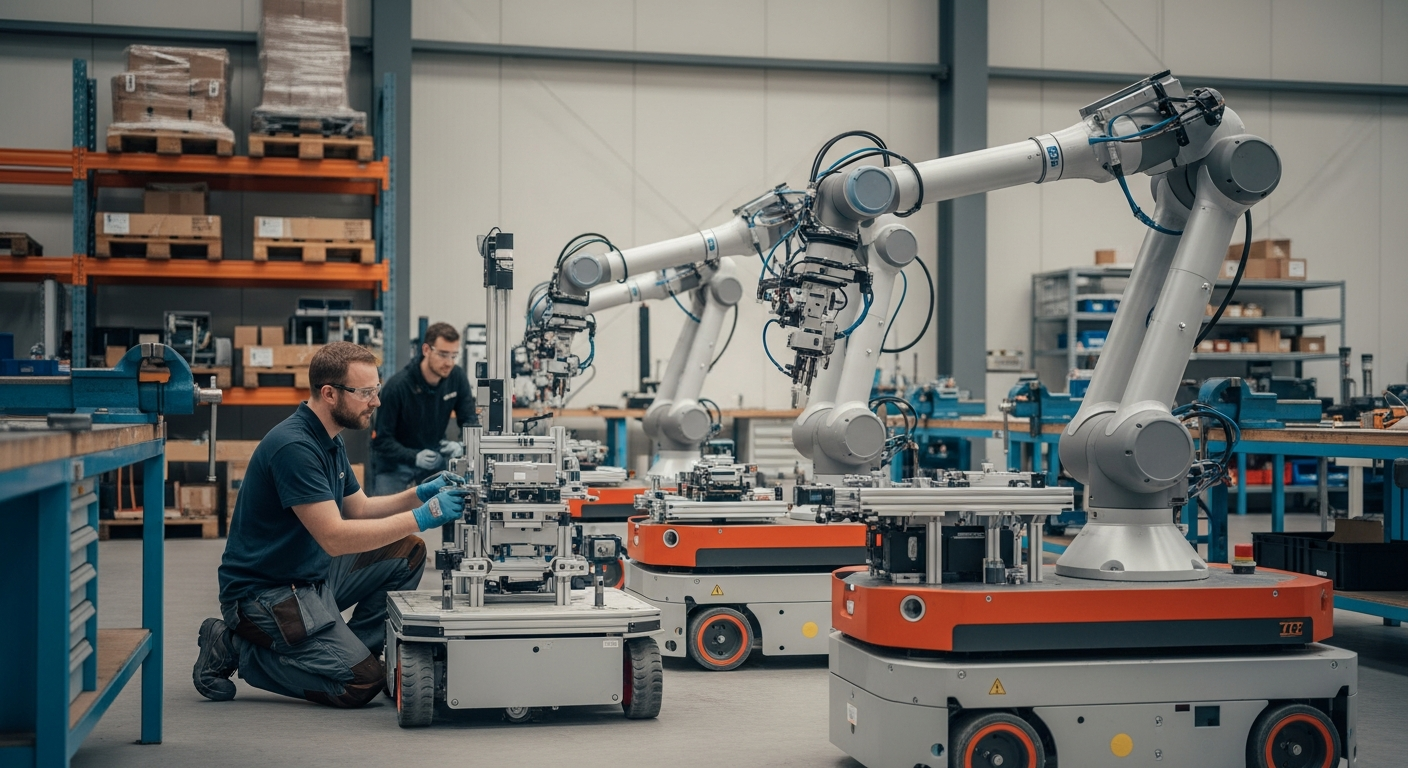
Agile Robots Integrator Europe: Automation in 8 weeks
The introduction of robotics often fails due to months of planning and complex integration. werob translates operational workflows into technical specifications in 48 hours and brings robots into live operation in eight weeks.
Logistics center, 3:15 a.m. The night shift is understaffed, but the autonomous yard patrol is already circling. While traditional consulting firms are still building discovery decks, this robot is already part of the balance sheet. werob is not a manufacturer, but rather the system integrator that is radically accelerating this transition. We do not consider the robot as an end in itself, but rather the operator's workflow. In Europe this means: 48 hours to the specification, five days to the offer and eight weeks to the first productive use on the site. werob now operates in 11 European countries and manages over 200 robots in live operation.
Key Takeaways
- 1As an Agile Robots Integrator in Europe, werob delivers a ready-to-use specification within 48 hours instead of months.
- 2Hardware agnostics enables access to over 44 OEMs and 280 robot models without vendor lock-in.
- 3Ready-made connectors for SAP EWM, Opera PMS and PointClickCare guarantee seamless software integration.
The difference between OEM manufacturers and a system integrator
In the robotics landscape there is often confusion about the distribution of roles. An OEM like Boston Dynamics, Keenon or Apptronik develops hardware. A system integrator like werob, on the other hand, develops the solution for the operator. Anyone who buys directly from the manufacturer binds themselves to a single ecosystem and bears the risk of integration themselves. werob breaks this vendor lock-in by listing over 44 OEM partners in a catalog and testing 280 different robot models against the customer's specific requirements.
An Agile Robots Integrator in Europe has to do more than just deliver hardware. He must speak the language of the operational managers. In care this means integration into PointClickCare, in the hotel industry into Opera PMS or Mews. werob delivers these connectors ready-made. This eliminates the need for months of development work for interfaces, which has caused many projects to fail in the past. We are the operational level that stands between complex robotics and daily workflow.
The Spec Engine: From process description to specification in 48 hours
Traditional robotics consulting projects take three to six months before the first robot is even ordered. werob has radically shortened this process with the Spec Engine. Based on data from over 35,000 projects, our AI-powered platform translates the verbal descriptions of a shift flow into an operational robot action graph. The operator describes the task, the environment and the frequency, who delivers the technical specification within 48 hours.
This agile approach enables companies to react quickly to staff shortages. Instead of wasting time in lengthy discovery phases, decision-makers receive a sound basis for their investment. The Spec Engine takes into account not only the purely mechanical requirements, but also the infrastructural conditions on site. The result is a precise roadmap that eliminates the risk of bad purchases and forms the basis for subsequent supplier matching.
Supplier Match: 44+ OEMs in an objective ranking
As soon as the specification is in place, the search for the optimal hardware begins. werob acts completely hardware-agnostic. Our Supplier Match algorithm compares the requirements of the Spec Engine with the performance data of over 280 robot models. Factors such as load capacity, battery life, navigation ability and, above all, regulatory suitability for the European market are evaluated. A robot that is successful in Asia does not necessarily meet strict European safety standards.
With this ranking, operators receive a quote within five days that is based on facts, not the salesmanship of a single manufacturer. Whether a humanoid robot from Apptronik for logistics or a serving robot from Pudu for the catering industry is the best choice depends solely on the fit with the workflow. This process ensures that the chosen hardware can be seamlessly integrated into the existing infrastructure and achieves the maximum ROI.
Regulation as a success factor: EU Machinery Regulation 2023/1230
A critical aspect for every Agile Robots Integrator in Europe is compliance with the legal framework. The new EU Machinery Regulation 2023/1230 will be binding from January 20, 2027. It places high demands on conformity assessment, especially for robots that are controlled with artificial intelligence or work in close proximity to people. werob has firmly integrated this compliance path into its platform.
For operators, this means legal certainty from day one. We take over the testing of ISO 13482 for service robots in care or compliance with the BewachVO for security robots. Without an experienced integrator, companies risk having their fleet shut down during an inspection by home inspectors or professional associations. werob ensures that all regulatory requirements are monitored in the live cockpit so that compliance can be verified at all times.
Economic efficiency and cost relief in numbers
Robotics is not an end in itself, but a tool for cost optimization. werob provides concrete figures from live operations. In care, the automation of the medication round leads to an annual cost reduction of €92,000 per location. In the hotel sector, the use of robots in room service saves an average of €112,000 per year. These sums are not estimates, but are based on the reduction of unproductive running times and the relief of specialist staff.
Another example is logistics, where an autonomous yard patrol reduces security costs by €68,000 per year. Thanks to werob's outcome-only model, customers only pay when the robot actually works productively. There are no hidden list prices or upfront investments in hardware that ends up sitting unused in the corner. This focus on measurable results makes werob the preferred partner for corporations like Korian Germany, which have already achieved double-digit cost reductions in the first year.
Seamless integration through pre-built connectors
The biggest hurdle in scaling robotics fleets is software integration. A robot that doesn't know when an order arrives in the SAP EWM system or which guest has just ordered room service in the Opera PMS remains an isolated toy. werob solves this problem with a library of ready-made connectors. We connect the robot fleet directly to the operator's existing tech stack.
The supported systems include PointClickCare and MatrixCare for the care sector, Mews and Toast for the hotel and catering industry, and Genetec for security applications. This integration enables a fully automated workflow without manual intervention. If a system integrator in Europe wants to be agile, he must master these interfaces. werob reduces the integration time from months to a few days, as the data streams already flow in a standardized manner via our platform.
The werob cockpit: live fleet management and audit trail
As soon as the robots are in use, the werob cockpit takes over the monitoring. It is a four-dimensional traffic light system that displays the status of hardware, infrastructure, regulatory and original specification in real time. Operators have a full overview of their fleet in all 11 operating countries at all times. This is particularly important for companies with multiple locations that require central control.
The cockpit not only serves for operational monitoring, but also as a seamless audit trail for compliance purposes. Every movement and every interaction is recorded in accordance with GDPR. If a robot deviates from the defined specification or a technical problem occurs, the system immediately raises an alarm. This proactive approach minimizes downtime and ensures that the promised cost savings are actually achieved. werob offers an operating level that goes far beyond what individual OEM dashboards can achieve.
Success in eight weeks: The werob onboarding process
At werob, the path to an automated area follows a clear 8-step process. Everything begins with recording the current status and defining the shift process. The specification is available within 48 hours. After supplier matching and hardware selection, integration into the software stack takes place. By standardizing these processes, we guarantee that the robot will be productive on the site within eight weeks.
This promise of speed is unique in the European market. While others are still discussing pilot projects, werob is already operating 200 robots in live use. Our goal is to scale to 2,000 robots by 2028. For operators, working with werob means the fastest and safest path to automation, without the risk of technical dead ends or regulatory hurdles. Start your specification in 48 hours at werob.de/en/onboarding.
FAQ
- What distinguishes werob from a robot manufacturer?
- werob does not produce its own hardware, but is a system integrator. We select the right hardware from over 44 manufacturers, integrate it into your software systems and take over fleet management.
- How long does it take until a robot is in use with us?
- At werob, it usually only takes eight weeks from the first contact to productive use on the site. You will receive the specification after just 48 hours.
- What costs are incurred for planning?
- werob works according to an outcome-only model. This means that you only pay when the robot is actually running in your company and provides the defined benefit.
- Is werob active throughout Europe?
- Yes, werob currently operates in 11 European countries, including Germany, Austria, Switzerland, France, Italy and the United Kingdom.
- How is compliance with the EU Machinery Regulation ensured?
- werob integrates the regulatory requirements of the EU Machinery Regulation 2023/1230 directly into the selection and operating process and monitors compliance in the live cockpit.
- Can existing software systems be connected?
- Yes, werob offers ready-made connectors for market-leading systems such as SAP EWM, Opera PMS, Mews, Toast, PointClickCare and MatrixCare.
Related reading
ABB GoFa Integrator Europe: Cobot solutions for operations
Find out how werob, as a hardware-agnostic system integrator, integrates the ABB GoFa into your operation. We do not deliver hardware catalogs, but rather ready-to-use solutions including software connectors and full regulatory compliance.
5 July 2026boston dynamics spot integrator GermanyBoston Dynamics Spot Integrator Germany: Operational scaling
If you want to use the Boston Dynamics spot productively in Germany, you need more than just the hardware. werob translates your operational requirements into a usable specification in 48 hours and integrates the robot directly into your existing software stack.
6 July 2026bear servi hotel industry GermanyBear Servi in the German hotel industry: Integration and ROI
The use of Bear Servi in the German hotel industry requires seamless integration into existing systems such as Opera PMS or Mews. werob translates your operational processes into a usable specification in 48 hours and ensures operations.
6 July 2026robotics integrator europeRobotics Integrator Europe: Scaling Fleet Operations in 8 Weeks
Moving from a single-robot pilot to a multi-OEM fleet requires more than a reseller. It requires an operating layer that handles specification, compliance, and stack integration.
7 July 2026boston dynamics stretch logistics partnerBoston Dynamics Stretch Logistics Partner: Integration in 8 weeks
Boston Dynamics Stretch automates truck unloading at the ramp. werob is the system integrator that translates this hardware into your operational workflow, connects it to SAP EWM and ensures compliance.
6 July 2026