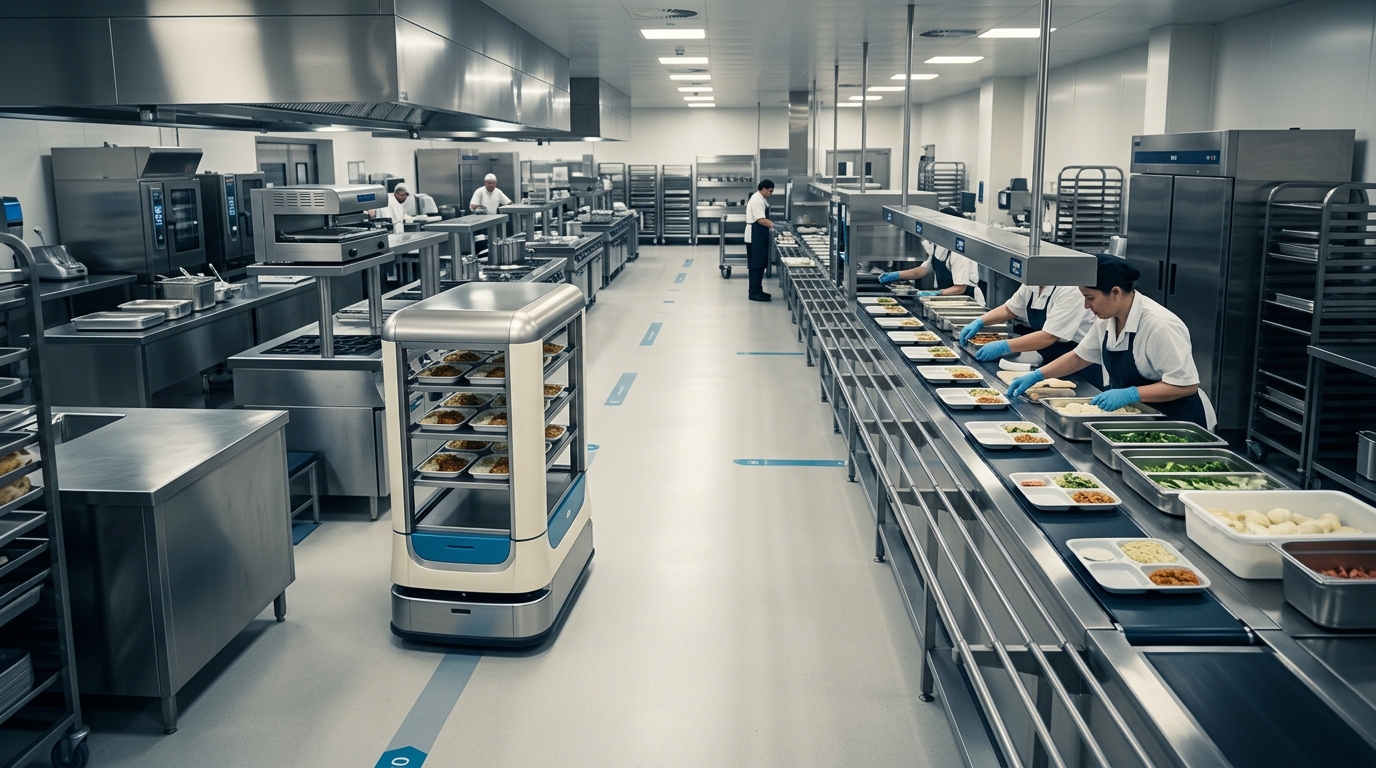
Institutional catering automation: what works and what fails
Discover which institutional catering stations benefit most from automation, from belt portioning to AMRs, and learn when variable menus make robotics fail.
Institutional kitchens rely on mass batch production, making them prime candidates for automation. From AMR meal distribution to belt portioning, this guide breaks down which catering stations deliver high robotic ROI and why variable menus cause automation efforts to collapse.
Key Takeaways
- 1Autonomous Mobile Robots (AMRs) efficiently manage internal transport and meal distribution, handling payloads up to 250kg on fixed routes.
- 2Vegetable prep automation struggles with natural shape variability and requires highly standardised incoming ingredients to function.
- 3Cook-and-chill stations must meet DIN 10506 standards, requiring food to cool from 60°C to 10°C within a maximum of 90 minutes.
- 4Belt portioning excels with repeated motions, but late menu substitutions and varying tray component sizes break the workflow.
Goods receiving and internal transport AMRs
Internal logistics between goods receiving, cold storage, batch production, and distribution corridors represents the most immediate, low-risk application for institutional catering automation. In large-scale operations such as a central production kitchen (Zentralküche) or hospital facility, staff spend hours pushing heavy roll containers, Euro-pallets, and GN-pan trolleys across extensive basement corridors. Automating these horizontal transport routes decouples material movement from kitchen staffing without altering a single culinary process or requiring changes to recipe formulation.
Autonomous Mobile Robots (AMRs) designed for industrial intralogistics navigate dynamic corridors safely using LiDAR, 3D time-of-flight cameras, and SLAM algorithms. Unlike traditional automated guided vehicles (AGVs) that depend on magnetic floor strips or fixed optical tracks, modern AMRs dynamically route around obstacles, call automated service lifts, and dock directly with transport carts.
- Heavy payload capacity: Industrial AMR platforms used in hospital and factory logistics are rated for payloads up to 250kg, for example the GoCart250 platform specified by Yujin Robot[1], enough for full Gastronorm (GN) racks and insulated food transport boxes without manual strain.
- Separation of zones: Automated transport bridges clean and unclean zones, enforcing physical separation between raw ingredient delivery and cooked meal dispatch.
- Facility interface: Modern systems interface directly with industrial fast-action doors, hygiene airlocks, and programmable logic controllers (PLCs) governing building management.
Because goods receiving and internal haulage involve rigid, standardised load carriers (such as DIN-standardised roll cages or ISO pallet footprints), automation reliability remains exceptionally high. The mechanical interface is defined, the routes are predictable, and the system operates independently of daily menu rotations.
Prep stations: The challenge of variable ingredients
The primary preparation station (Vorbereitung) in an institutional kitchen is where robotic manipulation frequently fails. While automated vegetable peeling, chopping, and slicing are technically feasible in dedicated food processing factories, deploying articulated robotic arms or vision-guided pick-and-place systems into a live commercial kitchen prep line rarely delivers operational stability.
The fundamental barrier is natural biological variability. Produce arrives with unpredictable geometry, surface moisture, firmness, skin thickness, and orientation. A human prep cook identifies a bruised section of a celeriac, trims an uneven root crown, and adjusts knife pressure in milliseconds based on tactile feedback. For a robotic system, handling this variance requires high-resolution multi-spectral vision systems, soft pneumatic or adaptive vacuum grippers, and real-time path recalculation.
- Dedicated continuous machinery vs robotics: High-throughput institutions succeed by deploying fixed, single-purpose prep machinery (continuous industrial peelers, centrifugal cutters, and dicers) rather than multi-axis robotic arms.
- Standardised pre-cut sourcing: When kitchens require uniform diced or shredded produce at scale, sourcing pre-cut, washed ingredients from agricultural processors is consistently more cost-effective than automating raw prep on site.
- Hygiene and washdown constraints: Articulated robots stationed at wet prep sinks must meet IP69K washdown ratings and comply with Regulation (EC) 1935/2004 for food contact materials, significantly raising capital costs.
Unless an institutional kitchen processes tens of metric tonnes of a single, geometrically graded cultivar under rigid factory conditions, the Vorbereitung station should rely on robust mechanical processing appliances operated by kitchen staff, rather than articulated robotics.
Cook-and-chill production and the hot line
In central production facilities operating under the cook-and-chill method, the cooking line offers substantial automation potential because production occurs in massive, repeatable batches. High-capacity tilting kettles, continuous combi-steamers, and automated braising pans process hundreds of litres of soups, sauces, stews, and purees in scheduled batch cycles, creating the identical thermal conditions needed for automated process control.
Unlike à-la-carte restaurants where tickets arrive unpredictably, an institutional central production kitchen executes a scheduled production plan days in advance. Automated pumping systems, robotic kettle stirring mechanisms, and automated volumetric depositors transfer cooked batches directly from kettles into standard GN containers or chill bags with minimal human intervention. For operations evaluating thermal automation across different catering models, cooking automation at the hot station illustrates how batch processes diverge sharply from short-order frying.
- Thermal core monitoring: Automated cooking kettles track core temperatures and hold times to ensure pasteurisation parameters without manual probe insertion.
- Hygiene compliance under DIN 10506: According to the DIN Consumer Council, the revised DIN 10506 requires hot-held food to hold a secured temperature of at least 60°C at every point, while the associated cook-and-chill standard DIN 10536 requires the microbiologically critical band between 60°C and 10°C to be passed through within a maximum of 90 minutes[2]. Trade guidance stresses that the 90-minute window starts at the temperature limit rather than at the end of the cooking process[3], which is what an automated blast-chilling sequence has to be programmed against.
- Automated blast chilling: Programmable blast chillers and continuous chilling tunnels integrate with kitchen management software to log HACCP temperature curves automatically, eliminating manual paper logs.
The economic return at the cook-and-chill hot line stems from precision yield management, energy optimisation during bulk heating cycles, and guaranteed compliance with microbiological safety standards across high-volume production runs.
Tray assembly and belt portioning
Tray assembly (Tablettierung) along a portioning belt (Bandportionierung) represents the single strongest business case for institutional catering automation. In hospitals, rehabilitation clinics, and large residential care networks, portioning lines assemble thousands of patient trays within tight two-hour service windows. The operational rhythm is characterised by high velocity, identical conveyor pacing, and severe ergonomic strain on staff who manually place heavy ceramic dishware, soup bowls, and insulated cloches.
Automated portioning cells deploy delta robots, multi-axis collaborative arms, and specialised volumetric dispensers over continuous conveyor belts. Vision systems identify the orientation of compartmentalised porcelain plates, while automated depositors meter sauces, purees, and grain components to gram-level accuracy. Robotic de-stackers and lid-placers eliminate repetitive lifting: staff on a manual line repeatedly lift insulated keep-warm tray sets and covers, and it is the cumulative lifted weight across a full service that makes the step a candidate for automation.
| Tray Component | Physical Characteristics | Handling Mechanism | What limits the station |
|---|---|---|---|
| Liquid & Semi-liquid (Soups, Sauces, Purees) | Homogeneous viscosity, non-particulate | Volumetric positive displacement pump with anti-drip nozzle | Only nozzle cleaning between recipes; no geometry recognition needed |
| Starch Base (Rice, Mashed Potatoes, Polenta) | Uniform density, predictable cohesion | Piston depositor or multi-head auger feed | Density drift between batches shifts portion mass; needs recalibration per recipe |
| Portioned Whole Proteins (Chicken Breast, Fish Fillet) | Irregular surface, variable weight, delicate texture | 3D vision system with adaptive soft vacuum gripper | Every piece must be optically sized and reoriented before picking |
| Special Diet Components (Renal, Pureed, Allergen-Free) | Highly custom recipes, frequent batch changeovers | Manual placement or dedicated isolated mini-feeder | Tool change and allergen purge per variant; belt stops during changeover |
While standard component portioning achieves exceptional uptime, line performance degrades quickly when complexity spikes. If a production batch introduces fragile breaded cutlets with unpredictable dimensions, or if diet-specific variations require constant manual intervention, the automated belt must slow to the cycle time of the most complex manual station.
Meal distribution and ward logistics
Once trays are portioned and loaded into insulated regeneration or passive keep-warm transport trolleys, meal distribution (Speisenverteilung) requires moving these heavy units from the central basement kitchen to ward kitchens across sprawling hospital complexes. A fully loaded meal trolley is heavy enough that manual transport over long internal distances is one of the primary drivers of physical fatigue and workplace strain in healthcare facility management.
Deploying dedicated transport AMRs transforms ward logistics into an automated scheduled service. In healthcare trials, such as the autonomous food logistics deployment at the Kustaankartano Senior Center in Helsinki, AMRs based on platforms with a 250kg payload capacity navigate service tunnels, call elevators, and deliver meal carts reliably across multi-building facilities[4].
- Elevator and door integration: AMRs communicate via industrial Wi-Fi or OPC UA with lift control systems, selecting designated service elevators without human intervention.
- Strict time-window adherence: Automated dispatch ensures that heated or active-chilled trolleys arrive at ward pantries exactly when nursing staff are scheduled to serve, preventing temperature decay.
- Isolation of dirty return flows: AMRs can be scheduled to collect used tray trolleys during off-peak hours, maintaining clean/dirty route segregation to support hospital infection control.
By transferring heavy trolley haulage to autonomous platforms, facility managers stabilize delivery schedules and allow ward care staff to focus on patient feeding rather than basement logistics.
Baseline cases: Floor cleaning and the dishroom
Floor cleaning (Reinigung) is the lowest-risk, highest-reliability baseline automation available to any commercial kitchen or central catering facility. Large kitchen production halls, pot-wash areas, and distribution corridors have hard, level flooring (such as slip-resistant epoxy or R11/R12 tile) that is ideally suited for autonomous industrial scrubber-dryers.
Unlike cooking or portioning systems, autonomous floor scrubbers require almost zero integration into existing kitchen workflows or ERP software. They execute pre-mapped cleaning routes during overnight sanitation shifts, dispensing water and detergent, scrubbing with heavy brush pressure, and squeegee-drying the floor in a single pass. Automated docking stations replenish clean water, discharge wastewater, and recharge batteries independently.
- Chemical and water tracking: Autonomous scrubbers meter chemical dosing precisely, reducing excess surfactant run-off into drainage separators.
- HACCP documentation: Onboard telemetry logs covered square metres, cycle times, and water volumes, providing auditable records for regulatory hygiene inspections.
- Warewashing interfaces: In the central dishroom, automated tray de-stackers, sorting belts, and flight-type dishwashers handle standard meal trays, an area analysed in detail within our companion review of commercial kitchen warewashing.
Automated cleaning provides immediate labor relief in the sanitation window following production, operating reliably night after night without sensitivity to menu variations or recipe changes.
The breaking point: When variable menus collapse automation
Institutional catering automation operates on a strict economic rule: return on investment is driven entirely by batch volume and repeated identical motion. When catering facilities attempt to automate stations that experience high menu variance, low batch sizes, or unpredictable component geometries, robotic systems quickly turn from efficiency assets into costly operational bottlenecks.
A tray portioning line running a single standard braised beef menu across a full service achieves remarkable throughput, because every tray calls for the same components in the same sequence. However, if that same kitchen introduces a dozen distinct diet variants (such as low-sodium, diabetic, renal, dysphagia purees, and multiple allergen exclusions) with batch runs of only a few dozen portions each, the changeover overhead collapses the line. Grippers must be swapped, volumetric pumps purged, vision algorithms retrained, and feeder bins reloaded, resulting in downtime that erodes productivity.
- Batch size thresholds: Stations require predictable batch volumes of identical items; sub-100-portion batches rarely justify robotic tooling setup.
- Component physical consistency: Uniform liquids, purees, and moulded starches automate reliably; irregular bone-in proteins, fragile leafy garnishes, and hand-rolled items resist automated picking.
- Menu cycle stability: Multi-week rotating menus with fixed component specs allow robust recipe programming; daily seasonal menu changes require continuous engineering re-specification.
- Safety and regulatory compliance: Operators must prepare for Regulation (EU) 2023/1230 (the Machinery Regulation), which becomes mandatory on 20 January 2027, introducing stricter safety and operational compliance requirements for collaborative robotic cells on the kitchen floor.
For facility directors and catering managers evaluating institutional catering automation, success begins with a rigorous task-level audit. As a manufacturer-independent systems integrator based in Hamburg, werob evaluates operational workflows through the werob Platform. By applying the Spec Engine to define task parameters, using Supplier Match to evaluate market hardware, and integrating systems via Connectors and Cockpit, operators can deploy automation where volume repeats and protect manual flexibility where menus vary.
FAQ
- Why is tray assembly automation successful in hospital kitchens?
- Tray assembly automation works well because it relies on identical motions repeated thousands of times per service. When the menu cycle is fixed and components are standardised, robotic belt portioning handles heavy, repetitive tasks - such as lifting keep-warm function trays weighing 1.52 kilos each - far more consistently than manual labour.
- How do DIN 10506 hygiene requirements impact cook-and-chill automation?
- DIN 10506 dictates strict temperature controls for institutional catering, explicitly requiring that food in cook-and-chill systems must cool from 60°C down to 10°C within 90 minutes. Automated cooking and cooling stations secure these limits by actively monitoring temperatures and eliminating the delays inherent in manual batch handling.
- Which institutional catering stations are best suited for AMRs?
- Autonomous Mobile Robots (AMRs) are highly effective for internal logistics, such as goods receiving, moving pallets, and meal distribution to hospital wards. Because these robots can transport heavy loads - often up to 250kg - along fixed, long-distance routes, they relieve staff of demanding physical transport tasks without interrupting food preparation.
- Why does vegetable preparation resist robotic automation?
- Robotic systems require predictable dimensions to operate efficiently. Natural ingredients like fresh vegetables vary significantly in shape, size, and texture, making them difficult for standard grippers and automated cutters to process. Unless the incoming produce is already highly standardised, prep stations remain challenging to automate.
- When does institutional kitchen automation fail?
- Automation collapses when the kitchen relies on a genuinely variable menu or when batch sizes fall below a critical threshold. A robotic portioning system configured for standard trays cannot easily adapt to sudden diet-specific variants or late menu substitutions, making rigid automation counterproductive for flexible catering operations.
Related reading
Robots at the hot station: what cooking automation in QSR delivers today
How robotic fry stations address turnover and worker safety at the QSR hot line, why they stay narrow and task-specific, and where the honest limits are.
24 July 2026qsr kitchen robotics worth itQSR kitchen robotics: which tasks pay off and which do not
A sober framework for QSR and mid-market operators: which kitchen tasks are worth automating, which are not, and why a narrow robot loses its case the moment the task stops being narrow.
25 July 2026dishroom automationDishroom First: Why Warewashing Leads Kitchen Automation
Discover why dishroom automation leads commercial kitchen robotics and how steam, IP washdown ratings, and tray-return logistics shape the specification.
3 September 2026Staff shortage in catering robotsShortage of staff in the catering industry: Robots as an operational solution
The shortage of staff in the catering industry endangers the operational viability of entire chains. As a system integrator, werob offers hardware-agnostic solutions that go live within eight weeks and massively reduce the workload on the workforce.
26 June 2026humanoid robots vs amr warehouse 2026Humanoids vs. AMRs: 2026 Warehouse Automation Guide
Compare humanoid robots and task-specific AMRs to find the most practical and scalable warehouse automation solutions for European operations in 2026.
24 August 2026