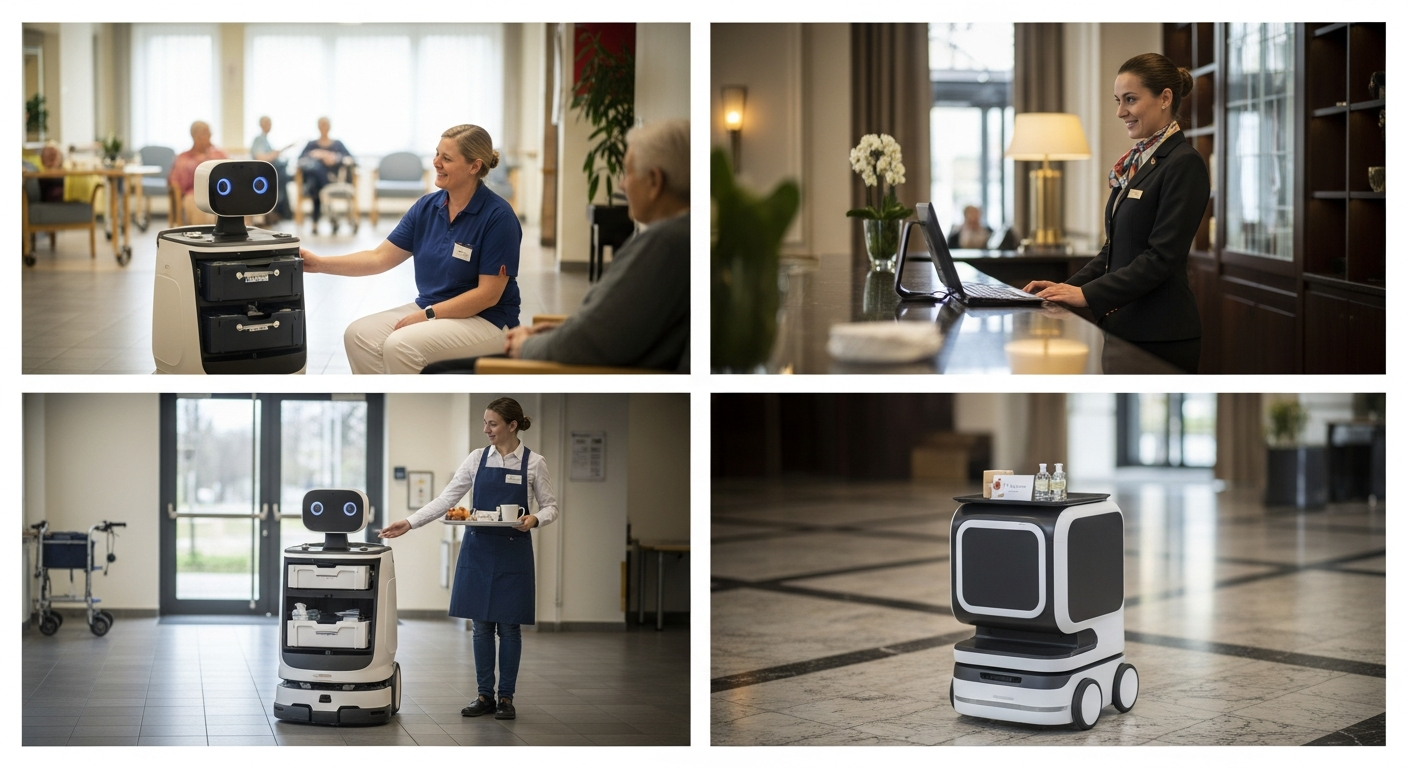
Shortage of staff in the catering industry: Robots as an operational solution
The shortage of staff in the catering industry endangers the operational viability of entire chains. As a system integrator, werob offers hardware-agnostic solutions that go live within eight weeks and massively reduce the workload on the workforce.
Kitchen. 7:30 p.m. Rush hour is at its peak. Two service staff are missing due to illness. Instead of the shift manager running the trays himself, an autonomous bot takes over the route between the pass and the guest room. The remaining staff focuses exclusively on the guest and the quality of the food. This is not a pilot project or a distant vision of the future, but rather everyday operations in over 200 installations that werob manages across Europe. As a system integrator, werob translates such workflows into technical specifications within 48 hours and brings the appropriate hardware onto the site in just eight weeks. The focus is not on the technology itself, but on the measurable reduction in the burden on operations.
Key Takeaways
- 1Robots relieve the catering industry of up to 76,000 euros per location annually by automating transport tasks.
- 2werob is hardware-agnostic and selects the best solution for your specific workflow from over 44 OEMs.
- 3Implementation takes place in just eight weeks, from the initial specification to productive use on the site.
The operational reality of staff shortages in the catering industry
The staff shortage in the catering industry is not a temporary phenomenon, but a structural challenge that threatens the growth and stability of F&B companies. If shifts remain unfilled, the quality of service drops, waiting times for guests increase and the remaining staff come under physical and psychological pressure, which further fuels fluctuation. In this situation, the use of robotics is not a question of innovation, but a necessity to maintain operations. A robot doesn't get sick, doesn't need breaks during rush hour and carries out monotonous transport tasks with a precision that frees up human energy for value-adding activities for guests.
However, many operators hesitate because they shy away from the integration effort or fear being tied to a single hardware manufacturer. This is where werob comes in as a system integrator. We look at staffing shortages from a workflow perspective. It's not about buying a robot, but about automating a function. Whether it's transporting dirty dishes to the washroom or continually cleaning kitchen floors, any automation must be reflected directly in the profit and loss statement. werob already has over 200 robots in live operation in 11 European countries that fill exactly these gaps.
Hardware-agnostic system integration instead of vendor lock-in
A key mistake in combating workforce shortages through robotics is tying yourself directly to a single robot manufacturer (OEM). The market is fragmented and technological development is rapid. Anyone who relies on a closed system today risks high follow-up costs and a lack of flexibility. werob is not a manufacturer, but the operational layer between the operator and the hardware. With over 44 OEM partners in the catalog and access to 280 different robot models, werob offers a hardware-agnostic platform that always selects the best solution for the specific workflow.
This approach protects operators from the so-called vendor lock-in. If a new, more efficient robot for tray logistics comes onto the market, it can be seamlessly integrated via the werob platform. The hardware is ranked against the customer's individual specification, which our spec engine creates in just 48 hours. Factors such as aisle widths, floor conditions, WiFi coverage and interaction with guests are taken into account. The goal is a solution that works regardless of what brand name is on the case. werob assumes responsibility for the selection, implementation and permanent operation in the live cockpit.
Measurable cost relief through targeted automation
In the catering industry, hard numbers count. Investing in robotics must provide a clear response to rising labor costs and the lack of labor availability. werob provides validated data from live operations. The use of a tray bot in the washing chamber results in an annual cost reduction of 76,000 euros per location. This sum results from the working time saved that was previously spent on just walking. In a typical restaurant, a server travels several kilometers per shift just to transport dishes. This time is missing for active sales and guest service.
Another essential area is cleaning. The automated kitchen floor cleaning saves the company an annual burden of 44,000 euros. These tasks often take place at off-peak times, for which it is particularly difficult to find reliable staff. Automating these processes not only saves money, but also ensures compliance with hygiene standards (HACCP). werob follows an outcome-only commercial model: you only pay when the robot actually runs on the surface and fulfills the defined workflow. There are no hidden costs for lengthy consultation phases or discovery decks.
The werob Spec Engine: To the specification in 48 hours
The biggest hurdle when introducing robotics is often the planning phase. Traditional consulting firms often need three to six months to collect requirements and create concepts. In the catering industry, where staff shortages require immediate action, this period is unacceptable. werob has radically shortened this process with the Spec Engine. Our platform translates your workflow description into a ready-to-use robot specification within 48 hours. This model was trained on the basis of over 35,000 projects and immediately recognizes which hardware requirements are critical for your specific location.
After the spec has been created, the supplier match takes place. Here the requirements are checked against our catalog of 44+ OEMs. The result is an objective ranking of the most suitable robots. This process ensures that you don't buy the product that a salesperson happens to have in stock, but rather the machine that will most effectively alleviate your labor shortage. At werob, it only takes five days from the first inquiry to the binding offer. This speed is unique in the market and enables operators to react to operational bottlenecks within a very short time.
Seamless integration into the existing tech stack
A robot that acts as an isolated unit offers limited added value. For automation to truly address the workforce shortage in the hospitality industry, it must become part of the digital ecosystem. werob delivers prefabricated connectors into the common operator stack. Whether you use Toast, Lightspeed or SAP EWM, our platform ensures that the robot receives the necessary information in real time. When an order is completed in the checkout system, the robot already knows which table to go to or when to pick up the finished dish at the pass.
This integration reduces complexity for on-site staff. Employees do not have to learn new software or control the robot manually. Communication takes place in the background via the werob connectors. This is an essential factor for the acceptance of the technology within the team. If the robot is perceived as a helpful tool that fits seamlessly into usual processes, productivity increases immediately. werob ensures that the technical infrastructure, from the WLAN connection to the interface configuration, runs stable from day one.
Regulatory and the EU Machinery Regulation 2023/1230
An often underestimated aspect when using robots is legal security. European operators are often faced with the challenge of proving compliance with local laws, particularly when it comes to hardware from Asian manufacturers. From January 20, 2027, the new EU Machinery Regulation 2023/1230 will be binding. This regulation places stricter requirements on the security and documentation of autonomous systems. Anyone who purchases robots today without a clear compliance path risks having these devices decommissioned in less than two years.
werob acts as your compliance partner here. We ensure that all systems used have the necessary certifications and meet the requirements of the EU Machinery Regulation. This includes not only the hardware itself, but also the secure integration into the operating environment. This is extremely relevant in industries such as catering, where robots operate in close proximity to people. Our cockpit monitors not only the hardware and infrastructure, but also the regulatory status of the entire fleet. With werob you do not run any legal risk.
From offer to live operation in eight weeks
Time is the critical factor when there is a shortage of staff. werob has optimized the entire process from specification to commissioning for maximum speed. Our promise is: The robot will be in use on your site in eight weeks. This tight schedule is only possible because Werob, as the system integrator, holds all the strings. We coordinate the hardware procurement, the configuration of the software connectors and the physical installation on site. While others are still discussing pilot projects, we are already delivering measurable results.
The process begins with a simple 8-step onboarding intake. Here you describe your shifts, tasks and spatial conditions. You will receive the specification within 48 hours. After the hardware has been selected through the supplier match and the commercial conditions have been clarified, implementation begins. Since we already support over 200 robots live, we rely on proven rollout structures. The goal is a smooth transition that relieves your team without disrupting ongoing operations.
The werob Cockpit: Live fleet management for maximum uptime
As soon as the robots are in use, the phase of permanent operation begins. A robot that is idle due to a technical error or a blocked route does not help with the staff shortage. That's why werob offers the live cockpit. This central management tool monitors the entire fleet in real time via a four-dimensional traffic light system. We check the status of the hardware, the stability of the infrastructure (WLAN), compliance with regulatory requirements and performance according to the original specification.
If there are deviations, the system often detects this before it leads to a failure. The cockpit enables operators of restaurant chains or hotel groups to centrally manage hundreds of robots at different locations. You receive detailed reports on the hours worked, the units transported and the cost reduction achieved. This data-driven approach makes the success of automation transparent and provides the basis for further scaling. werob plans to bring a total of 2,000 robots into live operation by 2028.
FAQ
- How much does it cost to introduce robots at werob?
- werob works according to an outcome-only model. This means you only pay when the system is running productively and providing the agreed service. There are no high upfront investments for consulting services.
- Which POS systems are supported?
- werob offers ready-made connectors for leading systems such as Toast, Lightspeed and SAP EWM. This ensures seamless integration into your existing tech stack.
- How safe are the robots when dealing with guests?
- Safety is the top priority. werob ensures that all robots used meet the EU Machinery Regulation 2023/1230 and have the most modern sensors for obstacle avoidance.
- Can werob also help with existing hardware?
- Yes, as a system integrator, we can often integrate existing hardware into our cockpit and optimize it with our software layer, provided the hardware meets the minimum technical requirements.
- What happens if there are technical problems?
- All robots are monitored in real time via the werob cockpit. Our support immediately detects disruptions and initiates appropriate measures to maximize uptime.
- How long does it take for a robot to be ready for use?
- It usually only takes eight weeks from the first contact to the robot in live operation. You will receive the specification after just 48 hours.
Related reading
Shortage of staff care robot solution: Efficiency through integration
The shortage of personnel in nursing requires immediate operational relief instead of lengthy consultation cycles. werob translates care workflows into usable robot specifications in 48 hours and integrates them directly into the existing IT stack.
26 June 2026Automation against a shortage of skilled workersAutomation against a shortage of skilled workers: Operational strategies 2026
The shortage of skilled workers endangers the operational viability of entire industries. werob shows how robot fleets create operational relief within eight weeks and free skilled workers from repetitive tasks.
21 June 2026institutional catering automationInstitutional catering automation: what works and what fails
Discover which institutional catering stations benefit most from automation, from belt portioning to AMRs, and learn when variable menus make robotics fail.
3 September 2026service robots against the labour shortage how facilityService robots against the labour shortage: how facility operators automate cleaning
Discover how facility operators use independent service robotics and flexible rentals to beat the cleaning labor shortage and stabilize workflows.
6 July 2026Robot pilot project gastronomyRobot pilot project for catering: Going live in 8 weeks
A robot pilot project in the catering industry often fails because the planning phase is too long. werob translates workflows into a specification in 48 hours and brings robots into live operation in eight weeks.
1 July 2026