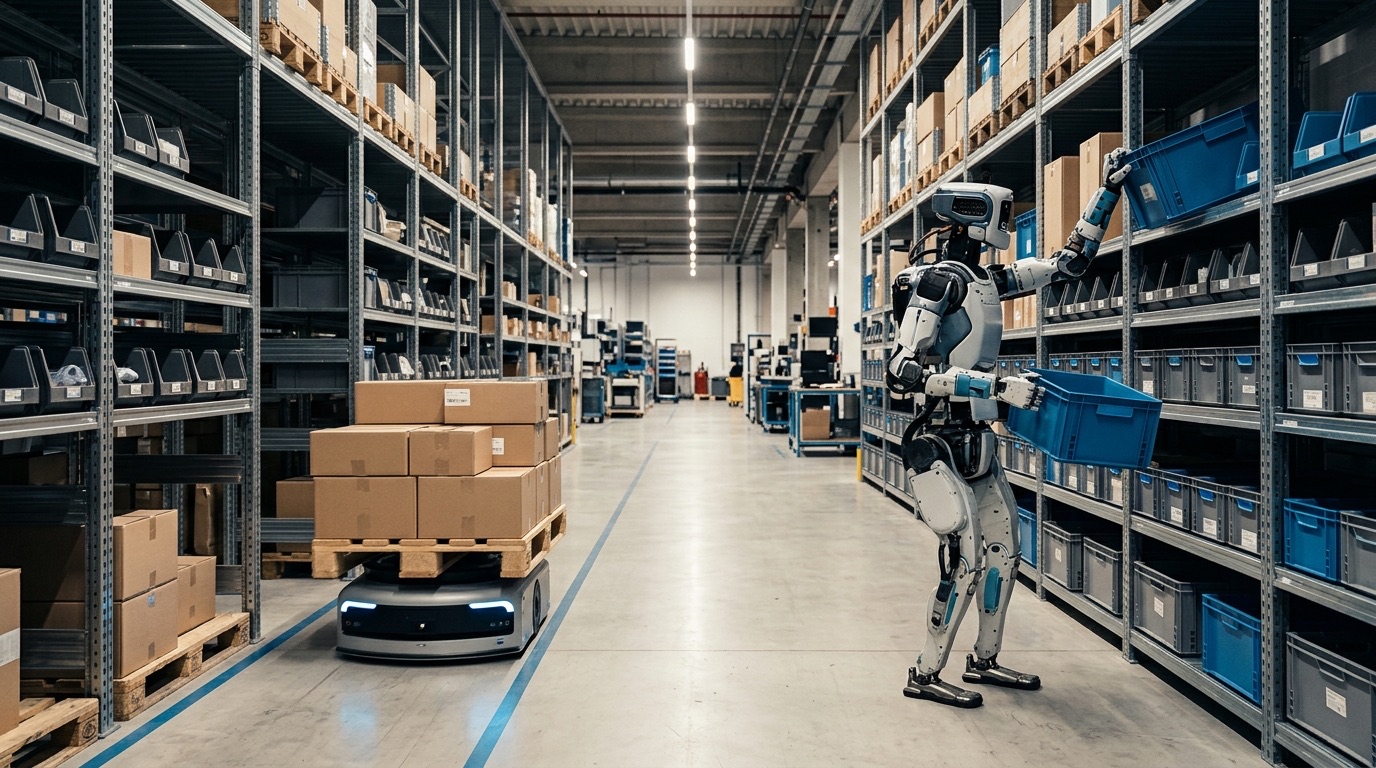
Humanoids vs. AMRs: 2026 Warehouse Automation Guide
Compare humanoid robots and task-specific AMRs to find the most practical and scalable warehouse automation solutions for European operations in 2026.
While humanoid robots promise a flexible future for brownfield sites, task-specific AMRs remain the pragmatic choice for 2026. This guide breaks down the procurement realities, throughput benchmarks, and business cases that European warehouse operators must weigh before buying.
Key Takeaways
- 1Most 2026 deployments rely on AMRs; Interact Analysis predicts 26 percent of warehouses will have meaningful automation by 2027.
- 2Agility Robotics' Digit has moved over 100,000 totes at GXO Logistics, establishing a key benchmark for humanoid deployments.
- 3Humanoid runtime per charge remains materially shorter than wheeled AMRs, making uptime and throughput per euro the harder case to close against proven task-specific machines.
- 4Task-specific AMRs win current business cases due to WMS integration, spare parts availability, and established service networks.
- 5Bosch is set to start series production for Humanoid in Bühl from August 2027, with only a few hundred units planned in the first year.
The State of Warehouse Automation in 2026
Industrial logistics in 2026 operates in an environment defined by persistent labor shortages, rising operational costs, and demanding order fulfilment windows. For warehouse, plant, and facility managers across Europe, automation is no longer an optional innovation experiment but a baseline operational necessity. However, despite significant public fascination with general-purpose robotics, the day-to-day reality on logistics floors remains overwhelmingly grounded in mature, task-specific technologies.
Most 2026 warehouse deployments continue to rely on proven autonomous mobile robots (AMRs) and goods-to-person (G2P) systems rather than humanoids, as highlighted in the nshift 2026 mid-year logistics report[1]. While high-profile logistics operators continue to test next-generation systems, the wider logistics estate is taking a measured approach. Market intelligence from Interact Analysis expects only around 26 percent of warehouse sites to have meaningful automation installed by 2027[2]. This steady adoption curve reflects the pragmatic calculation of European plant managers who prioritize predictable throughput, reliable uptime, and clear capital payback over experimental hardware.
- Proven material movement: Facilities prioritize low-deck transport AMRs, automated guided pallet jacks, and high-density cube storage systems that integrate directly into existing processes.
- Integration over novelty: Operational leadership focuses on linking automation data directly to transportation management, inventory tracking, and carrier cut-off schedules.
- Pragmatic capital deployment: Decision-makers evaluate automation based on proven cycles per hour, standard maintenance contracts, and verifiable regulatory compliance.
Because roughly three-quarters of warehousing sites remain largely manual or semi-automated, capital allocation is directed toward machines that can be specified, installed, and commissioned within standard operating quarters. For operations leaders, the critical challenge in 2026 is selecting the right automation layer for specific workflow bottlenecks rather than pursuing speculative technological milestones.
The Theoretical Appeal of Humanoid Robots
The concept of deploying bipedal, humanoid robots in logistics environments has gained substantial momentum across the technology sector. The core argument for the humanoid form factor centers on brownfield compatibility. The modern supply chain infrastructure was engineered specifically for human biomechanics: standard shelving heights, narrow racking aisles, manual dock levers, staircases, and standard industrial packaging totes. Specialized automation often requires dedicated infrastructure, whereas humanoids promise to slot directly into facilities without requiring civil engineering alterations or custom reracking.
Beyond physical facility navigation, general-purpose humanoids offer the theoretical flexibility to execute multi-step workflows that currently require several dedicated machines or manual human intervention. In principle, a single bipedal platform could unload containers, transport goods across mixed-traffic corridors, perform piece-picking from standard shelving, and palletize outbound consignments, shifting roles as hourly volumes fluctuate. That adaptability is the central promise of ongoing work on humanoid robotics architectures, and it remains a design goal rather than demonstrated field performance.
- Zero infrastructure retrofitting: Ability to traverse standard doorways, mezzanine walkways, and ramps without altering building layouts.
- Tool and interface reuse: Capability to operate handheld barcode scanners, push manual roll cages, and manipulate standard storage bins without custom mechanical grippers.
- Dynamic task reallocation: Shifting from inbound unloading during morning shifts to outbound sorting during evening peaks using software updates rather than hardware swaps.
For logistics executives managing older facilities where high-density automated storage and retrieval systems (ASRS) are physically or financially unviable, the humanoid promise offers an attractive theoretical path toward end-to-end automation without structural redesign.
The Practical Reality of Humanoid Deployments
While the long-term vision of general-purpose robotics is compelling, the operational realities of 2026 present substantial procurement and technical hurdles. On an active fulfillment floor, reliability and continuous throughput govern every business case. When evaluated against the rigorous uptime standards of production logistics, current humanoid platforms encounter severe physical and operational constraints.
A primary technical constraint is energy efficiency and battery runtime. Bipedal locomotion and multi-axis whole-body balance require continuous power expenditure across dozens of high-torque actuators, which materially shortens the runtime achievable between charging cycles. In contrast, wheeled AMRs benefit from rolling efficiency, sustaining full-shift operation alongside rapid opportunity charging during standard operational pauses. This runtime differential substantially alters the fleet size required to maintain constant throughput, driving up the total cost per moved unit.
| Operational Dimension | Task-Specific AMRs | Humanoid Robots |
|---|---|---|
| Mobility & Kinematics | Differential drive or omnidirectional wheels; high mechanical efficiency | Bipedal or articulated multi-joint locomotion; complex dynamic balance |
| Power & Uptime | Full-shift operation; automated fast opportunity charging | Materially shorter runtime; frequent battery swap or extended recharge |
| Safety Certification | Established ISO 3691-4 standards; mature CE marking protocols | Emerging frameworks; complex risk assessment in shared human workspaces |
| Maintenance & Parts | Standardized drive units, sensors, and readily available spares | Specialized high-density actuators; bespoke harmonic gears and limited regional parts |
| Software Integration | Standardized VDA 5050 and mature WMS/WES connector APIs | Proprietary autonomy stacks; custom orchestration integration required |
Beyond energy consumption, the support ecosystem in Europe remains immature for general-purpose humanoids. Securing rapid-response maintenance service-level agreements (SLAs), sourcing replacement actuators within 24 hours, and obtaining clear CE compliance under the Machinery Regulation present real operational risks. Integrating early-stage autonomy stacks with enterprise Warehouse Management Systems (WMS) and Warehouse Execution Systems (WES) also introduces software orchestration complexity that few operations teams are equipped to manage.
Agility's Digit at GXO: A Benchmark for Scale
Despite the early stage of the wider humanoid sector, commercial validation has begun to emerge in select enterprise environments. The most prominent real-world validation to date is the deployment of Agility Robotics' Digit robot across GXO Logistics operations. Unlike laboratory demonstrations, this deployment operates inside an active logistics facility under real commercial operating constraints.
A significant operational milestone was reached when Agility Robotics confirmed that Agility Digit moved more than 100,000 totes in a live, commercial GXO Logistics facility[3]. In this application, Digit operates within a defined repetitive workflow: retrieving standard plastic totes from autonomous mobile robots, transferring them across picking stations, and placing them onto outbound conveyors. This milestone demonstrates that bipedal and humanoid systems can achieve repeatable industrial reliability when assigned structured, repetitive material handling tasks.
- Structured scope: Initial commercial success relies on tightly defined, repetitive tote-handling processes rather than unconstrained general-purpose manipulation.
- Collaborative workflows: Bipedal units work in tandem with wheeled AMRs, utilizing mobile robots for horizontal transport and bipedal arms for vertical transfer.
- High-cycle reliability: Achieving six-figure cycle volumes is the baseline prerequisite for establishing measurable return on investment and calculating real wear-and-tear costs.
However, this 100,000-tote benchmark highlights the performance gap that most humanoid pilot programs have yet to cross. Outside of a handful of heavily resourced tier-one 3PL trials, the vast majority of humanoid trials in Europe remain low-cycle engineering proofs of concept that are not yet ready for unassisted, multi-shift production deployment.
Contract Manufacturing and the Path to 2028
To transition from bespoke pilot projects to commercially viable warehouse assets, humanoid robotics must solve its underlying manufacturing and supply chain constraints. Developing advanced robotic hardware in boutique engineering batches keeps unit costs high and restricts access to industrial-grade component supply chains. The transition toward scalable manufacturing is now beginning to take shape through partnerships with established tier-one automotive and industrial suppliers.
A key indicator of this industrial transition is Robert Bosch GmbH's move into contract manufacturing for the robotics sector. At its plant in Bühl, Germany, Bosch is set to start series production of AI-controlled humanoid robots for the London-based startup Humanoid in August 2027, beginning with a few hundred units in the first year[4]. Automotive supplier Schaeffler, which like Bosch is an investor in the startup, is confirmed as its first customer. Notably, Bosch is acting as a specialized contract manufacturer rather than developing its own proprietary humanoid platform, applying its automotive-grade production standards, quality assurance, and supply chain scale to third-party robotic designs.
- Prototype and pilot validation (2024 to 2026): Small-batch deployments and proof-of-concept trials testing basic kinematics, balancing algorithms, and vision systems in live warehouses.
- Industrialized contract manufacturing (2027): Established tier-one industrial suppliers initiate contract assembly lines, establishing standardized component sourcing and initial series quality control.
- Commercial mass production (2028 onward): Scaled production volumes lower bill-of-materials costs, establish structured regional spare parts networks, and make fleet leasing commercially accessible.
This manufacturing timeline underscores an essential procurement truth for European facility operators: mass-market availability of fully supported, cost-competitive humanoid fleets is a horizon development slated for 2028 and beyond. Operational strategies for the immediate 2026 to 2027 period must be built on hardware that is commercially mature today.
Why Task-Specific AMRs Win the Business Case
When evaluating capital expenditure and operational return, proven task-specific automation wins the business case on nearly every 2026 warehouse workflow. Unlike general-purpose systems that attempt to master dozens of complex kinematics, task-specific AMRs are engineered for singular mechanical excellence: moving horizontal payloads, transporting pallets, picking specific shelf configurations, or sorting parcels with maximum efficiency.
From a total cost of ownership perspective, purpose-built mobile robots clear every procurement hurdle with established certainty. Their mechanical simplicity ensures lower upfront acquisition costs, minimal actuator wear, and established maintenance cycles supported by nationwide technician networks across Europe. Furthermore, task-specific AMRs operate within well-defined safety standards, enabling rapid facility sign-off under existing industrial machinery directives without regulatory delays.
- Guaranteed throughput per euro: Optimized kinematics deliver higher picks, sorts, or pallet moves per kilowatt-hour than bipedal systems.
- Predictable maintenance contracts: Standardized spare parts, drive wheels, and LiDAR sensors are stocked regionally, ensuring standard service response times.
- Established financing and leasing: Financial institutions routinely underwrite task-specific AMR fleets with transparent residual value models and predictable operating lease terms.
- Standardized orchestration: Native support for fleet protocols like VDA 5050 allows operators to manage multi-vendor AMR fleets through a unified traffic management layer.
While humanoid robots hold legitimate long-term promise for unconstrained brownfield environments, operations managers must deliver quantifiable productivity improvements today. For 2026 fulfillment targets, task-specific AMRs provide the operational certainty, throughput guarantees, and financial payback that capital committees require.
A Decision Framework for Procurement and Integration
To navigate the choices between emerging robotics form factors and mature systems, operations leaders require a structured evaluation rubric. Rushing into an exploratory pilot without clear operational gating criteria risks stranding capital in proof-of-concept stagnation. Successful automation projects begin by isolating specific process bottlenecks and matching them to the simplest, most reliable mechanical solution.
- Define throughput and payload parameters: Quantify exact payload weights, required cycle times per hour, and operating shift durations before evaluating hardware form factors.
- Assess facility infrastructure: Determine whether layout modifications, barcode floor grids, or optical navigation markers provide a faster payback than infrastructure-free platforms.
- Audit regulatory and safety readiness: Verify whether the proposed robotic platform meets European machinery standards and can operate alongside human staff without physical safety cages.
- Evaluate software middleware: Ensure the hardware integrates natively with host WMS and ERP systems without requiring costly bespoke API development.
Achieving seamless robotics deployment requires partnering with an experienced systems integrator rather than attempting to navigate fragmented OEM landscapes alone. The werob Platform provides end-to-end integration infrastructure that moves warehouse automation from initial workflow concept to live facility operation within eight weeks.
Using the Spec Engine, operators can translate plain-language shift requirements into formally verified, deployable action graphs. The platform evaluates and ranks suitable hardware across an extensive OEM network using Supplier Match, connects directly to existing WMS environments such as SAP EWM via standardized Connectors, and provides unified real-time fleet oversight through Cockpit. By anchoring deployment strategy in proven systems integration, logistics operators secure measurable throughput and dependable operational payback today.
FAQ
- Why are task-specific AMRs currently preferred over humanoid robots?
- Task-specific AMRs and goods-to-person systems clear the procurement bar today. They provide guaranteed throughput, established service networks, and seamless integration with existing warehouse management systems, making them easier to finance and support.
- When will humanoid robots be ready for mass deployment in warehouses?
- While pilots are underway, deployment at scale is a later-decade prospect. Bosch is set to start series production of humanoid robots for the London startup Humanoid at its Bühl plant in August 2027, beginning with only a few hundred units.
- How many warehouse operations are automated today?
- The adoption of automation is growing steadily but remains selective. Interact Analysis expects around 26 percent of warehouse sites to have meaningful automation installed by 2027, which leaves roughly three-quarters of the estate largely manual or semi-automated.
- What is the theoretical infrastructure argument for humanoid robots?
- The argument is that a human form factor could work in buildings already laid out for people - navigating brownfield sites and standard aisles without custom reracking or dedicated automation zones. That is the design rationale rather than a demonstrated 2026 capability: current deployments remain confined to structured, well-defined tasks, and the infrastructure savings still have to be proven against a task-specific alternative.
- How do humanoid robots compare to AMRs on energy efficiency?
- Current humanoid prototypes expend significantly more energy maintaining balance and whole-body motion, which shortens achievable runtime per charge. Proven wheeled AMRs, by contrast, sustain operation across a full shift with opportunity charging during natural pauses.
- Which commercial milestone shows humanoid robots can work in real warehouses?
- A major validation for the technology occurred when Agility Robotics' Digit moved more than 100,000 totes in a live commercial deployment at a GXO Logistics facility, proving capacity for high-volume task execution.
Related reading
Humanoid Robot Vendor Comparison: 2026 Enterprise Integration Guide
A technical analysis of leading humanoid OEMs and the integration architecture required to move from pilot projects to live production environments.
2 July 2026agility digit europe integratorAgility Digit in Europe: The Path via the Systems Integrator werob
Deploying Agility Digit in European operations requires more than just hardware procurement. As a systems integrator, werob closes the gap between US technology and local operational reality through automated specification and regulatory safeguarding.
2 June 2026buy humanoid robot companiesBuying Humanoid Robots for Companies: The Guide
Companies face the challenge of integrating humanoid hardware into existing processes. As a systems integrator, werob offers the path from specification to live operation without manufacturer ties.
9 June 2026business case humanoid robotBusiness case humanoid robot: ROI and operational strategy
Humanoid robots leave the laboratories and take on operational tasks in nursing, hotels and logistics. This guide analyzes the business case based on real data and shows the path to implementation in eight weeks.
22 June 2026bosch humanoid robots black forestBosch Plans to Build Humanoid Robots in the Black Forest
Bosch will begin manufacturing humanoid robots at its Bühl plant in August 2027. Discover what this timeline means for European logistics managers.
24 August 2026