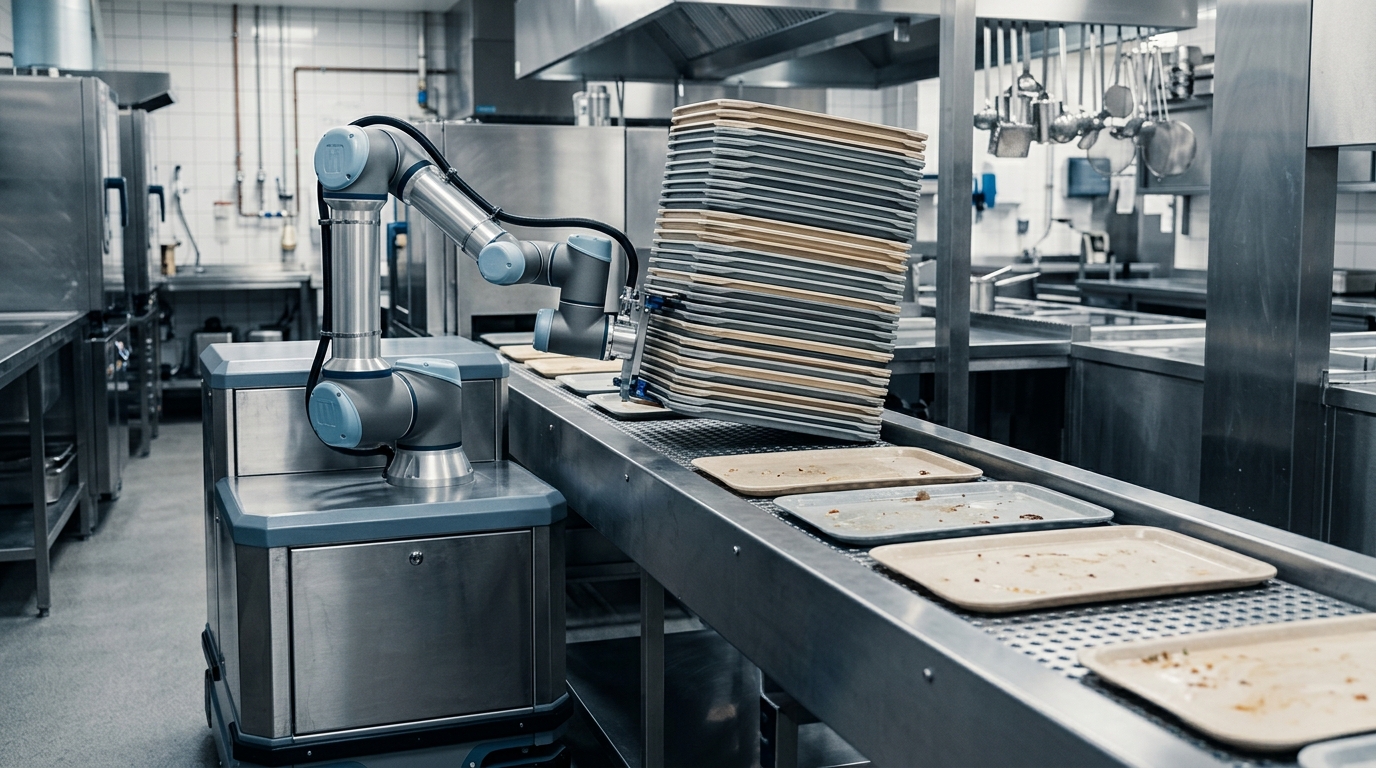
Dishroom First: Why Warewashing Leads Kitchen Automation
Discover why dishroom automation leads commercial kitchen robotics and how steam, IP washdown ratings, and tray-return logistics shape the specification.
While the cooking line often dominates the robotics conversation, the dishroom is the true entry point for commercial kitchen automation. Success here depends not on glamorous AI, but on managing extreme humidity, strict washdown ratings, and relentless tray-return logistics.
Key Takeaways
- 1The dishroom is the optimal entry point for kitchen robotics due to its fixed logistics and continuous, menu-independent workflow.
- 2Environmental hostility-including steam and aggressive chemistry-is the primary driver for dishroom robot specification.
- 3Robots deployed in the wet zone must meet strict washdown standards like IP69K to withstand high-pressure cleaning.
The Tray-Return Loop: Logistics Over Glamour
The tray-return and dish-clearing cycle is the most structurally sound entry point for automation in commercial kitchens and institutional catering (Großküche) operations. While culinary robotics aimed at the cooking line attract substantial attention, the back-of-house warewashing loop represents a deterministic transport problem rather than an open-ended culinary challenge.
Deterministic Transport Versus Culinary Variability
On the cooking line, automated systems must manage variable ingredient dimensions, moisture levels, searing profiles, and continuous menu changes. In contrast, the dish-return workflow operates across fixed origins and destinations: clearing stations in the dining room, staging racks at the dishroom threshold, and the loading table of the warewashing system. This fixed spatial topology eliminates the need for real-time culinary judgement or adaptive recipe execution.
Foodservice operations assessing which quick-service kitchen robotics investments actually pay off find that transport workflows offer the most predictable operational constraints. The soiled tray does not require sensory evaluation: whether a plate holds residual sauce, discarded napkins, or cutlery, the mechanical handling task remains strictly focused on point-to-point conveyance.
Operational Turnover and Continuous Flow
Warewashing and bussing stations suffer from some of the highest staff turnover rates in the hospitality and care sectors. The repetitive, physically demanding nature of shifting heavy dish racks and clearing laden trays creates persistent rostering gaps. Automating the transport leg stabilises floor throughput without interfering with food safety or preparation standards during peak meal services.
- Fixed spatial routing: Movement occurs strictly between designated dining-room clearing stations and dishroom reception zones.
- Zero product-quality dependency: Conveyance parameters remain unchanged regardless of plate composition or food residue.
- Continuous operational demand: Tray returns generate steady volume across breakfast, lunch, and dinner service windows.
The Environmental Reality of the Dishroom
The dishroom is the most physically hostile operating environment in any commercial building, characterized by high thermal loads, aerosolised chemicals, and continuous ambient humidity. Mobile robotic hardware designed for dry dining rooms fails rapidly when deployed across this threshold without specialized engineering protections.
Optical Sensor Degradation in Saturated Steam
Commercial flight-type and hood-type dishwashers discharge continuous plumes of warm vapour and steam during peak wash cycles. Standard 2D and 3D LiDAR sensors, optical time-of-flight cameras, and infrared obstacle-detection systems experience severe refraction and blindness when exposed to suspended moisture droplets. Condensation forming directly on optical lenses scatters laser returns, causing false obstacle detections, abrupt emergency stops, or complete navigation failure.
Traction Loss and Chemical Corrosion
Floors in the warewashing area present a persistent composite hazard of standing water, food oils, and chemical surfactants. Standard polyurethane drive wheels experience severe traction loss on wet quarry tiles, leading to odometry drift, steering deviations, and extended braking distances.
Furthermore, detergent formulations containing sodium hydroxide, chlorinated sanitizers, and acid rinse aids create aggressive airborne aerosols. When these vapours penetrate unsealed chassis seams, they attack copper wiring harnesses, corrode internal aluminium castings, and degrade standard rubber elastomeric seals within weeks of operation.
Ingress Protection: Washdown Ratings as the Hard Filter
Ingress protection (IP) ratings establish the definitive boundary between front-of-house service units and industrial back-of-house machinery. A standard dining-room bussing robot rated at IP54 or IP65 cannot survive the routine sanitation and ambient vapour conditions of a commercial dishroom.
High-Pressure Washdown and the IP69K Standard
Commercial kitchen sanitation protocols require regular cleaning with high-temperature water and chemical degreasers. Under ISO 20653 and IEC 60529 standards, IP69K certification validates that an enclosure withstands water sprayed at pressures between 80 and 100 bar, temperatures of 80°C (plus or minus 5°C), and flow rates of 14 to 16 litres per minute from distances of 100 mm to 150 mm[1]. Devices without hermetically sealed, IP69K-certified enclosures succumb to thermal shock and moisture ingress when high-pressure spray forces gaskets to deform.
Regulatory Compliance and Food Contact Frameworks
Robotic hardware operating near open food zones and commercial warewashers must comply with strict statutory safety and hygiene frameworks across Europe. Deployments within the European Union must align with Regulation (EU) 2023/1230 (the Machinery Regulation), which replaces Directive 2006/42/EC and applies from January 2027[2], governing machinery safety, control-system integrity, and risk assessments.
In addition, materials and coatings coming into direct or indirect contact with dishware and utensils must satisfy Regulation (EC) No 1935/2004, the harmonised EU framework regulation on materials and articles intended to come into contact with food, which requires that such materials do not release constituents into food at harmful levels or change its composition, taste or odour[3]. Specifications must therefore enforce a strict boundary between dry-zone and wet-zone equipment.
The Handoff: Managing Tray-Return Bottlenecks
The operational chokepoint in automated dish clearance is rarely the transport speed across the dining floor; it is the physical handoff and buffering capacity at the dishroom entrance. When the primary dishwashing line reaches capacity during peak meal times, inbound tray flow must be buffered systematically without causing floor congestion.
Peak-Service Buffering at the Wet-Zone Threshold
During peak lunch or dinner rushes, hundreds of trays arrive within narrow 30-minute intervals. If autonomous mobile units attempt to deliver trays directly to the machine infeed when the operator is overwhelmed, transport queues immediately spill back into service corridors. Establishing a dedicated buffer zone with standardized staging carts or gravity-fed roller tracks at the threshold decouples dining-room clearing from dishroom processing speed.
The True Bottleneck: Clean-Side Sorting and Stacking
A common operational misconception is that dishroom throughput is constrained by transport or pre-scrapping. In practice, the primary systemic bottleneck is clean-side unloading, sorting, and rack breakdown. If washed items cannot be sorted, stacked, and returned to service stations rapidly, the entire conveyor line halts automatically, backing up pre-wash sorting and stalling robot handoffs regardless of transport efficiency.
The Spülstrasse: Where Conveyors Meet Mobile Robots
The commercial dishwashing line (Spülstrasse) is already one of the most heavily automated systems in foodservice operations. Integrating autonomous mobile robots into this environment does not replace the core washing mechanism, but rather closes the logistical gap between the dining floor and the machine infeed.
High-Throughput Flight-Type Washers and Hygiene Norms
Modern flight-type conveyor dishwashers, such as the Hobart FT1000e, achieve continuous washing capacities of up to 14,310 dishes per hour according to the manufacturer's product specification[4]. These industrial systems automate internal wash zones, power rinses, chemical sanitisation, and drying stages in compliance with the DIN EN 17735 standard for commercial warewashing hygiene (which superseded DIN SPEC 10534, itself a consolidation of DIN 10510, DIN 10511 and DIN 10512)[5].
Mobile robots operate strictly as the horizontal transport layer feeding this continuous process. By bringing consolidated dish racks or tray cassettes directly to the pre-sorting tabling, mobile units ensure that the high-capacity conveyor never starves for washware during peak service windows.
| Operating Zone | Typical Ingress Protection | Primary Environmental Challenge | Functional Automation Role |
|---|---|---|---|
| Front-of-House Dining Room | IP54 / IP65 | Pedestrian navigation, carpet/tile transitions, obstacles | Autonomous bussing, guest tray collection, clearing transport |
| Threshold & Staging Area | IP65 | Traffic queuing, cart handoff, vapour buffer transition | Decoupled staging, buffer cart exchange, queue management |
| Back-of-House Warewashing Line | IP69K (washdown zones) | Continuous steam, detergent aerosols, wet floors, caustic washdown | Flight-type conveyor washing, pre-rinse, chemical sanitisation |
Clearing the Dining Room: Floor Plans and Behaviour
Front-of-house tray return automation depends directly on the structural layout of the dining room and the behavioural patterns of patrons and service staff. Unlike predictable warehouse aisles, dining areas present dynamic obstacles, shifting furniture, and variable human interactions.
Navigating Constrained Aisles and Dynamic Obstacles
Autonomous bussing robots require a clear minimum operating corridor to navigate reliably around tables, chairs, and guests, and that clearance has to be measured against the actual floor plan rather than assumed. In dense restaurant or canteen layouts, temporary obstructions, such as pulled-out chairs, delivery carts, or congregating patrons, force path recalculations. Systems must utilize responsive 2D LiDAR and ultrasonic sensors optimized for dry environments to maintain smooth clearance routes without intrusive stop-and-start jerking.
Structuring Guest Behaviour and Threshold Transfers
Clearing efficiency is determined by whether the venue operates a self-bussing model or staff-assisted clearing. In self-bussing institutional canteens, static tray-drop stations remain more effective than mobile robots attempting to collect trays table-by-table from untrained guests. Mobile units are best deployed on dedicated shuttle runs, moving loaded trolley cassettes from front-of-house aggregation points to the back-of-house threshold, where staff or specialized transfer mechanisms execute the wet-zone transfer.
Continuous Utilisation and Payback Mechanics
Warewashing transport reaches payback earlier than robotics at the hot station because of its continuous operational utilisation and immunity to menu variation. While cooking automation is constrained to specific recipes and meal preparation windows, dish return runs across every operational hour of the facility.
The Economic Mechanism of Repetitive Logistics
The return on investment for dishroom logistics does not depend on hypothetical performance metrics, but on concrete operational variables: total daily cover volume, transit distance between dining rooms and the wash line, shift duration, and the local cost of filling high-turnover stewarding shifts. Because the clearing task is identical whether a kitchen serves breakfast, corporate lunches, or evening banquets, hardware utilisation remains high throughout the entire operational day.
Integrating these workflows requires an engineering-driven approach rather than single-vendor hardware purchases. Sourcing teams scoping food and beverage automation must specify system components against exact physical site constraints, environmental moisture zoning, and conveyor interface requirements.
Specifying and Deploying Multi-Zone Automation
As a manufacturer-independent robotics systems integrator based in Hamburg, Germany, werob operates as a brand of CITO GmbH to translate complex hospitality and healthcare workflows into robust technical architectures. Using the werob Platform, Spec Engine, and Supplier Match, engineering teams match certified robotics hardware to exact wet- and dry-zone specifications, while Connectors and Cockpit provide unified integration with facility management software and continuous fleet monitoring across the entire operational lifecycle.
FAQ
- Why is dishroom automation easier to implement than cooking line robotics?
- Dishroom operations involve pure, repeatable logistics with a fixed origin and destination, unlike the cooking line which is highly menu-dependent. This continuous flow of dirty dishes allows transport robots to maintain high utilisation across a shift without needing complex product judgement.
- What IP rating does a commercial kitchen robot need?
- A robot operating deep inside the dishroom typically requires an IP69K rating to withstand high-pressure, high-temperature washdowns and aggressive cleaning chemicals. In contrast, a dining-room bussing robot operating in dry areas requires significantly lower ingress protection.
- How does the Machinery Regulation (EU) 2023/1230 affect kitchen robotics?
- Applying from 20 January 2027, Regulation (EU) 2023/1230 replaces the older Machinery Directive and requires manufacturers to maintain compliance throughout a machine's entire lifecycle, especially regarding substantial modifications and washdown safety standards.
- What is the biggest bottleneck in automated tray return logistics?
- The bottleneck is rarely the transport robot; it is usually the throughput capacity of the dish machine itself and the physical space available for clean-side stacking
- Can the same robot clear tables and operate inside the dishroom?
- Usually, these tasks require two different machines. A dining-room robot is designed for dry-side navigation and guest interaction, while a wet-side robot must endure steam, standing water, and detergent aerosol, making a physical handoff at the threshold the most practical solution.
Related reading
Robots at the hot station: what cooking automation in QSR delivers today
How robotic fry stations address turnover and worker safety at the QSR hot line, why they stay narrow and task-specific, and where the honest limits are.
24 July 2026qsr kitchen robotics worth itQSR kitchen robotics: which tasks pay off and which do not
A sober framework for QSR and mid-market operators: which kitchen tasks are worth automating, which are not, and why a narrow robot loses its case the moment the task stops being narrow.
25 July 2026institutional catering automationInstitutional catering automation: what works and what fails
Discover which institutional catering stations benefit most from automation, from belt portioning to AMRs, and learn when variable menus make robotics fail.
3 September 2026turnkey automation solutionTurnkey Automation Solution: To Live Operation in Eight Weeks
A turnkey automation solution requires more than just hardware. werob integrates 44+ OEMs directly into your existing software stack and assumes regulatory liability.
3 June 2026reduce personnel costs automationReduce Personnel Costs Through Automation: Strategies for 2026
The automation of routine tasks is not a technology project but an operational necessity. Through hardware-agnostic robotics solutions, personnel costs can be significantly reduced while maintaining stable service quality.
13 June 2026