Business case humanoid robot: ROI and operational strategy
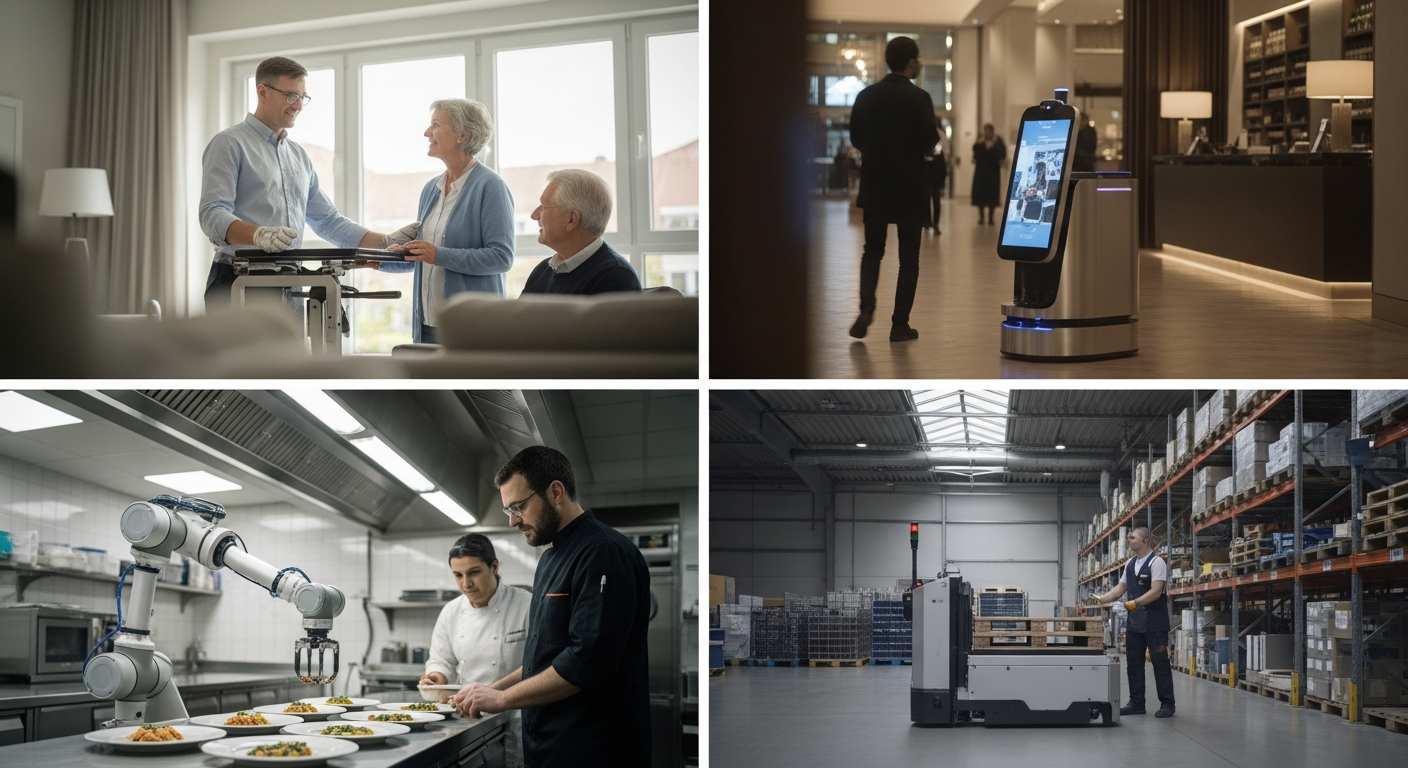
Humanoid robots leave the laboratories and take on operational tasks in nursing, hotels and logistics. This guide analyzes the business case based on real data and shows the path to implementation in eight weeks.
Station 2. 3:15 a.m. The night watch documents the final tour, while a humanoid robot is already preparing the morning's medication delivery. What seemed like science fiction years ago is now operational reality in facilities like the Hamburg care facility, where humanoid systems are already in their twelfth week of operation. It's no longer a question of whether the technology works, but rather how quickly it pays off. werob translates these complex workflows into a usable specification within 48 hours. As a system integrator, we evaluate over 44 OEM partners to find the right hardware for your specific workflow. The focus is on measurable results instead of lengthy pilot projects.
Key Takeaways
- 1Humanoid robots offer annual cost savings of up to 92,000 euros per location in care through the automation of medication rounds.
- 2The werob Spec Engine translates complex workflows into a usable specification in just 48 hours and shortens implementation to eight weeks.
- 3A hardware-agnostic approach with over 44 OEM partners protects against vendor lock-in and ensures compliance with the EU Machinery Regulation 2023/1230.
The evolution from pilot project to operational standard
The market for humanoid robots has reached a tipping point. While the industry was dominated by research prototypes and marketing videos for years, today the focus is on operational scaling. werob already operates 200 robots in live operation in eleven European countries. This number shows that the technology has left the pure testing phase. For a robust business case, it is crucial to view the robot not as an isolated gadget, but as part of an integrated operational level. The challenge for operators of nursing homes, hotels or logistics centers is to translate the theoretical capabilities of the hardware into measurable time and cost savings.
A key driver of this development is the acute shortage of skilled workers. If a nurse spends two hours per shift transporting supplies or distributing medications, this is a misallocation of expensive resources. Humanoid systems that are able to move in human environments without structural adjustments close this gap. werob acts as a system integrator, controlling the entire process from specification to live operation. The goal is to put a total of 2,000 robots into productive use by 2028. This scaling effect significantly reduces the entry barriers for companies, as proven action graphs and integration patterns can be used.
The Spec Engine: From workflow to hardware in 48 hours
A classic problem when introducing robotics are discovery phases lasting months. Consultants create massive decks without ever moving a machine. werob breaks this pattern with the Spec Engine. Within 48 hours, an operator's workflow is translated into a technical specification. This engine was trained on over 35,000 projects and immediately recognizes which hardware requirements are necessary for a specific task. Whether it's about fine motor skills when dispensing medication or stability when transporting heavy trays, the Spec Engine provides the foundation for the business case.
This process eliminates the risk of bad purchases. Instead of relying on the promise of a single manufacturer, the task is defined objectively. The specification covers not only the physical movements, but also the necessary digital interfaces and regulatory requirements. In an industry where time is of the essence, the 48-hour promise represents a massive competitive advantage. Operators receive a binding offer after five days and can deploy the first robot on the site just eight weeks later. This speed is essential in order to realize the ROI promptly and noticeably reduce the workload on the workforce.
Hardware agnostics as strategic risk management
The market for humanoid robots is highly dynamic. Manufacturers such as Boston Dynamics, Unitree, Apptronik and Figure AI are developing their systems at a rapid pace. It would be risky for an operator to commit to a single OEM through a direct purchase. werob therefore follows a hardware-agnostic approach. In the Supplier Match, over 44 OEM partners are ranked against the customer's individual specifications. There are currently 280 different robot models listed in the catalog and capable of being maneuvered. This ensures that the most technologically and economically sensible hardware is always used.
Should a manufacturer discontinue its software support or bring a new model with better energy efficiency onto the market, the werob platform enables a seamless change. The operator remains independent of the so-called vendor lock-in. This flexibility is a core part of the business case as it increases long-term investment security. The focus is not on the ownership of the hardware, but on the result of the automation. The ranking system objectively evaluates factors such as maintenance intervals, availability of spare parts in Europe and conformity with local standards. This significantly reduces the complexity for purchasing and technical management.
Cost reduction in care: The 92,000 euro argument
The economic pressure is particularly high in inpatient care. This is where the business case for humanoid robots has its strongest impact. A concrete example is the medication round. By automating this process, locations achieve annual cost savings of 92,000 euros. This sum results from the time saved by the specialists, which can instead be used for direct resident care. Another area of application is pure material transport, which saves around 71,000 euros in costs per location and year. Customers like Korian Germany are already using this potential to achieve double-digit cost reductions in the first year.
This is not about replacing people, but rather about compensating for unfilled positions and reducing overload. After twelve weeks of operation in the Hamburg care facility, it is clear that acceptance among staff is high when the robot takes on the physically demanding and repetitive tasks. The business case pays off not only through the direct wage costs, but also through a decreasing fluctuation rate and reduced downtime due to overload. The integration takes place deeply into the existing processes, so that the robot acts as a full team member that completes its rounds punctually and reliably.
Hotel and catering industry: increasing efficiency in service
In the hotel industry, the savings potential is often hidden. Room service is a classic example of inefficient routes. A humanoid robot that autonomously brings orders to the floors saves staff by 112,000 euros per year and location. A further 54,000 euros can be saved in the preparation of the bar and breakfast buffet. These numbers are based on real usage scenarios in European hotel chains that use werob systems. The robot takes over the unproductive travel time while the employees can concentrate on the guest.
The effects can also be measured in system catering (F&B). Cleaning kitchen floors saves you 44,000 euros, while using tray bots in the dishwashing chamber saves up to 76,000 euros per year. The key factor for success in this sector is hygiene compliance (HACCP) and seamless integration into POS systems such as Toast or Lightspeed. If the robot automatically knows when an order is ready or a table needs to be cleared, a fluid workflow is created without manual interaction. This not only increases efficiency, but also improves the guest experience through faster service times.
Integration into the operator stack: Connectors as enablers
A robot that does not communicate with the existing software is an isolated solution. The true value of the werob platform lies in the pre-built connectors. These enable direct integration into the operator’s IT stack. In care, these are connections to PointClickCare or MatrixCare. Systems such as Opera PMS or Mews are supported in the hotel industry. Connectors for SAP EWM are available for logistics. These interfaces ensure that the robot receives its tasks based on real-time data and reports its status directly back to the leading systems.
Without this integration, employees would have to control the robot manually or record tasks twice. That would destroy the business case. werob delivers these connectors as part of the platform, which reduces the implementation time to the promised eight weeks. The data flows bidirectionally: the robot receives orders from the PMS or ERP and reports back completion, fill levels or obstacles. This enables complete documentation and automated reporting. For the Director of Operations, this means full transparency about fleet performance without having to create new software islands.
Regulatory and Compliance: The Path to the EU Machinery Regulation
An often underestimated risk in the business case is regulatory compliance. From January 20, 2027, the new EU Machinery Regulation 2023/1230 will be binding. Many Asian OEMs currently do not have the necessary conformity assessments for the European market. werob acts as a compliance path here. We ensure that all systems used meet strict European safety standards. This includes not only the hardware, but also the software action graphs and data security in accordance with the GDPR.
This legal certainty is particularly essential in sensitive areas such as care (home supervision, ISO 13482) or security (BewachVO). A halt to operations by the authorities due to a lack of certification would be a financial disaster. werob assumes responsibility for regulatory acceptance and ongoing monitoring in the cockpit. The four-dimensional traffic light system in the live cockpit constantly monitors the status of the hardware, infrastructure, regulations and specifications. In this way, compliance risks are identified before they become an operational problem. This gives business managers the security they need for long-term investments in robotics.
Comparison: Humanoids vs. specialized service robots
When creating a business case, the question often arises as to whether a specialized robot or a humanoid system is the better choice. The decision depends heavily on the specific workflow. Humanoid robots score points with their versatility and the ability to operate in environments that have been optimized for humans, such as stairs or narrow passageways in old buildings. Specialized robots are often more efficient at a single, clearly defined task such as vacuuming large areas.
| Criteria | Specialized Service Robot | Humanoid Robot |
|---|
werob evaluates these options objectively in Supplier Match. A combination of different robot types is often the most economical solution. The goal is always to achieve maximum cost reduction per location. The hardware-agnostic platform allows both worlds to be managed in a single fleet. This allows companies to start small and expand the fleet in a modular manner depending on needs and technological advances.
Outcome-only: The commercial model with no upfront costs
A crucial obstacle for many companies is the high initial costs for hardware. werob solves this problem with an outcome-only model. This means that the operator only pays when the robot is actually running productively on the site. There are no hidden list prices or expensive upfront consultation fees. This model shifts risk from the operator to the integrator. werob is only successful if the robots deliver measurable added value to the customer. This creates a complete alignment of interests between both parties.
This model is particularly attractive for industries with tight margins, such as catering or care. It allows savings to be realized immediately without straining the capital expenditure budget (CAPEX). The costs are recorded as operational expenses (OPEX), which are directly financed by the cost relief achieved. Since werob takes over the entire operation, including maintenance and updates, the costs remain predictable and transparent. This turns the business case from a risky bet into a calculable operational decision. The speed of eight weeks until deployment also ensures a very early break-even point.
FAQ
- How much does it cost to introduce a humanoid robot at werob?
- werob works according to an outcome-only model. This means there are no upfront costs or list prices. You only pay when the system is running productively and delivering results.
- How long does it take for a robot to be ready for use?
- It usually takes eight weeks from the first conversation to live operation. The specification is available after just 48 hours and the offer after five days.
- Which IT systems can be connected?
- werob offers pre-built connectors for leading systems such as SAP EWM, PointClickCare, MatrixCare, Opera PMS, Mews and Toast.
- Is werob a robot manufacturer?
- No, werob is a system integrator. We are hardware-agnostic and select the best hardware for your specific workflow from over 44 OEM partners.
- How is the safety of the robots guaranteed?
- All systems follow a compliance path that takes into account standards such as ISO 13482 and the upcoming EU Machinery Regulation 2023/1230.
- What happens in the event of technical disruptions in operations?
- The werob cockpit monitors the fleet in real time with a 4-dimensional traffic light system. Malfunctions are identified immediately and can often be resolved remotely.
Related reading
CFO Automation Business Case: Robotics ROI in eight weeks
A CFO-friendly business case for robotics often fails due to unclear integration costs and long pilot phases. werob solves this through a hardware-agnostic platform and a purely results-oriented billing model.
22 June 2026humanoid robotHumanoid Robot in Operational Use: Integration and ROI
Humanoid robots are leaving the labs and taking on real tasks in care and logistics. werob integrates these systems hardware-agnostically into existing workflows.
8 June 2026humanoid robotsHumanoid Robots in Operational Use: Integration and ROI
Humanoid robots are leaving the labs and taking on real tasks in care and logistics. Learn how werob, as a systems integrator, integrates this technology hardware-agnostically into your operations.
8 June 2026humanoid robot manufacturers comparisonHumanoid robot manufacturer comparison: The best systems in 2026
The market for humanoid robots is growing rapidly, but choosing the right manufacturer determines the ROI. werob compares 44+ OEMs objectively based on their operational requirements.
8 July 2026fleet management humanoid robotsFleet Management for Humanoid Robots: Operational Scaling
Managing humanoid robots requires more than a remote control. It demands a unified operating layer that handles compliance, stack integration, and live performance monitoring across diverse hardware.
1 July 2026