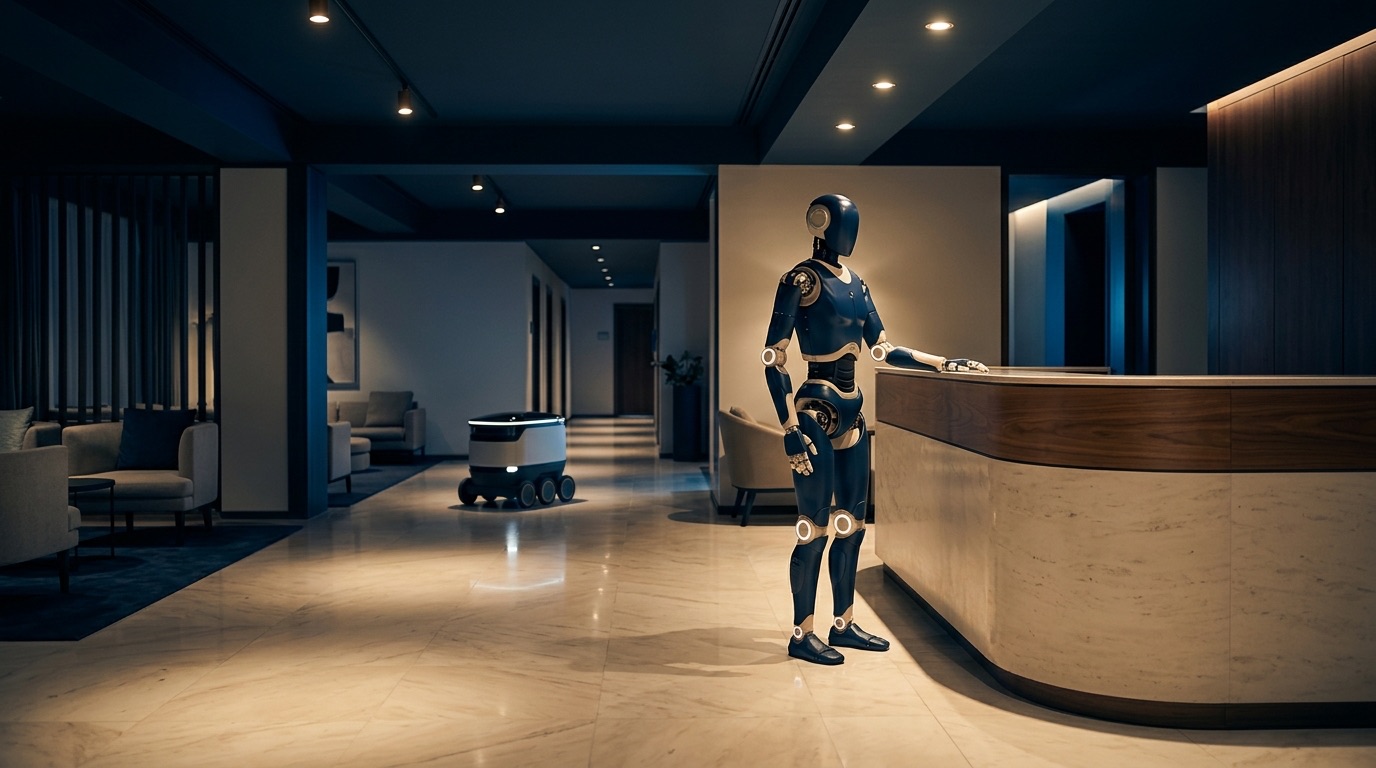
Humanoid hype, read from the outside: what a physical-AI primer adds to the PLAZA question
In August this site read the PLAZA Hotelgroup and NEURA Robotics announcement against the official vacancy statistics and against wheeled service robots. A March 2026 primer on physical AI, written for executives by an author with no stake in hotels, supplies the piece that announcement could not: what experts in the field say about the humanoid narrative when they are not selling one, and why the limiting factor in a humanoid is heat before it is intelligence.
When a hotel group and a robot manufacturer announce a humanoid pilot, the only sources are the two parties. This site read the PLAZA Hotelgroup and NEURA Robotics announcement of March 2026 that way in August: a declared practical test, no named properties, no dates, no operating figures, set against Bundesagentur vacancy data and against the wheeled transport robots that already run hotel corridors. What that reading lacked was an outside view of the humanoid category itself. Aaron Frank's A Business Leader's Introduction to Physical AI, published in March 2026 for business readers, provides one. It is not about hotels and mentions no German company. It is useful precisely because of that. Three of its observations bear directly on what an operator hosting such a pilot should expect, and this article sets them beside the announcement without merging the two.
Key Takeaways
- 1Frank writes that several experts he spoke to for the report consider the hype around physical AI louder than is currently justified, and that the narrative of machines taking over a near-limitless market for labour is loudest in humanoid robotics, where it is driving the valuations. That is his account of his interviews, not a measurement.
- 2The report's hardware chapter, drawing on an industry investor, puts the humanoid bottleneck in thermodynamics rather than AI: actuators generate heat, research demos run for minutes, and a production machine has to run for hours without overheating. The number of actuators rises with every added degree of freedom.
- 3The report also says most robots in production today remain classical machines built for narrow, repeatable tasks, and that early pilots of new machines mostly assign them narrow tasks too, which gives away much of what general-purpose intelligence is supposed to offer.
- 4None of that is a finding about NEURA's 4NE1 or the PLAZA pilot. The report does not test any machine. What it offers is the baseline against which a pilot's eventual results can be read, and a reason to ask for those results in hours of continuous operation rather than in demonstrations.
- 5werob's position is unchanged from August: wheeled, task-specific machines where the task is transport or cleaning, humanoids on evidence from live sites. The primer gives that position an outside witness; it does not add a werob claim to it.
Where the August piece had to stop
The announcement at ITB Berlin in early March 2026 was a partnership between the Heilbronn hotel group PLAZA and the Metzingen manufacturer NEURA Robotics to bring the 4NE1 humanoid into reception, guest service and housekeeping, positioned by both sides as support for staff rather than replacement. The August article on this site did what could be done with that material: it separated the announced pilot from a verified rollout, it put the partners' own labour-shortage estimate next to the Bundesagentur's registered vacancies, and it compared the payback arithmetic of a humanoid at a reception desk with that of a wheeled robot in a service corridor. It closed on a list of what an operator would need to see before drawing conclusions. As of late August none of that had been published, and this article has found nothing new since.
What that piece could not do was step outside the announcement. Everything it had on the humanoid category came either from the two partners or from this site's own experience with wheeled machines. That is a legitimate basis for scepticism but a narrow one, and a reader was entitled to ask whether the scepticism was an integrator's reflex. An outside source that is not selling a humanoid, not buying one and not competing with one is the thing that was missing.
What the primer is, and why it counts as outside
The report mentions no German manufacturer, no hotel and no hotel pilot. Its examples are Tesla's Optimus, 1X's NEO, Figure's funding round and a handful of research groups. That distance is the point. Nothing it says about humanoids was written with the PLAZA pilot in mind, so nothing it says can be read as commentary on it. It can only be read as a description of the category into which that pilot falls.
First point: the experts' own volume control
Frank does not hide his sources' scepticism, and he places it early. He writes that several of the experts he spoke to for the report indicated that the hype building around physical AI is louder than what is currently justified. A page later he describes the view that machines are on the cusp of taking over an almost limitless addressable market for labour, and observes that this narrative is especially loud in humanoid robotics, where the standard argument runs that a machine shaped like a person can step straight into buildings built for people. The expected reward for that, he notes, is what is currently fuelling the sector's valuations, and he cites Figure's billion-dollar financing round as the example.
Two features of that passage matter for an operator. It is an account of interviews, and Frank does not name the experts or count them, so it cannot be weighed as a survey. And it is a statement about the narrative, not about any machine: the claim is that the story of humanoids replacing labour runs ahead of what has been shown, not that humanoids do not work. Read with that precision, it lines up with what the August piece observed from the inside, that the announced hotel roles are a bundle of reception, service and housekeeping tasks, and that no evidence has been published of a humanoid carrying that bundle in a live property. The primer says the same about the category from outside it.
Second point: minutes versus hours, and the heat that separates them
The hardware chapter of the report is the part that a hotel operator is least likely to have heard and most likely to find useful. Frank quotes the robotics investor Jack Pearson, who says that if you ask a humanoid company what is holding it back you hear AI, data and software, and if you ask its engineers off the record you hear heat: actuators overheat and the machine folds. Pearson's phrasing, which the report sets out as a pull quote, is: ‘The dirty secret of humanoid robotics isn't intelligence. It's thermodynamics.’ Frank's gloss is short. Actuators generate friction, friction generates heat, many of today's research demonstrations run for minutes, and a production robot has to run for hours without overheating.
He then makes the arithmetic visible. As a humanoid gains range of motion, its actuator count rises: he gives Tesla's latest Optimus as 28 actuators driving 50 degrees of freedom. He notes that 1X's NEO takes a different route, moving actuators to the centre of the body and transmitting force through cables to save weight, and adds that nobody yet knows whether that architecture holds up in real environments at scale. The report treats these as design bets being fought out in internal engineering meetings, not as settled products.
For an operator this translates into one question, and it is not the one usually asked. The question is not what the machine can do in a demonstration but for how many consecutive hours it can do it under load in a warm lobby in July, and what it does when an actuator approaches its thermal limit: slows, stops, or hands over. A pilot that reports task success without reporting continuous runtime has reported the demonstration, not the shift. The August article asked for unassisted uptime as one item among six. The primer explains why that item is the one most likely to separate a humanoid from a wheeled machine, whose drivetrain does not have the same problem.
Third point: what pilots actually assign to new machines
The report's chapter on the deployment gap contains a sentence about pilots that the August piece could have used and did not have. Most robots in production today, Frank writes, are programmed for narrow, repeatable tasks and remain the classical machines of the previous paradigm; the early pilot programmes now under way at some firms mostly involve simple repeatable tasks as well, which, in his words, invalidates much of the benefit of general-purpose intelligence. He is not criticising the pilots. He is observing that an organisation absorbs a new class of machine at its narrow end, and that the narrow end is where a general-purpose machine has least to offer over a specialised one.
Applied to a hotel, and only as a question, that reads as follows. If the first tasks a humanoid takes on in a property are the repeatable ones, carrying items along a corridor, delivering to a room, moving linen, then it is doing wheeled-robot work at humanoid cost and humanoid thermal budget, and the pilot will tell the operator little about the general-purpose case it was announced for. If it takes on the unstructured tasks, the reception bundle, then it is testing the thing the primer's experts consider overhyped, and the results will be worth having precisely because they will be rare. Either outcome is informative. What an operator should not accept is a pilot report that blurs the two, counting corridor runs as evidence for the desk.
A fourth point the report makes only in passing
Two shorter observations in the primer are worth a paragraph each for anyone hosting a pilot. The first is about remote hands. The report describes teleoperation, a remote person taking over when the machine meets something it cannot handle, as likely to remain a standing part of deployed physical AI, and gives as its consumer example 1X's NEO, a home humanoid that is being sold on the basis that it will be, at least sometimes, operated by remote staff. Whether any given hotel pilot works that way is unknown and this article does not assert it. The question it raises is simple: if a remote operator can take over a machine standing in a hotel lobby, the operator sees the lobby, and the hotel should know who that is, where they sit, and what the recording rules are, before the first guest walks past.
The second is about why manufacturers pilot at all. The report argues that the real contest in robotics is the race to gather enough real-world data to train the next models, and that this creates a strong incentive to ship hardware into live environments as early as possible, because deployments generate the data that improves the model that wins the next deployment. Frank presents this as the central commercial logic of the field, not as a criticism of anyone. The August article noted NEURA's own statement that its systems are prepared for hotel tasks in its training centres with hospitality practitioners. The primer's point sits beside that: a live pilot is, for any manufacturer in this field, also a data source. A host property is entitled to ask what it receives in return, and to settle in writing what leaves the building.
What changes, and what does not
What the primer adds to the August reading is a witness. The scepticism about humanoids at a reception desk no longer rests only on an integrator's experience with wheeled machines; it now has beside it a report written by someone enthusiastic about the field, citing interviews with people inside it, saying that the narrative runs ahead of the evidence and that the binding constraint is thermal before it is cognitive. That does not make the PLAZA pilot a bad idea. A pilot is how the evidence gets made. It makes the pilot's eventual report the thing to wait for, and it says what that report needs to contain to count: continuous hours under load, not task demonstrations; the split between repeatable and unstructured tasks; who holds the remote link; and what data leaves the property.
What does not change is werob's position, and it is worth stating plainly so that the primer is not read as saying more than it does. werob is a manufacturer-independent systems integrator. For transport, delivery and cleaning tasks in hotels and care facilities it specifies wheeled, task-specific machines, because those are the ones with calculable payback and no thermal budget to manage. It will specify a humanoid when a live site, not a demonstration, shows one carrying an unstructured task for a shift. The report supports the reasoning behind that position. It says nothing about werob, measures nothing werob does, and this article does not borrow from it any claim about werob's own methods or results.
Limits: what is documented here and what is not
Everything attributed to the primer comes from the 25-page PDF of A Business Leader's Introduction to Physical AI by Aaron Frank, dated March 2026, read in September 2026, and is paraphrased except for the two-sentence Pearson pull quote and the phrase ‘louder than what is currently justified’, both reproduced as the report prints them. The expert scepticism is Frank's account of unnamed interviews and cannot be weighed as a survey. The actuator and degrees-of-freedom figures for Optimus are the report's and have not been checked against Tesla's own material. The remarks on 1X's NEO and on teleoperation are the report's descriptions of that product, not of any machine in a German hotel. The status of the PLAZA and NEURA pilot is as this site last recorded it in late August 2026: announced at ITB, no named properties, dates or operating figures published; a web search on 16 September 2026 surfaced only the March coverage and no operating results, which is not the same as there being none. Nothing on this page is a measurement of the 4NE1, of NEURA's training facilities, or of any humanoid in operation, and nothing on it describes werob's own tools or results.
FAQ
- Does Aaron Frank's report say humanoid robots are overhyped?
- It says that several experts he interviewed consider the hype around physical AI louder than is currently justified, and that the narrative of machines taking over a near-limitless labour market is loudest in humanoid robotics, where it is driving valuations. It is an account of interviews, not a survey, and it is a claim about the narrative rather than about any specific machine.
- What does the report identify as the main hardware limit of humanoids?
- Heat. Quoting the robotics investor Jack Pearson, it says the constraint engineers name off the record is thermodynamics: actuators overheat, research demonstrations run for minutes, and a production machine must run for hours. It gives Tesla's Optimus as 28 actuators for 50 degrees of freedom and notes that 1X's cable-driven design has not yet been proven at scale.
- Does the report say anything about the PLAZA Hotelgroup and NEURA Robotics pilot?
- No. It mentions no German company, no hotel and no hotel pilot. Its value here is that it describes the humanoid category from outside, without reference to this pilot, so its observations cannot be read as commentary on PLAZA or NEURA and serve only as a baseline for reading the pilot's results when they are published.
- What should a hotel ask a humanoid pilot to report?
- Continuous hours of operation under load rather than task demonstrations; the split between repeatable tasks, such as corridor deliveries, and unstructured ones, such as the reception bundle; whether a remote operator can take over the machine and from where; and what data leaves the property and what the host receives in return.
- Has werob changed its view of humanoids in hotels?
- No. werob is a manufacturer-independent integrator and specifies wheeled, task-specific robots for transport, delivery and cleaning because they have calculable payback. A humanoid will be specified when a live site shows one carrying an unstructured task across a shift. The primer supports the reasoning; it makes no claim about werob.
Related reading
Hotel Robots: What the PLAZA Humanoid Test Actually Means
Explore what the PLAZA Hotelgroup's humanoid robot deployment means for hospitality operators and how it compares to proven wheeled service robots.
27 August 2026humanoid robotsHumanoid Robots in Operational Use: Integration and ROI
Humanoid robots are leaving the labs and taking on real tasks in care and logistics. Learn how werob, as a systems integrator, integrates this technology hardware-agnostically into your operations.
8 June 2026rent humanoid robotsRenting Humanoid Robots: Strategies for B2B Deployment
Humanoid robots are leaving the labs and reaching operational practice. For companies, the question is no longer whether but how to integrate without capital risk through Robotics-as-a-Service.
8 June 2026rent humanoid robot priceRenting a Humanoid Robot - Price: Costs and ROI for Operators
Renting humanoid robots replaces high investment costs with calculable operating expenses. As a systems integrator, werob realizes the deployment of humanoids such as Apptronik Apollo or Unitree in eight weeks.
9 June 2026humanoid robots vs amr warehouse 2026Humanoids vs. AMRs: 2026 Warehouse Automation Guide
Compare humanoid robots and task-specific AMRs to find the most practical and scalable warehouse automation solutions for European operations in 2026.
24 August 2026