Renting a Humanoid Robot - Price: Costs and ROI for Operators
Renting humanoid robots replaces high investment costs with calculable operating expenses. As a systems integrator, werob realizes the deployment of humanoids such as Apptronik Apollo or Unitree in eight weeks.
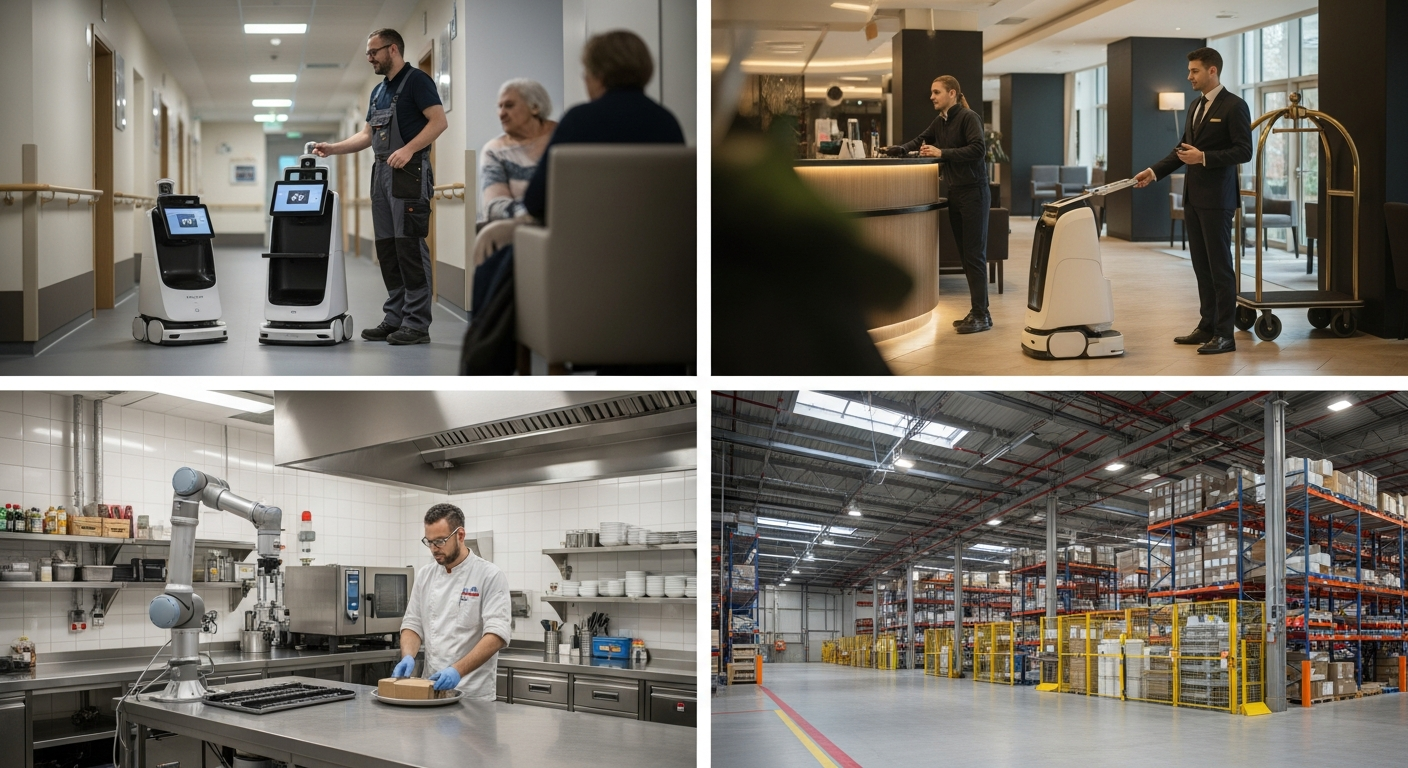
Ward 2. 22:00. The night service in the Hamburg care facility is understaffed, but the humanoid robot is already taking over the logistics of the medication round. While staff focus on residents, the machine moves autonomously through the corridors. This is no longer a pilot project, but week 12 of live operation. For operators, the question is no longer about technical feasibility, but about economic scalability through rental models. werob translates these workflows into a ready-to-deploy specification in 48 hours and brings the right robot onto the floor within eight weeks.
Key Takeaways
- 148 hours to specification and eight weeks to live operation of the robot on the floor.
- 2Verified cost relief of up to six-figure amounts per year in hotel room service.
- 3Full compliance with the EU Machinery Regulation 2023/1230 for all deployed systems.
Rent vs. Buy: Why the Outcome-only Model Dominates
The purchase price of hardware is often only a fraction of the total costs. Operators face the challenge that technology cycles for humanoid systems are extremely short. A robot bought today may be technically outdated in 24 months. This is where the werob rental model comes in. As a hardware-agnostic systems integrator, werob offers a commercial model based purely on results. You pay nothing before the robot is productively running in your operation.
This model eliminates investment risk (CapEx) and transforms it into plannable operating costs (OpEx). While classical providers often demand high one-off payments for hardware and provisioning, werob focuses on providing a functioning solution. This means that the costs for maintenance, software updates, and compliance with regulatory standards are already included in the operational rate. For a Director of Operations, this means a clear calculation basis without hidden cost traps from hardware wear or software obsolescence.
Economics: Verified Cost Relief per Location
The decision to rent a humanoid robot is primarily driven by cost relief. werob has data from over 200 robots in live operation showing that savings usually significantly exceed rental costs. In care, an automated medication round relieves the location by an average of a high five-figure amount per year. In transport logistics within facilities, the relief is at considerable sums annually.
| Industry / Use case | Cost relief per year/location |
|---|---|
| Care medication round | EUR 92,000 |
| Care transport | EUR 71,000 |
| Hotel room service | EUR 112,000 |
| Hotel bar/breakfast | EUR 54,000 |
| Logistics yard patrol | EUR 68,000 |
| Security retail patrol | EUR 58,000 |
These figures are based on real deployments, such as at a leading European operator of care facilities where double-digit cost relief was already realized in the first year. The price for the rental must therefore always be seen in relation to these savings. A system that saves six-figure amounts in room service refinances itself at a moderate utilization of two shifts per day.
The werob Spec Engine: To Calculation in 48 Hours
A main problem in determining rental prices for humanoid robots is the complexity of the task. Traditional consulting firms often need three to six months for a discovery phase. werob shortens this process through the Spec Engine to 48 hours. The Spec Engine is a model trained on over 35,000 projects that translates your verbal requirements into a technical specification.
Once the specification is in place, werob uses the Supplier Match to rank the optimal hardware from over 44 OEM partners and 280 different robot types. Whether an Apptronik Apollo, a system from Unitree, or a Boston Dynamics model is used is decided solely by its suitability for your specific workflow. This hardware-agnostic approach ensures that you are not tied to a manufacturer, but always receive the most economical and powerful hardware for your use case. The speed of 48 hours to specification and five days to binding offer sets new standards.
Integration into the Operator Stack: Connectors Instead of Island Solutions
A humanoid robot is only as valuable as its integration into your existing systems. A robot running in isolation causes manual effort in data maintenance and task distribution. werob provides pre-built connectors that integrate the robot directly into your software stack. These include interfaces to PointClickCare and MatrixCare in care, Opera PMS and Mews in the hotel industry, and SAP EWM for logistics.
Through these integrations, the robot can receive tasks directly from the system and return status reports in real time. If, for example, a transport order is generated in SAP EWM, the robot takes it over without human intervention. This reduces the error rate and significantly increases efficiency. The costs for these integrations are already included in the werob platform layer, which makes lengthy and expensive IT projects superfluous. The goal is a plug-and-play scenario that is realized within eight weeks of project start.
Regulation and Compliance: EU Machinery Regulation 2023/1230
An often underestimated cost factor when renting robots is compliance with legal regulations. From 20 January 2027, the EU Machinery Regulation 2023/1230 becomes binding. Many Asian OEMs currently do not have the necessary conformity assessments for the European market. werob acts here as a compliance path. We ensure that all deployed systems comply with European safety standards.
This includes not only the Machinery Regulation, but also specific standards such as ISO 13482 for service robots in personal contact or the BewachVO for security robots. In the werob Cockpit, the compliance status of the entire fleet is monitored via a four-dimensional traffic light system. This protects you as an operator from legal risks and liability claims. The costs for this continuous monitoring and certification are already reflected in the werob rental model, so you do not need to keep additional compliance budgets.
The werob Cockpit: Live Fleet Management for Maximum Availability
After provisioning the robots, the phase of live operation begins. Here, availability decides the actual ROI. The werob Cockpit offers a central management interface for all deployed robots, regardless of manufacturer. It monitors hardware parameters, infrastructure (such as Wi-Fi coverage and charging stations), adherence to regulation, and performance against the original specification.
If a robot experiences a malfunction, the system often detects this before operations are interrupted. Through the connection to the Cockpit, updates can be installed remotely and error analyses performed in real time. Since werob is operationally active in 11 European countries, physical on-site support is also ensured. This degree of transparency and control is essential to permanently secure the promised cost relief, such as high sums for tray bots in gastronomy.
From First Conversation to Robot in Eight Weeks
The process at werob is designed for maximum speed. After initial contact, an eight-step onboarding intake takes place. Shift schedules, task profiles, and the existing infrastructure are queried. Within 48 hours you receive a detailed specification. After five days you have an offer based on the outcome-only principle.
Delivery and commissioning takes place within eight weeks. During this time, the connectors are configured and the environment prepared for the robot. Compared to traditional approaches that often need years from the first idea to rollout, werob offers industrial scalability. With the goal of having over 2,000 robots in use by 2028, werob is the partner for companies that understand robotics not as an experiment, but as an operational tool.
Transparent Costs through Systems Integration
The question of the price for renting a humanoid robot cannot be answered with a simple list-price figure. It is always a function of the chosen OEM, the complexity of integration, and the desired economic outcome. werob offers the necessary transparency and security here. Through the hardware-agnostic approach and the outcome-only model, you minimize your risk and maximize the efficiency of your locations.
Whether in care with relief of high five-figure amounts or in the hotel industry with six-figure sums, the economic advantages are provable. With werob you choose not just a machine, but a complete operational layer covering everything from specification through compliance to live management. Start now and let us show in 48 hours how robotics can reduce your operating costs.
FAQ
- What does renting a humanoid robot at werob cost?
- werob works on an outcome-only model. There are no static list prices, as costs are based on the achieved result and the specific specification. You only pay when the system is productively running.
- Which humanoid robots are available?
- werob is hardware-agnostic and ranks over 44 OEM partners, including Apptronik, Unitree, and Boston Dynamics. In total, over 280 different robot types are available via the platform.
- How long does the implementation take?
- From the first intake to a ready-to-deploy specification takes 48 hours. The offer follows in five days, and the robot is in live operation within eight weeks.
- Are the robots compatible with my software?
- Yes, werob offers pre-built connectors for systems such as SAP EWM, PointClickCare, MatrixCare, Opera PMS, Mews, and Toast.
- Who is liable in case of accidents with the robot?
- Through the compliance path, werob ensures that all robots comply with the EU Machinery Regulation 2023/1230 and relevant ISO standards. The Cockpit continuously monitors the safety status.
- In which countries is werob active?
- werob currently operates over 200 robots in 11 European countries, including Germany, Austria, Switzerland, France, Italy, and Spain.
Related reading
Humanoid Robot Price 2026: Costs and ROI for Operators
The acquisition of humanoid robots is shifting in 2026 from a capital cost question to a purely results-oriented operating model. werob analyzes price structures and shows how operators can enter automation without upfront investments.
9 June 2026Humanoid Robot Price 2026: Costs and ROI for Operators
The price of humanoid robots in 2026 will no longer be defined by hardware list prices, but by the depth of integration and regulatory compliance. Find out how werob paves the way from specification to productive use in eight weeks.
24 June 2026rent humanoid robotsRenting Humanoid Robots: Strategies for B2B Deployment
Humanoid robots are leaving the labs and reaching operational practice. For companies, the question is no longer whether but how to integrate without capital risk through Robotics-as-a-Service.
8 June 2026humanoid robot price per month europeHumanoid Robot Price Per Month Europe: The Integrator Guide
Understanding the monthly cost of humanoid robotics in Europe requires looking beyond hardware list prices. This guide analyzes the shift toward outcome-only commercial models and the operational offsets that drive ROI.
2 July 2026humanoid robots hotelHotel Robots: What the PLAZA Humanoid Test Actually Means
Explore what the PLAZA Hotelgroup's humanoid robot deployment means for hospitality operators and how it compares to proven wheeled service robots.
27 August 2026