Hotel Robot Provider Germany: Systems Integration Instead of Hardware
The choice of the right hotel robot provider in Germany determines long-term ROI. As a systems integrator, werob offers access to over 44 OEM partners and guarantees seamless integration into existing PMS structures such as Opera or Mews.
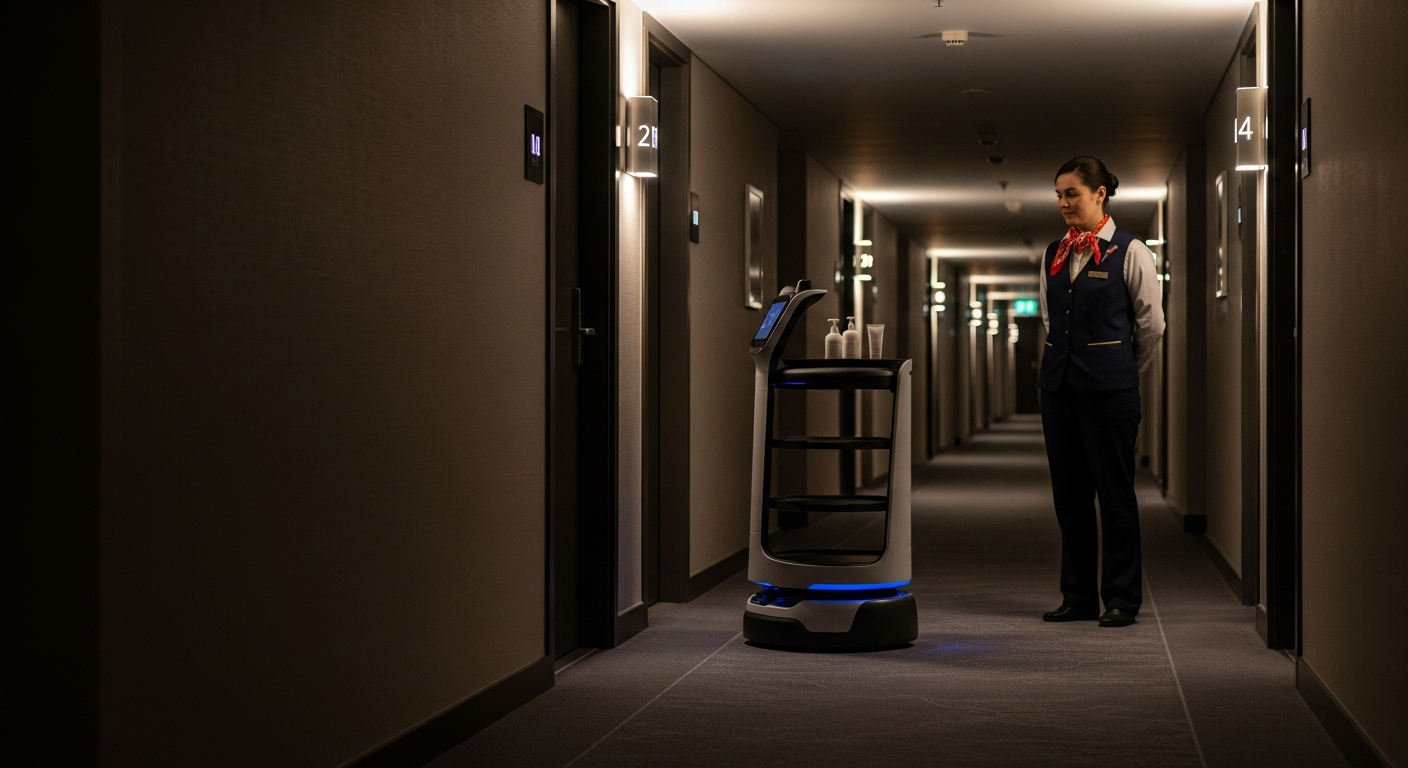
Friday evening, 23:30. The last room service order of the day comes into the system. While the staff at reception prepares the bills for the next morning, the robot in the basement is already setting off autonomously. It navigates safely through the hotel corridors, uses the elevator independently, and reaches the fourth floor without human intervention. In the German hotel industry, this is no longer a future scenario but operational reality in properties that rely on professional systems integration. The challenge for operators today is no longer simply acquiring a robot, but deep integration into the existing tech stack and compliance with strict European safety standards.
Key Takeaways
- 1Systems integration is more important than the hardware choice: only connection to Opera PMS or Mews secures ROI.
- 2Validated savings of up to EUR 112,000 per year in room service are achievable through professional robotics implementation.
- 3The EU Machinery Regulation 2023/1230 will, from January 2027, require a partner with deep regulatory know-how.
The Market for Hotel Robot Providers in Germany
Anyone looking for a hotel robot provider in Germany usually encounters a confusing landscape of hardware manufacturers (OEMs) and local resellers. The decisive difference, however, lies in the depth of the value chain. A pure hardware seller delivers a device, but leaves the hotel operator alone with process integration. werob, on the other hand, acts as a hardware-agnostic systems integrator. This means: we are not tied to a single manufacturer, but choose from a catalog of over 44 partners exactly the hardware that fits your specific floor structure and your elevator systems.
With over 200 robots in live operation in 11 European countries, werob has the necessary operational experience to avoid mistakes during implementation. In Germany, the hotel industry is particularly under pressure due to the shortage of skilled workers. Here, it is not enough to place a robot in the lobby. The machine must become part of the team. This requires precise coordination between the hardware, the existing IT infrastructure, and the legal framework of the location.
The Spec Engine: From Workflow to Specification in 48 Hours
Traditional consulting projects for the introduction of robotics often take three to six months. In the hotel industry, this timeframe is not acceptable due to the high operational pressure. werob has radically shortened this process through the so-called Spec Engine. Within just 48 hours, we translate your verbal or written requirements for a shift workflow into a ready-to-deploy robot specification. This engine has been trained on over 35,000 projects and immediately recognizes which technical parameters are crucial for your location.
Factors such as floor condition, door widths, Wi-Fi coverage, and the frequency of guest elevators are considered. The result is a technical specification document that serves as the basis for subsequent Supplier Matching. Instead of relying on the marketing materials of a single manufacturer, you receive an objective assessment of which hardware can most efficiently handle the tasks at hand. This data-driven approach minimizes the risk of misinvestments and ensures that the robot is productive from day one.
Hardware Agnosticism: 44+ OEMs in Direct Comparison
A key advantage of choosing werob as a partner is access to a broad portfolio of manufacturers. We carry robots from partners such as Keenon (e.g., T9, M2), Pudu (BellaBot, KettyBot), Bear Robotics, and many more. In total, over 280 different robot models in our system are available for ranking. This hardware agnosticism protects hotel operators from vendor lock-in. If a manufacturer changes its software strategy or discontinues support, the operational layer can be migrated through werob to a different model without having to set up the entire process from scratch.
In the Supplier Match, OEMs are ranked against your specific requirements. This is not just about price, but about technical suitability for the location. A robot for breakfast preparation in the basement has completely different requirements for sensors and load capacity than a model that operates in room service on carpeted floors. Through this ranking, we ensure that you always receive the technologically leading solution currently available on the market.
Connectivity: Integration into Opera PMS and Mews
The biggest pain point in introducing robotics in hotels is the lack of communication between the robot and the Property Management System (PMS). A robot that does not know which room a guest is checked into or whether an order has been authorized via the system remains an isolated toy. werob solves this problem through pre-built connectors. We offer direct integrations into market-leading systems such as Opera PMS and Mews.
These connectors enable bidirectional data exchange. When a guest places an order via the hotel tablet or smartphone, this information is forwarded directly to the werob Cockpit. The robot receives the task, drives to the bar or kitchen, is loaded, and sets off for the room. After successful delivery, the robot reports completion back to the PMS so that billing can take place automatically. This seamless process chain is the prerequisite for the cost relief we have validated.
Economics: Validated Cost Relief in the Hotel Industry
Investments in robotics must be measured against hard numbers. werob does not work with vague promises, but with validated data from live operations. In the hotel industry, we have identified two primary areas of application that enable significant savings. For hotel room service, the annual cost relief per location averages EUR 112,000. This sum results from the robot taking over delivery trips, freeing staff for value-adding activities with the guest.
A second key area is the preparation of bar and breakfast. Here our customers realize relief of EUR 54,000 per year. The robot takes over repetitive transport tasks between storage, kitchen, and buffet, often in the early morning or late evening hours, when staffing is particularly thin. These figures are not estimates, but are based on the operational evaluation of our fleet of over 200 robots. Through our outcome-only model, you also only pay when the robot is actually productively deployed.
Regulation: The EU Machinery Regulation 2023/1230
An often overlooked aspect when choosing a hotel robot provider in Germany is legal compliance. On 20 January 2027, the new EU Machinery Regulation 2023/1230 becomes binding. This regulation imposes significantly higher requirements on the conformity assessment of robots, especially when they operate in public areas such as hotel lobbies. Many Asian OEMs currently do not have the necessary certifications for the European market.
werob acts as your compliance path here. We ensure that all systems we deploy meet the applicable standards such as ISO 13482 for personal care robots and the upcoming requirements of the Machinery Regulation. We take responsibility for the regulatory safety of the entire fleet. This protects you as an operator from liability risks and official shutdowns. At a time when the EU AI Act is also being introduced gradually, a partner that integrates regulatory monitoring into the Live Cockpit is essential.
The Cockpit: Live Fleet Management with Traffic Light System
Once the robots are in use, the focus shifts to stable operation. The werob Cockpit is the central control unit for your entire fleet, regardless of how many different robot models you deploy at different locations. The system uses a four-dimensional traffic light system to monitor the status of each unit in real time. Hardware health, infrastructure stability (Wi-Fi, elevator control), adherence to regulatory parameters, and performance against the original specification are all checked.
If, for example, a robot stops due to a blocked path or a Wi-Fi outage, the Cockpit immediately alerts the relevant authorities or triggers automated corrective measures. This level of transparency is crucial for hotel chains that want to scale robots across multiple locations. You receive monthly reports on the actual performance delivered and the associated cost relief, which enables precise control of operational excellence.
Productive Deployment in Eight Weeks
Speed is a core promise of werob. While other providers are still in the discovery phase, we have already reached the first milestones. Our process is tuned for maximum efficiency: 48 hours to a finished specification, five days to a binding offer, and only eight weeks until the first robot is in live use. This tight schedule is only possible because we rely on standardized connectors and a well-rehearsed network of OEM partners.
The onboarding process comprises eight clear steps, from the initial capture of the shift plan to the final on-site acceptance. Since our commercial model is based on the outcome-only principle, we bear a large part of the implementation risk. You do not pay high upfront investments for hardware that ends up unused in the corner. Our goal is to operate over 2,000 robots in Europe by 2028 and thus set the standard for automated services in the hotel industry.
FAQ
- Which hotel robot providers are leading in Germany?
- While manufacturers such as Keenon or Pudu deliver the hardware, werob is the leading systems integrator in Germany. werob offers a hardware-agnostic platform that bundles 44+ OEMs and integrates them directly into hotel systems.
- How high are the costs for a hotel robot?
- werob works with an outcome-only model. This means there are no classic list prices for the hardware. Customers pay for the performance delivered and the operational relief once the system is live.
- Can robots be connected to Opera PMS or Mews?
- Yes, werob offers pre-built connectors for Opera PMS and Mews. These allow the robot to receive orders directly from the system and report the status of delivery back in real time.
- What happens in the event of technical problems with the robot?
- The entire fleet is monitored 24/7 via the werob Cockpit. A four-dimensional traffic light system immediately detects malfunctions in hardware or infrastructure and initiates appropriate support measures.
- How long does the implementation of a hotel robot take?
- At werob, it usually takes eight weeks from the initial specification to the robot being in live use. The creation of the technical specification takes place within 48 hours.
- Is the use of robots in German hotels legally safe?
- Yes, provided that the requirements of the EU Machinery Regulation 2023/1230 and ISO 13482 are met. As an integrator, werob ensures that all deployed systems meet these compliance requirements.
Related reading
Renting Hotel Robots: Increasing Efficiency through Systems Integration
Renting hotel robots offers flexibility without tying up capital. werob integrates this hardware directly into your existing systems such as Opera PMS or Mews and secures operation through an outcome-only model.
8 June 2026hotel robotsHotel Robots: Operational Efficiency and Cost Relief
Hotel robots solve the acute staff shortage in the back-of-house and increase the margin per room. As a hardware-agnostic systems integrator, werob delivers turnkey fleets with native connection to Opera PMS and Mews.
7 June 2026hotel reduce costs automationReducing Hotel Costs through Automation: Strategies for 2026
Rising labor costs and skilled labor shortages are forcing the hotel industry to increase efficiency. Learn how you can save up to EUR 112,000 per location through targeted automation in room service and preparation.
7 June 2026hotel automation labor costsHotel Automation Labor Costs: Strategies for Cost Relief
The hotel industry is facing a structural shortage of personnel. Automation is no longer a trend, but an economic necessity to reduce labor costs and ensure service quality.
7 June 2026robotics provider BerlinRobotics provider Berlin: system integration instead of hardware purchase
The search for a robotics provider in Berlin often ends with hardware manufacturers with a limited portfolio. As a system integrator, werob offers access to over 44 OEMs and integrates robots directly into existing software stacks such as SAP EWM or Opera PMS.
3 July 2026