Hotel Automation Labor Costs: Strategies for Cost Relief
The hotel industry is facing a structural shortage of personnel. Automation is no longer a trend, but an economic necessity to reduce labor costs and ensure service quality.
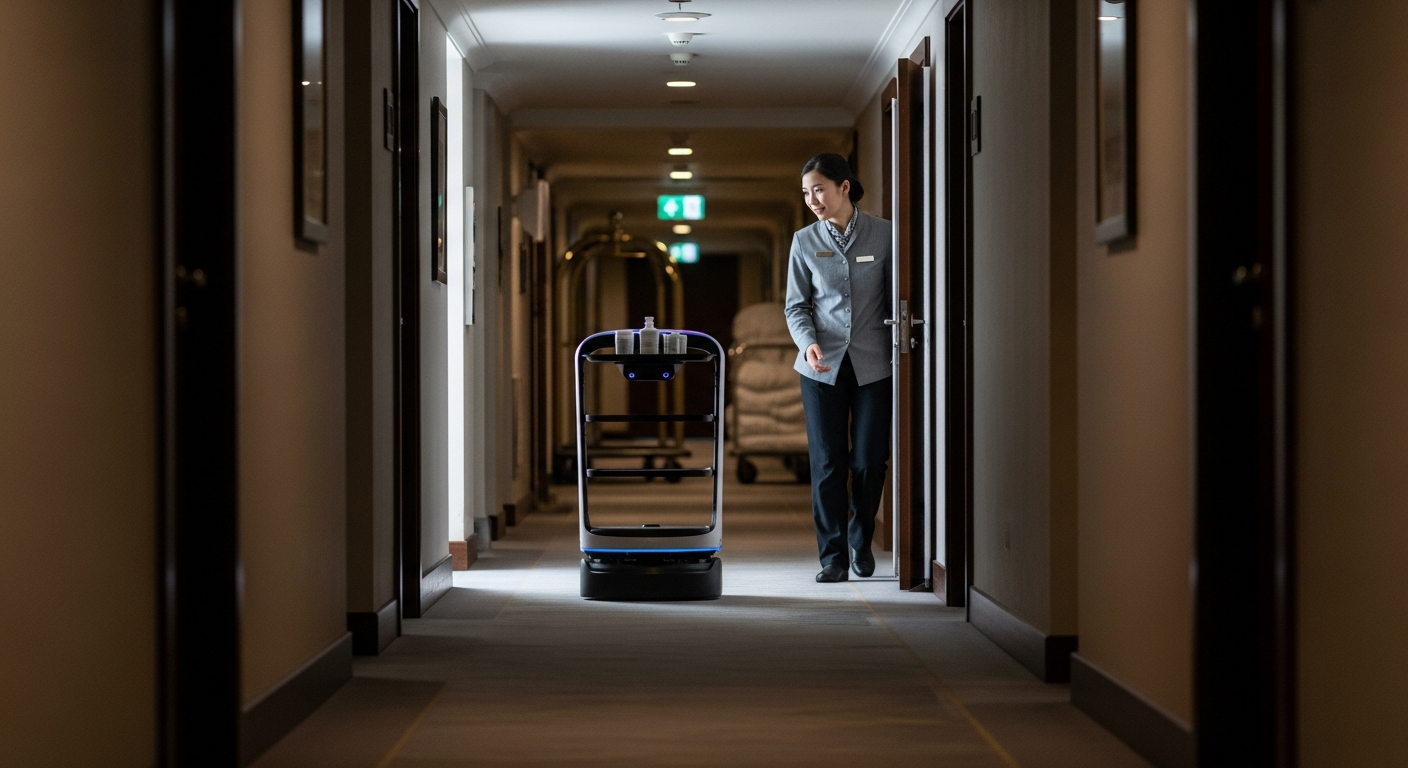
Friday evening, 23:30. The last room service order of the day comes in. Instead of tying up a skilled employee on the night shift, the robot is already on the move. It navigates autonomously through the floors, uses the elevator, and delivers the order directly in front of the guest room door. Meanwhile, the staff at reception focus on check-in and guest safety. This scene is already operational reality for werob customers. In a market with over 600,000 hotels in Europe, automation is the only way to sustainably counter rising wage costs and the shortage of skilled workers.
Key Takeaways
- 1Room service automation enables annual cost relief of EUR 112,000 per location.
- 2Pre-built connectors for Opera PMS and Mews guarantee seamless integration into the hotel stack.
- 3The EU Machinery Regulation 2023/1230 becomes mandatory for all robot installations from January 2027.
The Economic Necessity of Automation
The hotel industry in Europe is under massive pressure. Rising minimum wages and a chronic shortage of skilled workers are jeopardizing operating margins. Traditional approaches to recruiting staff are reaching their limits. This is where robot-supported automation comes in. It is not about replacing people, but about freeing them from unproductive walking distances and repetitive tasks. A room service employee often spends up to 40 percent of their working time on pure transport routes. This time is expensive and provides no direct added value for the guest.
Through the use of autonomous systems, these unproductive times can be eliminated. werob acts here as a systems integrator that bridges the gap between complex hardware and everyday hotel operations. We see automation not as an isolated gadget, but as an integral part of operational processes. Only when the robot is seamlessly integrated into the existing infrastructure does a real economic advantage emerge. The reduction of labor costs is the measurable success of this strategy.
Verified Cost Relief in Practice
Numbers don't lie. In operational practice, specific areas of application have proven to be particularly profitable. werob documents annual cost relief of EUR 112,000 per location for the hotel room service segment. This sum results from the savings on night-shift premiums, the reduction of overtime, and the increase in efficiency in floor service. The robot takes over the errands while staff are available for more complex guest requests.
Another important field is bar and breakfast preparation. Here, the verified cost relief is EUR 54,000 per year. While the robot autonomously makes preparations in the early morning hours or clears away used dishes, the team can focus on service quality for the guest. These relief effects are noticeable immediately after implementation. Since werob works on an outcome-only model, operators only pay when the systems are productively running. This minimizes investment risk and ensures rapid amortization of implementation costs.
Integration into the Hotel Stack: Opera PMS and Mews
A robot without a connection to the Property Management System (PMS) is merely an expensive toy. The decisive differentiator of werob is the provision of pre-built connectors. We integrate robotics directly into leading systems such as Opera PMS and Mews. This means that an order in the system automatically triggers an action by the robot. No manual intervention by staff is required. The robot knows which room the guest has ordered from and what permissions exist for the elevator or the floor.
This deep integration ensures that automation actually reduces labor costs instead of generating new administrative effort. The Connectors layer of werob ensures that data flows work bidirectionally. Status reports from the robot flow back into the PMS, so that management has full transparency about completed tasks at all times. Without this digital linkage, any robotics solution remains an isolated project that fails to scale. werob delivers the necessary infrastructure to efficiently control fleets.
Hardware-Agnostic Selection through Supplier Match
The market for service robots is opaque. There are hundreds of manufacturers, from established OEMs to new startups. werob is not a manufacturer and not an exclusive reseller of a single provider. We are hardware-agnostic. Our Supplier Match system ranks over 44 OEM partners and more than 280 different robot models against the specific requirements of your hotel. Whether Keenon, Pudu, or specialized transport robots, we choose the hardware that best fits your workflow technically and economically.
This approach prevents vendor lock-in. If the requirements of your property change or a new, more efficient robot comes onto the market, the werob platform allows a flexible change or expansion of the fleet. We translate your operational requirements into a technical specification. Within 48 hours, our Spec Engine delivers a ready-to-use profile. This shortens the industry-standard discovery phase from several months to a few days. The goal is clear: in eight weeks, the robot must be on the floor and saving costs.
Regulation and the EU Machinery Regulation 2023/1230
An often underestimated factor in automation is the legal framework. From 20 January 2027, the new EU Machinery Regulation 2023/1230 will be binding. This regulation imposes high requirements on conformity assessment, especially for autonomously operating systems in public spaces such as hotels. Many Asian OEMs do not have the necessary European certifications or documentation. werob acts as your compliance path here.
We ensure that all deployed systems comply with European safety standards. This includes, in addition to the Machinery Regulation, compliance with GDPR for sensor data collection and compliance with HACCP standards in the food sector. Our Cockpit monitors the fleet in real time and provides a four-dimensional traffic light system covering hardware, infrastructure, regulation, and specification. This means operators are legally protected and shielded from liability risks. Compliance is not an obstacle, but the prerequisite for permanent and safe operation in the hotel industry.
Comparison: Manual Service vs. Automated Processes
To clarify the economic superiority of automation, a direct comparison of process costs helps. In a classical structure, each room service delivery causes fixed labor costs through the binding of a skilled employee. Indirect costs arise from the interruption of other activities. An automated process, on the other hand, works with almost constant marginal costs per delivery.
| Process | Manual Effort | Automated Solution | Cost Relief (p.a.) |
|---|---|---|---|
| Room service | High (staff binding) | Fully autonomous (werob Connector) | EUR 112,000 |
| Breakfast logistics | Medium (repetitive) | Supportive (Tray-Bot) | EUR 54,000 |
| Cleaning (floors) | High (time-intensive) | Autonomous cleaning | EUR 44,000 |
| Night-shift support | Very high (premiums) | Constant (24/7 use) | Included |
The table clearly shows that the greatest levers lie in the area of transport and night work. By decoupling working time and service provision, hotels can better plan their capacities and absorb peak times without additional staff. Integration into the stack ensures that these processes mesh together without friction losses.
To Live Operation in Eight Weeks
Speed is a critical success factor in the hotel industry. While classical consulting projects often linger for months in the analysis phase, werob relies on an accelerated implementation process. After the initial capture of your workflows, it takes only 48 hours to a finished specification. Within five days, you receive a binding offer. The goal is to deploy the first robot productively on the floor within eight weeks.
This process is supported by our long-standing experience from over 35,000 projects and 200 robots already in live operation in eleven European countries. We know what pitfalls lurk in elevator control or Wi-Fi coverage and have already integrated the right solutions into our platform. The Live Cockpit allows management to monitor the performance of the fleet at any time and immediately identify optimization potential. Automation thus becomes a controllable and scalable part of hotel IT.
Conclusion: The Future of the Hotel Margin Is Automated
Reducing labor costs through hotel automation is not an option, but a survival strategy for modern hotel operations. The combination of hardware-agnostic selection, deep system integration into Opera PMS or Mews, and a clear focus on regulatory compliance makes werob the leading partner for systems integration in Europe. With verified cost relief of up to EUR 112,000 in room service, the platform offers a clear ROI without prior financial risk.
The path to an efficient fleet leads through precise specification and the selection of the right partners. werob takes over the complexity of the technology so that you can focus on what matters most: your guests. Start the process now and secure the competitiveness of your location for the coming years. The technology is ready, the interfaces are available, and the economic advantages are proven.
FAQ
- How high are the savings from hotel robots specifically?
- In the hotel industry, operations achieve werob-verified cost relief of EUR 112,000 in room service and EUR 54,000 in bar and breakfast preparation per year.
- Which PMS systems does werob support?
- werob offers direct, pre-built connectors for leading hotel systems such as Opera PMS and Mews to enable fully automatic order processing.
- What is the advantage of a systems integrator over a manufacturer?
- As a systems integrator, werob is hardware-agnostic and selects the best solution from over 44 OEMs. We also provide the necessary interfaces and regulatory protection that pure manufacturers often do not offer.
- How long does the implementation of a robot take?
- From first contact to finished specification takes 48 hours. An offer is available after five days and the robot is usually in operation within eight weeks.
- Is the use of robots legally safe?
- Yes, werob ensures compliance with all relevant standards, including the EU Machinery Regulation 2023/1230, the GDPR, and ISO 13482 for human-robot interaction.
- What does the use of the werob platform cost?
- werob works on an outcome-only model. This means that no costs are incurred for the customer before the system is productively in operation.
Related reading
Reducing Hotel Costs through Automation: Strategies for 2026
Rising labor costs and skilled labor shortages are forcing the hotel industry to increase efficiency. Learn how you can save up to EUR 112,000 per location through targeted automation in room service and preparation.
7 June 2026hotel robotsHotel Robots: Operational Efficiency and Cost Relief
Hotel robots solve the acute staff shortage in the back-of-house and increase the margin per room. As a hardware-agnostic systems integrator, werob delivers turnkey fleets with native connection to Opera PMS and Mews.
7 June 2026rent hotel robotsRenting Hotel Robots: Increasing Efficiency through Systems Integration
Renting hotel robots offers flexibility without tying up capital. werob integrates this hardware directly into your existing systems such as Opera PMS or Mews and secures operation through an outcome-only model.
8 June 2026Robots reduce labor costsReducing labor costs with robots: strategies for B2B use
Companies in the care, hotel and logistics industries are under massive cost pressure due to rising wages. As a hardware-agnostic system integrator, werob offers a way to significantly reduce these burdens through precise robotics specifications and rapid integration within eight weeks.
24 June 2026hotel coo automationHotel COO Automation: Strategies for Operational Excellence
Automation in the hotel industry is no longer an option, but an operational necessity to secure margins. Learn how COOs achieve annual savings of over 112,000 euros per location through precise specifications and seamless system integration.
24 June 2026