Renting Hotel Robots: Increasing Efficiency through Systems Integration
Renting hotel robots offers flexibility without tying up capital. werob integrates this hardware directly into your existing systems such as Opera PMS or Mews and secures operation through an outcome-only model.
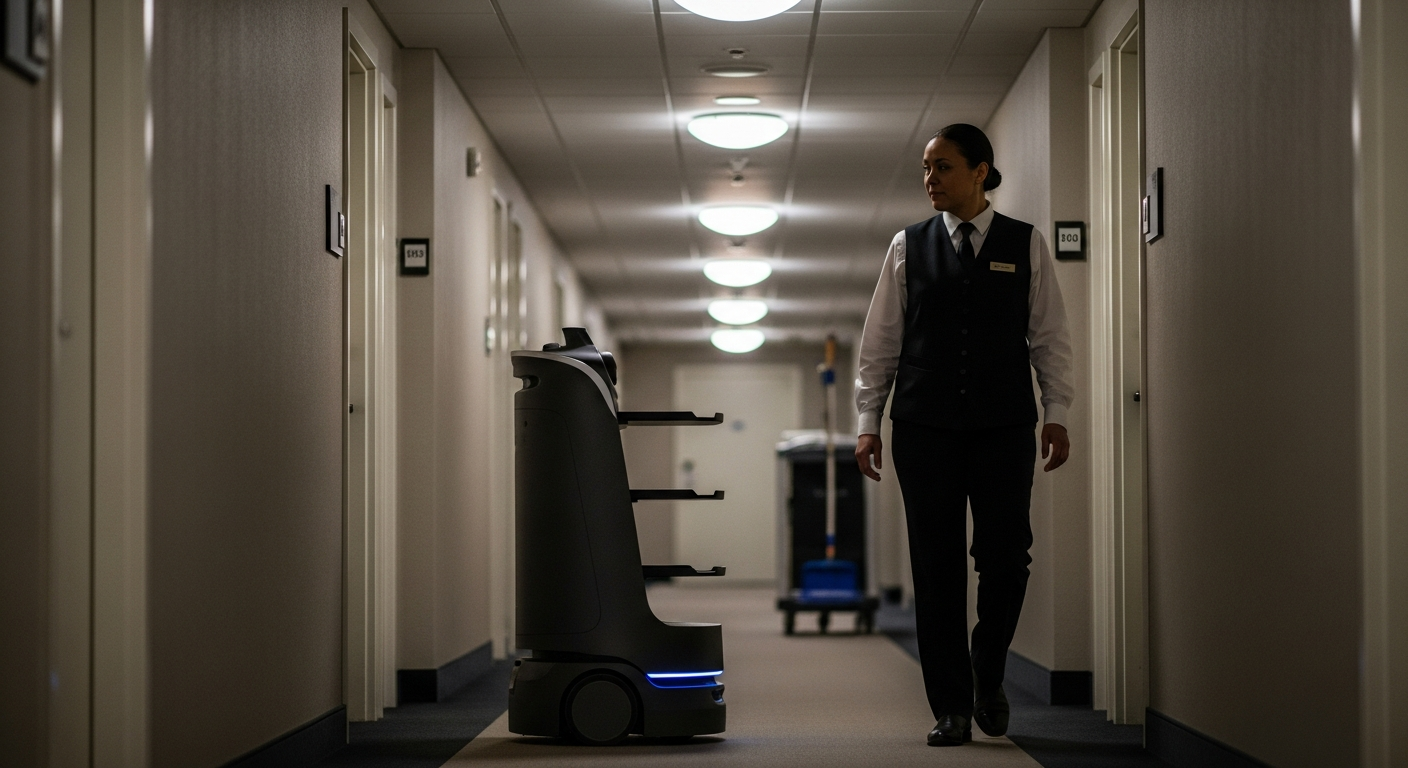
Sunday, 6:00 AM. Breakfast preparation in the basement has been running for two hours. While the team in the kitchen stocks the buffets, an autonomous system already transports the first heavy trays into the guest room. This scene is everyday life in properties supported by werob. The decision to rent hotel robots is for many operators the first step to operationally address the shortage of skilled workers. It is not about the robot as a stand-alone device, but about seamless integration into the digital workflow of the property. werob translates these workflows into a ready-to-deploy specification in 48 hours and ensures that the technology delivers measurable added value from the very first minute.
Key Takeaways
- 1Annual cost relief of EUR 112,000 in room service and EUR 54,000 in bar preparation is achievable through robotics.
- 2Integration into PMS systems such as Opera and Mews via werob connectors is the prerequisite for real operational efficiency.
- 3The EU Machinery Regulation 2023/1230 becomes mandatory from January 2027 and requires an experienced integration partner.
Rent vs. Buy: The Commercial Model of the Future
The acquisition of robotics hardware represents a hurdle for many hotel operations, as technological development is advancing rapidly. Anyone buying a robot today is tying up capital in hardware that could be outdated in three years. The rental model from werob solves this problem through a hardware-agnostic approach. You do not simply rent a device, but secure a functioning solution for a specific workflow. The special feature of the werob model is the outcome-only approach. You only pay when the robot is actually running in your operation and takes over the specified tasks.
This model shifts the risk from the hotel operator to the systems integrator. While classical providers often demand high one-off payments or rigid leasing contracts, werob focuses on operational availability. In the hotel industry, where seasonal fluctuations and short-term occupancy changes dominate everyday life, rental offers the necessary flexibility. If a workflow changes, the werob Spec Engine allows a quick adjustment of the requirements without the entire investment becoming obsolete. This is particularly relevant for hotel chains that have different requirements at different locations.
Economics: EUR 112,000 in Annual Cost Relief
The economic viability of hotel robots can be precisely quantified. In the hotel industry, significant cost shares are attributable to repetitive transport tasks. A verified use case shows that the deployment of robots in room service can result in annual cost relief of EUR 112,000 per location. This sum results from taking over delivery trips that previously distracted highly qualified personnel from core tasks. In the area of bar and breakfast preparation, the relief averages EUR 54,000 per year.
| Area of application | Cost relief per year/location |
|---|---|
| Hotel room service | EUR 112,000 |
| Bar / breakfast preparation | EUR 54,000 |
| Kitchen floor cleaning | EUR 44,000 |
| Tray transport (dishwashing) | EUR 76,000 |
These figures make clear that renting a robot is not an additional burden but an immediate relief for the operational budget. Through integration into the existing stack, these effects are maximized. A robot that does not know when an order comes in through the PMS (Property Management System) remains an isolated tool. Only the connection through werob connectors turns the hardware into a productive unit that autonomously reacts to events and thus realizes the stated savings.
The werob Platform: To Live Operation in Eight Weeks
The path from initial idea to robot on the floor takes only eight weeks at werob. This accelerated process is enabled by the four layers of the werob platform. First, the Spec Engine uses data from over 35,000 projects to translate your requirements into a technical specification. This happens within 48 hours. In the second step, the Supplier Match, over 44 OEM partners and more than 280 different robot models are evaluated against this specification. You do not receive a standard device, but the hardware that is optimal for your floor plan and your tasks.
The third layer consists of the Connectors. Here werob differs massively from pure hardware resellers. werob provides pre-built integrations for systems such as Opera PMS, Mews, Toast, or SAP EWM. This eliminates months-long IT projects. The robot communicates directly with your hotel software. The fourth layer is the Cockpit. Here you monitor your fleet live. A four-dimensional traffic light system informs you at all times about the status of the hardware, the infrastructure, the regulation, and the adherence to specification. This holistic approach ensures that the rented robots work reliably in the long term.
Integration into Opera PMS and Mews
A decisive factor when renting hotel robots is technical integration into the Property Management System (PMS). Without this connection, staff would have to enter every order manually on the robot, which would negate the efficiency advantage. werob offers direct connectors for market-leading systems such as Opera PMS and Mews. As soon as a guest orders a room service task via the system, the robot automatically receives the destination information and the content of the order via the werob connector.
This deep integration also makes it possible to send status updates back to the system in real time. When the robot has completed the delivery, the order is automatically marked as completed in the PMS. This significantly reduces the administrative effort for staff at the reception and in the kitchen. In addition, data on delivery times and utilization can be used directly for management reporting. werob acts here as the operating layer that closes the gap between physical hardware and digital management. This is an essential part of the promise to deliver a finished offer within five days that already takes all integration aspects into account.
Regulatory Certainty and EU Machinery Regulation 2023/1230
When operating robots in publicly accessible areas such as hotels, compliance with legal standards is mandatory. A critical date for all operators is 20 January 2027. From this date, the new EU Machinery Regulation 2023/1230 becomes binding. Many robot manufacturers, especially from outside Europe, do not yet fully meet these strict requirements. werob offers the necessary compliance path here. As a systems integrator, werob ensures that all deployed systems comply with European safety standards.
This includes not only physical safety according to ISO 13482 for service robots, but also aspects of cybersecurity according to IEC 62443 and data protection in accordance with GDPR. Since robots are equipped with cameras and sensors to navigate dynamic hotel environments, legally compliant data management is essential. The werob Cockpit continuously monitors these compliance parameters. When you rent hotel robots via werob, you buy yourself the certainty that your operation will remain legally compliant after 2027. This protects management from liability risks and ensures smooth operation in line with care supervision or other regulatory bodies.
Hardware Agnosticism: The Best Robots for Your Hotel
werob is not a manufacturer and is therefore not tied to a specific brand. The catalog contains over 44 OEM partners, including well-known manufacturers such as Keenon, Pudu, Bear Robotics, or specialized providers for humanoid systems such as Apptronik or Unitree. This hardware agnosticism is a decisive advantage for you as a renter. Depending on the architecture of your hotel, the condition of the floor coverings, and the width of the corridors, a model from Keenon may be better suited than one from Pudu. werob objectively ranks these options against your individual specification.
If a manufacturer discontinues production or brings a technically superior model to market, the werob approach allows easy switching within the platform. The software layer remains identical, only the hardware is replaced. This prevents vendor lock-in, where you would be tied to the software of a single manufacturer. In practice, this means that today you can rent a T9 for room service and in the future easily switch to a new generation or another manufacturer without having to adjust your IT integrations in Opera or Mews. werob remains your single point of contact for the entire fleet.
Operational Excellence through the Live Cockpit
The success of a robotics installation is decided in daily operation. A rented robot that stands still due to a blocked Wi-Fi connection or a soiled sensor causes costs without benefit. The werob Cockpit is the central tool for fleet management. It provides real-time monitoring of all active units in the 11 European countries where werob is operationally active. The system often detects problems before they disrupt the hotel routine.
The four-dimensional traffic light system in the Cockpit covers all critical areas. The hardware light monitors the battery status and mechanical components. The infrastructure light checks the connectivity in the building. The regulatory light ensures that all safety certificates are up to date. The Spec light compares the actual performance of the robot with the targets defined in the 48-hour workflow. This transparency is the basis for the outcome-only model. Only when all lights are green does the system deliver full performance. For the Director of Operations, this means maximum control over the automated workforce, without having to be a technical expert.
Conclusion: Automation as a Strategic Competitive Advantage
Renting hotel robots via a systems integrator such as werob is the most efficient path to automation. Through the combination of rapid specification, hardware-agnostic selection, and deep systems integration, operational hurdles are minimized. The measurable relief of up to EUR 112,000 per year shows that the technology already amortizes today. With the goal of having over 2,000 robots in use by 2028, werob is driving standardization in the European hotel industry.
For hotel operators, now is the right time to set the course. The regulatory requirements of the coming years and the increasing pressure on the labor market make automation unavoidable. With werob, you choose a partner that not only delivers hardware, but provides a complete operating layer. The process is clearly defined: 48 hours to the spec, five days to the offer, and eight weeks to the first deployment. Start this process today to sustainably reduce your operating costs and increase the service quality for your guests.
FAQ
- What does it cost to rent a hotel robot from werob?
- werob works on an outcome-only model. This means that you do not pay list prices for the hardware, but a fee tied to successful operation and fulfillment of the specification. You will receive an offer within five days after the specification is created.
- How long does it take to install a robot in the hotel?
- From the initial specification to live operation usually takes eight weeks. The technical specification is available after 48 hours, the concrete offer after five days.
- Which hotel systems can be connected?
- werob offers pre-built connectors for market-leading systems such as Opera PMS, Mews, Toast, and Lightspeed. Integrations into SAP EWM for logistics are also available.
- Do I have to take care of the maintenance of the robots?
- No. Within the framework of the rental model and monitoring by the werob Cockpit, the technical condition is continuously checked. Maintenance and support are part of systems integration.
- Are the robots safe for use among guests?
- Yes, all robots deployed by werob comply with applicable safety standards such as ISO 13482. In addition, werob is preparing operations for the upcoming EU Machinery Regulation 2023/1230.
- Can I combine different robot models?
- Yes, werob is hardware-agnostic and manages over 280 different robot types from 44+ manufacturers. These can be centrally controlled and monitored via the werob Cockpit.
Related reading
Hotel Robot Provider Germany: Systems Integration Instead of Hardware
The choice of the right hotel robot provider in Germany determines long-term ROI. As a systems integrator, werob offers access to over 44 OEM partners and guarantees seamless integration into existing PMS structures such as Opera or Mews.
7 June 2026hotel robotsHotel Robots: Operational Efficiency and Cost Relief
Hotel robots solve the acute staff shortage in the back-of-house and increase the margin per room. As a hardware-agnostic systems integrator, werob delivers turnkey fleets with native connection to Opera PMS and Mews.
7 June 2026hotel reduce costs automationReducing Hotel Costs through Automation: Strategies for 2026
Rising labor costs and skilled labor shortages are forcing the hotel industry to increase efficiency. Learn how you can save up to EUR 112,000 per location through targeted automation in room service and preparation.
7 June 2026robot integration pms hotelRobot Integration PMS Hotel: Efficiency through automation
The manual coordination of room service and cleaning ties up valuable human resources in the hotel industry. werob integrates robots directly into your property management system for automated processes without media breaks.
29 June 2026concierge robotConcierge Robot: Operational Efficiency and Cost Relief
Concierge robots are no longer a gimmick in modern hospitality but an answer to the skills shortage. Through seamless integration into PMS systems such as Opera and Mews, autonomous systems take over room service and sustainably relieve your team.
4 June 2026