The Gemini Robotics ER 2 model card prohibits safety-critical use
While the coverage celebrates robots collaborating, the model card for the same model tells you not to deploy it where a malfunction could injure someone. Both statements are true, and the gap between them is where operators live.
The most consequential sentence in the Gemini Robotics ER 2 release is not in the announcement. It is in the model card, and it says the model must not be used for safety-critical applications, naming healthcare and transport and any setting where a malfunction could foreseeably lead to death, personal injury or property damage. That sentence sits alongside genuine improvements in detecting nearby people. Both are true at once, and understanding why is the difference between a pilot that survives a works council and one that does not.
Key Takeaways
- 1The model card, not the API documentation, carries the prohibition. It rules out production use for safety-critical work and names healthcare and transport explicitly.
- 2Better human proximity detection is a capability improvement, not functional safety in the legal sense. Those are different categories of claim.
- 3Safety functions live in certified deterministic systems: person detection at PL d per ISO 13849 under EN ISO 3691-4, the harmonised standard since May 2024.
- 4From 20 January 2027 the Machinery Regulation (EU) 2023/1230 applies. Whoever substantially modifies a machine takes on the obligations of its manufacturer.
What the model card actually says
Under acceptable use, the model card asks users to exercise discretion before using the robotics models in production, commercial or public environments, and not to use them for safety-critical applications or work. It names healthcare and transport and, more broadly, settings where safety protocols matter and a malfunction could reasonably foreseeably lead to death, personal injury or property damage.
The API documentation is written in a milder register. It warns that generative models can make mistakes, that physical robots can cause damage, that hallucinations are possible and that responsibility sits with the user. It does not state a prohibition.
Keep those two apart when you quote them, because vendors and consultants frequently blur them. The model card carries the prohibition. The API documentation carries the warning. An operator citing the milder wording to justify a corridor pilot is quoting the wrong document.
Improved person detection is not functional safety
Google reports that ER 2 outperforms its predecessor on Safety Instruction Following and Human Proximity benchmarks, and that it halts a humanoid when a person is nearby, resuming only once the area is clear. That is a real improvement and it is worth having.
It is not a safety function. The distinction is not pedantic, it is the entire basis of machinery law. A safety function has to behave the same way every time, has to fail in a defined direction, and has to be demonstrable to a third party. A probabilistic model that is right more often than its predecessor satisfies none of those requirements, and the number that would matter, the residual failure rate under adversarial conditions, is not the number that gets published.
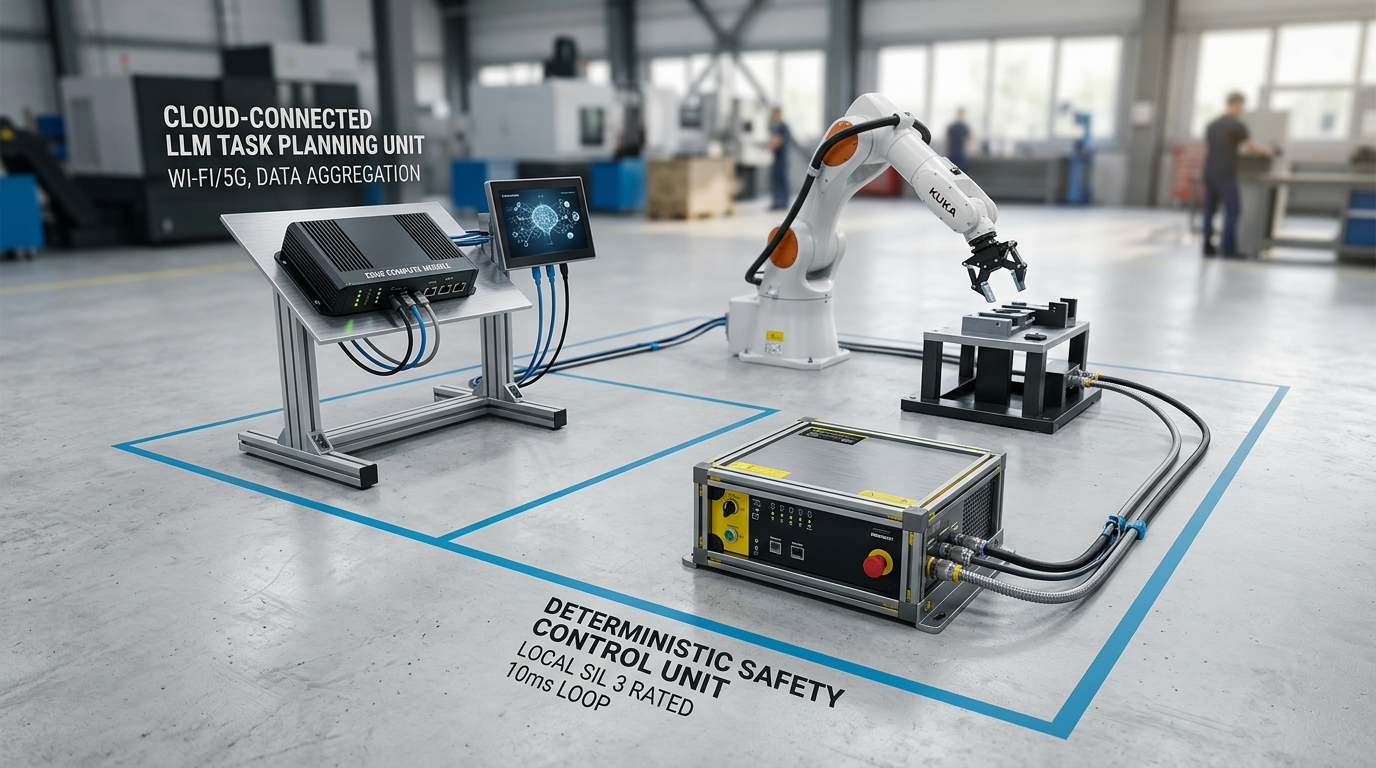
In practice this means the model may propose that a machine stops. It may not be the thing that stops it. The stopping is done by a certified protective device that would have stopped the machine anyway.
Where the safety requirement actually sits
For driverless industrial trucks and transport robots, EN ISO 3691-4 has been the harmonised type C standard since May 2024, and it requires person detection at performance level d per ISO 13849. That is the requirement a machine has to meet on a corridor where people walk.
A frequent market error is to cite ISO 13482 instead. ISO 13482 covers robots in physical contact with people, which is a different category. Vendors quote it regularly for transport machines, and it is worth checking which standard a supplier claims, because the answer tells you how carefully they have read their own documentation.
ISO 10218, revised in 2025, governs industrial robots and is a third category again. None of these standards has anything to say about a cloud planner, which is precisely why the planner cannot be part of the safety case.
January 2027 and the substantial modification trap
The Machinery Regulation (EU) 2023/1230 applies from 20 January 2027 and replaces Directive 2006/42/EC. Machines placed on the market before that date keep their existing status. The provision that matters for anyone connecting an AI planner to existing hardware is the treatment of substantial modification.
A modification counts as substantial when a machine is changed physically or digitally after being placed on the market, in a way the manufacturer did not foresee, and when that change creates a new hazard or increases an existing risk such that new protective measures become necessary. Whoever performs a substantial modification is legally treated as the manufacturer and takes on the corresponding obligations, including conformity assessment and CE marking for the affected aspects.
Connecting an external planner that changes what a machine does, where it goes or under what conditions it operates is exactly the kind of change that invites this question. It does not automatically trigger it. But it is a question that has to be answered deliberately, in writing, before a pilot rather than after an incident.
How to structure responsibility before you pilot
None of this argues against piloting. It argues for piloting with the boundaries drawn explicitly, because the parties involved have genuinely different exposures.
- Model provider. Supplies a planner and, through the model card, explicitly declines responsibility for safety-critical use.
- Robot manufacturer. Holds the CE conformity for the machine as delivered, including its protective devices.
- Integrator. Connects planner, fleet layer and building systems, and has to make sure the connection does not alter the safety case.
- Operator. Runs the machine, carries the workplace safety obligation, and is the party a works council will ask.
In German-speaking operations the works council question arrives early, and it is usually about video. A planner that reasons over live camera feeds is processing images of employees at work, which raises codetermination under section 87 paragraph 1 number 6 of the Works Constitution Act on technical monitoring equipment. Bringing that up yourself, before it is discovered, tends to go considerably better than the alternative.
werob works as an independent systems integrator across Germany, Austria and Switzerland, which includes being direct about what a technology cannot yet carry. Our piece on mixed fleet orchestration covers the architectural side of the same release.
FAQ
- Does the model card really prohibit safety-critical use?
- Yes. Under acceptable use it asks users not to deploy the robotics models for safety-critical applications or work, naming healthcare and transport and any setting where a malfunction could foreseeably cause death, personal injury or property damage. The separate API documentation is milder and only warns that models make mistakes and robots can cause damage.
- Can I still run a pilot with Gemini Robotics ER 2?
- Yes, provided the model has no authority over machine motion. Use it as an asynchronous planner above a deterministic safety layer, where certified protective devices retain the ability to stop the machine regardless of what the model proposes. What you cannot do is treat improved person detection as a substitute for a certified safety function.
- Which safety standard applies to transport robots in Germany?
- EN ISO 3691-4, harmonised since May 2024, is the type C standard for driverless industrial trucks and transport robots, requiring person detection at performance level d per ISO 13849. ISO 13482 is frequently cited by mistake; it covers robots in physical contact with people and is a different category.
- What changes on 20 January 2027?
- The Machinery Regulation (EU) 2023/1230 applies and replaces Directive 2006/42/EC, with existing machines keeping their prior status. The provision to watch is substantial modification: a party that changes a machine in a way that creates a new hazard or increases risk takes on the obligations of the manufacturer, including conformity assessment for the affected aspects.
Related reading
Gemini Robotics ER 2: what multi-robot orchestration really means for a mixed fleet
Google demonstrated a humanoid and a wheeled robot dividing a task between them. For an operator already running two vendors in one building, the interesting part is not the demo but the architecture behind it.
30 July 2026counter drone systems for critical infrastructure and eventsCounter-drone systems for critical infrastructure and events
Evaluate C-UAS hardware, navigate complex airspace regulations, and integrate counter-drone systems to secure critical infrastructure and large events.
6 August 2026iso 13482ISO 13482: Safety Standards for Service Robots in Practice
ISO 13482 is far more than a technical guideline. It is the regulatory foundation for the use of service robots in human environments such as care homes and hotels.
1 June 2026drone as a service the operating model thatDrone-as-a-Service: the operating model that turns drone pilots into routine programs
Discover how Drone-as-a-Service converts manual pilots into routine programs. Scale your operations legally under EU regulation 2019/947 with wedrone.
7 July 20264 dim traffic light robot use case4-dim traffic light system for robots: operational safety in live operation
A robot that stands up costs money. A robot that drives unsafely endangers operations. The 4-dimensional traffic light system in the werob cockpit offers the necessary transparency for scaled use.
21 June 2026