Buy care robots: Price and ROI for operators
Acquiring robotics in care often fails due to intransparent cost structures and lack of integration. This guide shows how werob realizes actual cost relief of up to 92,000 euros per year through outcome-based models and systems integration.
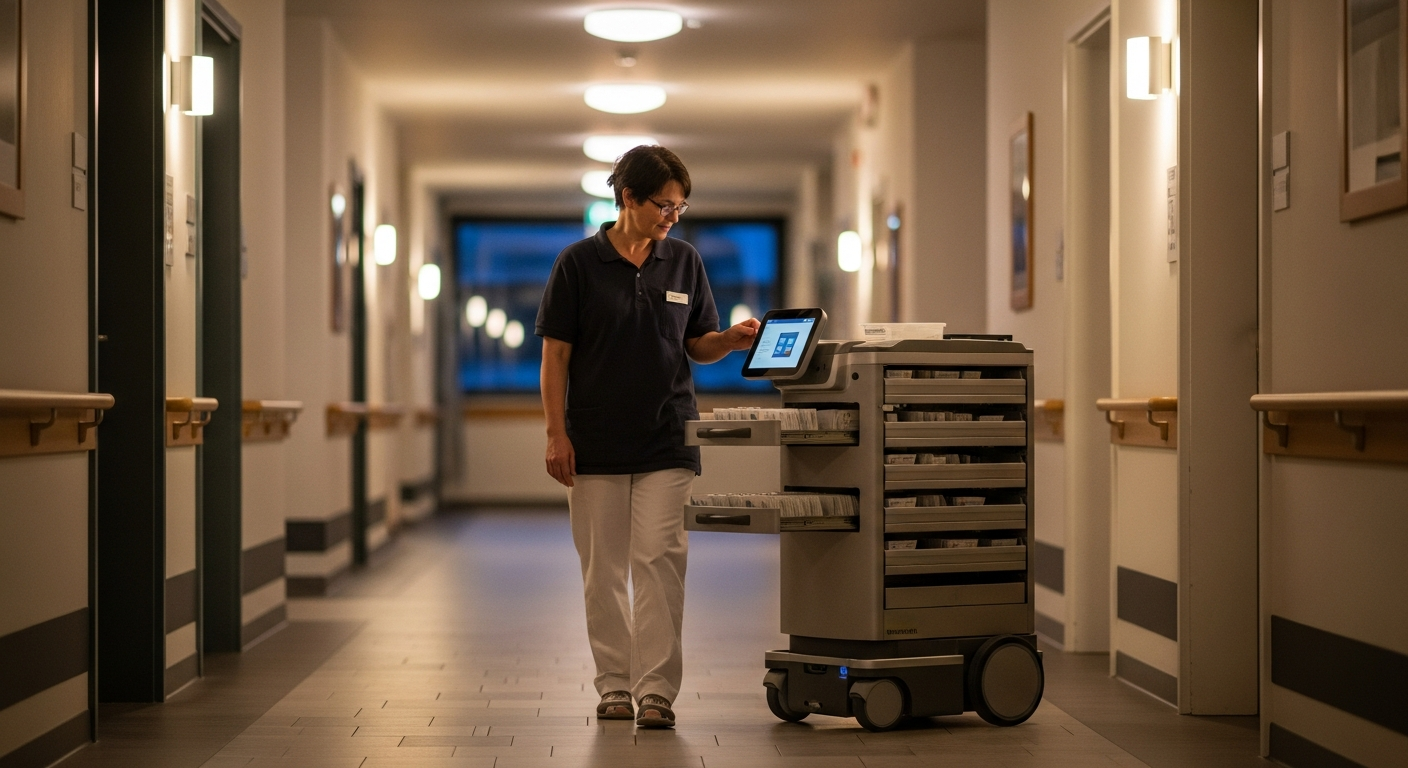
Station 4. 10:00 PM. The night shift at a Hamburg care facility has just begun. While a caregiver finishes documentation, the robot is already handling the first transport round of the night. At this moment, it's not about the hardware costs of the device, but about the 71,000 euros in annual cost relief that this automated process step generates for the location. In an industry suffering from massive staff shortages and rising operating costs, the focus shifts from the pure purchase price to measurable operational performance. werob acts as a systems integrator that translates the workflow into a technical specification and selects the appropriate hardware from over 44 OEM partners to stabilize operations economically.
Key Takeaways
- 1Cost relief in care reaches up to 92,000 euros annually for medication rounds and 71,000 euros for transport tasks.
- 2werob offers an outcome-only model where operators don't pay list prices but are charged only when the robot is successfully operating.
- 3The EU Machinery Regulation 2023/1230 becomes mandatory as of January 2027 and requires a professional compliance path through systems integrators.
Cost structure beyond the list price
Anyone who wants to buy a care robot often encounters list prices for hardware that represent only a fraction of total costs. Simply purchasing a robot from manufacturers like Keenon or Pudu doesn't solve an operational problem. The real cost factors lie in integration with the existing software stack, compliance with regulatory requirements, and continuous fleet management. werob breaks this model by acting as a hardware-agnostic systems integrator. Instead of being locked into a single manufacturer, operators gain access to a ranking of over 44 OEM partners that are precisely tested against individual specifications.
A key aspect of price consideration is avoiding vendor lock-in. If a care facility today invests in a proprietary solution that doesn't communicate with systems like PointClickCare or MatrixCare, high follow-up costs for manual interfaces emerge long-term. werob provides pre-built connectors that integrate the robot directly into the operator's digital infrastructure. The goal is not to own a machine, but to deliver an automated service. Therefore, werob forgoes classic list prices and relies on an outcome-only model: you pay only when the robot is productively in operation.
ROI calculation in residential care
The profitability of robotics in care can be precisely quantified. Based on live data from over 200 robots in operation, specialized use cases show the highest returns. In medication rounds verified cost relief reaches 92,000 euros per location annually. This sum results from the reduction of walking distances and relief of specialized staff from logistical support tasks, allowing more time for actual resident care. For pure transport of laundry, meals, or waste, relief amounts to 71,000 euros annually.
A concrete example is Korian Germany. Here, double-digit cost relief was achieved already in the first year. Such results are only possible when robotics are viewed not as an isolated gadget but as an integral part of shift planning. For larger care groups with multiple locations, this effect scales massively. A group with four locations and five robots each can achieve annual relief of around 1.8 million euros. These figures show that discussing the purchase price of a single unit is too narrow in scope. What matters is amortization across the entire operational workflow.
The role of systems integration for price stability
The complexity of robotics often leads to unforeseen cost explosions in self-implementations. werob minimizes this risk through a four-level platform architecture. First, the Spec Engine translates the operator's workflow into a deployable specification within 48 hours. This process is trained on over 35,000 projects and prevents misplanning in hardware selection. In the second step, Supplier Match, 280 different robot models are ranked against this specification. This ensures that the most cost-effective and capable device for the specific location is always chosen.
The third pillar is the Connectors. Direct integration into systems like PointClickCare or MatrixCare means no expensive custom programming is necessary. Finally, the Cockpit enables live fleet management with a four-dimensional traffic light system monitoring hardware, infrastructure, regulatory compliance, and specification. Through this standardization, operating costs drop dramatically. While traditional consulting firms often require three to six months for the discovery phase, werob delivers an offer within five days and brings the robot into live operation within eight weeks.
Regulatory hurdles and EU Machinery Regulation 2023/1230
An often overlooked cost factor when buying care robots is compliance. As of January 20, 2027, EU Machinery Regulation 2023/1230 becomes mandatory. Many Asian OEMs currently lack the necessary conformity assessments for the European market. Those who buy hardware today without a clear compliance path risk having devices shut down in less than two years. werob provides this compliance path as a built-in standard and ensures all deployed robots meet European safety standards.
Additionally, standards like ISO 13482 for personal care robots and nursing home supervisory authority requirements must be met. Particularly in Germany, barriers are high due to state-specific regulations. werob assumes regulatory responsibility and integrates it into Cockpit management. This protects operators from legal risks and unforeseen retrofit costs. The certainty that a fleet can be legally operated after 2027 is an essential part of werob's value creation and distinguishes the company from pure hardware resellers.
Comparison: Self-purchase vs. werob systems integration
In direct comparison between purchasing from an individual OEM and integration via werob, clear differences in risk and speed emerge. Individual purchase commits capital to hardware that can quickly become obsolete and often leaves integration costs unaccounted for. werob, by contrast, offers a model aligned with operational success.
| Criterion | Individual OEM Purchase | werob Systems Integration |
|---|---|---|
| Hardware Selection | Fixed to one manufacturer | Agnostic (44+ OEMs ranked) |
| Implementation Time | Often 6+ months | 8 weeks to live operation |
| Software Connection | Manual interfaces | Pre-built connectors (PCC, SAP) |
| Regulatory Compliance | Operator's responsibility | EU 2023/1230 compliance included |
| Payment Model | List price / prepayment | Outcome-only (payment at operation) |
This comparison shows that werob reduces complexity for the operator. While the risk of technical incompatibility lies with the customer in self-purchase, werob assumes responsibility for the functioning of the entire system in live operation.
Productive operation in eight weeks
The path to automated care facilities is strictly timed at werob. Everything begins with a 48-hour workflow translating the operator's requirements into a technical specification. Within five days, you receive a concrete offer based on Supplier Match. Robot delivery and commissioning then occur within eight weeks. This speed is unique in the industry and is enabled by the platform's high standardization.
An example of this efficiency is the deployment of the first humanoid in a Hamburg care facility, which was already in its twelfth week of operation in May 2026. Such pilot projects demonstrate that the technology is ready for mass market, provided integration is professionally managed. Operators no longer need to deal with technical details like ROS-2 or sensor calibration. They define the task, werob delivers the solution. This process-oriented approach minimizes downtime and maximizes the time the robot actually contributes to cost relief.
Future security through the live Cockpit
After commissioning, the systems integrator's task doesn't end. The werob Cockpit monitors the fleet in real time. The four-dimensional traffic light system immediately provides feedback if hardware problems occur, infrastructure (like WiFi or elevator controls) is disrupted, or regulatory requirements are no longer met. This proactive monitoring is crucial to sustainably secure the promised annual cost relief of 92,000 euros.
Additionally, the Cockpit enables continuous optimization of robot specification. When operations in the care facility change, the Spec Engine can adapt the robot's action graph without requiring new hardware purchases. This flexibility is a core advantage over rigid systems. werob ensures the fleet grows with the operator's requirements. By 2028, werob plans to expand the fleet to 2,000 robots across Europe, further strengthening the data foundation for optimizations and negotiating power with OEMs.
Conclusion for care decision-makers
The decision for robotics in care should not be based on a hardware catalog. The true value lies in seamless integration into daily work and measurable staff relief. With verified savings of up to 92,000 euros annually in medication rounds, werob offers an economically attractive solution to a pressing industry problem. The outcome-only model eliminates financial risk for operators and guarantees fast implementation within eight weeks.
Given the upcoming EU Machinery Regulation 2023/1230, now is the right time to invest in a future-proof integration platform. werob provides not just the technology, but the entire compliance path and connection to leading care systems. Those who invest in the right infrastructure today secure their locations' competitiveness for decades to come. Start your specification in 48 hours and let the data speak for itself.
FAQ
- What does a care robot cost at werob?
- werob works with an outcome-only model. There are no classic hardware list prices. You pay only when the robot is productively operating in your facility and delivers the specified cost relief.
- Which software systems can werob integrate?
- werob has pre-built connectors for leading systems such as PointClickCare, MatrixCare, SAP EWM, and various hotel PMS systems like Opera or Mews.
- How long does it take from inquiry to deployment?
- Within 48 hours, werob creates the specification, you receive an offer within five days, and the robot is ready for operation at your facility within eight weeks.
- Is werob a robot manufacturer?
- No, werob is a hardware-agnostic systems integrator. We rank over 44 OEM partners to find the best hardware for your specific workflow.
- What happens if there are technical problems during operation?
- The werob Cockpit monitors the fleet live with a 4-dimensional traffic light system. Hardware, infrastructure, or regulatory issues are detected and reported immediately.
- Do the robots meet German safety standards?
- Yes, werob ensures the compliance path for EU Machinery Regulation 2023/1230 as well as ISO 13482 and considers nursing home supervisory authority requirements.
Related reading
Care Automation: Efficiency Gains Through System Integration
Automation in care is no longer a future vision but an operational reality. Learn how werob as a systems integrator paves the way from specification to live operation in eight weeks.
13 June 2026medication robotsMedication Robots in Care: Efficiency and Compliance
Medication robots take over the time-consuming distribution of medication boxes in care facilities. Through integration into existing EHR systems such as PointClickCare, they secure documentation and relieve specialist staff of logistical routine tasks.
11 June 2026amortization robot carePayback of robots in care: ROI analysis for operators
The payback of robots in care does not depend on the hardware, but on the integration into the workflow. Find out how you can save up to 92,000 euros per year through automated medication rounds and transport routes.
21 June 2026care robotsCare Robots in Practice: Operational Efficiency for Operators
The introduction of care robots often fails because of months-long discovery phases. werob shortens the path from workflow analysis to a ready-to-deploy fleet to eight weeks and secures regulatory compliance.
1 June 2026rent care robotsRenting Care Robots: Costs, Benefits, and System Integration
The decision to rent care robots is often the first step toward relieving specialist staff. But without the right software connection and regulatory protection, the hardware remains ineffective.
14 June 2026