Care Automation: Efficiency Gains Through System Integration
Automation in care is no longer a future vision but an operational reality. Learn how werob as a systems integrator paves the way from specification to live operation in eight weeks.
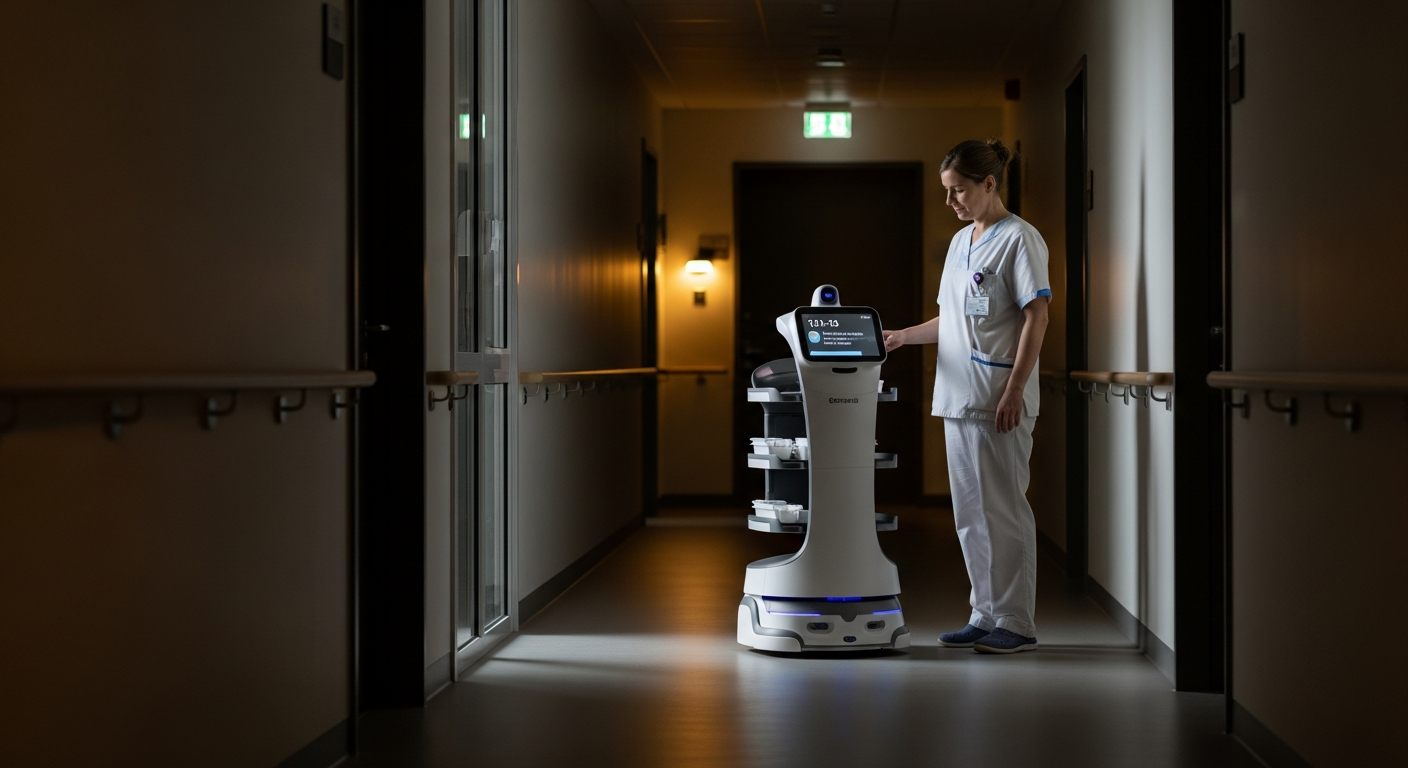
Ward 4. 10:00 PM. The night shift has just begun. While a caregiver tends to a resident, the transport robot silently sets itself in motion. It delivers pre-prepared medications for the next morning to the decentralized stations. In a Hamburg care facility, this has been routine for twelve weeks now. This is not about replacing people, but about reclaiming time for actual care work. werob translates such workflows into a deployment-ready specification within 48 hours and brings the right robot into live operation in eight weeks.
Key Takeaways
- 1Care automation enables annual cost relief of up to €92,000 per location through the automation of medication rounds.
- 2The werob Spec Engine delivers a deployment-ready robotics specification within 48 hours based on real workflows.
- 3Pre-built connectors guarantee seamless integration into existing systems such as PointClickCare and MatrixCare.
The Economic Necessity of Care Automation
The skilled workforce shortage in the European care landscape is no longer an abstract problem but a daily cost driver. Operators face the challenge of maintaining care quality while personnel costs rise and positions remain unfilled. This is where care automation comes in, by consistently automating non-care activities. werob already has over 200 robots in live operation and demonstrates that economic effects are immediately measurable.
A central lever is the automation of medication rounds. In a typical care facility, this leads to annual cost relief of €92,000 per location. Similarly, general transport tasks cost €71,000 per year. Large operators like Korian Deutschland are already utilizing these potentials and realized double-digit cost relief in the first year. This is not about vague synergies but hard operational metrics achieved through the deployment of service robots and humanoids.
Automation enables existing skilled staff to be deployed where human care and medical expertise are indispensable. When a robot handles logistics, the caregiver gains valuable minutes per shift that significantly reduce work burden in aggregate. werob acts as a systems integrator, ensuring the hardware fits exactly to the operator's workflow instead of selling rigid island solutions.
From Specification to Operation in Eight Weeks
Traditional consulting projects in robotics often take three to six months before the first robot is even ordered. werob breaks this slow process open with the Spec Engine. Within 48 hours, werob translates an operator's verbal requirements into a technically deployment-ready specification. This engine was trained on the basis of over 35,000 projects and immediately recognizes what hardware requirements are necessary for a specific ward or shift schedule.
After specification comes Supplier Match. werob is not a manufacturer but accesses a catalog of over 44 OEM partners. In total, 280 different robot models can be ranked against the customer's specification. This prevents vendor lock-in and ensures the technologically best solution for the specific use case is always chosen. Whether a humanoid robot from Apptronik or a specialized service robot from Keenon is deployed depends solely on the performance metric of the specification.
werob's promise is clearly defined: 48 hours to specification, five days to proposal and eight weeks to robot in live operation. This speed is crucial for operators under acute pressure to act. Through the hardware-agnostic approach, the operator remains flexible and can adapt their fleet to new requirements at any time without having to rebuild the entire software integration.
Seamless Integration into the Operator Stack
A robot that acts as an isolated system often creates more work than it saves. The true efficiency of care automation emerges through deep integration into the existing software landscape. werob delivers pre-built connectors for market-leading systems such as PointClickCare and MatrixCare. This ensures data on completed tasks, medication dispensing or transport routes flows directly into the digital patient record or the facility's management system.
This connectivity ensures no manual transfer effort is required. When a robot completes a medication delivery, it is documented in real-time in the system. This not only increases transparency but is also a crucial factor for quality assurance and compliance with legal documentation requirements. The IT departments of operators benefit from standardized interfaces that minimize the risk of implementation errors.
Beyond clinical systems, werob also enables connection to infrastructure components such as elevator controls or automatic door systems. A robot in care must be able to move autonomously across multiple floors to provide genuine added value. werob's connector layer handles this complex communication in the background so healthcare staff don't need to worry about the technology. The robot becomes an integral part of the team, completing its tasks without human intervention.
Regulatory Security and EU Machinery Regulation
The introduction of robotics in care is subject to strict regulatory requirements. Particularly critical is the new EU Machinery Regulation 2023/1230, which becomes mandatory on January 20, 2027. Many Asian OEMs currently lack the necessary conformity assessments for the European market. werob acts as a compliance pathway and ensures all systems deployed meet European standards.
For the care sector, ISO 13482 for personal care robots is of central importance. This standard defines safety requirements for robots operating in immediate proximity to humans. werob integrates these regulatory requirements already in the specification phase. The Live Cockpit additionally monitors fleet status against regulatory parameters continuously and immediately alerts if deviations are detected.
Operators in Germany must also consider home supervisory authority requirements and data protection under GDPR. Since robots are often equipped with cameras and sensors, clean data management is essential. werob ensures data processing occurs locally or in secured European clouds and all cybersecurity requirements per IEC 62443 are met. This gives responsible parties the legal certainty necessary for large-scale rollout.
Comparison: Single OEM vs. werob System Integration
When deciding on care automation, operators often face a choice between direct purchase from a manufacturer or partnering with a systems integrator. The following table clarifies the differences in operational implementation.
| Criterion | Single OEM Reseller | werob System Integration |
|---|---|---|
| Hardware Selection | Limited to one manufacturer | Agnostic (44+ OEMs ranked) |
| Planning Phase | 3-6 months discovery | 48 hours Spec Engine |
| Integration | Often proprietary / isolated | Connectors to PCC, MatrixCare |
| Compliance | Responsibility on operator | EU 2023/1230 pathway integrated |
| Commercial Model | List price / upfront investment | Outcome-only model |
The comparison shows werob's systems integrative approach minimizes risk for the operator. While a single OEM reseller is primarily interested in placing their own hardware, werob focuses on operational outcomes. If the facility's requirements change, hardware can be flexibly adapted via the werob platform without rebuilding the entire software integration.
Humanoid Robots in Practical Deployment
A special highlight in the current development of care automation is the deployment of humanoid robots. In a Hamburg care facility, the first humanoid is currently in its twelfth week of live operation. These systems, such as from Apptronik or Figure AI, are capable of taking on tasks in an environment designed for humans without expensive structural modifications.
Humanoids can not only handle transport tasks but in the future can also perform more complex interactions. Current focus is on relieving physically demanding or repetitive work. Acceptance among residents and staff is surprisingly high, as robots are perceived as helpful assistants that reduce station stress. werob monitors these deployments via the Live Cockpit to continuously gather data for optimizing Action Graphs.
Integration of humanoids requires precise control via the werob platform. Since these robots have high freedom of movement, safety requirements are even higher than with simple service robots. werob ensures control protocols are ROS-compatible and robots communicate seamlessly with existing infrastructure. This makes werob the leading partner for operators wanting to stay at the forefront of technological development.
Outcome-only: The Commercial Model of the Future
A major obstacle to care automation in the past was high upfront investment and unclear ROI timeframes. werob solves this problem through a consistent outcome-only model. This means: The operator only pays when the robot is actually in operation and fulfills defined tasks. There are no hidden list prices or expensive consulting fees upfront.
This model perfectly aligns werob's and the operator's interests. werob is motivated to complete implementation as quickly and smoothly as possible since live operation generates revenue. For the operator, this means maximum risk reduction. Automation costs are directly offset against realized savings in personnel costs or improvements in operational efficiency.
Billing is based on services delivered, enabling high flexibility. If a facility has seasonal fluctuations or wants to adjust fleet size, this is seamlessly possible in the werob model. This commercial framework is a key reason werob has grown so rapidly across eleven European countries. It transforms robotics from a complex investment project into a calculable operational service.
The Path to an Automated Location
Starting with werob follows a structured 8-step process designed to bind minimal resources at the operator. Everything begins with capturing the current state: Who are you, what does your shift look like and what tasks should be automated? This information flows directly into the Spec Engine. Within 48 hours, the operator receives a detailed specification describing exactly how automation will work in their specific environment.
After selecting the appropriate hardware through Supplier Match comes technical integration. This is where pre-built connectors come into play, enabling rapid connection to systems like PointClickCare. In parallel, the regulatory framework is established to ensure compliance with the EU Machinery Regulation. Once hardware arrives on-site, it is activated via the werob Cockpit and transitioned to live operation.
The Cockpit subsequently serves as the central control unit. Using a 4-dimensional traffic light system, the operator maintains oversight of hardware status, infrastructure, regulatory compliance and performance against the original specification at all times. werob manages operations and monitoring around the clock so care management can fully focus on core tasks. The path to an automated care facility is now easier and safer than ever.
FAQ
- What does implementing care automation with werob cost?
- werob works according to an outcome-only model. This means you only pay when the robot is running in your facility and fulfills defined tasks. There are no upfront investments for planning.
- How long does it take until the first robot is ready for deployment?
- From first contact to robot in live operation typically takes only eight weeks. The specification is already available after 48 hours.
- Which systems can be connected to the werob platform?
- werob offers direct connectors to leading systems such as PointClickCare, MatrixCare, Opera PMS and SAP EWM.
- Do the robots meet the new EU requirements?
- Yes, werob provides an integrated compliance pathway for EU Machinery Regulation 2023/1230, which becomes mandatory in January 2027, as well as for ISO 13482.
- Do robots replace care staff?
- No, robots take on repetitive and physically demanding tasks such as transport. This gives skilled staff time for direct resident care.
- Is werob bound to a specific robot manufacturer?
- No, werob is hardware-agnostic and ranks over 44 different OEM partners to find the best solution for your specific specification.
Related reading
Care Home Robot: Operational Efficiency and Compliance in Care
The use of robotics in residential care is no longer a vision of the future but an economic necessity to relieve staff. Learn how werob, as a systems integrator, paves the path from specification to live operation in eight weeks.
2 June 2026care robots buy priceBuy care robots: Price and ROI for operators
Acquiring robotics in care often fails due to intransparent cost structures and lack of integration. This guide shows how werob realizes actual cost relief of up to 92,000 euros per year through outcome-based models and systems integration.
14 June 2026medication robotsMedication Robots in Care: Efficiency and Compliance
Medication robots take over the time-consuming distribution of medication boxes in care facilities. Through integration into existing EHR systems such as PointClickCare, they secure documentation and relieve specialist staff of logistical routine tasks.
11 June 2026medication round automationMedication Round Automation: EUR 92,000 in Annual Relief
Automating the medication round massively reduces the unproductive walking distances of specialist staff. werob integrates hardware-agnostic robotics solutions directly into your existing software stack.
12 June 2026raas care robotRaaS care robots: Efficiency through system integration
Robotics as a Service (RaaS) transforms care from an investment-intensive hurdle into a scalable operating model. As a system integrator, werob provides the necessary infrastructure to productively integrate robots into everyday station life within eight weeks.
26 June 2026