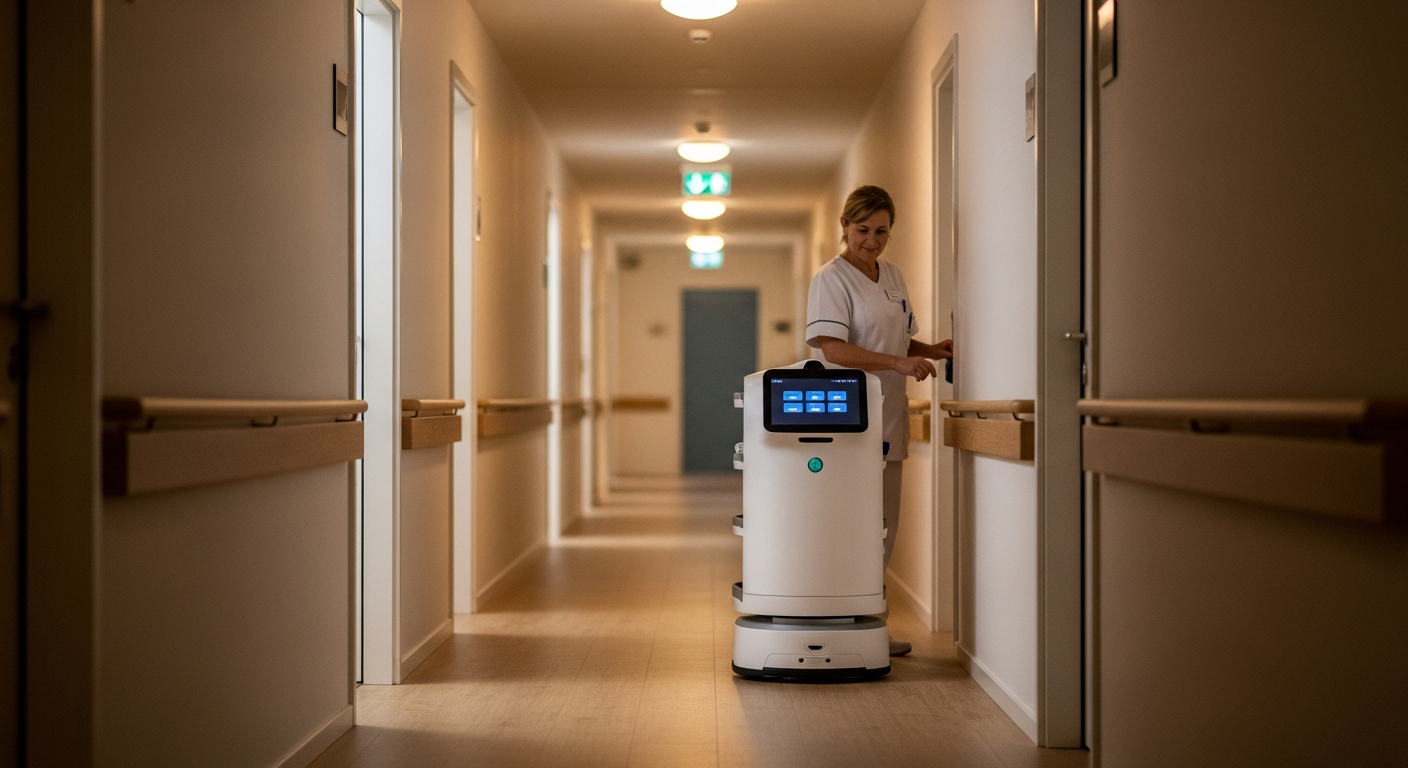
Medication Robots in Care: Efficiency and Compliance
Medication robots take over the time-consuming distribution of medication boxes in care facilities. Through integration into existing EHR systems such as PointClickCare, they secure documentation and relieve specialist staff of logistical routine tasks.
Ward 2. 22:00. The night shift has just begun. While the care worker handles an emergency call in room 214, the medication robot silently sets off. It transports the prepared medication boxes for the next round, securely locked, to the defined handover points. In an industry suffering from chronic personnel shortages, this is not a future scenario, but operational everyday life. werob already has over 200 robots in live operation in eleven European countries. The focus is not on the technology itself, but on the measurable relief of specialist staff. A medication robot saves around EUR 92,000 in costs per location and year by eliminating unproductive transport routes.
Key Takeaways
- 1A medication robot realizes annual cost relief of EUR 92,000 per location through the automation of transport routes.
- 2Integration into EHR systems such as PointClickCare and MatrixCare secures the documentation chain and increases process security.
- 3werob guarantees compliance with the EU Machinery Regulation 2023/1230 and offers legally secure operation up to 2027 and beyond.
The Medication Round as a Logistical Bottleneck
In inpatient care, medication supply ties up considerable personnel resources. The process begins with ordering and extends through professional storage and dispensing to distribution in the living areas. Especially the physical distribution of medication carts or boxes is a purely logistical task that requires no nursing qualification. Nevertheless, qualified care workers spend several hours daily on these transport routes. A medication robot steps in exactly here. It takes over the transport between central preparation and decentralized stations.
Through the use of autonomous systems, the error rate in delivery is minimized. The robots are equipped with secured compartments that can only be opened by authorized personnel via RFID or PIN code. This significantly increases security in handling medications, as unauthorized access during transport is excluded. werob translates this specific workflow into a ready-to-deploy robot specification within 48 hours. It analyzes how many stations must be approached at what frequency to achieve the maximum relief effect. The goal is seamless integration into the shift schedule without disturbing existing routines of care workers.
Economics and EUR 92,000 in Cost Relief
The economic evaluation of robotics in care is often wrongly carried out via the acquisition price of hardware. At werob, however, the outcome is in the foreground. The verified cost relief for an automated medication round amounts to EUR 92,000 per location and year. This figure is based on the saving of working hours previously spent on unproductive travel times. If a care worker spends 45 minutes per shift pushing carts or fetching forgotten medications, this quickly adds up to several full-time equivalents in a facility with multiple living areas.
werob's commercial model is consistently focused on this success. As a systems integrator, werob offers an outcome-only model. This means that operators only pay when the robot actually runs in live operation and delivers the specified performance. There are no hidden list prices or high upfront investments in the hardware. This approach enables care homes to finance automation directly from operational savings. In projects such as at Korian Germany, double-digit cost relief was already realized in the first year. Amortization begins on the first day of productive use in the Cockpit.
Integration into the IT Stack: PointClickCare and MatrixCare
A medication robot unfolds its full potential only when it does not remain an isolated system. Integration into the existing digital infrastructure of the care facility is decisive. werob delivers pre-built connectors into the operator stack, especially for market-leading systems such as PointClickCare and MatrixCare. These interfaces enable the robot to receive information about the provision of medications in real time. As soon as a batch is marked as dispensed in the system, the robot can be automatically called for pickup.
This deep integration ensures that the documentation chain is never interrupted. Every movement of the robot, every opening of a compartment, and every handover to a care worker is logged in the werob Cockpit and can be played back to the electronic patient record. This is an essential advantage for quality assurance and preparation for audits by the home supervision authority. Without these connectors, data would have to be transferred manually, which in turn would tie up time and create error sources. werob reduces this complexity through standardized integration paths that are activated within the eight-week implementation phase.
Regulation and EU Machinery Regulation 2023/1230
The use of robots in environments where people live and work is subject to strict regulatory requirements. Particularly critical is the new EU Machinery Regulation 2023/1230, which is binding from 20 January 2027 for all operators in the EU. This regulation imposes high requirements on the safety and conformity assessment of autonomous systems. werob acts here as a compliance path for operators. Since many robot manufacturers (OEMs) come from Asia or the USA, a local integration layer is necessary that guarantees compliance with European standards.
In addition to the Machinery Regulation, ISO 13482 for service robots in the personal care area is relevant. werob ensures that all deployed systems meet these standards and that the necessary risk assessments for the specific location are available. This protects the management of the care facility from liability risks. The werob Cockpit also continuously monitors the regulatory status of the fleet via a four-dimensional traffic light system. As soon as legal requirements change or software updates affect security-relevant functions, this is immediately visible and addressed in the Cockpit. Compliance is thus not a one-time project, but a permanent part of operations.
Hardware-Agnostic Selection from 44+ OEM Partners
A common error in introducing robotics is so-called vendor lock-in, that is, being tied to a single manufacturer. werob pursues a hardware-agnostic approach. The current catalog contains over 44 OEM partners with a total of 280 different robot models. For the medication round, different systems are eligible, from specialized transport robots such as the Keenon T9 to humanoid approaches from manufacturers such as Apptronik or 1X. The werob Supplier Match Engine ranks these providers against the operator's specific requirements.
Factors such as the width of corridors, the condition of floor coverings, the elevator control, and the required loading capacity are considered. A hospital with wide aisles needs different hardware than a historic care home with narrow radii. Through independence from individual manufacturers, werob can always select the technically and economically best solution. Should a manufacturer discontinue support or a new, more efficient model come onto the market, the werob platform allows a simple change of hardware while process logic and integrations in the stack are preserved. This secures the investment in the long term.
Implementation in Eight Weeks: From Spec to Live Operation
Speed is a decisive factor in countering skilled labor shortages. While classical consulting projects often need three to six months for the analysis phase, werob delivers a ready-to-deploy specification within 48 hours. This process is based on experience from over 35,000 projects that have flowed into the Spec Engine. After the specification, a binding offer follows within five days. The entire process up to the first robot in live operation usually takes only eight weeks.
During this time, werob takes over the entire coordination. This includes the technical preparation of the location, such as connection to the elevator control and Wi-Fi, as well as training employees on site. A critical success factor is staff acceptance. Therefore, the robot is communicated from the beginning as a tool that takes over tedious tasks so that more time remains for actual care for the resident. The Live Cockpit enables the care management to view the status of the fleet at any time and objectively evaluate the performance of the systems. This structured rollout process minimizes the burden on the organization and ensures quick results.
Verified Practical Examples: Korian and Hamburg
The effectiveness of the werob platform is underscored by real deployments. At Korian Germany, one of the leading private providers of care services, significant cost relief in the double-digit percentage range was already realized in the first year. Here, it becomes clear that scaling across multiple locations releases enormous synergies through standardized processes and central control via the Cockpit. Another example is a Hamburg care facility where, since May 2026, the first humanoid pilot project has been running in the twelfth week of operation. These projects prove that the technology is mature for operational use.
These references are decisive for decision-makers looking for proven solutions. werob does not deliver pilot projects for their own sake, but scalable operating concepts. The data from these live operations continuously flows back into the platform, making the Spec Engine and Supplier Match more and more precise. Operators thus benefit from the collective knowledge of the entire network. If a certain robot type is successfully used for the medication round in a similar facility, this knowledge can be directly transferred to new projects, further reducing implementation risks.
The Future of Care Logistics
The use of medication robots is only the beginning of a comprehensive automation of secondary processes in care. In addition to the medication round, werob offers solutions for general transport (EUR 71,000 savings) and cleaning. The vision for 2028 envisages operating over 2,000 robots actively in Europe. For operators, this means that they must commit today to a platform that grows with their requirements. werob offers this scalability through the combination of deep industry expertise, technical integration power, and regulatory security.
The decision for robotics is no longer a question of innovation today, but one of operational necessity. Given rising costs and declining personnel availability, the automation of logistics tasks is the most effective lever for securing care quality. With werob, operators have a partner at their side that takes over the risk and radically shortens the path to productive deployment. The process begins with a simple conversation about the current workflow and leads in less than two months to measurable relief on the ward.
FAQ
- How long does the implementation of a medication robot take?
- At werob, the process from the first specification to live operation usually takes eight weeks. The specification itself is available after 48 hours.
- Which IT systems are supported?
- werob offers pre-built connectors for PointClickCare, MatrixCare, Opera PMS, Mews, Toast, SAP EWM, and other market-leading systems.
- Is the use of a robot coordinated with home supervision?
- Yes, werob takes into account the requirements of the home supervision authority and relevant standards such as ISO 13482 to ensure conforming operation in Germany.
- What happens in case of technical malfunctions of the robot?
- All robots are monitored live via the werob Cockpit. A 4-dimensional traffic light system immediately detects problems with hardware, infrastructure, or regulation and initiates appropriate measures.
- Does the hardware have to be purchased?
- werob works on an outcome-only model. This means that commercial billing is tied to successful operation. There are no classic list prices for hardware.
- Can medication robots also use elevators?
- Yes, integration into elevator control is a standard component of werob implementation, so that the robot can act autonomously across multiple floors.
Related reading
Medication Round Automation: EUR 92,000 in Annual Relief
Automating the medication round massively reduces the unproductive walking distances of specialist staff. werob integrates hardware-agnostic robotics solutions directly into your existing software stack.
12 June 2026medication robot care homeMedication Robot in the Care Home: Efficiency and Compliance
Automating medication logistics relieves nursing professionals of time-consuming errands. werob integrates autonomous systems into existing workflows and secures regulatory compliance.
1 June 2026care home robotCare Home Robot: Operational Efficiency and Compliance in Care
The use of robotics in residential care is no longer a vision of the future but an economic necessity to relieve staff. Learn how werob, as a systems integrator, paves the path from specification to live operation in eight weeks.
2 June 2026care automationCare Automation: Efficiency Gains Through System Integration
Automation in care is no longer a future vision but an operational reality. Learn how werob as a systems integrator paves the way from specification to live operation in eight weeks.
13 June 2026care robots buy priceBuy care robots: Price and ROI for operators
Acquiring robotics in care often fails due to intransparent cost structures and lack of integration. This guide shows how werob realizes actual cost relief of up to 92,000 euros per year through outcome-based models and systems integration.
14 June 2026